AWS Elastic Disaster Recovery Cost Management Tips
Practical tips to cut AWS Elastic Disaster Recovery costs: optimise disks, choose cheaper EBS types, right-size failover instances and monitor costs.
Read moreBlog posts in the Disaster Recovery category

Practical tips to cut AWS Elastic Disaster Recovery costs: optimise disks, choose cheaper EBS types, right-size failover instances and monitor costs.
Read more
Plan, test and automate Kubernetes rollbacks across multiple clusters with GitOps, blue/green and canary strategies, metrics and versioned runbooks.
Read more
Compare thin, thick, hybrid, hyperconverged and cloud-adapted edge architectures to build resilient, low-latency systems while managing cost and complexity.
Read more
Cloud DR offers low upfront costs but higher long-term bills; on-premises DR needs big initial investment yet often lowers TCO for stable workloads.
Read more
Guide to building repeatable multi-region disaster recovery with ARM templates: design patterns, traffic management, replication, testing and automation.
Read more
AI rollback systems detect, diagnose and revert faulty deployments in seconds, cutting downtime and improving system reliability.
Read more
How PCI DSS v4.0.1 affects managed hosting DR: key requirements for backups, logging, key management, testing and compliant recovery architectures.
Read more
Compression vs deduplication for hybrid cloud transfers: practical use cases, CPU vs bandwidth trade-offs, and why dedupe-first then lossless compression delivers greatest savings.
Read more
Guide to reverting Kubernetes deployments: ReplicaSets, kubectl rollout commands, blue-green and canary strategies, RBAC and audit logging for safe rollbacks.
Read more
How multi-cluster Kubernetes reduces downtime, boosts scalability and cuts cloud costs with ArgoCD, Terraform, Cloudflare and automated monitoring.
Read more
Step-by-step guide to hybrid cloud disaster recovery: assess critical systems, pick an architecture, secure backups, automate failover and test recovery.
Read more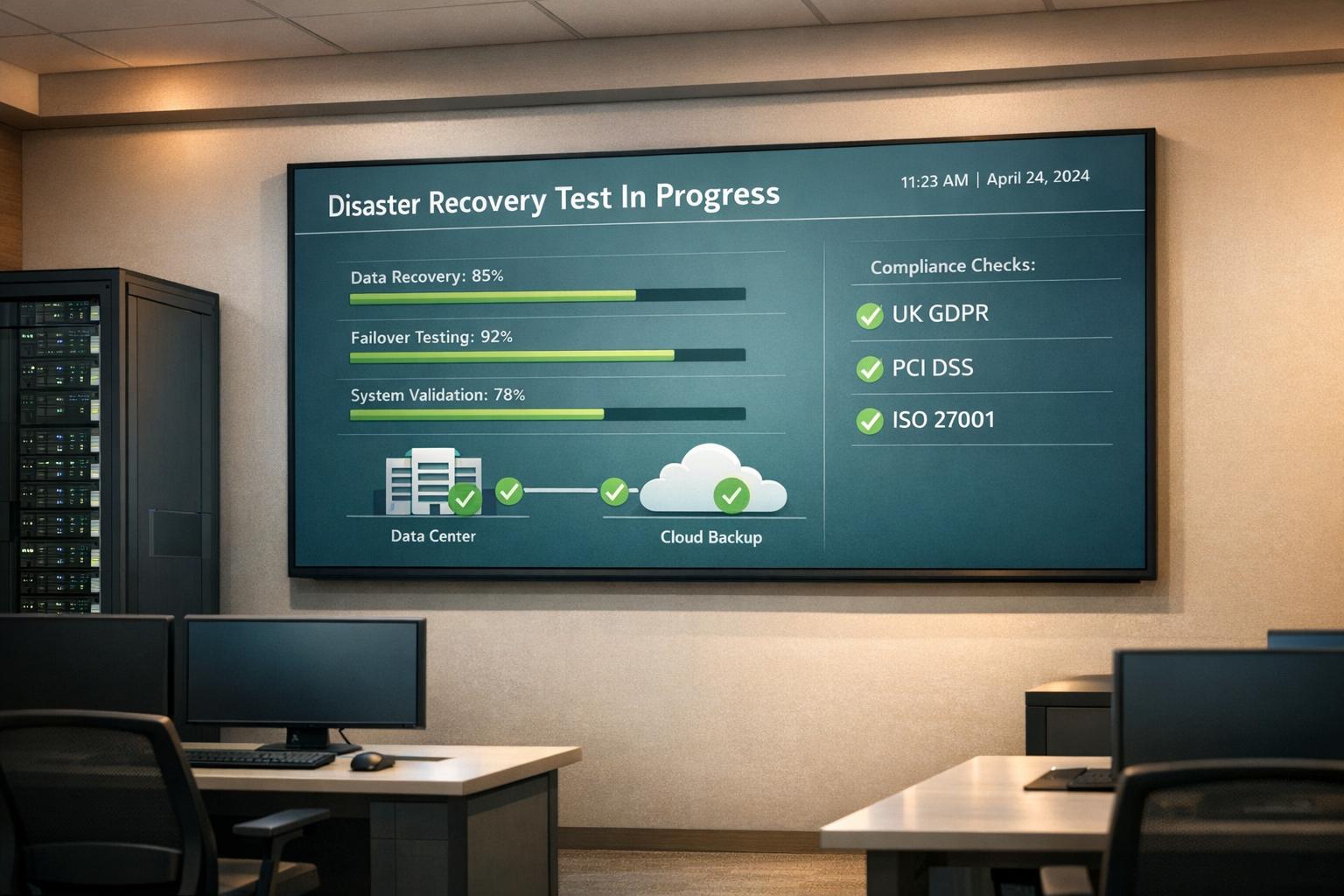
Regular hybrid cloud DR testing proves recoverability, enforces UK GDPR/PCI/ISO compliance, and exposes configuration gaps before they cause outages.
Read more