
AI-powered rollback systems are transforming how companies handle software failures. They detect issues, analyse root causes, and fix problems automatically - slashing recovery times from minutes to seconds. This not only reduces downtime costs (now exceeding £10,500 per minute in 2026) but also improves system reliability.
Key Takeaways:
- Manual vs AI Rollbacks: Manual methods rely on human intervention, often leading to delays and errors. AI systems, in contrast, use machine learning to monitor, detect, and resolve issues faster and more accurately.
- Speed: Manual rollbacks take minutes or longer, while AI systems recover in 12-15 seconds.
- Learning: AI systems continuously improve by analysing past incidents, while manual methods depend on static processes.
- Effectiveness: AI achieves 98% precision in root-cause analysis, significantly reducing downtime and errors.
Quick Comparison
| Feature | Manual Rollbacks | AI-Powered Systems |
|---|---|---|
| Trigger Mechanism | User complaints, static thresholds | Anomaly detection, predictive models |
| Recovery Time | Minutes to hours | Seconds |
| Learning | Limited to human post-mortems | Continuous improvement via feedback |
| Precision | Prone to errors | 98% accuracy in diagnosis |
Companies adopting AI rollback systems report up to 80% less downtime and higher efficiency in managing complex environments. While AI handles routine failures, human oversight remains essential for unique challenges. Ready to upgrade? Start by building a strong monitoring framework and conducting rollback drills.
::: @figure 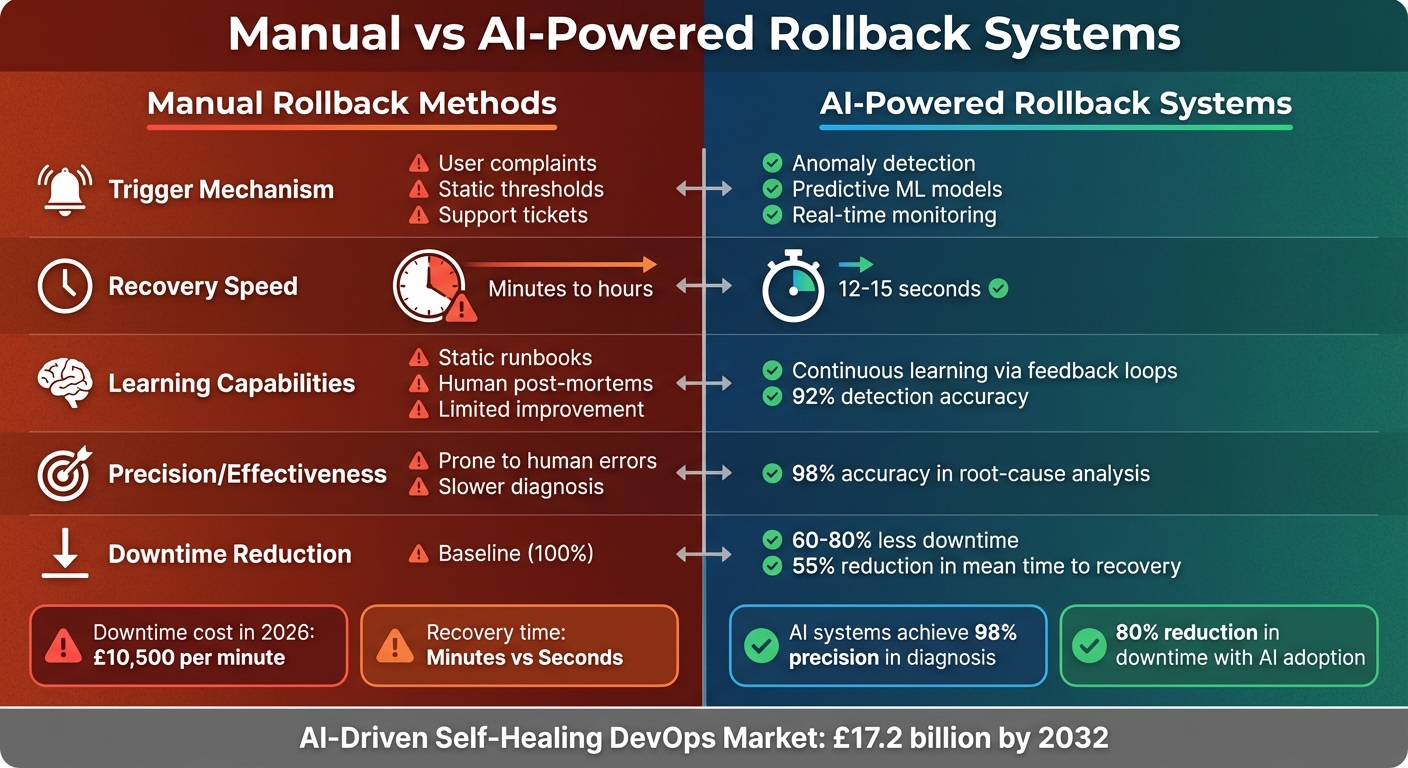 {Manual vs AI-Powered Rollback Systems: Speed, Accuracy and Cost Comparison}
:::
{Manual vs AI-Powered Rollback Systems: Speed, Accuracy and Cost Comparison}
:::
Self Healing Rollouts: Automating Production Fixes with Agentic AI & Argo Rollouts by Carlos Sanch
1. Manual Rollback Methods
Manual rollback processes depend heavily on human intervention, which can lead to delays and potential vulnerabilities. Typically, engineering teams identify issues through user complaints, support tickets, or internal testing. Once a problem is flagged, they must diagnose the root cause before initiating a rollback. This often turns into a reactive, time-consuming process commonly referred to as firefighting
[1]. Below, we explore the main triggers for manual rollbacks and their limitations.
Trigger Mechanisms
Traditional manual rollback methods often rely on static thresholds, such as predefined limits or conditions. However, these thresholds are not designed to handle the complexities of modern microservices architectures [9]. Even worse, the same infrastructure issues causing a deployment failure can also prevent a successful rollback, further undermining reliability [1]. Human errors add another layer of risk - administrators might inadvertently delete critical components like virtual disks, worsening the situation [10].
Recovery Speed
The speed of manual rollbacks is frequently hindered by approval processes. As Zen van Riel, Senior AI Engineer at GitHub, highlights:
If rollback requires multiple approvals, you're too slow. The on-call engineer should have authority [5].
To reduce delays, organisations need clear response targets, such as deciding on a rollback within 15 minutes of detecting an issue. However, the complexity of microservices, slow issue detection, and multi-layered approval systems often push recovery times well beyond acceptable limits [5].
Learning Capabilities
Manual rollbacks also limit opportunities for learning and system improvement. As Uplatz explains:
Automatically reverting the system can remove the crucial opportunity for human learning and system improvement. The transient conditions that led to the problem may be lost upon rollback [1].
This reactive approach often prevents teams from developing predictive maintenance strategies or setting up effective feedback loops to avoid similar issues in the future.
Effectiveness in Production
Manual intervention is particularly challenging in environments with stateful components like databases. Reverting a version may not address schema changes or inconsistencies in cached data. In AI production systems, the complexity increases further, as teams must manage three distinct states - code version, model version, and prompt version. Any mismatch between these can lead to new problems [5]. Additionally, manual rollback methods struggle to scale effectively, especially when dealing with large datasets and intricate microservice dependencies [1]. This human-dependent approach is far slower and less reliable compared to the swift, automated responses enabled by AI-driven systems.
2. AI-Powered Rollback Systems
AI-powered rollback systems are transforming the way organisations handle deployment issues, shifting from reactive problem-solving to a more proactive approach. These systems monitor production environments in real-time, making decisions to revert deployments without waiting for human intervention. The result? Faster recovery times and fewer interruptions to services.
Trigger Mechanisms
AI systems rely on advanced detection methods to identify issues. Anomaly detection algorithms analyse real-time metrics like P99 latency, error rates, and even cloud infrastructure costs to detect unusual behaviour. Unlike static thresholds that require manual updates, these algorithms learn baseline performance patterns and adjust automatically. This allows for highly accurate root-cause analysis, far surpassing traditional monitoring systems [1][3].
Some systems take it a step further with predictive failure detection. Using supervised learning models - such as decision trees and neural networks - these systems analyse historical data to spot warning signs before problems arise [7]. A standout example is IBM's STRATUS system, developed in 2025 by Saurabh Jha and researchers at the University of Illinois at Urbana-Champaign. STRATUS outperformed other systems by 150% on cloud engineering benchmarks, thanks to its transactional-no-regression
(TNR) mechanism. This approach evaluates the system state after every action and reverts unsuccessful changes automatically [6].
Our core assumption is that every action must be undoable. If the agent proposes an action... that the system identifies as destructive and non-recoverable, it will be rejected before it can even run.
- Saurabh Jha, Senior Research Scientist, IBM [6]
This combination of real-time detection and predictive capabilities ensures swift recovery and continuous improvement.
Recovery Speed
The speed advantage of AI-driven rollbacks is undeniable. Automated systems drastically reduce rollback times compared to manual interventions, thanks to event-driven orchestration. This not only minimises downtime but also significantly cuts costs [6].
AI monitoring also slashes the Mean Time to Detect (MTTD) issues by 50% compared to traditional static methods [8]. Given that unplanned IT outages in 2026 are estimated to cost around £11,000 per minute, these time savings translate into considerable financial benefits [6]. This efficiency makes AI-driven systems a powerful tool for maintaining operational performance.
Learning Capabilities
AI systems excel at learning from experience, overcoming the limitations of manual processes. Unlike static, rule-based systems, AI-powered rollback mechanisms use feedback loops to refine their strategies. Every incident and corrective action is logged into a knowledge base, allowing reinforcement learning algorithms - like Q-learning and Proximal Policy Optimisation (PPO) - to optimise future decisions. Adaptive thresholding further enhances detection accuracy by dynamically adjusting sensitivity based on observed patterns, achieving a 92% accuracy rate compared to 70% for traditional methods [2][7][8].
Professor Indranil Gupta from the University of Illinois at Urbana-Champaign praised this capability when discussing the STRATUS system:
The STRATUS work is groundbreaking in that it understands...
no regression, which is key to ensuring that a group of agents makes progress, rather than going in circles.
- Indranil Gupta, Professor of Computer Science, UIUC [6]
Some advanced systems even employ Thought Rollback
mechanisms, enabling Large Language Models to review their own reasoning and correct errors, further improving decision-making [2].
Effectiveness in Production
AI rollback systems are particularly effective in complex production environments. For example, Graph Neural Networks (GNNs) are used to map microservice interdependencies in dynamic graphs. This allows these systems to capture intricate structural and temporal relationships that traditional monitoring might miss. The result? A 17.93% improvement in precision and a 21.46% boost in F1 scores [9].
Organisations using AI-driven self-healing systems have reported a 60% reduction in overall downtime [8]. These systems manage stateful components efficiently by tracking multiple system states - such as code versions, model versions, and cached artefacts. When confidence levels fall below a set threshold (usually 0.85), issues are escalated to human operators, ensuring both rapid responses and valuable learning opportunities [1].
Forward-thinking companies like Hokstad Consulting (https://hokstadconsulting.com) are leveraging these advanced AI rollback systems to refine their DevOps strategies, build more resilient cloud infrastructures, and minimise operational disruptions.
Advantages and Disadvantages
Manual rollback systems rely heavily on human intervention, making them reactive and often sluggish. Teams wait for alerts to respond, and diagnosing the issue, followed by deploying fixes, can take valuable time - typically targeting a 15-minute window after detection. This delay is further exacerbated by the potential for human error, especially during high-pressure situations.
In contrast, AI-powered systems take a proactive stance. By continuously monitoring infrastructure and detecting anomalies in real time, they can initiate rollback actions before users even notice a problem. This approach has been shown to reduce the mean time to recovery by approximately 55% [3]. Considering that unplanned IT outages are projected to cost around £10,500 per minute by 2026 [6], every second saved directly impacts operational costs.
| Feature | Manual Rollback Methods | AI-Powered Rollback Systems |
|---|---|---|
| Trigger Mechanism | Manually triggered alerts, support tickets [5] | Automated anomaly detection, predictive ML models [7][3] |
| Recovery Speed | Minutes to hours [8] | Seconds [8] |
| Learning Capabilities | Static runbooks, human post-mortems [1] | Continuous learning via feedback loops, 92% detection accuracy [8] |
| Production Effectiveness | Human error increases recovery delays | 98% precision in root-cause analysis, 55% reduction in downtime [1][3] |
This comparison highlights how AI systems not only accelerate recovery but also reduce the likelihood of errors caused by human involvement.
AI rollbacks also offer another advantage: they evolve continuously. While manual methods depend on post-incident documentation - which can be incomplete or forgotten over time - AI systems utilise reinforcement learning to build a persistent and ever-improving knowledge base. This adaptability strengthens system resilience and aligns with the concept of self-healing pipelines. When faced with uncertainties that exceed predefined thresholds, AI systems escalate the issue to human operators [1], acknowledging that some challenges still require human expertise.
Companies like Hokstad Consulting (https://hokstadconsulting.com) are helping organisations integrate these advanced AI-driven rollback systems. They provide strategic guidance to optimise deployment while ensuring that human oversight is maintained for critical scenarios. The market for AI-driven self-healing DevOps is expected to grow to approximately £17.2 billion by 2032, reflecting increasing trust in these transformative technologies [3].
Conclusion
This analysis highlights how AI-driven rollback systems outperform traditional manual methods in terms of speed, accuracy, and dependability.
Switching from manual rollbacks to AI-powered systems revolutionises deployment management. While manual processes are often sluggish and reactive, AI-driven solutions offer near-instantaneous detection, diagnosis, and resolution - achieving in seconds what once took minutes or even hours. Considering that unplanned IT outages can cost around £10,500 per minute [6], the financial incentive to automate is hard to ignore.
That said, transitioning to AI-powered pipelines requires deliberate preparation. Organisations need a robust observability stack, including comprehensive monitoring, logging, and tracing, to provide the real-time, detailed data that AI systems rely on for detecting anomalies and patterns [1]. Additionally, incorporating human-in-the-loop protocols is crucial, ensuring that complex or unfamiliar issues are escalated to skilled engineers rather than risking inappropriate automated actions [1].
Self-healing CI pipelines aren't about replacing developers. They eliminate the repetitive, low-value work that slows teams down.- Tomas Fernandez, Writer, Semaphore [4]
To minimise risks, adopt strategies like canary or blue-green deployments, ensure all actions are reversible (as demonstrated by IBM's STRATUS [6]), and conduct regular rollback drills to maintain operational resilience [5][2].
For organisations ready to embrace this shift, Hokstad Consulting (https://hokstadconsulting.com) offers expert guidance on integrating AI-driven rollback systems while retaining critical human oversight. By balancing rapid automation with strategic human intervention, they help organisations achieve the goal of fully self-healing pipelines. With their expertise in DevOps transformation and AI strategy, Hokstad ensures automation enhances operations without introducing new risks.
FAQs
What data does an AI rollback system need to work well?
An AI rollback system uses data like system logs, error rates, latency metrics, and records of past builds and deployments. This data allows it to spot problems and decide when to revert to a stable version, helping maintain smooth operations while reducing disruptions.
How do AI rollbacks avoid making the incident worse?
AI rollbacks act as a safety net, stepping in to restore systems to a prior stable state when issues arise. By doing so, they tackle challenges such as aligning model states, code versions, cached data, and ongoing processes. This process helps maintain stability and reduces potential damage effectively.
When should a rollback be escalated to a human engineer?
When automated tools like error monitoring or latency alerts can't fix an issue, or when more intricate problems occur - such as inconsistencies in AI models or lingering cached artefacts - a rollback should be escalated. These scenarios typically demand human oversight to properly diagnose and address the problem.