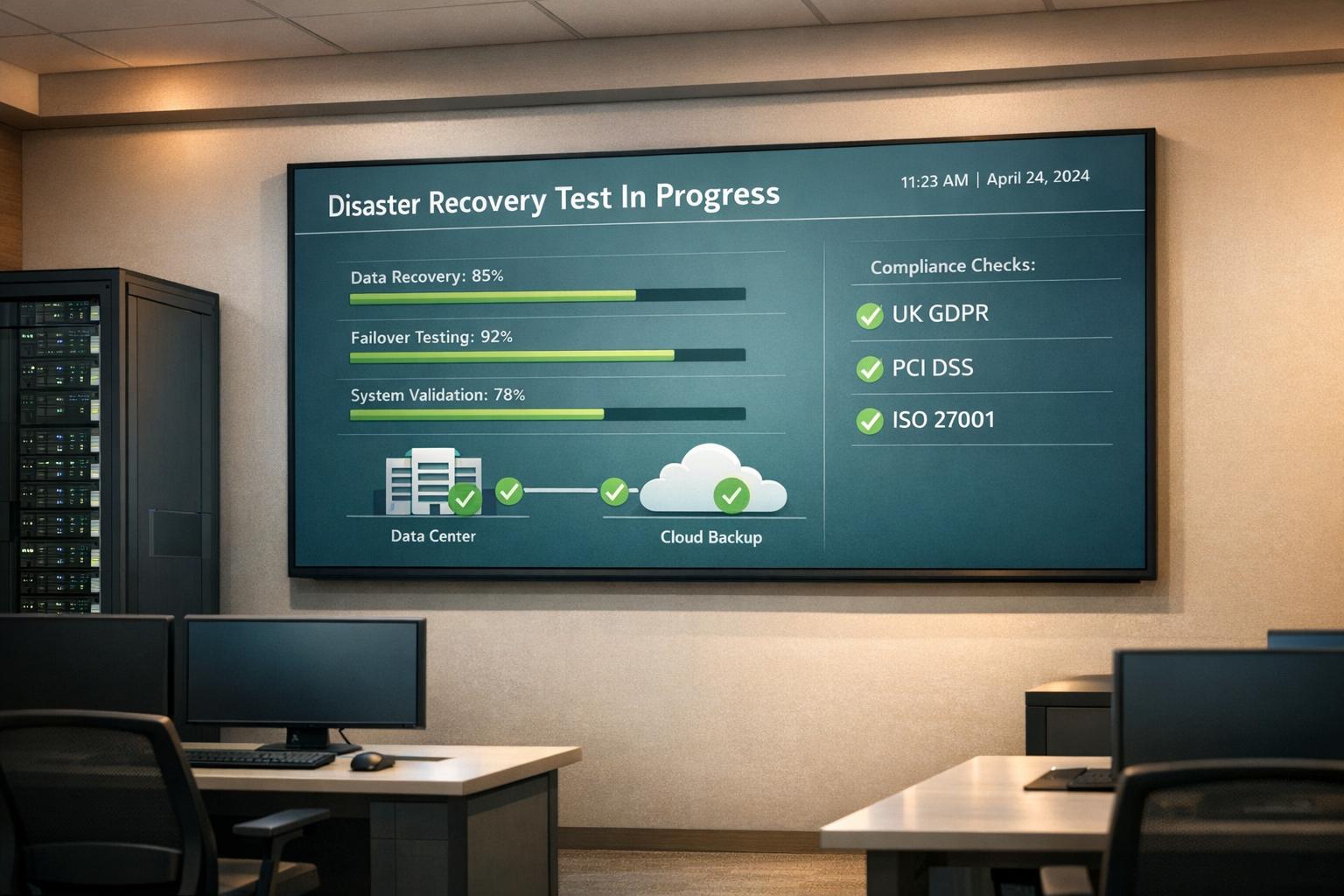
Disaster recovery (DR) testing in hybrid cloud environments is essential for maintaining business continuity and meeting compliance standards like GDPR, PCI DSS, and ISO 27001. This involves simulating failures across on-premises and cloud systems to ensure quick recovery with minimal data loss. Non-compliance can result in legal penalties, reputational damage, and prolonged downtime.
Key Points:
- Compliance Requirements: Regular DR testing is mandated by UK GDPR, NIS Regulations, and other standards to ensure data security, availability, and resilience.
- Testing Objectives: Recovery Time Objective (RTO) and Recovery Point Objective (RPO) must align with risk assessments, regulatory needs, and business impact.
- Testing Types: Options include tabletop exercises, test failovers, and live failovers, each offering varying levels of insight into recovery readiness.
- Security Validation: Includes encryption, authentication, and data residency checks to ensure systems meet compliance during failover scenarios.
- Automation & Monitoring: Automating DR testing reduces errors, improves efficiency, and provides real-time compliance reports.
Takeaway: Regular, well-documented DR testing ensures your organisation can recover quickly, meet legal obligations, and protect its reputation.
Hybrid Cloud Disaster Recovery in AWS | Amazon Web Services
Compliance Requirements for Disaster Recovery
Businesses in the UK operating within hybrid cloud environments must navigate several regulatory frameworks that shape their disaster recovery strategies. At the forefront is the UK GDPR, which lays out essential requirements. Article 5(1)(f) stresses the importance of processing personal data securely, protecting it against unauthorised access, accidental loss, or damage. Meanwhile, Article 32 obliges organisations to ensure they can restore access to personal data in a timely manner
after any physical or technical incident [3][6].
In addition to GDPR, Relevant Digital Service Providers (RDSPs) must adhere to the NIS Regulations. These require organisations to manage risks to their networks and systems effectively. Under Regulation 12, RDSPs are specifically tasked with implementing business continuity measures and regularly testing their recovery capabilities [2]. The Data (Use and Access) Act, introduced on 19 June 2025, has also prompted a review of existing data security guidance in the UK. Businesses now need to ensure their disaster recovery strategies align with these updated legal provisions [2][3].
Documentation plays a vital role in demonstrating compliance. The Information Commissioner's Office (ICO) highlights:
You must have recovery capabilities, and be able to test and assess these on a regular basis [2].
Organisations are required to keep detailed records of disaster recovery tests, system assessments, and verification activities. These records may be requested during investigations, and failure to provide them - regardless of the robustness of technical controls - can lead to regulatory action.
These compliance requirements underpin the approaches outlined for GDPR, ISO, and PCI DSS standards.
GDPR Compliance for Data Privacy
While the UK GDPR does not prescribe specific technical measures, it does establish clear objectives. Organisations must ensure the confidentiality, integrity, availability and resilience
of their processing systems [3]. Determining what constitutes timely
data restoration depends on the level of risk involved. The ICO advises organisations to evaluate the potential harm to individuals if data remains unavailable and to set Recovery Time Objectives (RTO) accordingly [3]. This guidance directly informs disaster recovery planning and testing.
Organisations remain accountable for data security even when they rely on third-party cloud providers. Contracts with these providers must require them to implement security measures equivalent to those expected of the organisation itself, including disaster recovery capabilities [3][6]. The ICO also recommends a 3-2-1 backup strategy: three copies of data stored on two different devices, with one copy kept off-site. In hybrid cloud setups, this often involves backups across both on-premises infrastructure and separate cloud regions or accounts to mitigate risks like regional outages or ransomware [3][4].
Beyond GDPR, broader security frameworks also shape disaster recovery strategies.
ISO 27001 and Cybersecurity Standards
ISO/IEC 27001 is the leading international standard for information security management in the UK, while ISO/IEC 22301 focuses on business continuity management [2]. These standards guide disaster recovery by advocating for systematic security management [2]. Instead of rigid checklists, regulators now emphasise outcomes-based security, prioritising risk management, protection, detection, and mitigation. This approach allows organisations to design scalable disaster recovery strategies tailored to their hybrid environments [6].
Risk assessments are a cornerstone of these standards. Organisations are expected to consider factors such as the state of the art, costs of implementation, and the nature of their data processing activities [3][6]. This means that a small e-commerce business and a large financial institution will have different disaster recovery needs, but both must demonstrate that their measures are appropriate to the risk
[3]. These standards highlight the critical role of rigorous disaster recovery testing in building cyber resilience.
For organisations dealing with payment data, additional compliance measures come into play.
PCI DSS for Financial Data Protection
Businesses handling payment card data must meet the stringent requirements of the Payment Card Industry Data Security Standard (PCI DSS). The ICO takes PCI DSS compliance into account when assessing whether an organisation has adhered to GDPR's security principles after a breach [3]. Therefore, businesses must comply with both PCI DSS and GDPR requirements [3][5].
In hybrid cloud environments, PCI DSS compliance becomes more complex due to the shared responsibility model [5]. Clearly defining which security controls are managed by the cloud provider and which are the organisation's responsibility is crucial. Mandatory measures include regular vulnerability scans, documented incident response procedures, and specific technical controls [3][5]. Failure to maintain these controls can result in contractual penalties and increased scrutiny from the ICO during investigations [3].
Steps for Hybrid Cloud DR Testing
::: @figure 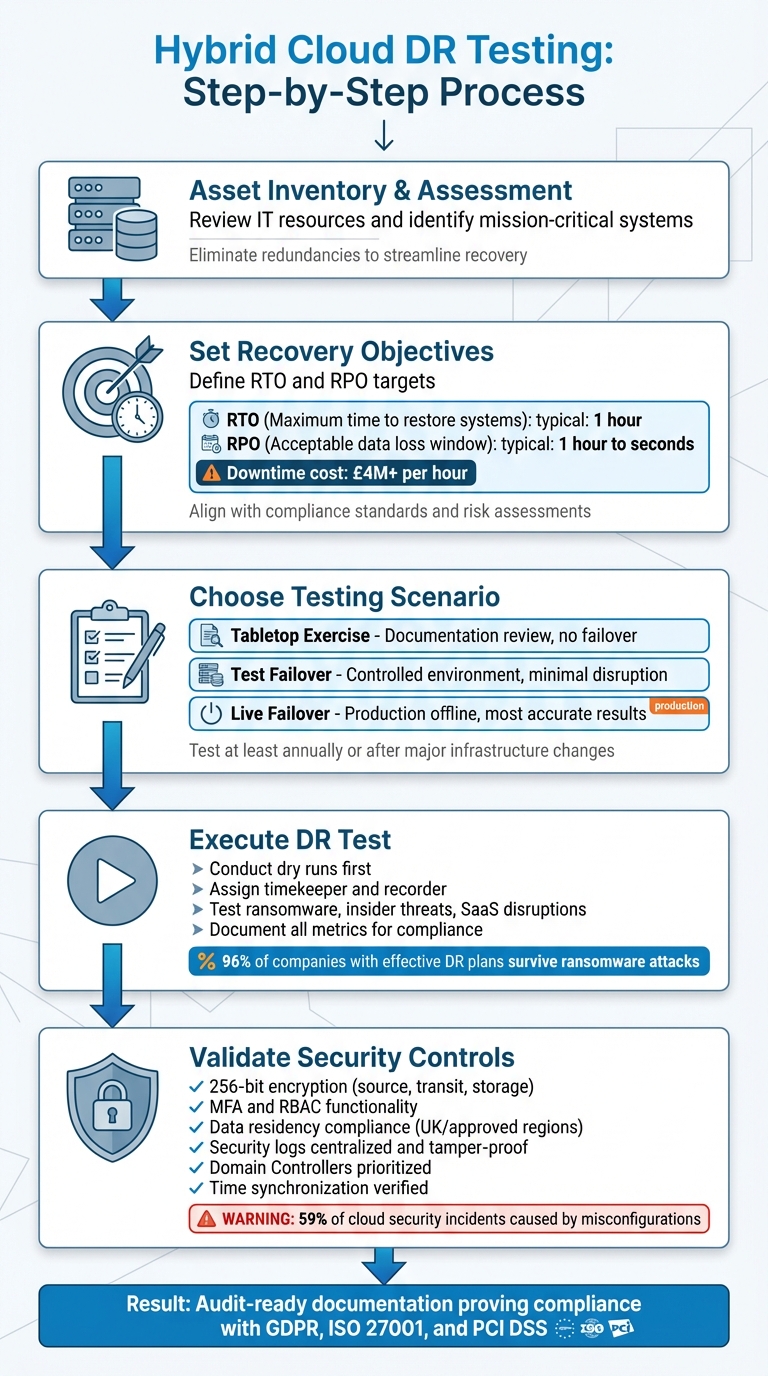 {5-Step Hybrid Cloud Disaster Recovery Testing Process for Compliance}
:::
{5-Step Hybrid Cloud Disaster Recovery Testing Process for Compliance}
:::
Start by reviewing your IT resources to pinpoint mission-critical systems and eliminate unnecessary redundancies. This helps streamline recovery efforts and manage costs effectively. Once you've identified what needs protection, develop a testing framework that ensures both technical reliability and compliance with regulatory requirements. With a clear inventory of essential assets, set recovery targets to guide your testing process.
Setting RTO and RPO Objectives
Recovery objectives should align with compliance standards and operational needs. Recovery Time Objective (RTO) defines the maximum time allowed to get systems back online after a disruption, while Recovery Point Objective (RPO) determines the acceptable amount of data loss, measured in time [14]. These metrics should be based on thorough risk assessments. For example, many managed DR services promise an RTO of one hour and an RPO of the same duration, with advanced solutions reducing RPOs to mere seconds [10][13].
The financial impact of downtime - estimated at over £4 million per hour - and outages lasting more than eight hours should heavily influence your RTO and RPO targets [13]. These goals need to reflect both the economic risks and the regulatory requirements for data availability.
In hybrid cloud setups, managing capacity and quotas is critical to meeting RTOs. Ensure that the CPU and memory resources in your secondary cloud region match those in your primary environment to avoid performance issues during recovery [12]. Additionally, map out system dependencies carefully to establish a precise startup sequence, preventing cascading delays that could jeopardise RTO targets [12].
Running DR Testing Scenarios
Disaster recovery plans should be tested at least once a year or whenever significant changes occur in your IT infrastructure [9]. The type of test you choose will depend on your organisation's risk tolerance and operational constraints:
- Tabletop exercises: These involve walking through recovery steps with key stakeholders without actually initiating failovers. They help identify gaps in documentation and communication but offer limited technical validation.
- Test failovers: These create a controlled environment to validate recovery procedures without affecting live systems [12]. While this approach minimises disruption, it might not uncover issues that arise under real-world conditions.
- Live failovers: These tests involve taking production servers offline and switching to the DR environment, providing the most accurate assessment of recovery times [12].
Ryan Tracey, Head of Technical Operations at Synextra, notes:
Ideally, you're testing because you want to ensure your DR solution works, with compliance being a beneficial side effect rather than the primary driver [12].
Modern testing should account for more than just hardware failures. Scenarios should include ransomware attacks, insider threats, and disruptions to SaaS platforms like Microsoft 365 [11]. With 96% of companies with effective DR plans surviving ransomware attacks, compared to 93% of firms without such plans shutting down within a year after a breach [9], the stakes couldn't be higher.
Before live tests, conduct dry runs to identify potential issues without disrupting operations [9]. During the actual test, assign a timekeeper and recorder to document key metrics for compliance reporting [9]. This documentation serves as proof of recoverability
, which is often required by regulators and cyber insurers [9][11]. For large IT environments, testing one representative application from each category instead of every server can simplify the process while maintaining adequate coverage [12].
After validating recovery scenarios, incorporate thorough security checks to ensure compliance and system integrity.
Testing Security Controls
Security validation should be an integral part of DR testing. Encryption testing ensures that 256-bit encryption remains effective across all stages - source, transit, and storage - within the DR environment [7][10]. Multi-Factor Authentication (MFA) and Role-Based Access Controls (RBAC) must also function properly post-failover, as authentication issues can make recovered systems unusable [15][17].
For organisations bound by GDPR, data residency compliance is critical. This involves confirming that backups remain in designated regions, such as the UK or other approved jurisdictions [10]. Misconfigurations are responsible for 59% of cloud security incidents, making configuration checks essential [8]. Testing should verify that security logs cannot be altered or disabled during a disaster and that they are centralised for incident response [15][16].
Domain Controllers should be prioritised during the startup sequence to prevent cascading failures in authentication and access permissions [12]. Many servers cannot handle time differences exceeding five minutes, so time synchronisation is vital but often overlooked [12]. Network tests should confirm IP address consistency and that firewall policies replicate correctly to maintain connectivity [12].
Formation Tech highlights the importance of resilience:
Your last line of defence shouldn't be your weakest link [11].
Testing should also involve third-party providers. Review the roles, responsibilities, and response plans of managed service providers (MSPs) and cloud vendors to uncover gaps in SLAs and communication protocols [11]. Under the shared responsibility model, cloud providers secure the infrastructure, but the security and compliance of applications and data within the DR environment remain your responsibility [17].
These security checks not only protect the integrity of your disaster recovery plan but also ensure compliance with UK data protection regulations.
Need help optimizing your cloud costs?
Get expert advice on how to reduce your cloud expenses without sacrificing performance.
Automating and Monitoring DR Testing
Manual disaster recovery (DR) testing is not only labour-intensive but also prone to errors. Automation addresses these challenges effectively. With misconfigurations responsible for 59% of all reported cloud security incidents, automation plays a crucial role in maintaining compliance while reducing operational strain [8]. Orchestration tools can streamline complex recovery processes across hybrid environments, cutting recovery times and verifying system functionality [18]. These advancements naturally pave the way for stronger, real-time monitoring.
Benefits of Automated Testing
Automated failover systems significantly reduce Recovery Time Objectives (RTOs) by removing the need for manual intervention [8]. This is particularly important given that 76% of cybersecurity professionals express concerns about cloud security due to misconfigurations and skill gaps [8]. Unified automation tools manage provisioning, monitoring, and governance across both private and public cloud platforms, ensuring consistency throughout. Shifting from annual manual testing to quarterly automated testing ensures recovery plans stay aligned with evolving threats and infrastructure updates [7][8].
Hybrid cloud solutions further enhance cost efficiency, allowing organisations to scale resources during emergencies without the need to maintain idle, duplicate infrastructure year-round [8]. Ultima emphasises this advantage, stating: Automated workflows and expert Managed Services free up your teams to focus on innovation and high-value strategic initiatives
[18]. In addition to streamlining processes, automated testing ensures compliance with mandates such as GDPR, ISO 27001, and PCI DSS.
But automation is just one part of the equation. Continuous monitoring adds another layer of resilience by providing real-time insights and detailed audit trails.
Continuous Monitoring and Reporting
Real-time monitoring enables organisations to maintain compliance and readiness at all times. Tools offering unified visibility across on-premises, private cloud, and public cloud environments eliminate potential blind spots that could undermine recovery efforts [20][22]. These systems track metrics like Recovery Time Actual (RTA) and Recovery Point Actual (RPA) against predefined objectives during tests or failover events, automatically generating audit trails to meet regulatory requirements, including GDPR, ISO 27001, and PCI DSS.
Automated evidence collection simplifies compliance by producing audit-ready reports without manual effort [21]. Advanced platforms equipped with machine learning can identify anomalies and detect policy deviations in real time, alerting teams whenever performance strays from expected RTO and RPO targets [20][22]. For example, one organisation successfully reduced its reliance on 33 separate monitoring tools to just six, boosting IT efficiency while maintaining comprehensive oversight [20].
For UK businesses managing hybrid environments, centralised monitoring platforms that integrate with tools like AWS CloudWatch or Azure Monitor ensure consistent policy enforcement across all infrastructure layers [18][19]. With the cloud compliance market projected to surpass £46 billion by 2027, it’s clear that continuous monitoring has become a cornerstone of operational resilience [21].
Expert Support for DR Compliance
Navigating hybrid cloud compliance requires a level of expertise that many organisations find challenging to maintain. A staggering 59% of reported cloud security incidents stem from misconfigurations, underscoring the risks of handling intricate disaster recovery (DR) strategies without proper guidance[8]. This need for expertise becomes even more critical when addressing stringent regulatory requirements such as GDPR, PCI DSS, and ISO 27001.
Hokstad Consulting for DR Compliance

Specialised external support can simplify the path to DR compliance, and Hokstad Consulting is a standout provider in this space. Their approach begins with comprehensive risk assessments to identify the systems and data essential for uninterrupted business operations[25]. They integrate compliance into the very foundation of infrastructure design, implementing robust measures like access controls, encryption, and logging mechanisms. Additionally, they prepare audit-ready documentation to meet GDPR, PCI DSS, and ISO 27001 standards[24].
Hokstad Consulting doesn’t stop at setup. They conduct regular simulation exercises, providing detailed audit reports that demonstrate system resilience to stakeholders such as executives, insurers, and regulators[23][11]. They also scrutinise third-party integrations, uncovering vulnerabilities in cloud vendor SLAs and communication protocols to ensure seamless operations[11].
Solutions for UK Businesses
For organisations in the UK, Hokstad Consulting tailors its services to address local compliance needs. By leveraging UK-based cloud platforms that meet GDPR requirements, they ensure data residency compliance[10]. This approach aligns with the UK GDPR and NIS2 mandates, which demand clear evidence of system availability and data integrity[11]. Their solutions are designed to achieve Recovery Point Objectives (RPO) of one hour and Recovery Time Objectives (RTO) measured in minutes - a vital consideration as tolerance for downtime continues to diminish[23][11].
Hokstad Consulting also focuses on the technical nuances of failover scenarios. Key measures include mirroring CPU quotas, prioritising domain controllers, and maintaining consistent IP address mapping during recovery[12]. These steps are crucial for preventing cascading failures and ensuring system integrity throughout the recovery process. With downtime costs posing a major financial risk, having expert guidance can make all the difference[13].
Conclusion
Testing hybrid cloud disaster recovery (DR) plans is not just a good practice - it’s a necessity for meeting compliance requirements and ensuring resilience. Without a structured testing process, organisations may find it hard to prove that their recovery strategies will work when it matters most. As TechFinitive wisely puts it:
A disaster recovery plan is only as effective as its last test. [8]
Regular testing not only verifies recovery capabilities but also ensures compliance with regulatory standards [25][1]. This systematic approach helps organisations prepare for future challenges, including the shift towards automated compliance measures.
By conducting these tests, businesses can catch and address misconfigurations before they lead to problems, reducing risks and minimising downtime [8]. It also ensures that critical safeguards - like encryption, access controls, and data sovereignty - function properly during failovers. This is crucial for avoiding hefty fines and protecting an organisation’s reputation [26].
Today’s compliance landscape demands continuous and automated testing to confirm system availability and data integrity. Regulations such as the UK GDPR and NIS2 mandate clear evidence of these capabilities [11][24]. Testing should also cover third-party integrations, ensuring that service level agreements and communication protocols with cloud vendors hold up under stress [11].
For businesses navigating the complexities of hybrid cloud environments, expert guidance can make all the difference. By partnering with specialists like Hokstad Consulting, UK organisations can simplify hybrid cloud DR testing. These experts can assist with non-disruptive testing, automated compliance management, and meeting UK-specific data residency requirements - all while balancing the control of on-premises systems with the scalability of the cloud [8][10][27].
When supported by the right expertise and automation tools, disaster recovery testing doesn’t just meet compliance - it strengthens an organisation’s overall resilience [11].
FAQs
What compliance standards should be followed for disaster recovery testing in hybrid cloud environments?
Organisations in the UK must follow key compliance standards when conducting disaster recovery (DR) testing in hybrid cloud environments. These standards focus on data security, privacy, and meeting regulatory requirements. Key regulations include UK GDPR, ISO 27001, and industry-specific standards like PCI DSS, FCA guidelines, or NHS Digital Data Security Standards. Achieving compliance means documenting DR policies, encrypting sensitive information, enforcing strict access controls, and regularly testing recovery plans to safeguard data and meet legal obligations.
Regular DR testing plays a crucial role in ensuring that Recovery Time Objectives (RTO) and Recovery Point Objectives (RPO) are realistic. This involves simulating disaster scenarios, validating data restoration processes, and reviewing infrastructure configurations. To stay compliant and operationally prepared, organisations must maintain detailed audit logs, respect data sovereignty laws, and consistently update their recovery procedures to align with evolving requirements.
How does automation enhance disaster recovery testing in hybrid cloud environments?
Automation takes disaster recovery (DR) testing to the next level by simplifying tasks, reducing human mistakes, and delivering consistent results. With automated testing, organisations can carry out recovery steps with speed and precision - an absolute must during high-stakes situations. By cutting out manual processes, it ensures tests are repeatable and dependable, boosting confidence in recovery strategies.
On top of that, automation supports compliance by making sure recovery procedures meet regulatory standards and align with recovery time objectives (RTO) and recovery point objectives (RPO). Regular automated tests also allow organisations to simulate different disaster scenarios, helping them fine-tune their strategies and tackle challenges like configuration drift or outdated processes. This forward-thinking method ensures systems are ready to recover effectively and reliably, even in complex hybrid cloud setups.
Why is it crucial to test various failover scenarios in disaster recovery plans?
Testing various failover scenarios within your disaster recovery (DR) plans is a crucial step to ensure your systems can bounce back effectively from different types of failures. It’s a chance to spot potential vulnerabilities, like capacity constraints or configuration errors, before they turn into real-world problems.
By simulating a range of failure conditions, you can confirm whether your Recovery Time Objective (RTO) and Recovery Point Objective (RPO) targets are both realistic and consistently achievable. This proactive testing not only keeps your organisation aligned with regulatory standards but also helps reduce disruptions to your business operations.