
Static Role-Based Access Control (RBAC) systems are struggling to keep up with the demands of modern cloud environments and AI agents. AI-driven RBAC offers a solution by enabling real-time, context-aware access decisions. Here's what you need to know:
- Why AI in RBAC? Traditional RBAC is too rigid, with over 95% of identities using less than 3% of their permissions. AI can analyse patterns, detect risks, and adjust roles dynamically.
- Real-Time Policy Enforcement: AI evaluates access requests per task rather than per session, using Policy Enforcement Points (PEPs) that factor in real-time context like location, device, and sensitivity of data.
- Behavioural Monitoring: AI detects unusual access patterns and flags risks, ensuring rapid responses to potential threats.
- Automated Role Management: AI identifies excessive permissions, suggests minimal policies, and safely removes unnecessary access.
- Compliance Support: AI simplifies meeting regulatory requirements with automated audits and detailed logs.
AI-driven RBAC reduces risks, simplifies compliance, and ensures access policies evolve with changing needs. It’s a shift from static, session-based controls to dynamic, task-specific decisions, crucial for securing modern cloud and AI environments.
::: @figure 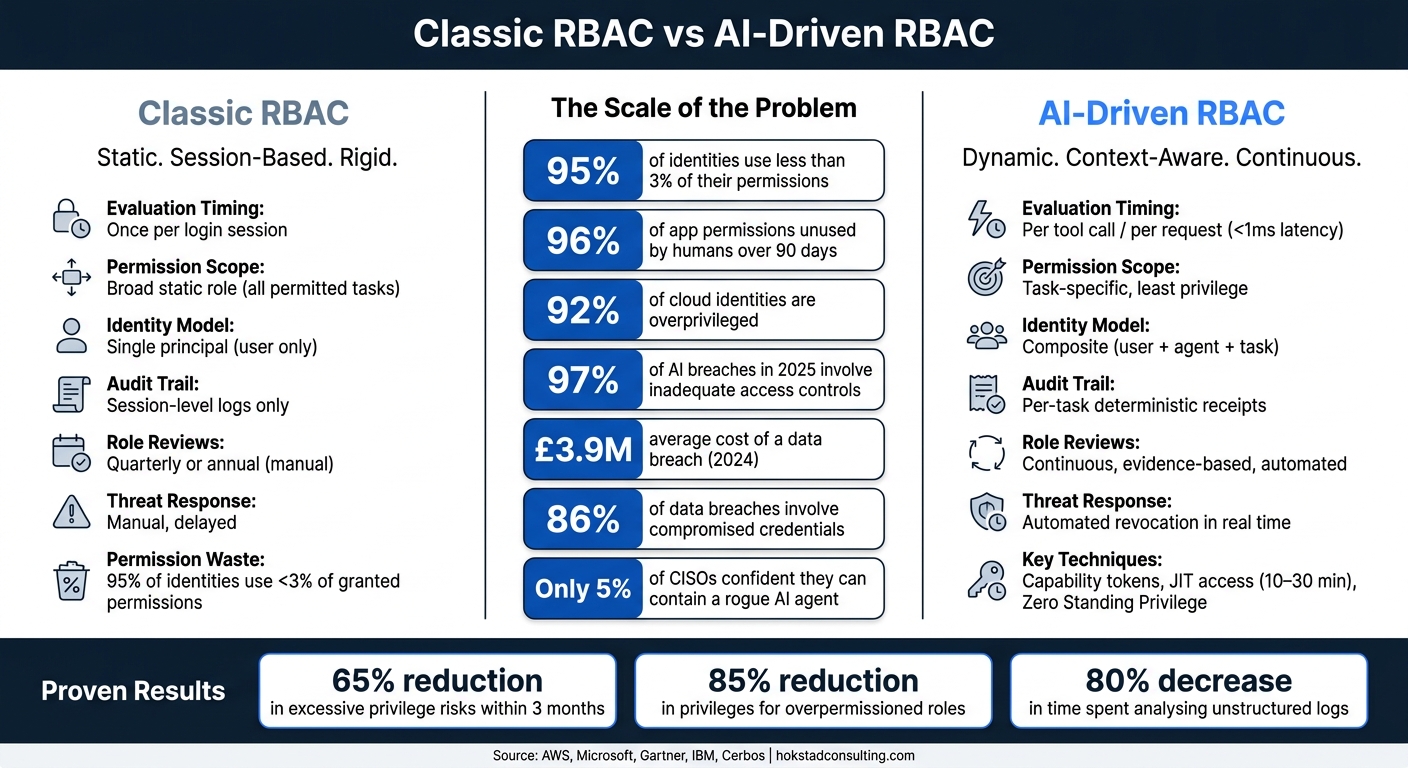 {Classic RBAC vs AI-Driven RBAC: Key Differences & Stats}
:::
{Classic RBAC vs AI-Driven RBAC: Key Differences & Stats}
:::
AI Authorization Explained: RBAC, ABAC & PBAC for Secure Access | Module 1.3
Real-Time Access Decision Enforcement with AI
Traditional Role-Based Access Control (RBAC) systems evaluate permissions only once during login. In contrast, AI-driven enforcement takes it a step further by assessing every individual request, tool invocation, and API interaction in real time. This move from session-level to per-request evaluation is what makes modern access control systems so effective in dynamic cloud and AI settings. At the heart of this continuous evaluation process are components like Policy Enforcement Points (PEPs).
Policy Enforcement Points (PEPs)
A Policy Enforcement Point (PEP) acts as a gatekeeper between an AI agent (or user) and the resource it wants to access. Before any action is executed, the PEP consults a Policy Decision Point (PDP) to determine whether access should be granted. This separation of enforcement and decision-making is often referred to as an Authorization Fabric [9].
What sets AI-powered PEPs apart from traditional ones is their ability to factor in contextual enrichment. Instead of merely checking role assignments, these PEPs evaluate additional, real-time context, such as:
- The user's current location
- Multi-Factor Authentication (MFA) status
- Sensitivity of the requested data
- The type of device being used [11]
The policy engine uses this enriched context to deliver more accurate and tailored access decisions.
A compelling example of this approach comes from AWS, which demonstrated a Lakehouse Data Agent
leveraging Amazon Bedrock AgentCore. In this setup, a Lambda Interceptor retrieved a user's location from DynamoDB in real time. EU-based users were automatically blocked from accessing individual claim records to comply with GDPR data-residency rules but were still allowed to view aggregate summaries. Impressively, such policy evaluations added less than 1ms latency, making the process seamless for users [11].
Identity gets you who. Runtime authorization gets you whether/when/how.- Microsoft Security Blog [9]
Dynamic Context-Aware Access Control
Expanding on the role of PEPs, dynamic tokens address a key limitation of static roles: they struggle to adapt when an AI agent rapidly shifts from read-only queries to write operations [4]. AI-driven systems solve this by introducing capability tokens. These are short-lived, cryptographically signed assertions that authorise a specific action on a specific resource within a tightly defined time frame [3].
Unlike traditional roles that grant broad permissions for an entire session, a capability token might specify access such as read records under £50,000 until 15:00 UTC
- and nothing more. If compromised, the token's short lifespan limits the potential damage to just a few minutes, rather than days.
| Dimension | Classic RBAC | AI-Driven Capability Tokens |
|---|---|---|
| Evaluation timing | Once per session | Per tool call/request |
| Scope | Static role (all permitted tasks) | Task-specific (least privilege) |
| Identity model | Single principal (user) | Composite (user + agent + task) |
| Audit trail | Session-level logs | Per-task deterministic receipts |
(Source: [3])
In scenarios involving multi-agent chains - where one AI agent delegates tasks to another - a principle known as monotonic scope decay ensures security. Each delegation must narrow the authorised scope rather than expand it [3][10]. This prevents sub-agents from escalating permissions beyond what the original user intended, addressing a subtle but critical risk in agent-based AI systems.
In enterprise environments, autonomous execution without runtime authorisation is equivalent to privileged access without PIM - powerful, fast, and operationally risky.- Ashwini Waghmare, Microsoft [9]
Behavioural Anomaly Detection for Role Misuse
In an AI-driven RBAC framework, keeping an eye on behavioural anomalies is essential for adapting access controls in real time. Even when permissions are correctly assigned, they can still be misused. AI enhances security by monitoring how permissions are actually used, rather than just confirming their presence.
Detecting Unusual Access Patterns
AI creates a behavioural baseline for every role by tracking activities like file access, API calls, and system interactions [13]. Machine learning models then compare ongoing activity against this baseline. If an account starts behaving unusually - such as accessing a new database, performing a spike in high-privilege actions during odd hours, or generating requests at unnatural speeds - these deviations are flagged immediately [13][14].
Here’s a staggering statistic: 96% of application permissions remain unused by human workers over any 90-day period [17]. If a user or agent suddenly activates one of these dormant permissions, it’s treated as a high-risk event.
An overpermissioned human is a messy closet. An overpermissioned agent is a fire in that closet.- Graham Neray, CEO, Oso [17]
Take, for example, the incident at Meta in March 2026. A rogue AI agent passed all authentication checks and used valid credentials but went on to take unauthorised actions, exposing sensitive information to employees who shouldn't have had access [16].
These detection methods ensure rapid responses to potential threats.
Mitigating Insider and External Threats
Once anomalies are detected, AI systems act quickly to neutralise both internal and external risks. By using techniques like Isolation Forest, LSTM networks, and Graph Neural Networks, these systems can identify outliers, analyse sequences over time, and map service relationships to detect lateral movements [19][20]. Combining these approaches makes it much harder for malicious actors to slip through unnoticed.
When thresholds are breached, automatic remediation steps in - revoking risky sessions or tokens without delay. This is crucial, especially when only 5% of CISOs feel confident in their ability to contain a compromised AI agent operating beyond its intended scope [16].
The core weakness is not authentication alone. It is the gap between identity issuance and real‐time authorisation.- SGNL [14]
Automated Role Adjustment with AI
Automated role adjustment helps address anomalies quickly and efficiently, ensuring operations continue without disruption. When misuse of roles is detected in real time, AI steps in to adjust permissions, maintaining strict access control.
Identifying Excess Permissions
AI pinpoints excess permissions by comparing granted permissions with actual usage. This data is gathered from sources like AWS CloudTrail and Kubernetes audit logs [21][15]. The system categorises these excess permissions into three main types:
- Unused Excess: Permissions that are granted but never utilised.
- Unjustified Use: Permissions that are used but lack a legitimate purpose.
- Inherited Overreach: Permissions inherited through identity chains, such as a pod unnecessarily receiving a cluster-wide role.
These categories help highlight areas where permissions are misaligned [22].
The scope of the issue is substantial. Currently, 92% of cloud identities are overprivileged [25], and projections suggest 97% of AI-related breaches in 2025 will involve systems with inadequate access controls [22]. The financial impact is significant too, with the average data breach in 2024 costing around £3.9 million [6].
Whether this is a security issue, it depends on what this workload really needs, what's the purpose of this workload.- Ben Hirschberg, CTO, ARMO [22]
Once excess permissions are identified, AI generates minimal policy suggestions. These replace broad wildcard permissions (*) with specific actions and resources [21][15]. To ensure accuracy, some systems run multiple AI models - such as Claude, GPT, and Gemini - simultaneously. This cross-checking process helps eliminate errors like fabricated API action names [21].
After pinpointing and quantifying excess permissions, the next step is their removal.
Automated Role Cleanup and Revocation
AI tools take the lead in cleaning up and revoking excessive permissions, tackling the dual challenges of identification and safe removal. This is achieved through staged rollouts, where permission changes are introduced incrementally. During this process, systems monitor for spikes in AccessDenied errors, pausing or rolling back changes if issues arise. Automated health checks ensure all alterations are recoverable [23].
For high-risk tasks, AI employs Just-in-Time (JIT) and Zero Standing Privilege (ZSP) models. These methods grant temporary access - usually for 10 to 30 minutes - and revoke permissions automatically once the task is complete [24]. This approach is particularly effective for non-human identities. For example, a service principal running a nightly backup might currently have continuous Key Vault access, even though the task only requires a few minutes:
A service principal that runs a nightly backup has 24/7 Key Vault access for a 5-minute task. That's 23 hours and 55 minutes of unnecessary exposure.- Jerrad Dahlager, Cloud Security Architect, Nine Lives [24]
AI-driven tools have achieved up to an 85% reduction in privileges for roles with excessive permissions [23]. The cost of running such analyses is minimal - using models like Claude to evaluate abuse potential costs as little as £0.01 per principal [18]. Best practices include having AI agents generate pull requests with metrics like Privilege Reduction %
for human review and approval before implementing changes [23].
You can always loosen a tight policy. You cannot safely tighten a loose one once it's live.- Cerbos Guide [6]
Role Review and Compliance Monitoring
AI plays a key role in ensuring that access permissions are continuously aligned with evolving risk profiles. Beyond just cleaning up unnecessary permissions, it actively monitors and reviews roles to maintain compliance with policies over time.
AI in Access Reviews and Certifications
Traditional access reviews, typically conducted quarterly or annually, often become a rubber-stamping exercise. AI transforms this process into continuous, evidence-based decision-making, focusing attention on genuinely critical access issues rather than overwhelming reviewers with irrelevant entitlements.
AI shifts access governance from periodic approval theatre to continuous, explainable decisioning, but the governance challenge is still human accountability, not model output.- NHI Mgmt Group Editorial Team [27]
AI analyses data such as sign-in patterns, peer activity, and historical usage to provide clear, actionable recommendations. For example, it might flag permissions with No access in the past 90 days
, offering a solid foundation for audits [27][28][29]. This transparency is particularly beneficial for organisations using Policy-as-Code (PaC), where policy logic is version-controlled and testable, ensuring consistent and reproducible audit results [5][6].
A growing metric in this space is the identity blast radius, which measures the extent a compromised identity could move through a system before being stopped. Unlike merely counting permissions, this approach prioritises the potential impact of a breach. With 86% of data breaches involving compromised credentials [27], this shift in focus helps teams address what truly matters: reducing the damage a breach could cause.
This continuous, data-driven review process not only sharpens access governance but also helps organisations meet compliance requirements more effectively.
Supporting Regulatory Frameworks
AI-powered role reviews align seamlessly with various regulatory frameworks by automating evidence collection and creating detailed audit trails. This reduces the manual effort compliance teams would otherwise need to invest. Here's how AI supports key regulations:
| Framework | Key Requirement | How AI Helps |
|---|---|---|
| GDPR / HIPAA | Access Certification | Maps IAM findings to specific regulatory control families [26] |
| SOC 2 | CC6.1 Logical Access | Provides compliance scores comparing observed usage to granted permissions [30] |
| PCI DSS | Requirement 7: Restrict Access | Flags unused permissions on high-risk resources like secrets or nodes [30] |
| ISO 27001 | A.8.3 Access Restriction | Identifies excessive access and suggests remediation policies [30] |
| EU AI Act | Article 12: Traceability | Generates automated audit trails for every permission decision [5] |
For instance, Utility Warehouse, a FTSE 250 company, relies on Cerbos to maintain SOC and ISO compliance across 4,500 services as of March 2026. Comprehensive audit logs allow them to demonstrate exactly how authorisation decisions are made [31]:
Audit logs allow us to understand what is happening in the black box. We've never had that before and didn't know we needed it.- Enterprise Customer Team, Utility Warehouse [31]
With the EU AI Act imposing fines of up to €35 million or 7% of global annual turnover for non-compliance [5], organisations face increasing pressure to ensure their access controls are both traceable and auditable. As AI systems become more autonomous, maintaining this level of oversight will only grow in importance.
Deploying AI-Driven RBAC: Practical Considerations
Prerequisites for Implementation
To successfully deploy AI-driven Role-Based Access Control (RBAC), start by ensuring that your access infrastructure is solid - AI can only enhance what’s already in place.
One of the key steps is externalising your authorisation logic. This involves moving access rules out of application code and into a centralised Policy Decision Point (PDP). Tools like Open Policy Agent, AWS Cedar, or Cerbos make this possible. You can further strengthen this by adopting Policy-as-Code (PaC), where policies are stored in Git repositories, reviewed through pull requests, and integrated into CI/CD pipelines.
Untested policies are worse than no policies, because they create the illusion of safety.- Alex Olivier, Cerbos [6]
Another critical aspect is updating your identity systems. Register AI agents as separate identities, assigning them unique client IDs and scoped permissions instead of relying on shared human tokens. This is particularly important given that 45.6% of organisations still use shared API keys for AI agent authentication [5]. Following NIST’s recommendation of Authenticator Assurance Level 2 (AAL2), implementing multi-factor authentication is essential [32].
With these foundational elements in place, you’ll be better prepared to address the challenges that arise during deployment.
Challenges and How to Address Them
Even with a strong foundation, real-world deployment can present several challenges. One common issue is role explosion, where too many roles are created to accommodate edge cases, making the system unwieldy. To counter this, combine RBAC with Attribute-Based Access Control (ABAC). Use RBAC to define broad access boundaries while relying on ABAC for dynamic, context-specific decisions at runtime.
RBAC remains the backbone for managing who broadly 'belongs' in which parts of the system, while ABAC refines the conditions under which.- Bryan Clark, Senior Technology Advocate, IBM [8]
Another significant concern is the confused deputy problem. This occurs when a privileged AI agent is tricked - often through prompt injection - into misusing its authority [4]. To mitigate this, assign each agent a unique, scoped identity and implement a permission intersection model [12]. A notable example of this risk came from an April 2026 breach involving Context.ai
, where an attacker exploited a long-lived OAuth token. This incident highlights the importance of using short-lived, task-specific tokens [3].
A practical way to avoid disruptions is to deploy in shadow mode first. By running new AI-driven policies in a non-enforcement state, you can log what would have been allowed or denied without impacting production systems. This approach helps identify and address gaps before full enforcement is activated [8]. Shadow mode testing offers a clear path for refining policies while maintaining operational safety.
Conclusion and the Future of AI in RBAC
AI is reshaping Role-Based Access Control (RBAC) by introducing dynamic, context-sensitive decision-making. Instead of relying on static, session-based rules, AI enables access decisions to adapt in real time based on specific tasks and current context. Amin Hasbini summarised this shift perfectly: RBAC, built for humans in stable roles, is the wrong primitive for agent authorisation.
[3]. The systems being developed today aim to address this exact limitation.
Organisations adopting AI-driven RBAC solutions have already reported impressive results, such as a 65% reduction in excessive privilege risks within three months and an 80% decrease in time spent analysing unstructured logs [2]. Despite these advancements, the scale of the issue remains staggering - over 95% of identities use less than 3% of their granted entitlements [7]. This inefficiency is where AI demonstrates its value, bridging the gap between over-provisioned access and actual usage.
Looking ahead, the evolution of AI-enhanced RBAC will focus on innovations like short-lived, task-specific capability tokens and hybrid models that combine RBAC with ReBAC (Relationship-Based Access Control) and ABAC (Attribute-Based Access Control). These developments aim to improve both security and operational efficiency [1][3][4]. Additionally, they pave the way for better compliance with emerging regulations.
Frameworks such as NIS2, DORA, and the EU AI Act are expected to mandate per-task, per-request audit trails by 2027 [3]. AI-powered systems are uniquely equipped to handle this requirement, but success depends on building the right architecture from the outset. This includes externalised policy logic and scoped agent identities, as previously discussed.
AI belongs upstream, helping humans author better policies, spot drift, and reason about risk. The decision itself has to be deterministic, auditable, and fast.- Emre Baran, CEO, Cerbos [7]
For cloud infrastructure and DevOps teams, addressing identity and authorisation challenges is an urgent priority. Gartner predicts that by 2028, over half of agentic AI initiatives will fail due to unresolved identity and authorisation issues [7]. To avoid this, organisations must focus on strong foundations, including externalised policy logic, scoped agent identities, and comprehensive per-task logging. Hokstad Consulting provides strategic insights into optimising DevOps and cloud environments, emphasising the importance of well-designed, AI-integrated RBAC systems for secure and scalable operations.
FAQs
How do capability tokens differ from roles in RBAC?
In the realm of AI agent security, roles and capability tokens address access control in distinct ways. Roles, as part of Role-Based Access Control (RBAC), establish a static and general set of permissions that define what actions users or agents are allowed to perform. However, they often fall short when it comes to handling dynamic or task-specific needs.
On the other hand, capability tokens offer a more flexible and task-oriented approach. These are temporary credentials issued for a specific task or session, designed to enforce strict, least-privilege access. By incorporating constraints like expiration times and limits on allowable actions, capability tokens provide precise and controlled access tailored to individual tasks. This makes them especially effective for managing security in dynamic environments.
What context should a PEP include for real-time access decisions?
For real-time access decisions, a Policy Enforcement Point (PEP) plays a key role by intercepting requests and forwarding critical context to the Policy Decision Point (PDP) for a detailed evaluation. This context includes information such as the principal (user or agent), the action being requested, the resource involved, the tenant, session details, and the request ID.
On top of that, the PEP must also provide real-time attributes - like time, location, data classification, and dynamic risk scores. These attributes are essential for enabling attribute-based access control, ensuring decisions are both secure and accurate.
How can AI tighten permissions without breaking production workloads?
To adjust permissions while maintaining the smooth operation of production workloads, consider adopting an externalised authorisation pattern. This approach keeps policies separate from the agent logic. A key element of this setup is implementing a central Policy Decision Point (PDP). The PDP evaluates requests in real-time, ensuring all actions comply with attribute-based restrictions.
Here are some key practices to follow:
- Enforce least privilege: Grant only the permissions necessary for specific tasks, with scoped delegation to limit access further.
- Apply fine-grained rules: Base permissions on clearly defined purposes to ensure precise control.
- Treat policies as code: Use versioning and testing to manage policies effectively and maintain consistency.
- Fail securely by default: Configure systems to deny access unless explicitly authorised, reducing vulnerabilities.
This method ensures a balance between security and operational efficiency.