
Vendor reporting frameworks are structured systems that help organisations measure and manage vendor performance using clear metrics like KPIs and SLAs. They improve vendor accountability, reduce incidents, and align vendor outcomes with business goals. Key benefits include:
- 22% improvement in on-time delivery for organisations using scorecards.
- 15% cost savings through performance-based contracts.
- 40% reduction in vendor-related incidents with continuous tracking.
To create an effective framework, focus on:
- Metrics: Track cost control, quality, delivery, and service KPIs.
- Automation: Use tools to integrate data, reduce manual work, and maintain real-time insights.
- Scalability: Ensure the system can handle changes, like new vendors or cloud setups.
- Review Schedules: Conduct regular reviews (e.g., quarterly for key vendors).
- AI Integration: Use AI for anomaly detection and predictive reporting.
::: @figure 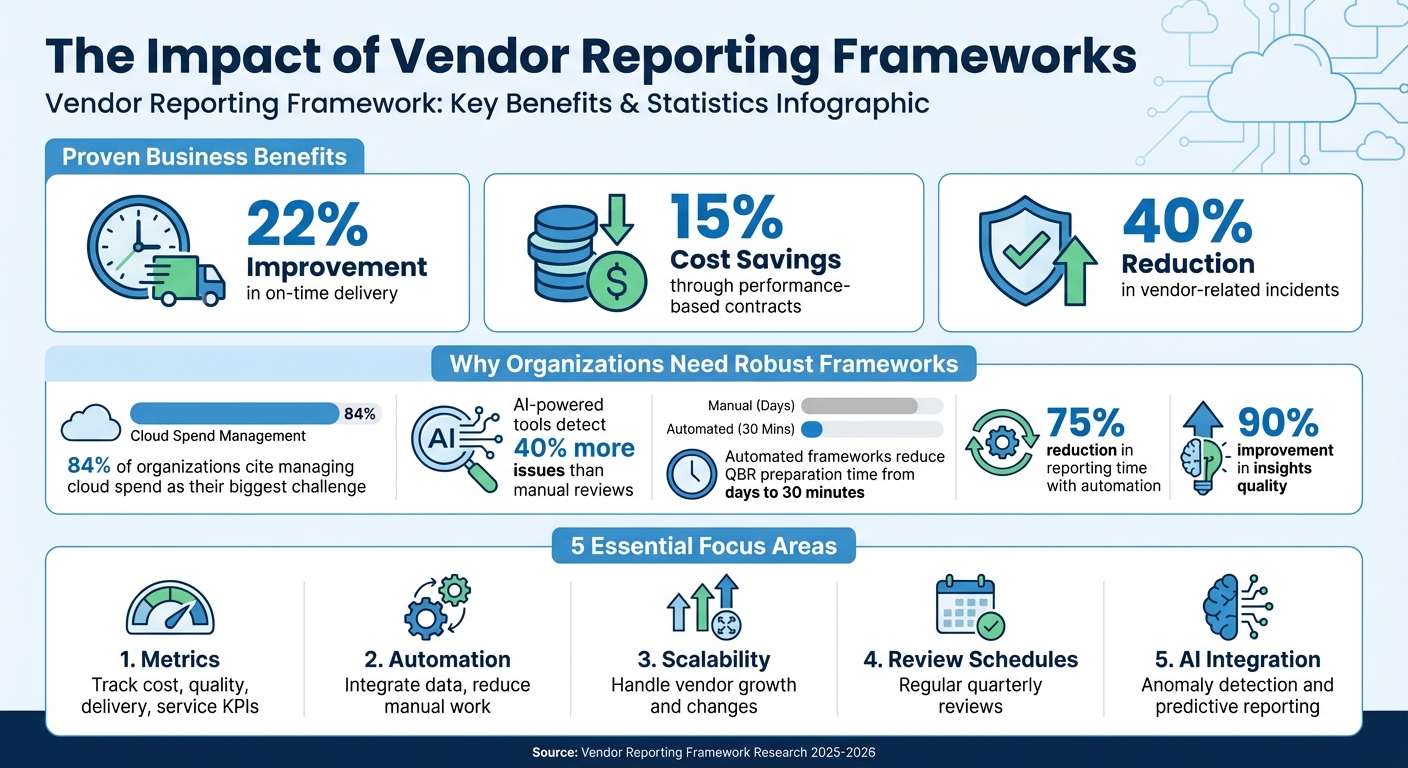 {Vendor Reporting Framework Benefits and Key Statistics}
:::
{Vendor Reporting Framework Benefits and Key Statistics}
:::
Core Components of Vendor Reporting Frameworks
Metrics and KPIs
At the heart of any vendor reporting framework is the selection of metrics that directly influence cost control and business performance. Mismanaged cloud spending can significantly reduce profit margins, making it essential to keep a close eye on expenses.
Did you know that 84% of organisations cite managing cloud spend as their biggest challenge? [2] This highlights the need for robust cost-related metrics. Beyond simply tracking expenses, a strong framework should measure indicators like:
- Allocation coverage percentage: How much of the total spend is accurately assigned to business owners.
- Forecast variance percentage: A measure of how closely actual costs align with budget predictions.
- Amortised effective rates: The actual cost per unit after factoring in discounts and commitments.
These metrics don’t just reflect past performance - they also offer actionable insights to fine-tune spending strategies.
Data Integration and Automation
Once metrics are established, the next step is efficient data integration. Automation plays a key role here, slashing the time needed for quarterly business review (QBR) preparation from days to just 30 minutes [1]. While spreadsheets might work for managing up to 20–30 vendors, they quickly become unmanageable as the vendor count grows. Automated frameworks, on the other hand, can handle data from hundreds of vendors while maintaining a clear, portfolio-level perspective [1].
A major part of this process involves integrating operational data through APIs and standardising billing exports from platforms like AWS CUR, Azure Export, and GCP BigQuery. This creates a centralised view across multi-cloud environments [2]. Automation ensures that data stays up-to-date, unlike manual approaches that often lag by 4–6 weeks [1]. Additionally, the FinOps Foundation's 2025 Framework introduced the idea of Scopes
, encouraging organisations to manage spend by team, application, or environment rather than rigid account structures [2].
Scalability and Flexibility
A successful framework isn’t just about what works today - it must also accommodate future growth and change. This means using reusable cost groupings tied to business ownership rather than static account structures [2]. Such flexibility ensures the framework can handle organisational changes or new product launches without requiring a complete overhaul.
Proactive issue management is another critical feature. Multi-level alerts - set at 80% for review, 90% for validation, and 100% for escalation - allow teams to address budget variances before they spiral out of control [2]. For organisations using Kubernetes alongside traditional cloud setups, it’s vital that the framework ties cluster, namespace, and pod data back to business owners. Without this, Kubernetes risks becoming a reporting black box
[2].
Lastly, the framework should support policy-driven waste detection. Instead of relying on periodic cleanups, continuous automated scans for idle resources and overprovisioned services keep the system efficient and cost-effective [2].
Vendor Scorecards: Managing Vendor Performance
How to Set Up a Vendor Reporting Framework
Creating a vendor reporting framework involves focusing on metrics, automation, and scalability. Here's how to get started.
Defining Goals and Selecting KPIs
Begin by identifying vendors who manage sensitive data, play a critical role in operations, or pose significant financial risks [3][4]. This step helps prioritise your reporting efforts and determine which vendors need closer monitoring.
Engage stakeholders from procurement, legal, IT, and finance early in the process. Doug Roginson, Head of Supplier Relationship Management at JPMorganChase, emphasises:
Without a solid foundation in cost control, performance standards and risk management, you can't really build effective supplier relationships [5].
This collaboration ensures your framework addresses all necessary criteria and gains consensus on evaluation methods [3][5].
Define KPIs at the start of the contract rather than waiting for issues to arise [1]. Group these KPIs into four categories:
- Quality: Metrics like defect rate and first-pass yield.
- Delivery: Includes on-time delivery and lead time accuracy.
- Service: Measures such as response time and SLA compliance.
- Commercial: Factors like invoice accuracy and contract compliance.
Aim for a scorecard with 8–12 well-chosen KPIs to maintain focus and manage performance effectively [1]. Use a composite scoring system on a 0–100 scale, where scores above 90 indicate Preferred
status and scores below 75 call for a performance improvement plan [1]. Research shows that formal scorecard programmes can lead to a 22% boost in on-time delivery and 15% average cost savings through performance-linked terms [1].
Once KPIs are established, the next step is to implement tools that simplify data management.
Choosing Tools and Automating Processes
After defining KPIs, selecting the right tools and automating processes is essential for efficient reporting. Managing data for more than 20–30 vendors becomes challenging with spreadsheets due to issues like data delays and version control [1].
Modern vendor management systems address these challenges by automating data collection, calculating composite scores, and triggering alerts [6][1]. This approach can reduce reporting time by 75% and improve insights by 90% [6].
Platforms such as SAP Ariba, Coupa, Jaggaer, and Oracle Fusion are ideal for handling complex procurement needs [6]. For organisations requiring tailored solutions, custom development can integrate reporting frameworks directly into multi-cloud environments, offering real-time visibility that aligns with business processes.
The priority is choosing a solution that works seamlessly with your existing tech stack, eliminating manual data entry and ensuring stakeholders have access to up-to-date dashboards.
Setting Up Review Schedules
With KPIs and automated tools in place, establish review schedules based on vendor importance. Strategic Tier 1 vendors should undergo quarterly business reviews (QBRs) and monthly KPI monitoring, while less critical Tier 3 vendors may only need annual reviews [1]. This tiered approach ensures resources are allocated effectively.
Send out scorecards at least five business days before a QBR to allow time for root cause analysis [1]. Structure the QBR agenda as follows:
- 15 minutes to review the scorecard.
- 15 minutes to address open issues.
- 20 minutes for root cause analysis and improvement planning.
- 20 minutes for strategic discussions.
If a vendor scores below 75 for two consecutive periods, issue a formal Vendor Performance Improvement Plan (VPIP), requiring a root cause analysis within 10 days [1]. Structured QBRs have been shown to drive 3.2 times greater vendor innovation [1], proving that consistent engagement delivers value beyond compliance.
Best Practices for Vendor Reporting Frameworks
Once your framework is up and running, keeping it effective demands constant attention. Regular updates and tweaks can turn vendor reporting from a routine task into a valuable strategic tool.
Regular Audits and Refinements
Vendor reporting frameworks should be reviewed formally every quarter, with informal checks happening monthly - or even more frequently for critical vendors [7]. These reviews ensure your metrics still align with your business goals, covering areas like cost, service delivery, quality, and compliance [7].
Start by documenting baseline metrics when you first set up the framework. This gives you a clear point of comparison to track progress over time. With this data, you can pinpoint vendors consistently meeting expectations and identify those needing performance improvement plans or contract adjustments [7].
Adjustments to the framework should be made when you observe a 15–20% variance in KPI performance, changes in business priorities, regulatory updates, new vendor partnerships, or data quality concerns [7].
Gather feedback from internal teams who work with vendors - such as IT, procurement, and business units - via surveys, interviews, or feedback sessions during audits. This qualitative input can highlight issues that numbers alone might miss, like poor communication or lack of alignment with business needs [7]. Combine this qualitative feedback with quantitative metrics (e.g., costs, uptime, response times) by using a weighted scorecard that balances both perspectives for a more comprehensive vendor evaluation.
This ongoing refinement lays the groundwork for incorporating advanced AI tools for deeper insights.
Using AI for Anomaly Detection
AI can spot statistical anomalies and unusual patterns that human reviewers might overlook, such as sudden cost increases, unexpected service disruptions, or irregular transaction volumes [7]. For example, AI might flag a 40% rise in response times - even if it still falls within contractual limits - by recognising deviations from normal patterns.
In fact, AI-powered tools in supply chain reporting have been shown to detect 40% more issues than manual reviews, cutting downtime by up to 30% [8].
By training AI models on historical vendor data, you can set them to flag deviations over 10%. Hokstad Consulting, for instance, offers AI strategy services that help organisations deploy machine learning models capable of analysing vendor data across multiple dimensions. This approach can uncover correlations between metrics that point to root causes, allowing you to address issues early and reduce both downtime and costs [7].
Review AI-generated insights weekly to fine-tune detection algorithms, addressing false positives or missed anomalies. Once an anomaly is flagged, act quickly - conduct an assessment within 24–48 hours to evaluate the situation.
By integrating AI, you not only improve anomaly detection but also boost the overall reliability of your framework.
Linking Reports to Business Outcomes
To maximise the value of your framework, vendor metrics should be tied directly to business objectives.
Map vendor KPIs to specific outcomes [7]. For example, if your goal is to cut cloud infrastructure costs by 30–50%, focus on vendors that directly impact this goal - like cloud providers, cost consultants, or automation tools - and set relevant metrics for each.
Clearly document these relationships. For instance: Vendor X's cost optimisation recommendations → £50,000 monthly savings
or Vendor Y's automation tools → 2-day reduction in deployment cycles
[7]. Use dashboards that display both vendor metrics and their related business outcomes side by side, making these connections clear to stakeholders. This approach elevates vendor reporting from a compliance task to a strategic advantage.
Go beyond technical metrics by tracking business-focused KPIs, such as cost per transaction or customer, to provide context. Create dashboards that tie operational metrics like on-time delivery (target: over 95%) and cost variance (less than 5%) to broader outcomes, such as savings (e.g., 20–30% reduction) and faster deployment cycles [8].
When presenting vendor performance to leadership, always frame results in business terms. For example: Our primary cloud vendor's 99.99% uptime SLA enabled zero-downtime deployment, supporting our 2026 expansion into three new markets
[7]. Hokstad Consulting can assist in analysing vendor data to uncover inefficiencies, potentially reducing cloud costs by 30–50% while improving deployment speeds.
Aligning vendor performance with business goals ensures that your reporting framework directly supports organisational growth and efficiency.
Future Trends and Advanced Strategies for 2026
The business landscape is evolving from reactive problem-solving to proactive intelligence. Companies are now focusing on predicting vendor challenges before they disrupt operations. By leveraging AI to forecast behaviours and integrating reporting across increasingly intricate cloud systems, businesses are staying ahead of the curve.
AI-Powered Predictive Reporting
AI is revolutionising vendor reporting, turning it from a backward-looking process into a forward-facing strategic asset. By analysing historical data, AI can anticipate risks and predict performance trends.
AI does more than manage vendor relationships; it reveals patterns that forecast vendor behavior.- TYASuite [9]
Modern vendor management platforms now feature predictive risk scoring, which evaluates vendor performance across multiple dimensions - like cost patterns, service quality, compliance history, and external factors such as cybersecurity risks [9]. This approach allows businesses to address potential problems weeks - or even months - in advance.
AI excels at spotting connections between various metrics, helping businesses act before minor issues escalate. For example, a steady increase in API response times from one vendor might align with rising infrastructure costs from another, hinting at potential capacity concerns. Hokstad Consulting's AI strategy services can help businesses implement these predictive tools, reducing vendor-related disruptions and cutting costs by as much as 30–50%.
This forward-thinking approach is particularly critical for navigating the complexities of multi-cloud environments.
Multi-Cloud and Hybrid Hosting Integration
As multi-cloud and hybrid hosting strategies become the norm, vendor reporting frameworks must evolve to handle diverse environments. Each cloud provider uses unique tagging and cost allocation methods, which can make unified reporting a challenge.
The solution lies in defining consistent metrics that apply across platforms. Metrics such as latency, throughput, error rates, and CPU usage are universal indicators of performance and directly impact user experience and business outcomes. For instance, tracking latency across AWS, Google Cloud, and Azure enables businesses to compare vendor performance on an equal footing, even when the data is reported differently.
Hokstad Consulting offers tailored cloud solutions for public, private, hybrid, and managed hosting setups, helping businesses create reporting frameworks that deliver clear, actionable insights across their entire vendor ecosystem.
Zero-Downtime Cloud Migrations
AI-driven insights are also transforming cloud migrations, enabling vendor frameworks to support seamless transitions. During migration, businesses can track both the legacy and new platforms simultaneously to ensure no drop in performance or unexpected costs.
Using parallel monitoring, businesses can compare critical metrics - like response times, transaction volumes, error rates, and costs - between the old and new environments. This dual visibility ensures the new vendor meets or exceeds the performance standards of the previous setup before full deployment. For example, if the migration goal includes a 99.99% uptime SLA, monitoring both environments during the transition ensures consistent delivery.
Vendor reporting frameworks also now incorporate ESG metrics into risk profiles [9]. During migrations, businesses can track these metrics to ensure new vendors align with sustainability and security goals. This approach not only minimises downtime but also underscores the strategic importance of robust vendor reporting.
Hokstad Consulting provides expert cloud migration services designed for zero downtime, combining their migration expertise with advanced vendor performance tracking to ensure smooth transitions while maintaining operational transparency.
Conclusion
Vendor reporting frameworks play a crucial role in managing cloud environments, DevOps workflows, and multi-vendor ecosystems. They help shift businesses from simply reacting to issues to taking a more proactive approach to optimisation.
Key Lessons
Successful vendor reporting relies on three main elements: accurate metrics, automation, and regular audits. Metrics such as uptime, cost per deployment, and response times reveal inefficiencies like overprovisioning or unreliable vendors. Automation reduces manual errors and provides real-time insights across public, private, and hybrid cloud setups. For instance, businesses that use automated anomaly detection often identify 20–30% cost overruns that might otherwise go unnoticed. Regular audits ensure reporting frameworks stay relevant to business objectives, preventing outdated KPIs from hiding vendor price hikes or declining performance.
The goal is to tie every metric to a clear business outcome - whether it's speeding up time-to-market, lowering hosting costs, or boosting service reliability. By understanding these principles, businesses can refine their processes and make focused improvements.
Next Steps for Businesses
Start by evaluating your current vendor-reporting practices. Ensure your KPIs align with your business objectives, optimise automation workflows, and increase the frequency of reviews. If you're struggling to integrate data from platforms like AWS, Google Cloud, or Azure, you could be losing out on potential savings.
For those looking to advance beyond basic reporting, Hokstad Consulting provides tailored solutions. Their expertise spans DevOps transformation, cloud cost engineering, and AI-driven strategies. With a focus on seamless multi-cloud integration and zero-downtime migrations, they help ensure your vendor reporting framework scales effectively while delivering the cost insights and performance transparency needed to stay ahead in 2026 and beyond.
FAQs
Which vendors should I report on first?
Begin by focusing on cloud vendors that play a critical role in your core infrastructure and support systems. These should be providers offering essential services that directly impact your organisation's operations. Make sure their support tiers, SLAs (Service Level Agreements), reliability, and compliance standards (like GDPR) align with your business needs and regulatory requirements.
Once these foundational needs are addressed, you can shift your attention to secondary vendors. These might be providers that cater to specific projects or offer additional, supplementary services. By prioritising key vendors first, you can ensure your organisation stays on track in terms of performance, compliance, and cost management.
How do I choose the right KPIs and SLAs?
To choose the right KPIs and SLAs, make sure they align with both your business objectives and vendor requirements. Select KPIs that are easy to measure and directly tied to performance goals, such as on-time delivery rates or compliance levels. When it comes to SLAs, prioritise metrics like uptime percentages or response times that impact service quality. Regular reviews are essential to keep these metrics relevant and ensure they continue to enhance vendor performance.
When should I switch from spreadsheets to automation?
When managing vendor performance becomes too complicated, takes up too much time, or leads to frequent mistakes, it might be time to consider automation. Some clear signs include dealing with massive amounts of data, requiring real-time tracking, or striving for greater precision and efficiency. For instance, automation works perfectly for monitoring KPIs, simplifying review processes, and spotting irregularities in intricate setups - especially when monthly expenditures surpass £40,000–£50,000. This transition can lead to clearer insights, fewer errors, and smarter decision-making.