
If I had to sum this up in one line: private cloud segmentation works best in layers, not as a single control.
The article breaks it into five approaches: VLAN/VRF zoning, microsegmentation, security groups and ACLs, SDN/service-aware policy, and compliance-led segmentation.
Here’s the short version:
- VLANs and VRFs split large trust zones
- Microsegmentation limits east-west traffic between workloads
- Security groups and ACLs control access at subnet and workload level
- SDN lets policy follow services as they move
- Compliance-led segmentation keeps systems like a PCI DSS cardholder data environment inside a tighter scope
If your private cloud is flat, one breach can spread sideways. If it is segmented well, you can:
- cut lateral movement
- keep admin systems away from app traffic
- scale web, app, and database tiers on their own
- shrink audit scope for PCI DSS and ISO 27001
- make rule changes safer through infrastructure as code
One point stood out to me: PCI DSS segmentation testing is not optional when segmentation is used to reduce scope. The article also notes review points such as annual testing for merchants, every six months for merchant service providers, and checks again after major network change.
Microsegmentation Explained (Best Practices for Cloud Security)
Quick comparison
| Strategy | Best for | Control level | Main limit |
|---|---|---|---|
| VLAN/VRF zoning | Broad separation by zone, tenant, or environment | Coarse | Less detail inside a zone |
| Microsegmentation | East-west control between VMs, containers, or services | Fine | More policy to maintain |
| Security groups & ACLs | Workload and subnet policy | Medium | Can sprawl if rules are not kept tidy |
| SDN / service-aware policy | Fast-moving estates with changing workloads | Medium to fine | Depends on platform setup and policy discipline |
| Compliance-led segmentation | Regulated workloads and audit scope | Varies by rule set | Extra review and evidence work |
My takeaway: if you run private cloud workloads with payment data, personal data, or admin tooling, this article gives a plain map for separating them with tighter rules and cleaner audit boundaries.
Why Segmentation Matters in Private Clouds
Without segmentation, a private cloud acts like a flat network. If one workload gets compromised, it can often talk to other workloads on the same fabric. Segmentation shrinks that blast radius. In plain terms, it helps with containment, cuts exposure, supports scale and narrows audit scope.
Limit Lateral Movement Between Workloads
If an attacker gets into one workload - say, a web server with a known flaw - the next move is often sideways towards databases or admin systems. Segmentation blocks that path by enforcing default-deny policies for east-west traffic. Only traffic you allow gets through.
In day-to-day use, that means:
- separating development, test and production into distinct virtual networks
- isolating management interfaces such as hypervisors, storage controllers and configuration management tools onto dedicated admin segments
- restricting inter-tier traffic even within production
A compromise in a test environment should have no routing path into production databases or management systems. That's the whole point: one problem stays one problem.
Reduce the Attack Surface in Shared Infrastructure
Shared infrastructure brings risk. Services on the same physical hosts or clusters can often reach each other when there's no good reason for them to do so. Segmentation cuts that down by limiting which services can communicate, on which ports and from where.
The controls that tend to matter most are fairly simple: service-specific allow-lists, allowing only HTTPS from a web tier to an application tier, putting SSH, RDP and API endpoints on hardened admin networks that are reachable only through bastion hosts, and placing shared services like DNS and NTP in their own segments instead of leaving them open to every subnet by default.
That smaller set of reachable services is what makes the next part work at scale.
Support Independent Scaling of Application Tiers
When web, application and database tiers sit in separate trust zones, each tier can scale on its own without forcing changes to the security rules around the others. Picture a UK retail platform ramping up its web tier for a January sale. It can add instances without changing firewall rules or weakening controls around payment or customer data - as long as policies rely on tags and roles instead of hard-coded IP addresses.
This also helps when you're trying to draw a clean line around regulated systems.
Define Compliance Scope More Clearly
For UK organisations working under PCI DSS or ISO 27001, segmentation can cut audit effort in a very direct way. Without it, scope tends to spread across many more systems. If cardholder data environments sit inside dedicated virtual networks with tightly controlled ingress and egress, auditors can treat the CDE as a bounded zone and exclude systems with no routing path into it.
The same idea applies to ISO 27001. Grouping assets by risk and regulatory relevance into clear network zones makes risk assessment and control mapping much easier to defend.
1. Virtual Network Zoning with VLANs and VRFs
Start with network zoning when you need clear, enforceable boundaries between major trust areas. VLANs split traffic at Layer 2. VRFs split routing at Layer 3. Used together, they carve up a shared network into isolated zones without the cost and hassle of building separate physical networks.
Isolation granularity
This setup gives you macrosegmentation. In plain terms, that means broad trust zones, not isolation for each workload.
In day-to-day use, teams usually group workloads by function, such as web, application, and database. They may also group by environment, like development, staging, and production, or by tenant. A payment-processing environment, for example, can sit in its own dedicated VRF, with only specific flows allowed to upstream services.
That said, these zones are only as good as the controls between them. If traffic can drift across boundaries too easily, the whole model starts to lose its teeth.
Boundary enforcement
Policy should be enforced at the edges between zones. Cross-zone traffic should pass through a firewall or a controlled routing handoff with deny-by-default rules. That way, traffic is allowed only when there is a clear reason for it.
Within a VLAN, VACLs can limit communication between endpoints that share a subnet but should not talk freely. This matters more often than people expect. Just because two systems sit on the same subnet doesn't mean they should have open access to each other. Keep route leaking to a minimum as well, because every shared route gives lateral movement one more path.
This model works best when it is backed by Infrastructure as Code. Templated VLAN and VRF configurations help make sure each new zone is built in the same way, with the same baseline controls. They also push changes through a review process instead of leaving engineers to make manual edits on individual devices.
Compliance evidence and auditability
Auditors want proof that sensitive workloads are separated in practice, not just labelled in a diagram. In other words, it is not enough to say a system is isolated. You need to show how that isolation is built and enforced.
Keep a clear mapping from VLAN → subnet → VRF → firewall policy → application.
The evidence trail should include:
- Network diagrams
- IP and VLAN allocation records
- Inter-zone firewall rules
- Change tickets for any modifications
- Periodic test records that confirm blocked paths stay blocked
Once the zone boundaries are in place, the next step is to control traffic inside them with more precision.
2. Microsegmentation for East-West Traffic Control
VLANs and subnets set broad lines between zones. Microsegmentation goes much deeper. It applies tight security controls at the level of each workload, focusing on traffic between servers, services, and containers inside your private cloud. Instead of policing only the edge of a zone, it controls what each workload can talk to.
Isolation granularity
With microsegmentation, each VM, container, or application becomes its own boundary. You’re not just grouping machines by subnet and hoping that’s enough. You define rules for each workload, which means a compromised web server can’t wander across the network and reach a payment database just because both happen to sit on the same VLAN.
A sensible starting point is tier-based policy. Web, application, and database tiers should get only the protocols they need. For example:
- HTTPS from web to app
- SQL from app to database
For regulated workloads, such as cardholder data or health records, you can tighten things even more with per-application or per-service rules. That helps keep compliance scope as small as possible. The catch, of course, is scale. The more workloads you have, the harder it gets to keep all that control tidy.
Policy enforcement model
In a dynamic private cloud, label-based policy tends to work better than static IP rules. IP lists age badly. A workload moves, scales, or gets replaced, and suddenly your rule set starts to look like a junk drawer.
A better approach is to write rules against metadata like env=prod, app=payments, and tier=db. Then pair those labels with identity-based controls, such as mutual TLS and service identities. That way, policy stays in place even when workloads move around or scale up and down.
Scalability across workloads
The main problem here is policy sprawl. If every workload ends up with its own one-off rule set, things get messy fast.
Reusable templates help a lot. You can build patterns for web, API, batch, and shared services, then apply them by tag. Central control cuts drift, and it also makes it easier to keep rules in step across the estate.
Store those policies in Git and push them through a CI/CD pipeline. That gives you versioned, reviewed, repeatable changes. It also makes testing and audit work far less painful, because the policy history is sitting there in plain sight.
Compliance evidence and auditability
Microsegmentation also gives you clear evidence for audit work. Exported policy definitions, approval records, and Git commit histories show that rules went through formal review. Flow logs show that only permitted east-west traffic took place. Periodic tests help prove that blocked paths are still blocked.
For PCI DSS, that can help narrow the scope of the Cardholder Data Environment. The next section shows how security groups and ACLs apply similar rules with simpler network controls.
3. Security Groups and Network ACLs for Policy-Driven Isolation
Use security groups for workload-level rules and NACLs for subnet-level boundaries. That split matters.
Security groups are stateful, which means return traffic is allowed automatically after an outbound connection is permitted. NACLs are stateless, so you have to define both inbound and outbound rules yourself. In practice, this setup works well when you want clear isolation, easy scale-out, and boundaries you can show to an auditor without rebuilding the whole network.[14][17][19][20]
Isolation granularity
A good pattern is to use NACLs as the outer fence and security groups as the inner allow-list. Say you separate production and development subnets with NACLs, then use security groups to control which tier can talk to which, and on which ports.[16][18][20][21]
Don’t put mixed trust levels into one security group. Keep them split by role, such as web, application, and database, so privilege boundaries stay plain and easy to check.[2][20][21]
Policy enforcement model
Start from default deny on sensitive ports, then allow only known sources.[15][17][18][19]
Where the platform allows it, use security group references instead of broad CIDR ranges. For example, let the database tier accept traffic only from the application-tier security group. That holds up far better than tying access to a fixed IP address that might change next week.[14][17][2]
Scalability across workloads
It helps to standardise reusable security group templates for web, application, and database workloads, then apply them through Infrastructure as Code. That cuts drift and keeps rules aligned across the estate.[14][17][2][5]
Compliance evidence and auditability
For regulated workloads, controls alone aren’t enough. You also need proof.
Enable flow logs for all security groups and NACLs that cover regulated workloads, and keep those logs with exported rule definitions and change-control records.[10][11][12][13][5][6]
PCI DSS cares about effective isolation, not the technology used.[4][5][7][8] Auditors will want to see that blocked connections fail in practice, not just on paper. The clearest evidence is periodic segmentation testing plus samples of denied traffic. PCI DSS requires segmentation testing at least once a year for merchants, every six months for merchant service providers, and again after any major network change.[7][9][5]
When policy needs to follow services rather than subnets, move to SDN and service-aware segmentation.
4. Software-Defined Networking and Service-Aware Segmentation
Building on workload-level controls, SDN makes segmentation rules portable in private cloud setups that change fast.
When workloads move all the time, static VLANs and ACLs start to creak. SDN separates policy from packet forwarding, which means segmentation rules can move with VMs, containers and services as they shift around the estate.
Isolation granularity
VLANs segment by subnet. SDN works at the level of service identity.
That shift matters. Policies attach to the service itself, so they stay in place even when IP addresses change or workloads move. In practice, that means you can isolate a single microservice that handles payment card data inside a shared application tier, while still allowing tightly controlled links to other services on specific ports and protocols. [22][24][25]
Put simply, the rule follows the service, not the address. That gives you identity-based policy across the full service chain.
Policy enforcement model
SDN platforms enforce policy through distributed virtual firewalls at the hypervisor layer. Rules are applied at each workload’s virtual network interface, not just at one central perimeter device. [23][24]
That has a direct upside: when a workload migrates or scales out, the policy goes with it. Isolation doesn’t get weaker just because the environment changed underneath it.
SDN also makes deny-by-default much easier to run in day-to-day operations. New workloads can start with restrictive policy, then receive the right labels from the deployment pipeline before any broader access is allowed. [3][29]
Scalability across workloads
Because policies bind to service identity instead of fixed IPs or VLAN IDs, SDN scales well as environments grow.
Say a new service is deployed through Terraform or a Kubernetes operator. It can inherit the right segmentation policy from its labels without manual rework. [23][24] That cuts out a lot of hand-built reconfiguration, which is often where mistakes creep in.
There’s another upside too. The same policy model makes compliance reporting easier, because the controller already has a record of which services are allowed to communicate with each other.
Compliance evidence and auditability
This is where SDN often earns its keep: estates that need both fast change and clean evidence.
The controller gives you a single record of active policy and flow decisions, which makes audit checks less painful. [26][27][28] It logs allowed and denied flows centrally, and it keeps a history of policy changes for audit review.
For regulated workloads, teams can map SDN policy sets to PCI DSS segmentation controls and check that live traffic matches the documented intent. [29]
5. Compliance-Driven Segmentation for Regulated Workloads
Compliance-driven segmentation starts with the rules: UK GDPR, the Data Protection Act 2018, PCI DSS, or sector-specific controls. The goal is simple. Apply the segmentation patterns already covered to regulated workloads so that control boundaries and audit scope line up with the rule set.
Isolation granularity
At the heart of this approach is the use of dedicated trust zones for regulated workloads. These zones should have tight control over ingress, egress, and east-west traffic. For PCI DSS, that means isolating systems that store, process, or transmit card data in a dedicated CDE [30][31][32]. For workloads that handle personal data under UK GDPR, segmentation can also follow geography and data residency rules, keeping data stores and workloads inside defined networks and regions [33].
For broad separation, use VRFs or VLANs. If regulated and non-regulated workloads sit in the same private cloud, add per-application or per-service controls on top. That extra layer helps stop one shared estate from turning into a compliance headache.
Policy enforcement model
Use deny-by-default allow-lists. In plain terms, nothing talks unless you say it can. Every cross-zone flow should be explicit, documented, and narrow. A good example is web to payment app on TCP 443 only.
Policy should be enforced in layers:
- Virtual networking
- Security groups
- Distributed firewalls
Where network rules alone aren't enough, add mutual TLS or IPsec so identity checks back up the traffic policy.
Compliance evidence and auditability
Keep network diagrams, ruleset exports, change records, and flow logs up to date. Auditors won't just want the design on paper. They'll want proof that the live estate matches it. PCI DSS also requires annual segmentation testing and quarterly firewall/router rule reviews [30][31][32].
If payment systems are cleanly isolated from internal collaboration tools, the audit can stay focused on the payment zone instead of pulling in the whole private cloud. That can cut remediation work and reduce assessment overhead.
| Evidence Type | What Auditors Look For |
|---|---|
| Network and data-flow diagrams | Documented boundaries, IP ranges, and segmentation zones |
| Firewall and ACL exports | Live ruleset matching the documented design |
| Change records | Approved, traceable modifications to segmentation policy |
| Flow logs | Allowed and denied traffic across regulated zone boundaries |
| Penetration test reports | Validated segmentation effectiveness, at least annually |
The comparison below shows how this compliance-led approach differs from the earlier strategies.
Comparing the 5 Strategies
::: @figure 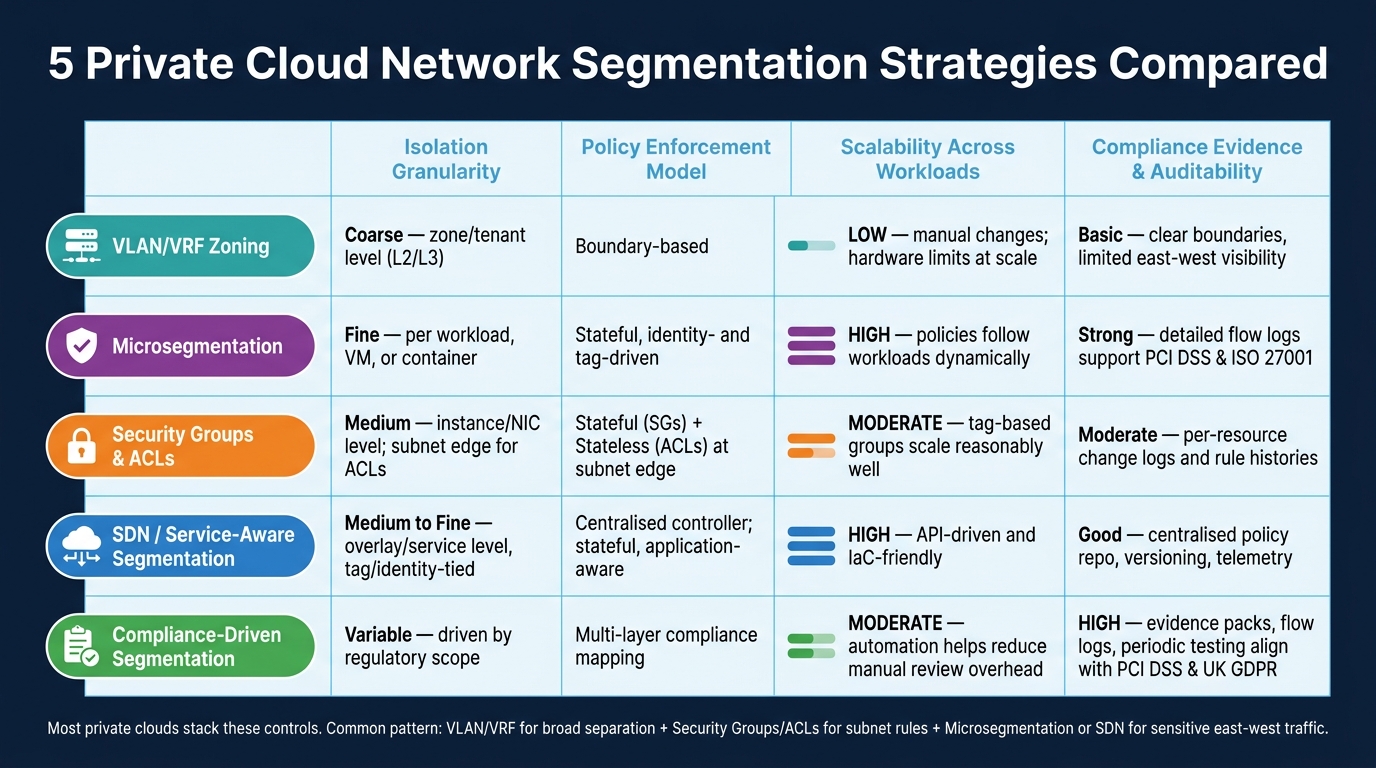 {5 Private Cloud Network Segmentation Strategies Compared}
:::
{5 Private Cloud Network Segmentation Strategies Compared}
:::
Use this table to pick the right mix of controls. In most private clouds, one method on its own isn't enough. You usually need layered segmentation: broad zoning for separation, workload controls for containment, and compliance layering for regulated scope.
Comparison Table: Scope, Controls, Scale, and Audit Support
The table below shows where each control works best, and where its limits start to show.
| Strategy | Isolation Granularity | Policy Enforcement Model | Scalability Across Workloads | Compliance Evidence and Auditability |
|---|---|---|---|---|
| VLAN/VRF Zoning | Coarse - zone/tenant level (L2/L3) | Boundary-based | Low - manual VLAN and VRF changes; hardware limits can become an issue in large estates | Basic - clear network boundaries and diagrams, but limited east–west flow visibility |
| Microsegmentation | Fine - per workload, VM or container | Stateful, identity- and tag-driven | High - policies follow workloads dynamically; well suited to autoscaling and containers | Strong - detailed east–west flow logs and policy definitions support PCI DSS and ISO 27001 |
| Security Groups & ACLs | Medium - instance/NIC level; subnet edge for ACLs | Security groups are stateful and policy-driven; ACLs are stateless and applied at the subnet edge | Moderate - tag-based groups scale reasonably well | Moderate - per-resource change logs and rule histories help demonstrate least privilege |
| SDN / Service-Aware Segmentation | Medium to fine - overlay/service level, tied to tags or identity | Centralised controller; stateful, application-aware, and identity- or tag-driven | High - API-driven and IaC-friendly | Good - centralised policy repository, versioning, and telemetry support consistent enforcement across the estate |
| Compliance-Driven Segmentation | Variable - driven by regulatory scope | Multi-layer compliance mapping | Moderate - can slow down if each new workload needs manual compliance-zone review, though automation helps | High - evidence packs, change control, flow logs, and periodic testing align well with PCI DSS and UK GDPR |
A simple way to read this:
- Use VLAN/VRF for broad zones.
- Use microsegmentation for workload isolation.
- Use security groups for resource-level rules.
- Use SDN for automated service policy.
- Use compliance-driven segmentation for regulated scope.
Most private clouds stack these controls rather than picking just one. A common pattern is VLAN/VRF for broad separation, security groups and ACLs for subnet and instance rules, and microsegmentation or SDN for sensitive east–west traffic.
That layered mix is the starting point for the implementation steps that follow.
How to Put Segmentation into Practice
The five strategies above only work if they’re backed by clear design, policy, and regular review. On paper, segmentation can look neat and tidy. In practice, it falls apart fast if nobody knows what talks to what, who owns it, or how changes are approved.
Build an Asset Inventory and Data-Flow Map
Start with evidence, not policy. You can’t set zone boundaries, VLANs, microsegmentation rules, or security groups with any confidence if the traffic flows are still guesswork.
Catalogue every workload, data type, owner, and environment. Then map the source and destination flows, protocols, and ports for each one.
This is usually where the hidden mess shows up. Legacy services, batch jobs, and one-off admin tools often communicate with no formal record at all. Running flow logs and packet capture across a full business cycle helps bring these paths to light before rules are tightened.
Once you’ve found them, sort each flow into one of three buckets:
- required
- retire
- remove
That way, policy decisions are deliberate instead of rushed. Treat the inventory as a living document. Keep it under version control and update it automatically through CMDB feeds or IaC outputs.
Design Trust Zones, Addressing, and Routing Early
Once the flows are clear, fix the network shape before deployment. Define zones before you allocate IP space.
Use distinct, non-overlapping CIDR blocks for each zone so routing and policy rules stay unambiguous. Make sure inter-zone traffic passes through a security control, such as a firewall, service mesh, or SDN policy, instead of moving freely. These decisions made early give you a stable base for VLANs, microsegmentation, security groups, and compliance-focused controls to sit on in a consistent way. [34][16]
Use Deny-by-Default Rules and Consistent Tagging
Every firewall, security group, and ACL should block all traffic unless it is explicitly allowed. That’s the starting point.
Tag each workload with its environment, application name, data classification, zone, and owner team. Then write policies around tag relationships instead of hard-coded IP addresses. For example, allow HTTP from tag:web-frontend to tag:app-backend in prod.
Why does that matter? Because IPs change. Instances scale up and down. Tags stay tied to what the workload is, not where it happens to sit. That keeps rule sets smaller, easier to audit, and closer to business intent than raw infrastructure detail. [36][35]
Manage Policies with Infrastructure as Code and Change Control
Segmentation policies should live in the same version-controlled repository as the application infrastructure. Tools like Terraform or Ansible can define network segments, security groups, ACLs, and routing rules as code.
Each change should go through a pull request and be reviewed by both network or security specialists and application owners. Automated CI checks should catch any any-to-any rules before they get anywhere near production.
This gives you a clear history of each segmentation decision, cuts down configuration drift, and makes rollback much simpler. If something breaks, you redeploy the earlier version. Once policy is automated, the next step is making sure the live estate still matches what the code says.
Monitor, Test, and Review Segmentation Regularly
Centralise virtual firewall logs, SDN controller logs, and flow logs into a SIEM. Alert on spikes in denied connections, odd protocols, and policy changes made outside approved windows.
It also helps to run network verification tools to confirm that policies behave the way they were meant to. On top of that, carry out penetration testing and red-team exercises - simulated lateral-movement attacks - aimed at east-west traffic paths.
For PCI DSS environments, segmentation controls must be reviewed at least every six months and validated through penetration testing when they are used to reduce compliance scope. [1][6]
Segmentation also has a habit of drifting over time. A harmless-looking change here, a temporary rule there, and before long the isolation you thought you had starts to weaken. That’s why rules should be tested after every material change, with automated regression tests run after each policy update to check that key isolation guarantees still hold.
Conclusion
These five strategies work best in layers, not as either-or choices. Put them together and you get defence in depth: broad separation at the network edge, tighter control between services, and clear compliance boundaries around regulated data.
That same setup also makes change control easier to handle. Segmentation becomes repeatable because new services can inherit existing zones and policy templates, which gives teams a control model that can grow with the business.
Clear, documented boundaries can also narrow audit scope and make PCI DSS and UK GDPR evidence easier to pull together. It helps to treat segmentation design as part of the deployment pipeline, not as a separate task bolted on later. For re-architectures or audit preparation, specialists in cloud infrastructure and DevOps such as Hokstad Consulting can help map workloads to trust zones and embed segmentation into deployment pipelines.
The aim is simple: define boundaries, automate enforcement, and test them on a regular basis.
FAQs
Which segmentation strategy should I start with in a private cloud?
Start by mapping your network architecture. Document your infrastructure, including physical servers, virtual machines, storage and databases, so you can see how data moves across the environment.
That gives you a clear view of your assets, connections, critical systems and weak points. From there, you can set effective segmentation boundaries and prioritise protection for security and regulatory compliance.
How do I stop segmentation rules becoming too complex to manage?
Move away from manual setup and use Policy as Code instead. Store security and segmentation rules in version-controlled repositories, then enforce them through CI/CD pipelines.
It’s also smart to base policies on identity, tags, and metadata rather than static IP addresses. That way, rules move with workloads on their own as things change.
Tools such as Open Policy Agent and Kyverno can validate configurations at deployment time too. That helps keep setups consistent and cuts down on human error.
When does PCI DSS require segmentation testing?
PCI DSS requires segmentation testing to make sure the cardholder data environment is kept separate from other workloads.
In software-defined and private cloud setups, you need to check segmentation settings on a regular basis. That helps you stay in line with Requirement 11 and keeps the network secure and ready for audit.