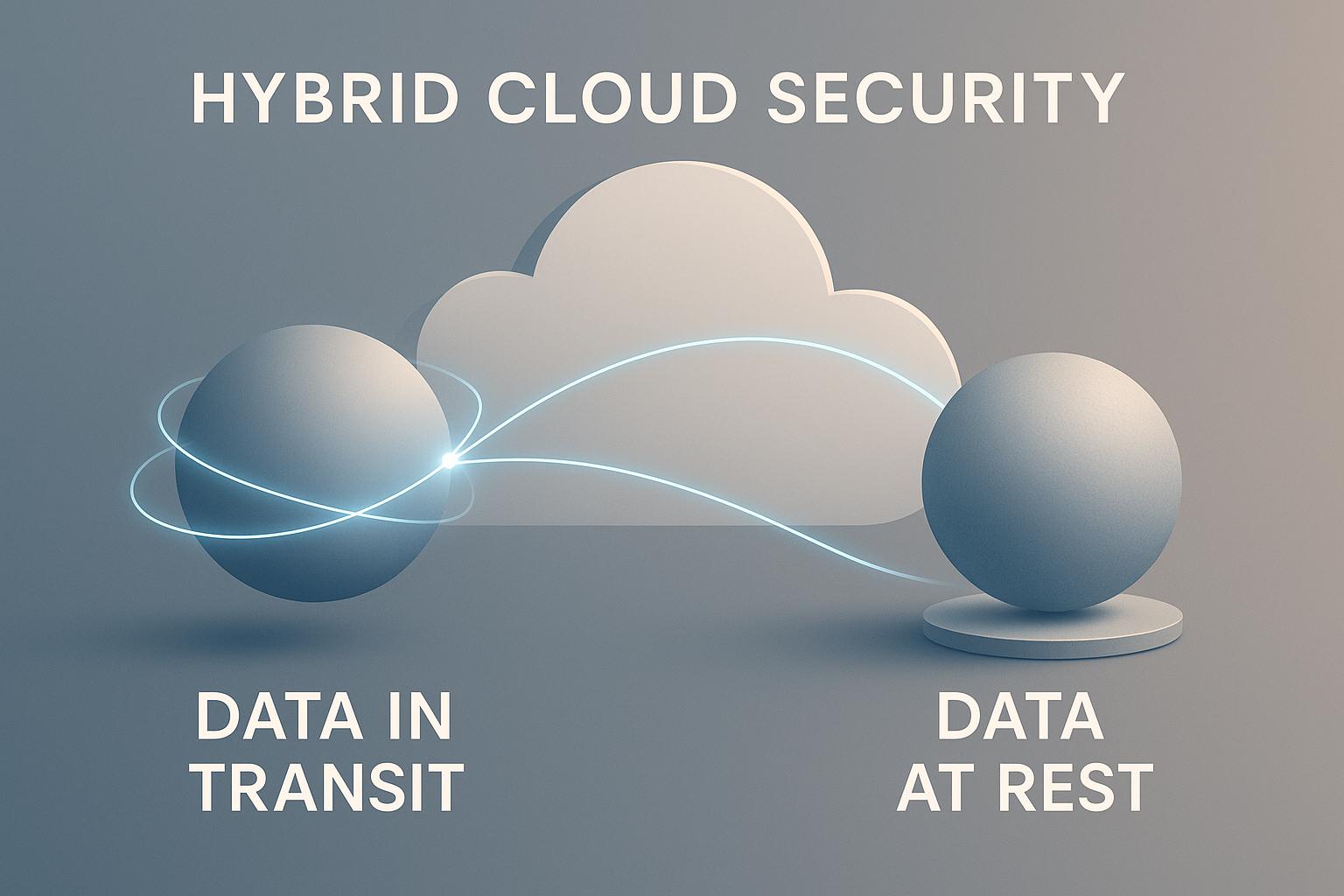
Hybrid cloud environments combine private, public, and on-premises systems, making them flexible but complex. This complexity increases the risks to data as it moves (data in transit) or stays stored (data at rest). Here's what you need to know:
- Data in transit: Actively moving data (e.g., email, file transfers) is vulnerable to interception, such as man-in-the-middle attacks. Encryption protocols like TLS, SSL, and IPsec are essential for protection.
- Data at rest: Stored data (e.g., databases, cloud storage) is at risk from weak access controls, misconfigurations, and insider threats. Encrypting with AES-256 and implementing strict access policies can help safeguard it.
- Hybrid cloud challenges: Data crosses multiple systems and jurisdictions, increasing exposure. Consistent security measures, encryption, and access management are crucial.
To protect both states, organisations must combine encryption, authentication, and continuous monitoring. This layered approach ensures data safety across hybrid infrastructures while meeting regulatory requirements like UK GDPR.
What Are Hybrid Cloud Security Best Practices?
Data in Transit vs Data at Rest: Definitions
Grasping the difference between data in transit and data at rest is a key step in safeguarding hybrid cloud environments. These two states of data come with distinct security challenges, each demanding tailored protection measures. Let’s break them down further to highlight their unique traits and risks.
What is Data in Transit?
Data in transit refers to information actively moving across hybrid cloud networks, where it is particularly susceptible to interception [2][4]. In hybrid cloud setups, data often travels between on-premises systems and public cloud services, exposing it to increased risks during transmission [2][4]. Every time data crosses these boundaries, it faces potential vulnerabilities [2][4].
Examples of data in transit include:
- API calls linking on-premises databases with cloud applications
- File transfers via secure protocols between data centres
- Email exchanges with sensitive content
- Real-time synchronisation of files between private and public cloud storage systems [4]
The main risk lies in the movement itself. As data travels through various network layers and protocols, it becomes exposed to interception [2]. When data moves across the internet - whether between cloud providers or from on-premises systems to public clouds - your organisation may not have full control over its transmission paths [2]. Without encryption protocols like TLS (Transport Layer Security) or SSL, data can easily be intercepted by unauthorised parties during transit [2].
In contrast, data at rest stays stationary, presenting a different set of challenges.
What is Data at Rest?
Data at rest refers to information stored on physical or virtual systems within hybrid cloud environments, remaining static until it is accessed [2][4].
In a hybrid cloud model, data at rest can exist in multiple locations at the same time - on-premises hard drives, private cloud storage, public cloud databases like Amazon S3 or Azure Blob Storage, and hybrid cloud file systems that span both environments [4].
Examples of data at rest include:
- Customer records stored in on-premises databases
- Financial data archived in cloud storage
- Intellectual property files saved in private cloud repositories
- Configuration files for hybrid cloud management systems
- Backup copies distributed across various storage locations [2]
Stored data often contains sensitive and valuable information, making it a prime target for attackers. This could include customer records, financial details, or proprietary files [2]. Without robust encryption methods like AES-256 and strict access controls, data at rest becomes vulnerable to theft or tampering [2].
Since data may reside across on-premises servers, private cloud infrastructure, and public cloud services, each with its own security setup, it’s crucial to implement encryption and access controls tailored to each storage environment [4]. Recognising these differences is vital for deploying effective security measures in hybrid cloud environments.
Security Challenges for Data in Transit
Data travelling through hybrid cloud networks faces heightened risks. As touched on earlier, hybrid cloud environments expose more network junctions, creating potential vulnerabilities. The movement of data between on-premises systems and public cloud services provides opportunities for attackers to intercept or steal sensitive information. To safeguard your organisation's data, it's essential to understand these risks and implement robust encryption measures.
Common Vulnerabilities for Data in Transit
When data moves through hybrid cloud environments, it encounters three main threats:
- Interception attacks: Data that isn't encrypted during transmission can be intercepted and accessed by unauthorised parties.
- Man-in-the-middle (MITM) attacks: Attackers position themselves between the sender and receiver to alter or steal data. These attacks often target interconnection points, such as dedicated network links, VPN tunnels, or internet connections, where data transitions between private systems and public cloud services.
- Session hijacking: This involves taking control of an active session, allowing attackers to impersonate users and gain access to sensitive systems.
Hybrid cloud setups amplify these risks. Each transition between providers, on-premises systems, and third-party networks increases the attack surface, making it easier for malicious actors to exploit vulnerabilities.
According to research, 55% of organisations operating in multi-cloud environments cite data protection and privacy as their top concerns [4]. Data in transit is particularly vulnerable compared to data at rest, as it is constantly exposed during transmission. Compromised intermediate systems, such as routers or firewalls, can capture sensitive data as it passes through network gateways. Additionally, inconsistent security standards across different service providers can make effective protection even more challenging.
These risks highlight the critical importance of strong encryption protocols.
Encryption Protocols for Data in Transit
Encryption protocols are the backbone of securing data in transit, ensuring that intercepted information remains unreadable without the proper decryption keys. These cryptographic tools encrypt data before it leaves your systems and decrypt it only at its destination.
- TLS (Transport Layer Security): TLS is the modern standard for securing web traffic, operating at the application layer. It is highly effective for protecting communications between web services across various infrastructures. Most major cloud providers support TLS for secure HTTPS connections and API requests.
- SSL (Secure Sockets Layer): SSL, the predecessor of TLS, is still mentioned in some contexts but is largely outdated. While the term
SSL
is often used, most secure connections today rely on TLS. - IPsec: This protocol operates at the network layer and is ideal for securing site-to-site connections between private data centres and public cloud providers. IPsec encrypts all traffic between specified networks, making it a strong choice for VPN connections linking on-premises infrastructure with cloud resources.
Here's a summary of these protocols and their relevance in hybrid cloud environments:
| Protocol | Operating Layer | Primary Use Case | Hybrid Cloud Strengths | Key Considerations |
|---|---|---|---|---|
| TLS | Application | Web traffic, API calls, application-to-application communication | Secures HTTPS connections and API requests across cloud boundaries; widely supported by cloud providers | Requires proper certificate management; must use version 1.2 or higher |
| IPsec | Network | Site-to-site VPN connections, network-to-network encryption | Encrypts all traffic between on-premises and cloud infrastructure regardless of application | More complex to configure; can impact network performance |
| SSL | Application | Legacy systems (superseded by TLS) | Maintains compatibility with older systems during migration | Outdated security; should be replaced with TLS where possible |
A layered approach using multiple protocols is the most effective strategy for hybrid cloud environments. For example, TLS is ideal for application-level communications, such as API calls and web services. IPsec can secure site-to-site VPN connections between on-premises infrastructure and cloud resources. Meanwhile, HTTPS with TLS ensures safe web-based data transfers. This combination provides comprehensive protection across various communication channels.
To illustrate, AWS encrypts all network traffic between its data centres at the physical layer and within Virtual Private Clouds (VPCs) at the network layer when supported EC2 instance types are used [6]. This demonstrates how leading cloud providers secure data across multiple levels of their infrastructure.
Implementing encryption protocols requires careful planning. Organisations must focus on effective key management and automated encryption policies to reduce human error and ensure consistent protection across diverse systems. Compatibility between different cloud providers' encryption standards is also critical. While encryption can sometimes affect performance, advancements in hardware and optimised protocols have significantly reduced these impacts.
In addition to encryption, managed file transfer solutions simplify the process of securing data in transit. Firewalls and other network security tools offer an additional layer of defence. Authentication measures, such as multi-factor authentication (MFA) and digital certificates, further enhance security by ensuring that only authorised users can access transmitted data. Techniques like certificate pinning add another safeguard by ensuring applications only accept certificates from trusted endpoints, reducing the risk of fraud.
Monitoring your network is equally important. Tools like Security Information and Event Management (SIEM) systems can help detect unusual traffic patterns or connection attempts, which may signal interception or MITM attacks. UK organisations must also comply with the UK General Data Protection Regulation (UK GDPR) and the Data Protection Act 2018. These regulations require organisations to implement technical and organisational measures, including encryption, to protect personal data during transmission.
Security Challenges for Data at Rest
Data at rest - whether stored on hard drives, databases, or cloud storage - is a prime target for attackers aiming to access sensitive information, such as customer records, financial data, or intellectual property [2]. Protecting this data in hybrid environments demands consistent security policies that span multiple platforms. Unfortunately, what works effectively in your on-premises data centre might not align with your cloud provider’s infrastructure. This lack of uniformity creates vulnerabilities that attackers are keen to exploit. Let’s delve into the specific risks and defences associated with data at rest.
Common Vulnerabilities for Data at Rest
Unlike data in transit, data at rest faces a distinct set of threats. One of the most frequent issues is unauthorised access. Weak access controls and poorly set permissions can allow both malicious insiders and external attackers to view, alter, or delete sensitive data [2]. In hybrid cloud environments, this risk increases because security measures must work across different platforms with varying security models. For instance, an employee with legitimate access to one system might use that access to reach restricted data in another.
The distributed nature of hybrid clouds complicates monitoring and auditing access. Logs and events are often scattered across multiple systems, making it harder to detect suspicious activity. Many ransomware attacks exploit this by moving laterally through systems to gain access to credentials and, ultimately, data at rest [8]. For example, an attacker who breaches an on-premises server might use that foothold to infiltrate cloud storage if proper segmentation and controls aren’t in place.
Another major risk comes from misconfigured storage systems in hybrid setups [2]. These occur when storage buckets, databases, or file shares are left with overly permissive access settings. Common mistakes include cloud storage buckets set to “public” instead of “private,” internet-exposed databases without authentication, or backup systems lacking encryption. Hybrid environments amplify this problem because organisations must manage configurations across multiple platforms, each with its own syntax, defaults, and security frameworks. A single misstep - like a security setting inadvertently altered during data migration - can create a significant vulnerability.
Physical security threats also pose risks that vary depending on where the data is stored. On-premises storage faces dangers such as stolen hard drives, lost backup tapes, or unauthorised access to server rooms. Environmental hazards like fire or flooding add to the risks. While organisations can address these with measures like locked server rooms and surveillance systems, the responsibility is entirely theirs. In contrast, cloud providers typically offer advanced physical security, including multi-layered access controls and environmental monitoring across distributed data centres. However, transferring data between on-premises and cloud storage opens a window of vulnerability, especially if portable devices or remote access are involved.
Insider threats are another concern, as individuals with legitimate access might misuse their privileges to steal or manipulate data. The complexity of managing permissions across hybrid systems makes this even harder to control. Misconfigurations or outdated permissions - such as those tied to employees who’ve changed roles or left the organisation - can leave sensitive data exposed [4].
Encryption Standards and Access Controls for Data at Rest
Given these vulnerabilities, robust encryption and strict access controls are essential. AES-256 is the gold standard for securing data at rest, offering 256-bit symmetric keys that provide a high level of protection [2][9].
Different encryption methods suit different needs. Full disk encryption secures entire storage volumes, database-level encryption protects structured data, and file-level encryption safeguards individual files [9]. In hybrid cloud environments, applying encryption consistently across all storage locations - whether on-premises or in private and public clouds - is critical. Consistency ensures that data remains protected regardless of where it resides, closing potential gaps in security.
However, encryption key management is a complex challenge in hybrid environments [9]. Keys must be securely generated, stored, rotated, and managed across various systems. Mismanagement can render encrypted data inaccessible or vulnerable. Organisations often face the decision of whether to use cloud provider-managed keys - where the provider handles rotation and storage - or customer-managed keys, which offer more control but also more responsibility. Managing keys across on-premises systems, private clouds, and public clouds often requires navigating different key management tools and practices.
Access control mechanisms in hybrid environments also demand a different approach. Traditional systems often rely on centralised access control, but hybrid setups require a federated model that enforces consistent policies across on-premises, private cloud, and public cloud systems. Role-based access control (RBAC) is particularly effective, assigning permissions based on job roles rather than individual assets. This approach scales well across distributed systems and aligns with the principle of least privilege, ensuring that users, applications, and services only have the minimum access needed to perform their tasks [8].
Regular audits are essential to maintain strong access controls. Permissions can drift over time, particularly when employees change roles or leave the organisation. In hybrid environments, these audits become more complex but also more important. Automated tools can help track access patterns and flag unusual activity that might indicate a breach.
Data classification and segmentation further strengthen security by tailoring measures to data sensitivity levels [2][4]. For instance, highly sensitive data - like customer financial records - might require stronger encryption, stricter access controls, and more secure storage locations. By categorising data (e.g., public, internal, confidential), organisations can apply appropriate protections based on its classification.
Maintaining consistent security policies in hybrid environments requires careful planning and ongoing management. Regular security audits can identify misconfigurations before they become exploitable [2]. Automated tools and infrastructure-as-code practices can help ensure that security settings are applied consistently. Adding multi-factor authentication (MFA) provides another layer of defence against unauthorised access.
Finally, UK organisations must comply with regulations such as the UK General Data Protection Regulation (UK GDPR) and the Data Protection Act 2018. These laws mandate technical and organisational measures - like encryption - to protect personal data. Non-compliance can result in significant penalties, making effective data protection both a security priority and a legal obligation.
Need help optimizing your cloud costs?
Get expert advice on how to reduce your cloud expenses without sacrificing performance.
Authentication and Verification Methods
Securing hybrid cloud data requires both authentication and verification. While encryption safeguards the data itself, authentication limits access to authorised users. In hybrid setups - where data flows between on-premises systems, private clouds, and public cloud services - these methods must function seamlessly across all platforms to block unauthorised access at various entry points. Authentication confirms identity, while verification ensures authorisation. This two-step approach helps protect sensitive information from both external hackers and insider threats [2]. Just as encryption is vital for data security, strong authentication practices are crucial to safeguarding data, no matter where it resides or how it is transmitted.
This builds on earlier discussions about encryption and access controls in hybrid settings. Consistency in authentication policies across diverse systems can be tricky, as each platform - whether it’s an on-premises data centre, a private cloud, or a public cloud - often has unique requirements. This complexity can create vulnerabilities, leaving room for attackers to exploit weaker links in the authentication chain.
Multi-Factor Authentication and Identity Management
Multi-factor authentication (MFA) has become a cornerstone of hybrid cloud security. Instead of relying solely on passwords, MFA combines multiple factors, such as something the user knows (a password), something they have (a token or mobile device), and something they are (biometric data). Studies indicate that MFA can lower the risk of account compromise by up to 99.9% compared to password-only systems [5].
MFA protects data both in transit and at rest. For data in transit, it prevents session hijacking where attackers might intercept active connections. For data at rest, it strengthens access controls, ensuring unauthorised users can’t retrieve sensitive information. In hybrid environments - where data is distributed across on-premises databases, private cloud storage, and public cloud services - MFA ensures consistent protection regardless of the data's location. Moreover, MFA creates an audit trail, recording who accessed data and when, offering organisations better visibility into data movements. Given that data protection remains a top priority for organisations operating in multi-cloud environments [4], MFA is a critical tool for maintaining security.
Digital Certificates and Secure Communication
To further secure hybrid systems, digital certificates play a key role in authenticating system-to-system communications. These certificates use cryptography to verify the identity of servers, applications, and users by linking a public key to an entity's identity. When data moves between on-premises systems and cloud services, digital certificates ensure that both ends of the communication are legitimate before any data is exchanged. Organisations should deploy digital certificates across all hybrid cloud components - servers, APIs, and user devices - to establish a strong authentication framework.
When paired with TLS/SSL protocols, digital certificates secure client-server connections and confirm identities. Both AWS and Microsoft Azure utilise TLS at the application layer to enable encrypted communication and secure authentication, with all API requests routed through HTTPS connections [6][7]. Effective management of certificates is essential in hybrid environments to prevent expired or invalid certificates from creating security gaps.
Identity and Access Management
Identity and access management (IAM) systems are essential for controlling who can access specific resources and under what conditions. In hybrid cloud environments, IAM systems should implement role-based access control (RBAC), ensuring users only have permissions relevant to their responsibilities. For data in transit, identity management verifies that only authorised users can initiate transfers and access specific network paths. For data at rest, IAM enforces strict access policies to block unauthorised access due to weak permissions. Centralised IAM systems help maintain consistent authentication policies across hybrid platforms, making it easier to revoke access when employees leave or change roles, thereby reducing insider threats. Integrating IAM with monitoring tools also provides an audit trail to identify and respond to suspicious activities.
A risk-based authentication strategy can strike a balance between security and usability. Instead of applying the same security measures to all access attempts, this approach tailors authentication requirements based on factors such as the sensitivity of the data, the user’s location, the device being used, and access patterns. For example, accessing non-sensitive data from a secure corporate network may only require a password, while accessing sensitive financial records from an external location might demand MFA and additional verification steps [9]. Adaptive authentication systems enhance security further by monitoring user behaviour and flagging unusual patterns - like logins from unexpected locations or at odd times - prompting extra verification only when necessary.
Continuous verification goes beyond initial authentication by tracking user behaviour and access patterns throughout a session. Behaviour analytics establish normal activity patterns, such as usual access times, locations, and frequently accessed data types. Deviations from these patterns can signal compromised credentials or insider threats. For data in transit, continuous verification can monitor data transfer volumes and speeds, alerting security teams to unusual patterns that might indicate data exfiltration. Automated authentication controls enforce security policies and notify users of potential risks without manual intervention [5]. These systems work across hybrid cloud infrastructures to maintain consistent security, regardless of where data is stored or how it moves.
UK organisations must also adhere to legal requirements when implementing authentication measures. The UK GDPR and the Data Protection Act 2018 mandate robust technical and organisational safeguards to protect personal data, including strong authentication mechanisms. Adopting these practices not only strengthens security but also ensures compliance with legal standards. For tailored advice on integrating these authentication strategies into your hybrid cloud setup, UK businesses can turn to Hokstad Consulting.
Building a Layered Security Strategy
A solid security plan goes beyond just authentication and encryption - it requires a multi-layered approach to tackle threats from every angle. Cyber attackers are opportunists, targeting data whether it’s in transit, at rest, or actively in use, depending on the easiest entry point [5]. A layered security strategy ensures that if one defence fails, others remain in place to safeguard sensitive information. This approach takes into account the variety of threats, such as man-in-the-middle attacks during data transmission or risks like unauthorised access, misconfigured storage, and physical breaches for stored data [2]. By integrating encryption and authentication across hybrid infrastructures, this strategy creates a comprehensive defence.
Protecting distributed data is a top priority for many organisations, but it’s no simple task. A robust plan needs to weave together encryption, access control, network security, and constant monitoring as its core components [2].
Key Components of a Layered Security Approach
Encryption serves as the cornerstone of protecting data both in transit and at rest. For data in transit, encryption protocols shield information from unauthorised interception [2][4]. For stored data, strong encryption standards like AES-256 ensure that data on hard drives, databases, and cloud environments remains secure [2][3]. Together, these measures provide end-to-end protection across hybrid cloud systems.
Access controls and authentication mechanisms act as the gatekeepers of the system. Strong authentication methods, regularly updated access policies, and tight permission controls limit unauthorised access to sensitive data, especially in complex hybrid cloud setups [4]. Organisations should adopt least-privilege policies, conduct regular audits of user permissions, and utilise automated alerts to flag potential risks [5].
Network security infrastructure is another critical layer. Firewalls and VPNs act as barriers, monitoring and securing data traffic between on-premises systems and cloud environments [5]. In hybrid setups, firewalls should be strategically positioned - between the organisation and the internet, among various cloud providers, and between cloud and on-premises systems. VPNs further secure remote access and communication between data centres, ensuring data integrity across hybrid environments [2].
Continuous monitoring and threat detection form the active defence layer. By deploying systems that monitor data flows and automatically block threats, organisations can identify and respond to suspicious activities in real time [5]. Tools like SIEM systems log and audit data access, while regular security assessments help uncover vulnerabilities [2].
Data classification and categorisation ensure that security measures align with the sensitivity of the data. Organisations need to identify high-priority data types - like customer records or intellectual property - and apply appropriate protections [2]. Tailoring security protocols to the data’s value and context ensures that sensitive information receives the highest level of protection, whether it’s in transit or at rest [3]. Automated file transfer solutions can further enforce encryption and prevent data leaks [2].
Automated security controls simplify the enforcement of policies and reduce human error. These controls can block threats, warn users of risks, and automatically encrypt data before transmission [5]. By implementing policy-driven encryption, revoking access when roles change, and flagging unusual access patterns, organisations can ensure consistent security across their hybrid environments.
Balancing robust security with performance and cost efficiency is a practical challenge. Designing hybrid, private, or public cloud solutions that meet both security and operational goals is key. Cloud cost engineering can reduce spending by 30-50% while improving performance through automation and better resource management [1]. For UK organisations looking for expert guidance, Hokstad Consulting offers services in cloud infrastructure optimisation, DevOps transformation, and strategic cloud migration.
As highlighted in earlier sections, a proactive, layered approach to security is critical for staying resilient in today’s ever-changing threat landscape [2]. By combining encryption, strong access controls, network defences, continuous monitoring, and automated policies, organisations can build a robust system that protects sensitive data, whether it resides in on-premises facilities, private clouds, or public cloud environments. This integrated method ensures comprehensive protection across all stages of data handling.
Conclusion
Safeguarding data in hybrid cloud environments means understanding that the risks to data in transit and data at rest are distinct. Data in transit is vulnerable to interception, while stored data faces threats like unauthorised access and misconfiguration. These unique challenges make it clear that no single security strategy is enough - each data state needs tailored protection measures that work together to form a strong defence.
Encryption is a cornerstone of this defence. Protocols like TLS and SSL ensure data remains secure as it moves, while AES‑256 encryption protects stored data across hard drives, databases, and cloud platforms. However, encryption alone isn’t sufficient. Strong access controls and multi-factor authentication are essential to prevent unauthorised access, whether the data is in motion or at rest. Network defences such as firewalls and VPNs add another layer of protection for data in transit, while continuous monitoring systems help detect and respond to suspicious activity in real time. When these measures are applied consistently, they address vulnerabilities and create a proactive security posture.
Hybrid cloud environments add another layer of complexity to data protection. Data moves across diverse infrastructures - public clouds, private data centres, and on-premises systems - each with its own security capabilities and compliance requirements. Unlike single-cloud setups, hybrid environments demand consistent security standards across these varied systems to ensure comprehensive protection.
The stakes for inadequate security are high. Organisations that fail to protect data in both states risk regulatory penalties, reputational harm from breaches, financial losses, and a decline in customer trust. Attackers will exploit any weak point, making it critical to close security gaps throughout the entire data lifecycle. This highlights the importance of an integrated, layered approach to security.
For organisations navigating the challenges of securing hybrid cloud environments, expert guidance can make all the difference. Designing a solution that balances security, performance, and cost efficiency requires a careful evaluation of organisational needs. UK businesses aiming to optimise their cloud infrastructure while maintaining strong security can turn to Hokstad Consulting. Their expertise in DevOps transformation, strategic cloud migration, and cloud cost management can help improve security through automation and smarter resource allocation.
FAQs
How can organisations securely manage encryption keys in hybrid cloud environments?
To keep data secure in hybrid cloud environments, managing encryption keys effectively is crucial. Organisations should adopt strong practices like using dedicated key management services, routinely rotating encryption keys, and enforcing tight access controls to reduce vulnerabilities. Additionally, encryption keys should always be stored securely and kept separate from the encrypted data. Using recognised encryption protocols for both data in transit and at rest is equally important.
These steps help businesses protect sensitive data across hybrid cloud platforms while staying aligned with data protection laws.
What are the best practices for using multi-factor authentication (MFA) to secure data in a hybrid cloud environment?
Implementing multi-factor authentication (MFA) is a crucial move to strengthen security in hybrid cloud environments. Start by enabling MFA for all users, especially those accessing sensitive systems or data. Opt for authentication methods that strike a balance between security and ease of use, like time-based one-time passwords (TOTP) or biometric verification.
To ensure consistent security measures, integrate MFA with identity and access management (IAM) tools. This approach helps enforce uniform policies across both on-premises and cloud systems. Make it a priority to regularly review and update MFA settings to counter new threats. It's equally important to educate users on identifying phishing attempts that could compromise their credentials.
Pairing MFA with robust encryption for both data in transit and data at rest adds another layer of defence, reducing the risk of unauthorised access in hybrid cloud setups.
What makes data security more challenging in hybrid cloud environments, and how can these challenges be addressed?
Managing data security in hybrid cloud environments can be tricky. With data spread across on-premises systems and the cloud, you need to juggle consistent security policies, meet various compliance standards, and safeguard data as it moves between these environments.
To tackle these challenges, start by encrypting data both in transit and at rest. This ensures protection whether data is being stored or transferred. Use secure transfer protocols like HTTPS or SFTP to minimise risks during data movement. Strong access controls are another must - limit access to only those who truly need it. On top of that, regularly audit your security practices and use monitoring tools to detect potential threats early. These steps can help you keep your data well-protected in a hybrid setup.