
AI-based schedulers can cut cloud cost, trim latency, and lower energy use - but most results come from small tests, not messy production estates.
If you run a hybrid setup across on-premises systems and public cloud, the research points in one clear direction: better workload placement and scaling usually means lower spend and fewer service issues. Across studies from 2020 to early 2026, reported results include:
- ~32% lower cost on average
- ~45% lower latency on average
- 3.68% to 71% lower energy use
- fewer SLA breaches in many RL-based setups
I’d boil the evidence down like this:
- DRL is often used for live placement and cloud bursting
- LSTM, ARIMA, and ARIMA–LSTM are used to predict demand before spikes hit
- GA, PSO, and NSGA-II are used when teams need to balance cost, speed, energy, and resilience at the same time
- Kubernetes is a common place to apply these methods
- UK teams need hard rules for region, residency, and compliance built into scheduling logic
- The catch: many published gains may be upper-limit results, because testbeds are often small and model drift is still a problem
AI Workload Placement in Hybrid Infrastructures
Need help optimizing your cloud costs?
Get expert advice on how to reduce your cloud expenses without sacrificing performance.
Quick comparison
| Method | Best use | Reported upside | Main risk |
|---|---|---|---|
| DRL | Live scheduling and bursting | Lower SLA breaches, lower latency, lower energy use | Can fail when workloads change |
| Forecasting-led scaling | Predictable or bursty demand | Lower overprovisioning, lower response time | Forecast errors hurt scaling decisions |
| Multi-objective optimisation | Balancing cost, energy, and speed | Better trade-off control | Can be harder to run at scale |
For most UK organisations, I’d read this research in a simple way: use AI scheduling where guardrails are clear, risk is low, and results can be checked against a strong rules-based baseline.
The Main AI Methods Used in Hybrid Cloud Scheduling Research
Recent hybrid cloud scheduling research tends to fall into three AI families: DRL, forecasting-led autoscaling, and multi-objective optimisation [5][10][1][12]
The research groups neatly into these three method families.
Deep reinforcement learning for workload placement and bursting to the public cloud
DRL schedulers treat hybrid cloud scheduling as a step-by-step decision problem. The agent looks at the current state of the system - queue lengths, per-node CPU and memory use, network latency, task deadlines, VM pricing, and in some cases energy or carbon-intensity signals - and then decides where each task should go: on-premises, at the edge, or in the public cloud. It can also burst workloads to the cloud when local capacity is exhausted [5][10][11][1]
Most of the tuning work sits in the reward function. Studies often combine a cost term, an SLA term, and an energy term. That means the agent is pushed to meet deadlines without sending work to placements that are too expensive or too power-hungry. One SLA-aware DRL framework reported 41.6% fewer SLA violations, 32.1% lower average latency, and 28.5% less energy consumption than the best non-DRL baseline [1]
Common model choices include DDQN, which tends to be more stable than vanilla DQN. Actor–critic systems such as IntelliScheduler split the job in two: the actor suggests placements, while the critic scores them using total execution delay. PPO also appears in multi-cloud scheduling work, especially where latency limits are tight [5][10][11][15]
Forecasting-led autoscaling and proactive scheduling
Forecasting-led methods try to act before the pressure hits. A prediction service - usually an LSTM, ARIMA, or hybrid ARIMA–LSTM model - estimates future CPU demand, memory demand, or request rates for each cluster or microservice. A policy engine then adjusts VM counts, Kubernetes node pools, or autoscaling group sizes before the spike lands [6][7][9]
In practice, LSTM models often do better than ARIMA on non-linear, bursty workloads. Hybrid ARIMA–LSTM methods are useful when the workload has both steady trends and sudden shifts, because they can model both more accurately than either method on its own. That can make a big difference in operations: one hybrid ARIMA–LSTM forecasting framework, paired with a Pelican Optimisation Algorithm for autoscaling, reported 50% lower resource usage and a 70% reduction in response time compared with threshold-based autoscaling [6]
Multi-objective and hybrid optimisation methods
Multi-objective methods make the trade-offs plain. Instead of chasing one goal, they optimise several at the same time - usually makespan, execution cost, energy consumption (kWh), resource utilisation, and risk or resilience [8][12]
Algorithms such as genetic algorithms (GA), particle swarm optimisation (PSO), and NSGA-II search for Pareto-optimal schedules. In plain terms, they look for scheduling plans where improving one metric would worsen another. A hybrid DRL plus genetic algorithm scheduler, DALRS, reported a 34.7% improvement in resource utilisation, a 28.3% reduction in task completion time, and a 31.5% decrease in energy consumption against state-of-the-art baselines [14] A federated multi-cloud scheduler that combined NSGA-II with Q-learning, MO-NSGAQ, achieved an 18–32% reduction in makespan and a 10–22% improvement in resource utilisation [13]
| Method family | Typical algorithms | Primary optimisation targets | Key metrics reported |
|---|---|---|---|
| Deep reinforcement learning | DQN, DDQN, PPO, actor–critic | Cost, SLA adherence, latency, energy | Task completion time, SLA violation rate, energy (kWh), £/month |
| Forecasting-led autoscaling | LSTM, ARIMA, ARIMA–LSTM, Bi-LSTM | Demand prediction, proactive scaling | Forecast error, SLA breach rate, CPU utilisation, monthly spend |
| Multi-objective / hybrid optimisation | GA, PSO, NSGA-II, DRL + metaheuristic | Makespan, cost, energy, resilience, utilisation | Pareto front metrics, makespan, kWh, violation rate, £/month |
These families are assessed by what they deliver on cost, latency, SLA performance, and energy use; the next section looks at those results side by side.
What the Research Shows: Cost, Performance, and Energy Outcomes
::: @figure 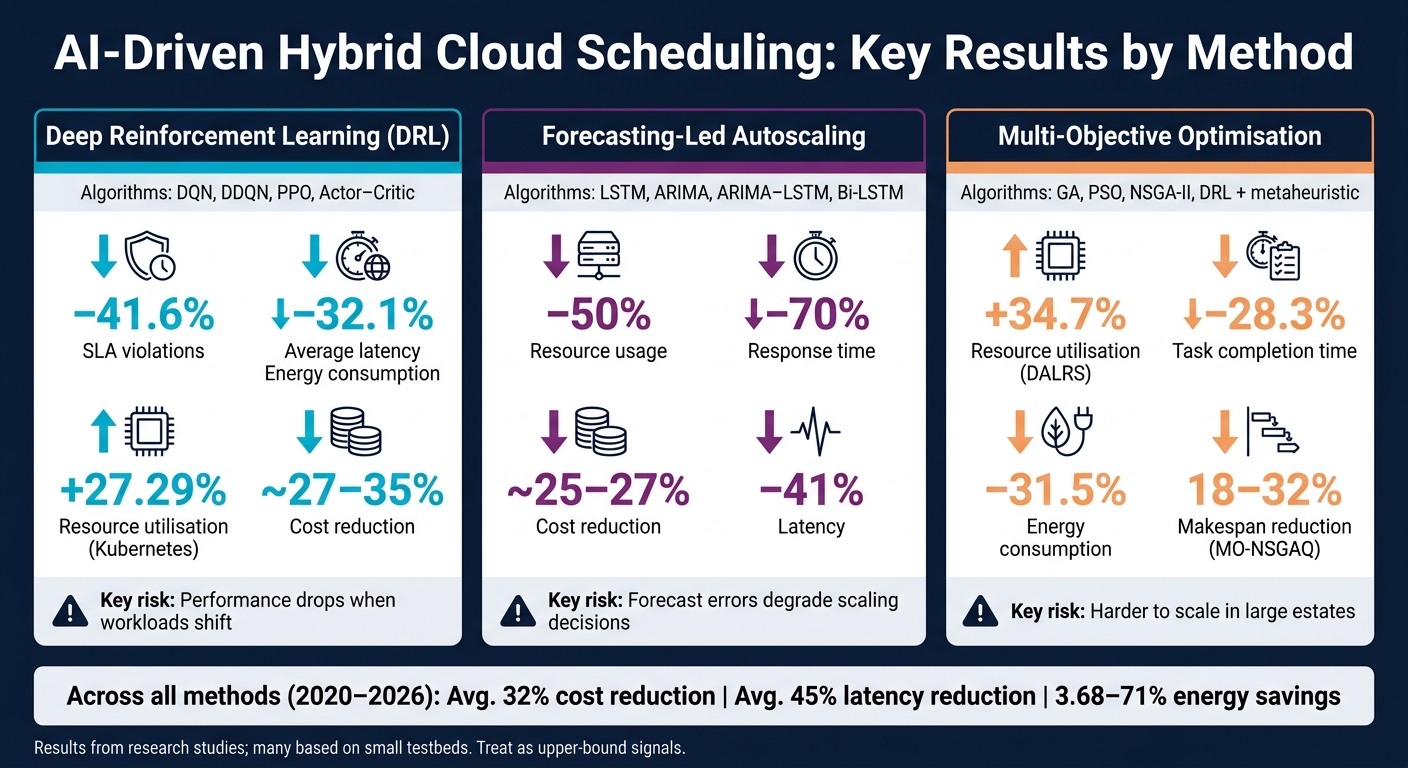 {AI Scheduling Methods for Hybrid Cloud: Cost, Performance & Energy Results}
:::
{AI Scheduling Methods for Hybrid Cloud: Cost, Performance & Energy Results}
:::
Across DRL, forecasting-led autoscaling, and hybrid optimisation, the same theme shows up again and again: better placement and scaling choices lead to lower cost, lower latency, and lower energy use. In the studies reviewed, AI schedulers beat rule-based baselines on cost, latency, SLA breaches, and energy use.[21] One survey-level synthesis found an average 32% drop in cost (10–48%), an average 45% drop in latency (11–77.7%), and energy-use cuts of 3.68–71% in studies that reported measurable results.[21] Those ranges are broad because workloads, pricing models, and test conditions differ.
Cost reduction and resource utilisation gains
Most cost savings come from smarter placement, better cloud bursting, and less overprovisioning. For example, a hybrid LSTM–DQN scheduler tested on Google Cluster traces delivered 32% higher resource utilisation, 25% power savings, 41% lower latency, and about 27% lower cost than standard methods.[2] In another study, a multi-objective DQN framework for serverless workloads cut cost by 34.6% and reduced SLA violations by 18.7% against heuristic baselines.[16]
What matters here is simple: these systems save money by using capacity better, not by paying less per unit. EcoTaskSched cut execution cost per task from US$11.55–US$11.86 to US$7.35, which is roughly a 35% reduction. At the same time, it reduced average energy use from 109.3 and 95.1 kWh to 65.8 kWh per task.[19]
That same pattern tends to show up in service quality too. Lower cost often comes from scheduling work faster and with less waste.
Faster job completion and fewer SLA breaches
Performance gains are most obvious in bursty workloads, where fixed rules often struggle. A DQN–PSO scheduler reduced average task time by 35%, cut SLA violations from 28 to 8, and increased utilisation from 60.1% to 84.6%, using real Google and PlanetLab traces.[4] An RL-based Kubernetes autoscaler recorded 0.00% SLA violations while using 29.8% fewer pods than standard autoscalers.[22][23] That’s a strong sign that better scheduling can protect service quality while also reducing resource use.
On more stable workloads, the gap tends to shrink. If demand is predictable and steady, fixed rules can get close to the best result.
Energy efficiency and lower power consumption
Energy-aware scheduling matters when both spend and emissions are under pressure. RL schedulers reduced energy use from 125 kWh to 85 kWh and cut task time from 180 ms to 125 ms.[18] RL-MOTS reduced energy by 28–30%, cut cost by 20–25%, and reached a 98% task completion rate while meeting deadlines.[20]
Some schedulers also use carbon-intensity signals to move flexible workloads into lower-carbon time windows.[24] That can work well, but there’s a trade-off. Pushing harder on consolidation may save energy while adding network delay or reducing fault tolerance.
These results fit neatly with Kubernetes and other container platforms, where placement and autoscaling decisions happen all the time.
Kubernetes, Hybrid Platforms, and What This Means for UK Teams
Building on the cost, latency, and energy results above, this section looks at how AI scheduling works inside Kubernetes and hybrid platforms.
AI-based scheduling in Kubernetes and container platforms
Kubernetes is the main control plane for container orchestration. More teams now extend it to manage hybrid resources across public cloud, private infrastructure, and on-premises hardware.[34] This is the point where scheduling stops being theory and starts affecting day-to-day operations in hybrid estates.
The default kube-scheduler relies on fixed filters and scoring rules. AI schedulers do something different: they learn placement policies from live cluster telemetry.
The DRS deep reinforcement learning scheduler reported 27.29% better resource utilisation and a 2.90× reduction in load imbalance against the default scheduler. The extra cost was modest: 3.27% CPU overhead and 0.648% communication delay.[25][35]
DRL schedulers used in edge–cloud Kubernetes clusters have cut energy use by up to 24% through smarter pod placement.[29] KubeGreen, which combines live Prometheus metrics with external carbon intensity APIs, achieved an average 15% reduction in carbon emissions and a 22% reduction in network latency at the same time.[36] For UK teams working to emissions targets, that matters.
LSTM-based schedulers use historical traces to predict near-future resource demand, then place containers on nodes likely to have enough headroom. That cuts unscheduled pods and throttling during bursts.[26] RL-based schedulers built for compute-heavy workloads, such as SDQN and SDQN-n, showed 10–20% lower average CPU utilisation per node than both the default scheduler and Transformer/LSTM-based options, which means load is spread more evenly across the cluster.[28]
Scheduling constraints in regulated hybrid environments
For UK teams, the hard part is turning compliance into a hard scheduling rule.
Organisations running regulated workloads must keep data in approved regions and use certified nodes under UK GDPR and sector rules. Those limits need to be encoded in the scheduler itself.[27][29][30] Region, jurisdiction, and compliance state can all sit inside the model’s state space, so the agent learns that breaking locality rules leads to a negative reward or a blocked action.[3][29]
Latency is tied closely to this. European edge computing guidance indicates that low single-digit millisecond latencies may need edge nodes roughly every 100 km.[31][32][33] For UK teams serving domestic users, geography can’t be an afterthought. It needs to be treated as a first-class input. Multi-criteria optimisation frameworks handle this by setting locality and compliance as hard constraints, while cost, latency, and energy stay as soft objectives to optimise inside those limits.[27][29]
Resilience adds another layer. Hybrid schedulers must spread critical services across sites or cloud regions to meet failover needs, and that can clash with consolidation goals. These trade-offs need to be stated plainly in the reward function or scoring logic. If not, the scheduler will chase one target and damage another.
Comparison table of representative studies
The studies below show the same pattern in platform terms: better placement, lower imbalance, and tighter energy control.
| Study / System | AI Technique | Target Environment | Main Objective | Key Reported Result |
|---|---|---|---|---|
| DRS scheduler [25] | Deep reinforcement learning | Kubernetes cluster | Resource utilisation and load balancing | +27.29% utilisation; 2.90× reduction in load imbalance vs default scheduler; 3.27% CPU overhead and 0.648% communication delay [25][35] |
| SDQN / SDQN-n [28] | RL (DQN variants) | Kubernetes, compute-heavy pods | CPU load distribution | 10–20% lower average CPU utilisation per node vs default and LSTM-based schedulers [28] |
| KubeGreen [36] | Multi-objective scoring with carbon intensity API | Kubernetes clusters | Carbon emissions and network latency | −15% carbon emissions; −22% network latency; more even CPU usage [36] |
| LSTM-based container scheduler [26] | LSTM prediction | Kubernetes, fluctuating workloads | Resource utilisation and pod scheduling success | Higher utilisation and fewer unscheduled containers vs heuristics [26] |
| DRL edge–cloud scheduler [29] | Deep reinforcement learning | Edge–cloud Kubernetes | Energy consumption | Up to 24% reduction in energy use via pod placement [29] |
| DICS-OPT [27] | Multi-criteria attribute scoring | Hybrid cloud and edge, data-intensive workloads | Data locality and scheduling efficiency | Improved placement for data-intensive containers while respecting locality constraints [27] |
Limits of Current Research and Key Takeaways
Open issues: generalisation, explainability, and operating overhead
The results look promising, but the evidence still has clear limits. Most studies are still based on simulations or small testbeds, usually with 100 nodes or fewer.[42] For UK hybrid estates, that's a serious constraint. A result that looks good in a small lab setup may not hold up in a messy production estate spread across on-prem and cloud.
Generalisation is still the biggest sticking point. DRL schedulers learn from specific workload patterns, infrastructure setups and objective trade-offs. Change those conditions, and performance can drop hard.[37][39][40] One GNN-based DRL scheduler is a good example: it failed in a systematic way when tested on DAG topologies it had not seen during training.[43] That's the catch with learned scheduling. It can work well inside the world it knows, then stumble when that world shifts.
Explainability is the other big gap. Many of these models are opaque, which makes it hard to trace why a placement or scaling decision was made.[37][38][40] In sectors like financial services, healthcare and central government, that lack of visibility creates governance risk. If a team can't explain why a service moved, scaled, or missed a target, the model becomes much harder to trust. That's why policy guards, admission controllers and rule-based overrides still matter in UK hybrid environments.
Operating overhead is also easy to understate. Training and maintaining AI schedulers takes serious compute, specialist skills, data pipelines and repeated retraining as workloads change.[17][40][42] And the overhead doesn't stop once the model is live. One study found that decision latency rose linearly and became unstable beyond 500 nodes, while SLA violations increased by 26% during traffic spikes because the system reacted to spikes instead of forecasting them.[46] So the maths has to work both ways: any savings need to cover training, retraining, data pipelines and specialist labour.
Conclusion: What businesses should take from the evidence
The strongest evidence for AI-driven scheduling comes from carefully engineered RL-based autoscaling systems. In those settings, studies have reported clear utilisation gains and large SLO reductions.[41] But those gains are strongest in controlled clusters. In live hybrid estates, most teams should expect less.
For UK teams, the key issue is simple: where does AI help without weakening control? The safest reading of the research is to treat published results as upper-bound signals, not promises. That makes pilot deployments, phased rollouts and strict A/B testing against well-tuned heuristic baselines the sensible route.[42]
A practical starting point is narrow use cases where the risk is lower, such as:
- energy-aware consolidation for non-critical batch jobs
- limited autoscaling in well-understood service groups
- controlled tests before any move into regulated or mission-critical services[44][45][46]
For most UK organisations, the best fit is augmented orchestration: AI-driven schedulers working inside clear guardrails, with human oversight still in place. That gives teams a shot at better cost, performance and energy outcomes without losing visibility or running into trouble with regulatory duties.
FAQs
Where should AI scheduling be piloted first?
Start by looking at current infrastructure performance and cloud spend so you can spot which workloads make sense to move first. Instead of rolling this out across the board, test one specific service to begin with.
A good starting point is to put the scheduler in recommendation mode before switching to full automation. That gives you time to set a baseline and watch the trade-offs between performance and cost over a few weeks.
How do you prevent model drift in hybrid cloud schedulers?
Prevent model drift with continuous monitoring and regular retraining so the AI keeps up with shifts in data patterns. That helps cut the risk of inaccurate or unreliable scheduling decisions.
Use data augmentation, active learning and AI observability tools to track model behaviour in real time and spot drift early. Hokstad Consulting helps businesses put these methods into practice and keep feedback loops strong, so accuracy stays on track.
How can compliance rules be built into scheduling decisions?
Build compliance rules into the scheduler’s policy layer by treating governance metadata, such as data residency boundaries, cluster labels, and quotas, as hard constraints during filtering and scoring.
That means the scheduler shouldn’t prefer the right locations by default. It should rule out anything that falls outside approved limits.
Use label-based cluster selectors or explicit cluster names so only approved jurisdictions are picked. Apply per-cluster overrides where needed, especially when one environment has tighter rules than another. For non-critical workloads, start in recommendation mode first. It’s a sensible way to see how the policy behaves before you let it make live placement decisions.
You’ll also want a clear audit trail. Keep centralised logs, use least-privilege IAM, and make sure placement decisions can be traced back to the policy inputs that drove them.