
Managing access control in hybrid cloud environments is a growing concern for UK businesses. The key challenges include fragmented identity systems, weak authentication practices, excessive permissions, and poor visibility into access activity. These issues can lead to data breaches, compliance failures, and operational inefficiencies.
Here’s the good news: there are clear solutions. By centralising identity management with tools like Single Sign-On (SSO), enforcing Multi-Factor Authentication (MFA), adopting least privilege access, and conducting automated IAM audits, you can strengthen security and meet compliance standards. For example, using federated identity systems can cut provisioning times and reduce credential risks. Tools like AWS IAM Access Analyzer and Azure Policy help ensure permissions are correctly configured, while Cloud Security Posture Management (CSPM) tools detect and fix misconfigurations in real time.
Key Takeaways:
- Centralise Identity Management: Avoid multiple credentials by linking on-premises and cloud systems through a unified Identity Provider (IdP).
- Enforce MFA Everywhere: Protect accounts with strong authentication methods like FIDO2 security keys.
- Limit Permissions: Use role-based access control and automate access reviews to minimise risks.
- Monitor and Audit: Leverage CSPM tools and centralised logging to maintain visibility and compliance.
- Seek Expert Support: Professional consulting can optimise IAM systems and reduce costs by up to 40%.
These steps not only protect sensitive data but also improve efficiency and reduce costs. By addressing access control challenges head-on, UK businesses can stay secure and compliant in hybrid cloud environments.
Securing hybrid cloud at scale: A unified path to efficiency, continuity, and control
Common Access Control Challenges in Hybrid Cloud
Managing access control in a hybrid cloud setup can be tricky. For UK businesses blending on-premises systems with public cloud services, there are several hurdles to navigate. Let’s break down the main issues.
Fragmented Identity Management Across Environments
One major issue is dealing with disconnected identity systems. When users have to juggle multiple credentials - like separate logins for on-premises Active Directory and cloud services - it can lead to inefficiency and risky behaviours. For instance, users might resort to reusing passwords, which weakens security and hampers productivity [1].
Gaps in Multi-Factor Authentication (MFA) Enforcement
Passwords alone aren't enough to keep systems secure. Without MFA, organisations leave themselves exposed to threats like weak or reused passwords. In today’s hybrid setups, the focus has shifted from securing the network perimeter to protecting identities. This means organisations must verify key factors - such as location, device, and user behaviour - at every access point to strengthen defences [1].
Excessive Permissions and Poor Role Management
Another challenge is the issue of overly generous permissions. When users or accounts have more access than they need, it increases the potential damage if a breach occurs. Once an attacker gains control of a single account, they can exploit these excessive permissions to move through the hybrid environment, amplifying the impact of the attack [2].
Practical Fixes for Access Control Problems
With the challenges identified, it’s time to explore actionable solutions. These methods can help businesses in the UK enhance hybrid cloud security while keeping things manageable.
Setting Up Identity Federation and Single Sign-On (SSO)
Streamline identity management by using a federated Identity Provider (IdP). This eliminates the need for multiple credential systems by creating a single source of truth. By linking a central IdP - like Microsoft Entra ID, Okta, or Google Workspace - to your cloud platforms, users can log in once and access services across AWS, Azure, and GCP without interruptions.
This process relies on SAML 2.0 for web-based console access and OpenID Connect (OIDC) for modern apps and APIs. SAML 2.0 leverages XML-based assertions, making it suitable for enterprise and legacy systems, while OIDC uses JSON/JWT tokens, ideal for modern applications [3][5].
For machine-to-machine interactions, adopt workload identity federation. This approach replaces static credentials with short-lived tokens, reducing the risk of credential leaks. As the CloudToolStack Team highlights:
Workload identity federation eliminates the need for long-lived API keys, access keys, or service account keys... Long-lived credentials are the number one cause of credential leakage incidents[3].
To further secure access, enforce MFA (Multi-Factor Authentication) at the IdP level. This ensures consistent protection across all platforms. For privileged accounts, consider using FIDO2 hardware security keys like YubiKeys, which offer strong defences against phishing [4][6].
Unified identities lay the groundwork for effective MFA and Zero Trust principles.
Enforcing Multi-Factor Authentication (MFA) and Zero Trust Models
A Zero Trust approach is essential for today’s hybrid environments. This model verifies every access request based on factors like user identity, device health, location, and behaviour, rather than relying on network-based trust.
Use tools like Azure Privileged Identity Management (PIM) or AWS IAM Identity Center to implement Just-In-Time (JIT) access. These systems grant elevated permissions only when necessary and for a limited time, reducing the attack surface. It’s worth noting that through 2025, over 99% of cloud security failures are expected to result from customer misconfigurations, with IAM issues being a leading cause [4][6].
Applying Least Privilege Access and Automated IAM Audits
Building on unified identity systems, adopt precise role-based controls and automate access reviews. Tools such as AWS IAM Access Analyzer or GCP IAM Recommender can simplify periodic audits by identifying and removing unused or excessive permissions. These tools continuously monitor your environment, ensuring that users only have the access they need [4].
Using Cloud Security Posture Management (CSPM) Tools
CSPM tools provide real-time scanning of hybrid cloud configurations to detect security risks. They can identify misconfigured access policies, insecure APIs, and compliance gaps before they lead to incidents. By integrating with your existing cloud platforms, CSPM tools offer clear remediation steps, making it easier to address issues promptly.
Centralising Logs with SIEM Systems and Runtime Monitoring
Centralised logging is key to maintaining visibility across hybrid environments. Aggregate logs from systems like on-premises Active Directory, AWS CloudTrail, Azure Activity Log, and GCP Cloud Audit Logs into a unified Security Information and Event Management (SIEM) system. This consolidated view helps detect anomalies, such as unusual login attempts or privilege escalations.
As Andrios Robert puts it:
A hybrid cloud access data lake access control strategy starts with unified authentication. One identity provider pushes consistent user and service credentials to every environment[7].
Adding runtime monitoring enhances this setup by tracking access patterns and alerting teams to suspicious activity in real time.
Custom Access Control Solutions for Hybrid Cloud
Building Custom Identity Federation Systems
Sometimes, off-the-shelf solutions just don’t cut it. That’s where custom identity federation systems come in. These systems allow organisations to link their on-premises Active Directory with cloud platforms like Azure AD or AWS IAM, all while adhering to their unique security and compliance requirements. By supporting protocols like SAML 2.0 and OIDC, they enable smooth single sign-on experiences.
Take Barclays Bank, for example. In Q1 2024, under the leadership of their CISO, Mark Thompson, they implemented a custom federation system that bridged on-premises LDAP with AWS IAM and Azure AD. The results? Provisioning time for 50,000 users dropped from 5 days to just 30 minutes. This also led to a 40% reduction in breach risks and saved the company a staggering £1.2 million annually in operational costs [8]. Custom systems like this also offer precise access control based on user roles, which can reduce authentication failures by up to 40%, according to industry benchmarks from major cloud providers [8][9].
These tailored systems aren’t just about convenience - they also set the stage for stronger compliance and security automation, which we’ll explore next.
Regular Security Audits and Automation for Hybrid Environments
Misconfigurations in hybrid cloud setups are a major headache, responsible for 32% of breaches. But tools like AWS Config, Azure Policy, and Terraform Sentinel can help. These tools perform regular scans of IAM policies - often weekly - and flag roles that exceed least-privilege principles. Automated audits like these can prevent up to 75% of misconfiguration-related risks [13].
HSBC UK provides a great example. In June 2023, they rolled out automated security audits across their hybrid environment, which spans GCP private and Azure public clouds. Using Prisma Cloud, Security Architect Lena Patel oversaw a system that scanned over 10,000 policies each month. The tool automatically resolved 92% of flagged issues, saving the company £800,000 in potential breach costs [13]. By combining quarterly automated scans with annual third-party penetration tests, HSBC aligned its practices with UK NCSC guidelines for cloud security [11][12].
This proactive approach doesn’t just improve security - it also creates measurable financial and operational benefits.
Reducing Cloud Costs with Professional Support
Professional consulting services can be a game-changer for businesses looking to optimise hybrid cloud setups. Take Hokstad Consulting, for instance. They specialise in DevOps transformation and cloud cost engineering, offering services like IAM audits and automation. Their work often results in significant savings - cutting hosting costs by 25-40% through strategies like rightsizing, cleaning up dormant IAM roles, and facilitating strategic migrations that comply with UK GDPR requirements.
One standout service is automated IAM clean-up, which removes inactive users and unnecessary roles. For mid-sized businesses, this alone can save over £10,000 annually. On average, companies that invest in professional support for cloud IAM optimisation see a 28% reduction in their cloud bills, all while improving access control [9]. Hokstad Consulting even offers a No Savings, No Fee
guarantee, ensuring businesses only pay for results. It’s a low-risk way to boost efficiency and strengthen security in hybrid cloud environments.
These tailored solutions not only reduce costs but also enhance the overall security and functionality of hybrid cloud systems.
Summary of Challenges and Fixes
::: @figure 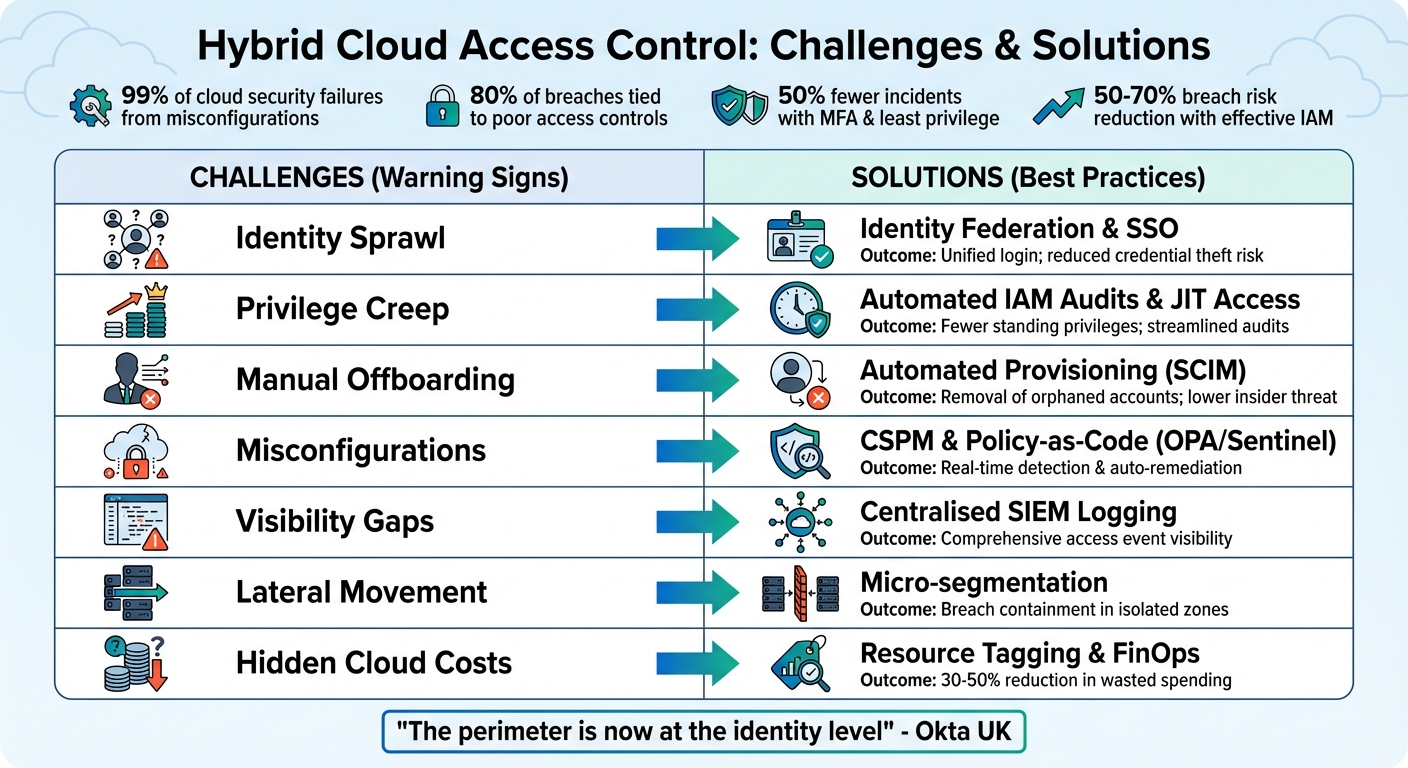 {Hybrid Cloud Access Control Challenges and Solutions Comparison}
:::
{Hybrid Cloud Access Control Challenges and Solutions Comparison}
:::
Challenge-to-Solution Comparison Table
Hybrid cloud access control can be tricky, but aligning the right solutions to specific challenges can simplify the process. Below is a table that pairs common issues with recommended fixes and highlights the outcomes you can expect when these solutions are applied effectively.
| Common Challenge | Recommended Solution | Expected Outcome |
|---|---|---|
| Identity Sprawl | Identity Federation & SSO | Unified login; reduced risk of credential theft |
| Privilege Creep | Automated IAM Audits & JIT Access | Fewer standing privileges; streamlined audit processes |
| Manual Offboarding | Automated Provisioning (SCIM) | Removal of orphaned accounts; lower insider threat risk |
| Misconfigurations | CSPM & Policy-as-Code (OPA/Sentinel) | Real-time risk detection and automatic remediation |
| Visibility Gaps | Centralised SIEM Logging | Comprehensive view of access events across environments |
| Lateral Movement | Micro-segmentation | Breach containment within isolated zones |
| Hidden Cloud Costs | Resource Tagging & FinOps | 30–50% reduction in wasted cloud spending |
As Okta UK aptly states:
The perimeter is no longer at the network level, but now at the identity level[1].
This shift underscores the importance of a robust identity management strategy, which now serves as the backbone of your overall security framework.
Action Steps for UK Businesses
The table above provides a clear roadmap for addressing hybrid cloud access challenges. Here’s how businesses in the UK can apply these solutions for stronger access control:
Centralise Identity Management: Use a single identity provider (IdP) with SAML or OIDC protocols. This ensures a unified dashboard for managing access across cloud and on-premises systems, reducing password fatigue and policy inconsistencies.
Optimise Permissions: Implement Role-Based Access Control (RBAC) and conduct quarterly reviews to remove excessive permissions. Connect your HR system to your IAM platform for instant offboarding, ensuring access is revoked immediately after an employee leaves.
Secure Secrets and Keys: Leverage cloud-native tools like AWS Secrets Manager or Azure Key Vault to manage sensitive credentials. Rotate API keys every 90 days to maintain security.
Ensure Compliance: Apply Service Control Policies (SCPs) or Azure Policy to restrict data storage to UK regions like London or Cardiff. This helps meet UK GDPR requirements and ensures data residency compliance.
Reduce Costs and Improve Access Control: Collaborate with Hokstad Consulting for automated IAM cleanups and cloud cost optimisation. Their
No Savings, No Fee
model ensures measurable results, often cutting hosting costs by 30–50% while enhancing security measures.
Conclusion
Securing hybrid cloud access is a critical step for UK businesses aiming to comply with strict regulatory standards and safeguard their operations. Research shows that 99% of cloud security failures are due to customer misconfigurations[11], with 80% of breaches tied to poor access controls. The financial impact is staggering, with the average data breach costing £3.4 million, and 74% of that linked to weak identity and access management (IAM)[8][11]. These numbers highlight the pressing need to address fragmented identity systems, excessive permissions, and insufficient visibility into access logs.
The strategies discussed - identity federation, zero trust enforcement, automated IAM audits, Cloud Security Posture Management (CSPM), and centralised SIEM logging - are proven to work. For example, organisations that implement multi-factor authentication (MFA) and least privilege policies report 50% fewer access-related incidents[8]. Additionally, effective IAM practices can slash breach risks by 50–70%[8]. For businesses navigating GDPR and NCSC requirements, these measures can also deliver cost efficiencies of 30–50% through better resource management[10].
To strengthen your access control, start with an IAM audit using tools like AWS IAM Access Analyzer or Azure AD. Enforce MFA across the board and adopt zero trust principles without delay. For more complex hybrid environments that require customised identity federation, regular security reviews, or cloud cost management, Hokstad Consulting offers tailored solutions. Their No Savings, No Fee
model ensures measurable outcomes without upfront costs.
In today’s landscape, identity has become the new security boundary. By securing hybrid cloud environments effectively, UK businesses can protect sensitive data, maintain compliance, and gain a competitive advantage with a more efficient and resilient infrastructure.
FAQs
How do I choose between SAML and OIDC for SSO?
Choosing between SAML and OIDC for Single Sign-On (SSO) depends largely on your organisation's specific needs and the types of applications you use.
- SAML works best for older enterprise systems and web portals, providing strong security for web-based environments.
- OIDC, on the other hand, is more modern and lightweight, making it a better fit for mobile apps, API-driven systems, and cloud-native applications.
Many organisations opt to implement both protocols to meet a variety of requirements efficiently.
What’s the quickest way to roll out MFA across a hybrid cloud?
To implement MFA swiftly in a hybrid cloud setup, it's crucial to tackle potential hurdles like device synchronisation issues and failed login attempts right from the start. Offering self-service reset options can empower users to resolve problems independently, reducing reliance on IT support. Additionally, providing straightforward and accessible user instructions can minimise login delays and confusion. These measures help maintain a balance between secure access and operational efficiency in a hybrid cloud environment.
How can I spot and remove excessive permissions automatically?
Regular audits and automation tools are key to identifying and eliminating excessive permissions. By reviewing permissions on a routine basis, you can spot and address unnecessary access. Automation platforms and policies, such as those implemented through tools like Open Policy Agent (OPA), simplify this process. These approaches help ensure permissions are continuously monitored and adjusted, preventing privilege creep and upholding the principle of least privilege - all without relying heavily on manual work.