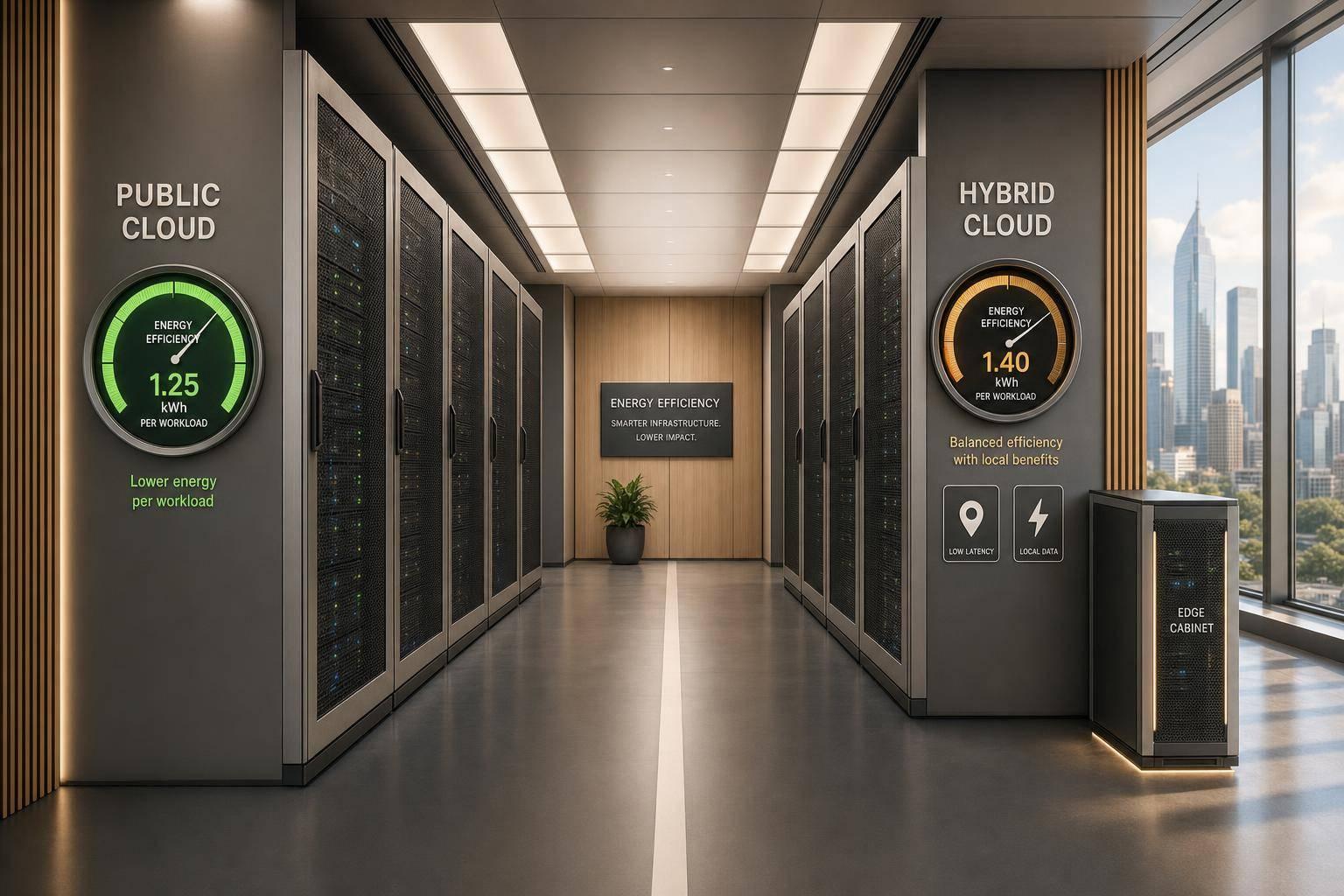
If you want the short answer: public cloud often uses less energy per workload, but hybrid can win when location, latency and data rules matter more.
I’d boil it down like this:
- Public cloud usually has lower PUE and higher server use, often around 60%–80% utilisation
- Many private estates sit closer to 15%–30% utilisation, which means more idle kit drawing power
- Hybrid cloud can cut delay and data transfer by keeping apps and data closer together
- But hybrid can also waste power if you duplicate capacity, tools and monitoring
- So the main question is not just “Which data centre is more efficient?” but “Where should each workload run?”
In plain English, elastic workloads like test environments, burst analytics and seasonal traffic often fit public cloud well. Latency-sensitive or regulated workloads may fit hybrid better, especially when data must stay in the UK or near the source.
Cloud, Hybrid or On-Prem? How to Decide Where Each Workload Runs
Quick Comparison
| Point | Public Cloud | Hybrid Cloud |
|---|---|---|
| Energy use | Often lower per workload at scale | Depends on placement and unused capacity |
| Performance | Good when apps run near users | Good for local and edge workloads |
| Latency | Can rise if workloads are too far away | Often lower for on-site or UK-based processing |
| Data residency | Limited by region choice and controls | More control over where data stays |
| Complexity | Lower day to day | Higher across mixed estates |
| Best fit | Spiky demand, managed services, short-term workloads | Regulated apps, local processing, low-latency systems |
My view: lower facility power does not always mean lower total energy for your app. Distance, data movement, idle servers and poor placement can wipe out gains. That’s why I’d judge this choice on utilisation, latency targets, residency rules, governance and team capability rather than cloud type alone.
Public cloud: lower PUE, higher utilisation and the performance trade-offs
Compared with that baseline, public cloud has one big edge: scale. Hyperscale public cloud data centres are built for high density and low PUE. But PUE only tells part of the story. It does not measure application efficiency, network energy or workload placement.[1]
The bigger factor is utilisation. Many enterprise estates run at just 15% to 30% average utilisation because teams size for peak demand, then leave that spare capacity sitting there for the rest of the time. Public cloud platforms work differently. They pool demand across thousands of customers, which lets servers run at 60% to 80% utilisation.[1] That means less power goes into hardware that is switched on but doing very little. On top of that, many hyperscalers match most of their electricity use with renewables, which can reduce carbon impact without changing PUE.[1][2] This edge is strongest when workloads spike and dip rather than staying flat all day.
Where public cloud leads on energy per workload
Public cloud tends to do best with elastic, variable-demand workloads. Think public websites, burst analytics, CI/CD pipelines, and short-term test or development environments. When demand jumps, compute can scale up. When demand drops, resources can scale back down. That helps cut the idle capacity that often sits between peaks.
Multi-tenant managed services can push this further. Serverless functions, managed databases and PaaS messaging platforms often run at higher density than dedicated virtual machines, which can lower energy use per workload even more.[5]
Where public cloud efficiency does not guarantee better user performance
A more efficient data centre does not erase distance. If a workload runs farther from UK users, even a very efficient site can still add network distance, extra hops and latency. For real-time or latency-sensitive applications, response time may matter more than how well the remote facility is cooled.[3]
Data handling and residency rules can narrow the options too. UK organisations may need to keep some data in set jurisdictions, apply contract controls, or separate regulated datasets from less sensitive systems. That can limit region choice and, in some cases, add overhead.[4]
There is also the shared-infrastructure issue. In multi-tenant setups, noisy-neighbour effects can show up when workloads compete for resources, leading to uneven performance during busy periods.[3][5]
Public cloud is strongest on energy per workload when demand is elastic and region choice stays open. In those cases, placement matters just as much as facility efficiency.
Hybrid cloud: local control, edge processing and workload placement
Hybrid cloud lets you run each workload where it makes the most sense: on-premises, in colocation, at the edge or in public cloud. Public cloud is hard to beat on scale. Hybrid, though, comes into its own when location matters more than shared use of big pooled infrastructure.
At the heart of it is workload placement. That means deciding where applications should run based on latency, data sensitivity, utilisation patterns and energy cost, instead of putting everything in one place. Latency-sensitive services should stay on-premises or in a UK colocation facility to keep response times tight. Batch analytics or AI training jobs, by contrast, can move to a highly efficient public cloud region.
How hybrid can cut latency and avoid unnecessary energy use
Local and edge processing shorten the path data has to travel. That cuts latency and trims avoidable network energy use. Private links can also deliver more steady low-latency performance than routes over the public internet. And when data has to move back and forth between environments, that adds both delay and energy overhead. So the practical move is simple: keep large datasets close to the workloads that use them.
The catch is operational complexity.
Why hybrid adds complexity that affects efficiency
That extra control only works if teams can govern both environments as one system. Once you’re running two or more environments, it’s easy to end up with duplicated tooling, split monitoring and uneven utilisation across each layer. If visibility is patchy, teams can’t spot idle capacity or show where energy is being wasted.
Policy overhead adds another layer of friction. Security controls, compliance rules and data residency requirements may differ between the private and public layers. That means more management effort and slower automation, which makes efficient placement harder to pull off. Without that base in place, the complexity of hybrid can wipe out the efficiency gains you were aiming for.
Hybrid vs public cloud: comparing energy, performance and operations
::: @figure 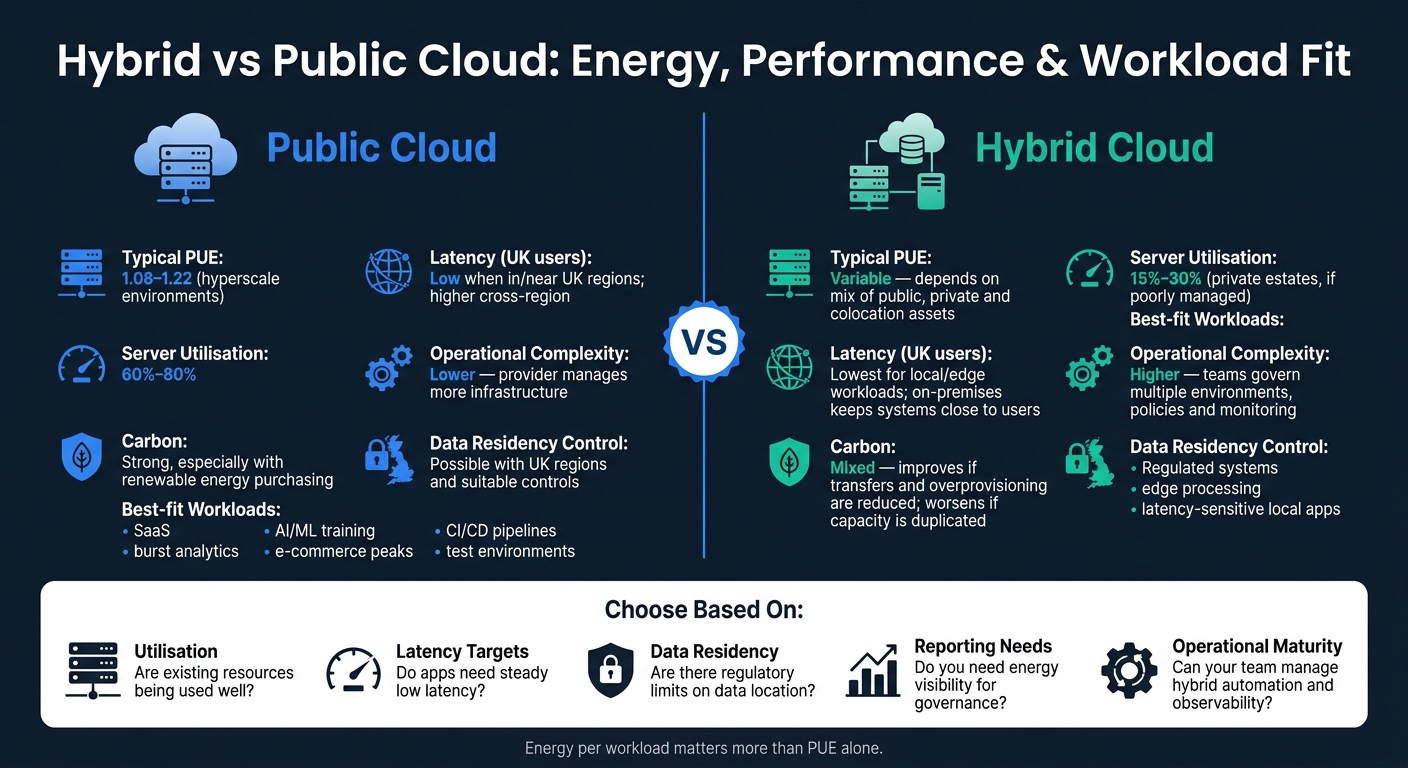 {Hybrid vs Public Cloud: Energy, Performance & Workload Fit}
:::
{Hybrid vs Public Cloud: Energy, Performance & Workload Fit}
:::
The main trade-off comes down to infrastructure efficiency vs workload placement. Looking at PUE alone only tells part of the story. What matters more is energy used per workload once you factor in latency, transfer overhead and idle capacity.
Here’s how the two models compare on the points that matter most:
| Factor | Public Cloud | Hybrid Cloud |
|---|---|---|
| Typical PUE range | 1.08–1.22 in hyperscale environments | Depends on the mix of public, private and colocation assets |
| Energy savings potential | Highly variable; depends on utilisation and duplicated capacity | Highly variable; depends on utilisation and duplicated capacity |
| Latency profile (UK users) | Low when workloads run in or near UK regions; higher with cross-region dependencies | Lowest for local workloads; edge or on-premises processing keeps systems close to users or data |
| Carbon considerations | Strong, especially at scale and with renewable energy purchasing | Mixed; can improve if it reduces unnecessary transfers and overprovisioning, but can worsen if capacity is duplicated or underused |
| Operational complexity | Lower; the provider manages more of the infrastructure | Higher; teams must govern multiple environments, policies and monitoring layers |
| Data residency control | Possible with UK regions and suitable controls | Full control; often easier when data must stay within tighter governance boundaries |
| Best-fit workloads | SaaS, batch analytics, AI/ML training, e-commerce peaks | Regulated systems, edge processing, latency-sensitive local apps |
The pattern is pretty clear: the better option depends on where the workload runs and how much data movement it needs.
Best fit by workload type
Workload type usually matters more than anything else.
Public cloud works well for spiky, elastic demand. Think seasonal retail peaks or burst analytics. In those cases, scaling up and down helps keep idle capacity low, which is where a lot of waste tends to creep in.
Regulated or latency-sensitive workloads often lean the other way. If data must stay within tighter governance boundaries, or processing needs to stay close to the source, on-premises infrastructure or a UK colocation facility will often make more sense. Put simply, if distance adds delay or risk, keeping workloads nearer to users or data can pay off.
Cost and governance implications of energy-aware design
Existing assets can make total cost look lower than it is. But power, staffing and hardware refresh cycles still do most of the damage. Public cloud removes much of that capital burden, yet weak governance can chip away at those savings bit by bit. Idle instances, unnecessary scaling and data egress charges are common culprits.
Energy-aware design is, at heart, a governance discipline. It works when teams do the boring but necessary things well:
- Tag resources
- Monitor utilisation
- Run regular workload reviews
- Apply chargeback models
Those controls keep costs tied to actual usage in either setup. Without shared governance, duplicated tooling and idle capacity can wipe out most of the energy gains. That’s what decides whether energy-aware design holds up in day-to-day use.
Conclusion: choosing the right model for efficient performance
Put it all together, and the picture is fairly clear: public cloud often gives you the best infrastructure efficiency because utilisation is higher and PUE is lower. But infrastructure efficiency on its own doesn't settle the matter. The best option still depends on the workload. If latency matters a lot, or data residency rules shape the choice, a well-run hybrid setup may be the more practical fit.
That said, hybrid only pays off when workload placement is handled well and your automation, observability and governance are strong. In plain terms, the key question is simple: can your team manage placement, automation and observability well enough to actually get those efficiency gains?
That puts governance at the centre of the decision. Use this checklist to judge whether a change is likely to improve efficiency in day-to-day use:
- Current utilisation - Are existing resources being used well, or is idle capacity already an issue?
- Latency targets - Do your applications need steady low latency, or is some variation acceptable?
- Data residency - Are there regulatory or contract rules that limit where data can be stored?
- Reporting needs - Do you need better visibility into energy use for planning and governance?
- Operational burden - Does your team have the automation and observability maturity to run a hybrid environment well?
If automation and observability aren't strong yet, hybrid complexity may cost more than it saves. That's not a reason to dismiss hybrid. It's a reason to get the groundwork in place first.
FAQs
How do I choose the right workloads for hybrid cloud?
Assess performance, data residency, and resource demand patterns first. That gives you a clearer view of where each workload should live.
Use on-premises infrastructure for compute-heavy workloads that run at high, steady utilisation. It also makes sense when strict data residency rules apply, or when low latency is non-negotiable.
Use the public cloud for workloads with uneven demand. In those cases, elastic scaling and managed services can absorb traffic spikes without the energy cost of keeping idle resources running.
A simple energy audit and a 30-day usage review can help you spot the best fit.
Does lower PUE always mean lower total energy use?
No. A lower PUE means the facility side of a data centre is running more efficiently, especially things like cooling and power distribution. But PUE does not count the energy used by the IT equipment itself.
So a data centre can post a low PUE and still consume a lot of energy if it’s packed with underused or inefficient servers. Lower total energy use comes from two things working together:
- Better PUE
- Active compute management
That’s the key difference. PUE tells you how well the building supports IT load. It does not tell you whether the compute layer is using power well.
When does hybrid cloud become less efficient than public cloud?
Hybrid cloud gets less efficient when workloads aren’t consolidated well. That leaves servers underused, even though they still pull baseline power. You end up paying the energy cost without getting much work out of the hardware.
It also becomes less efficient when teams stick with legacy over-provisioning to cover rare demand spikes. In plain terms, that means keeping too much capacity sitting there just in case.
Energy waste can also come from:
- internet-based VPNs handling high-volume traffic
- idle resources
- poorly sized instances
- complex distributed infrastructure without integrated, real-time monitoring