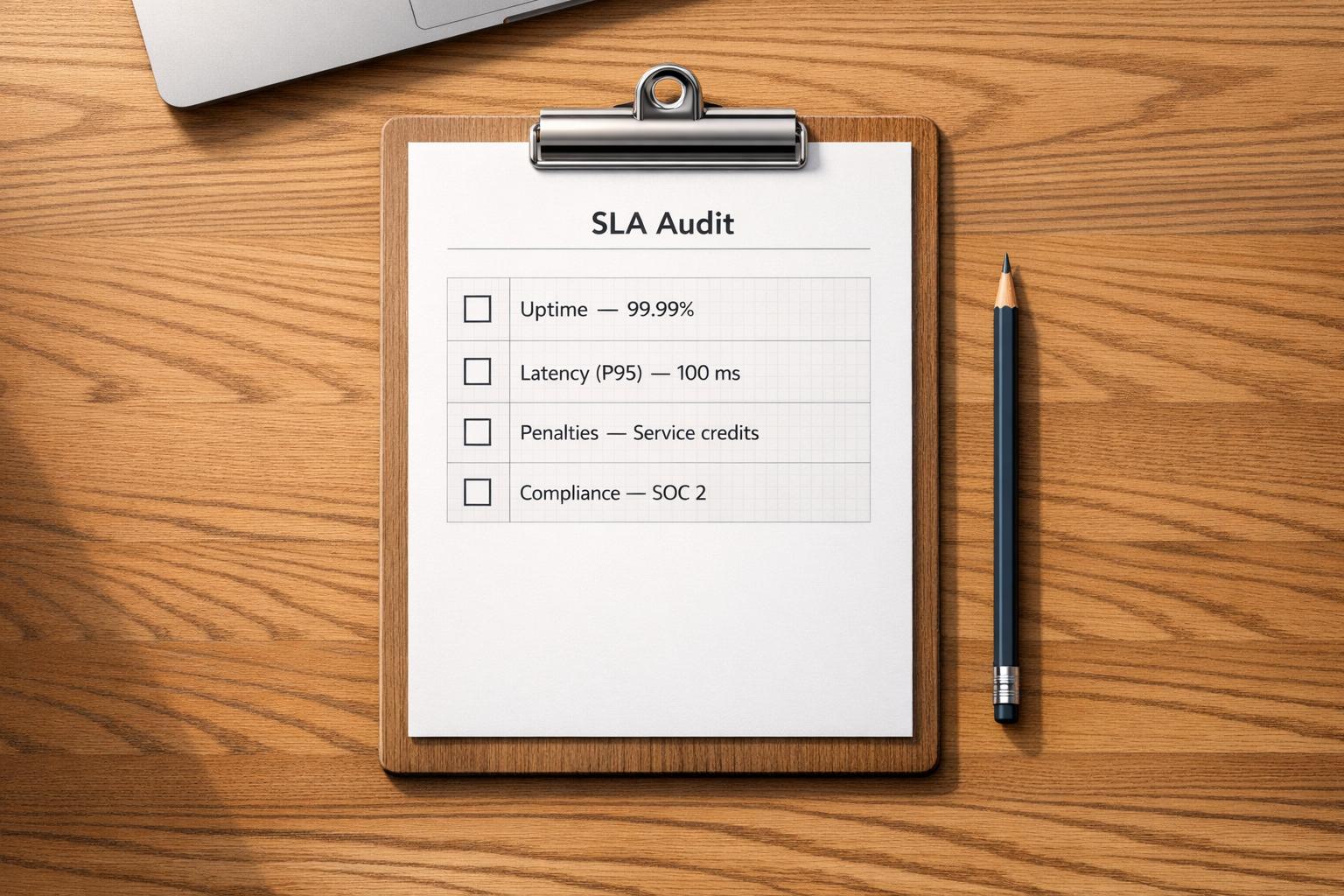
When it comes to cloud vendor SLAs (Service Level Agreements), promises about uptime, performance, and support often sound great on paper. But without proper audits, these commitments can leave critical gaps, exposing your business to risks like downtime, financial losses, and compliance penalties. Here's what you need to know:
- Uptime Guarantees: Understand what percentages like 99.9% or 99.99% mean in terms of actual downtime. For instance, 99.9% allows 43 minutes of downtime per month.
- Performance Metrics: Look for clear, measurable terms like latency (<30ms) or error rates (<0.1%).
- Compliance: Ensure SLAs align with UK regulations like GDPR or PCI DSS v4.0, especially for data residency and encryption.
- Penalties: Check if service credits or termination rights are enforceable for SLA breaches.
- Monitoring: Use independent tools to verify vendor performance instead of relying solely on their reports.
- Audit Rights: Confirm your right to review vendor compliance through third-party certifications or detailed reports.
Regular SLA reviews (quarterly or annually) help ensure vendors stay accountable and their commitments align with your business needs. By focusing on measurable metrics, independent monitoring, and compliance verification, you can hold vendors to their promises and protect your operations from disruptions.
Auditing IT Managed Services Contracts: From SLA to Control | IT Audit Webinar | GISA Council |
Need help optimizing your cloud costs?
Get expert advice on how to reduce your cloud expenses without sacrificing performance.
SLA Components That Affect Reliability
::: @figure 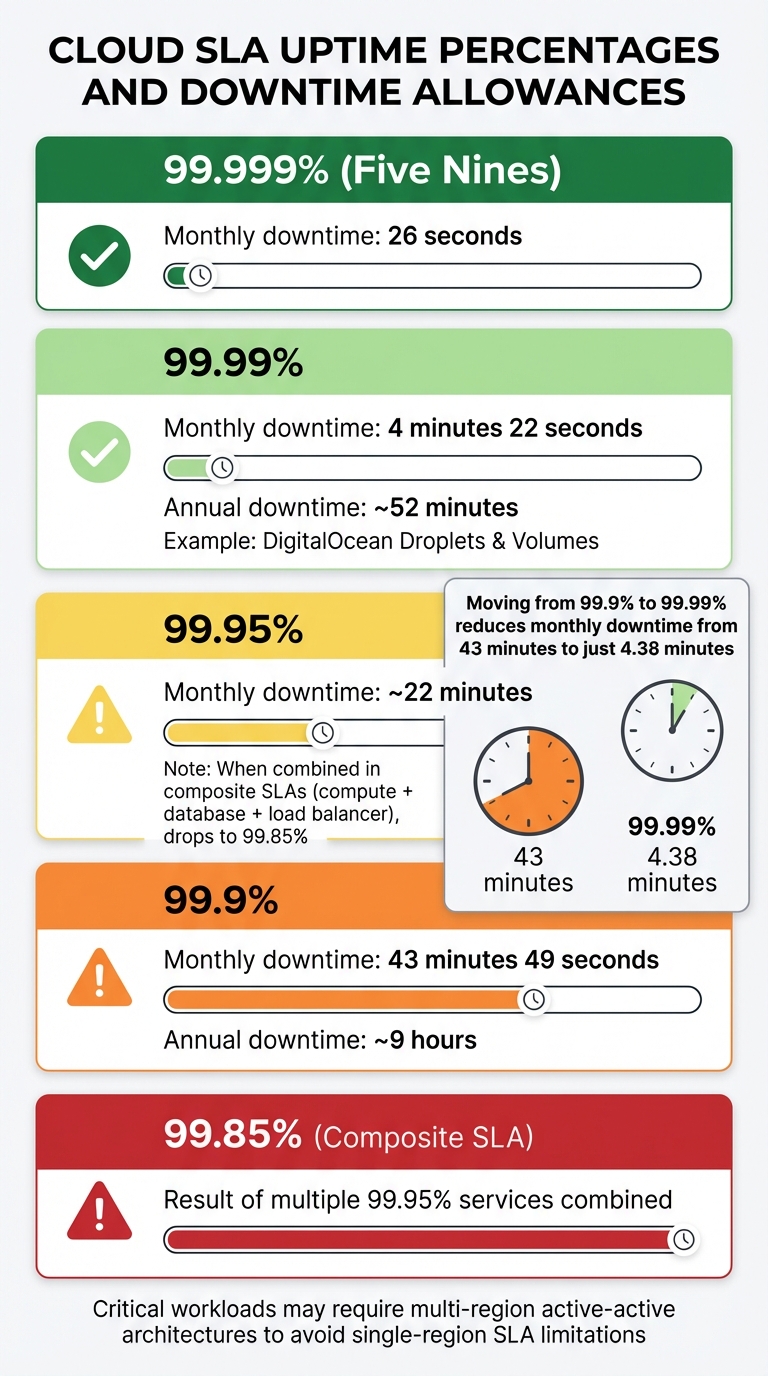 {Cloud SLA Uptime Percentages: Downtime Allowances Comparison}
:::
{Cloud SLA Uptime Percentages: Downtime Allowances Comparison}
:::
Before diving into an audit, it’s crucial to ensure your SLA includes metrics that reflect real-world service levels and directly impact your operations. The National Institute of Standards and Technology (NIST) defines availability as:
Availability \[is\] a core property of information system reliability.[1]
Despite this, many businesses sign contracts without fully understanding how specific terms translate into actual service levels. Let’s break down how uptime, performance, and response metrics help quantify SLA reliability.
Uptime, Performance, and Availability Metrics
Uptime percentages are often the most visible SLA metric, but the details can make all the difference. For example:
- A 99.999% (
five nines
) uptime commitment allows for just 26 seconds of downtime per month [1]. - A 99.9% SLA, by contrast, permits 43 minutes and 49 seconds of downtime monthly, or almost 9 hours annually [1].
For critical workloads, this difference is far from trivial.
DigitalOcean provides an example of a clear SLA:
DigitalOcean provides a 99.99% uptime SLA around Droplets and Volumes Block Storage. If we fail to deliver, we'll credit you based on the time that service was unavailable.[2]
This translates to roughly 4 minutes and 22 seconds of allowable downtime each month.
Composite SLAs, however, can complicate reliability. When dependent components - like compute, database, and load balancer services - each offer 99.95% uptime, their combined availability drops to around 99.85% [1]. This reduction can significantly impact overall reliability.
To mitigate these challenges, many organisations adopt multi-region active-active architectures. This approach helps avoid single-region SLA limitations, especially when a provider’s 99.95% regional commitment doesn’t meet the needs of critical workloads [1]. These architectural choices are key when evaluating whether vendor commitments align with your operational expectations.
Incident Response and Disaster Recovery Terms
Response times in your SLA define how quickly vendors act when something goes wrong. CIO’s Stephanie Overby highlights a common issue:
A provider may tweak SLA definitions to ensure they are met... some providers may meet the SLA 100 per cent of the time by delivering an automated reply to an incident report.[3]
For this reason, your SLA should clearly state that Response Time
refers to meaningful human action, not just automated ticket acknowledgements.
Typical response targets vary depending on the issue’s severity:
- Critical issues: 15–30 minutes
- High-priority problems: 2–4 hours
- Low-priority matters: 24–48 hours [4]
However, response time isn’t the same as resolution time. Even critical incidents may take 2–4 hours to fully resolve [4].
Disaster recovery terms focus on two metrics: Recovery Time Objective (RTO) and Recovery Point Objective (RPO) [1]. RTO defines the maximum allowable downtime during major failures, while RPO specifies the acceptable amount of data loss. For example, if your business requires a 15-minute RTO, a 99.9% SLA allowing 43 minutes of monthly downtime may not suffice [1].
Holly Wheeler, Director of Cloud Ops Service Availability at Genesys, stresses the importance of accountability:
Ensure the developers who write the code are also responsible for maintaining it. This way, when issues occur, they can be routed immediately to the appropriate subject matter expert, reducing the isolation and triage time.[4]
Cloud-native microservices can also help minimise the impact of incidents compared to traditional monolithic architectures [4]. By understanding these response and recovery terms, you can better assess whether vendor commitments align with your operational needs. Once these are defined, the next step is to evaluate the SLA’s penalty structure.
Penalties for SLA Breaches
Without enforceable penalties, SLAs lose their purpose. As Contracta HQ puts it:
An SLA without enforceable remedies is just a wish list dressed up as a contract.[5]
The most common enforcement mechanism is service credits, which typically range from 10% to 30% of monthly fees for breaching a 99.9% commitment [1] [4]. However, these credits are often capped at 100% of the monthly fee, even if actual business losses are much higher [5]. Many cloud SLAs also declare service credits as the sole and exclusive remedy
, meaning customers cannot seek legal action for additional damages [5].
Termination rights can offer stronger leverage. Some SLAs allow contract cancellation without penalties if the provider consistently fails to meet agreed thresholds [5]. Be wary of earn-back
provisions, which let providers cancel credits by exceeding targets in subsequent months - this can undermine accountability [5]. Additionally, check claim windows; many SLAs require credit requests within 30 days, or you lose the remedy entirely [5].
To ensure fair terms, verify that degraded performance - when services are technically up
but practically unusable - is counted as downtime [5]. Monthly measurement windows are also preferable to annual averages, which can obscure severe short-term outages behind acceptable yearly figures [5]. By carefully auditing these penalty terms, you can hold vendors accountable and protect your business from insufficient compensation for service failures.
How to Audit SLAs for Measurable Metrics
Auditing SLAs for measurable metrics is essential to ensure vendors deliver on their promises, not just on paper but in real-world performance. Without precise definitions and independent validation, organisations often find themselves relying on vendor self-reporting, which can be unreliable.
Reviewing Availability and Performance Commitments
A good starting point is translating uptime percentages into actual downtime allowances. For example, moving from 99.9% uptime to 99.99% uptime drastically reduces the permissible downtime - from 43 minutes to just 4.38 minutes per month [6]. For UK businesses, particularly those in e-commerce or financial services, this difference can have a direct impact on revenue and regulatory compliance.
Ensure the SLA clearly defines what constitutes downtime.
This could include metrics like response times exceeding 5 seconds or multiple consecutive failures. Additionally, the SLA should specify measurable performance targets such as:
- Latency: Typically between 10–30 ms for UK-EU traffic.
- Error rates: Less than 0.1%.
- Resource utilisation limits: For example, CPU usage under 85% and memory usage under 90%.
To confirm compliance, use independent monitoring tools rather than relying entirely on vendor reports.
Verifying Metrics with Monitoring Tools
Once the performance criteria are established, robust monitoring systems are needed to verify them. Relying solely on vendor dashboards can lead to biased or incomplete data. Instead, implement independent monitoring from at least three geographically diverse locations. This approach helps identify issues like regional ISP outages or CDN failures that might go unnoticed with single-location monitoring.
The frequency of checks is also crucial. For SLAs promising 99.95% uptime or higher, monitoring should occur at 30-second intervals. Longer intervals, such as 5 minutes, can miss short outages, leading to inaccurate uptime reports [6]. Monitoring tools should match the SLA's measurement methods, using techniques like:
- HTTP/HTTPS checks: To detect application-level failures.
- TCP port monitoring: For database or API connectivity.
- ICMP/ping tests: To confirm basic network availability.
Rules should require 2–3 consecutive failures before declaring an outage, reducing false alarms caused by temporary network issues. Automate SLA calculations within your monitoring platform and exclude scheduled maintenance from the analysis. Additionally, set up alerts for critical issues, such as SSL/TLS certificate expirations, with at least 14 days' notice to avoid unnecessary downtime.
For UK organisations governed by regulations like GDPR or financial compliance standards, maintaining independent monitoring logs isn't just a best practice - it’s often a legal necessity. These records serve as vital evidence when disputing vendor claims or requesting service credits, ensuring accountability and protecting against underperformance.
For more tailored advice on auditing SLAs effectively, visit Hokstad Consulting, where expert guidance helps organisations achieve dependable and measurable SLA performance.
Checking Compliance with Industry Standards and Security
Measurable metrics might showcase performance, but sticking to certified standards is what truly underscores a vendor's reliability. When auditing cloud vendor SLAs, it's crucial to verify compliance with recognised frameworks that ensure strong security practices - something especially important for UK organisations managing sensitive data.
Required Certifications
Start by identifying certifications relevant to your industry. These certifications should align with your regulatory requirements. For instance, ISO/IEC 27001:2022 sets the standard for Information Security Management Systems (ISMS). The 2022 update introduced Annex A Control 5.23, which specifically focuses on cloud service security. While ISO 27001 confirms the presence of a documented ISMS, it doesn’t guarantee complete security.
For SaaS and cloud providers, SOC 2 Type II offers more robust assurance than Type I. It evaluates operational effectiveness over 6–12 months, covering the five Trust Services Criteria: Security, Availability, Processing Integrity, Confidentiality, and Privacy. UK businesses handling payment data must also ensure compliance with PCI DSS v4.0, which has been effective since March 2024, with mandatory requirements coming into force by March 2025. Healthcare organisations, on the other hand, should prioritise HIPAA compliance, requiring vendors to sign a Business Associate Agreement (BAA) to protect electronic Protected Health Information (ePHI).
Pay close attention to the scope of certifications. A vendor might hold an ISO 27001 certification for its headquarters, but that doesn’t necessarily extend to the specific data centres or services you use. Always request documentation confirming that the certification applies to the exact service configurations and geographic locations relevant to your operations. This is particularly important for ensuring GDPR compliance for businesses in the UK and EU.
Third-Party Audits and Vendor Transparency
Certifications alone aren’t enough; third-party audits provide a clearer picture of vendor reliability. While certifications like ISO 27001 confirm that certain standards are met, they don’t provide the same depth of detail as audit reports. For example, SOC 2 audits result in detailed reports rather than certificates, offering a deeper understanding of operational security.
When reviewing audit documentation, request full reports rather than summaries. Carefully examine the scope section to ensure that all relevant services and data centres are included. Watch out for any areas marked as out of scope
or not tested
, as these could impact your specific deployment [8][9]. Additionally, pay attention to any observations or exceptions noted in the findings. If risks are identified, ask the vendor to explain the compensating controls they’ve implemented to address them.
Ensure that auditors are properly accredited for the specific frameworks they’re assessing. For added cloud-specific assurance, certifications like ISO 27017 (cloud security) and ISO 27018 (cloud privacy) can provide extra peace of mind, as they extend ISO 27001 with more targeted controls [9]. The Cloud Security Alliance (CSA) STAR registry is another useful resource, listing vendors with either self-assessment (Level 1) or third-party audited (Level 2) certifications [7].
Lastly, make sure your contract includes clearly defined audit rights. This should allow you to verify compliance controls, either directly or through third-party reports. Request a detailed responsibility matrix based on the shared responsibility model. This matrix should clearly outline which security controls are managed by the vendor (e.g., physical security) and which are your responsibility (e.g., IAM policies and encryption key management) [9]. This is especially crucial, given that 99% of cloud breaches through 2025 are expected to result from improper use of cloud services [9].
Scheduling Regular SLA Reviews and Updates
Certifications and audits give you a snapshot of a vendor’s reliability, but cloud environments are constantly evolving. Regular reviews play a key role in maintaining accountability and ensuring vendor performance stays aligned with your operational standards. By scheduling consistent SLA reviews, you can adapt to changing business needs while ensuring your vendor's commitments remain relevant.
Quarterly Performance Reviews
Plan quarterly audits that align with the UK fiscal calendar (31 March, 30 June, 30 September, and 31 December). This timing makes it easier to connect SLA performance with budgeting and financial discussions. Use performance data from the past 90 days, collected via monitoring tools, to calculate compliance rates. You can determine uptime percentages using this formula:
uptime % = (total minutes - downtime) / total minutes × 100
Compare these results to the service levels your vendor promised to identify any dips in quality [12][14].
These reviews shouldn’t just involve IT. Invite cross-functional teams to provide a broader perspective. For example, finance can verify whether service credits for any breaches have been correctly applied, while security and compliance teams can confirm that certifications are still valid. Business leaders can also weigh in on whether the service continues to meet operational requirements [10]. A 2024 CloudZero report highlights that 62% of organisations faced SLA breaches in 2023, with many issues going unnoticed without regular reviews. Companies conducting quarterly audits saw undetected problems drop by 45% [14].
Ensure your vendor participates in these sessions. Ask them to bring detailed reports, including uptime data, incident logs, performance metrics, and disaster recovery test outcomes. Request this information in a standardised format to make it easier to track trends over time. To stay ahead of any potential issues, rely on automated monitoring tools that send alerts as performance nears SLA thresholds. This way, problems can be addressed immediately instead of being uncovered months later.
Revising SLAs for New Business Needs
Once you’ve reviewed performance quarterly, adjust your SLA to reflect any new challenges or growth opportunities. Revisions might be necessary when your business expands significantly - such as a 20% increase in traffic - enters new markets with different regulations, or adopts updated compliance frameworks [11][13]. Flexera's 2025 State of the Cloud Report found that 75% of cloud users revise SLAs annually to keep up with scaling needs, while those who don’t risk paying double the downtime costs [14].
When proposing changes to your SLA, back up your recommendations with a clear business case. Outline which metrics need updating, provide before-and-after comparisons, and explain why the changes are necessary. For example, new PCI DSS v4.0 standards might require 99.99% uptime for payment processing. Include an analysis of the financial impact to strengthen your case. Submit your proposal to the vendor 30–60 days in advance, using data from your quarterly reviews to demonstrate the feasibility of the new commitments [10].
While an annual full-scale SLA review with legal oversight is advisable, be ready to make ad-hoc updates when major breaches occur or during critical periods like system migrations. This ensures your SLA remains a living document, capable of adapting to your business’s evolving demands.
Comparing Vendor SLAs for Reliability
When evaluating vendor SLAs, it's crucial to identify which providers offer the strongest reliability guarantees. This process ensures you minimise risks and select a vendor that aligns with your operational needs. Start by defining your internal Service Level Objectives (SLOs) based on what your customers expect. Then, work backwards to determine the minimum SLA standards your vendors must meet [15].
Focus your comparison on metrics that directly impact your operations, such as uptime guarantees, response times for critical incidents, penalty terms, and audit rights. Request actual performance data from UK/EU data centres rather than relying on global averages, as these can mask regional inconsistencies. Aim to review data from the past 12–24 months for the specific regions your business operates in. This approach provides a clearer picture of how each vendor performs in practice.
Key SLA Metrics to Analyse
- Uptime Guarantees: Ensure the promised availability meets your operational needs.
- Critical Response Times: Check how quickly vendors respond to incidents that disrupt services.
- Penalty Terms: Some vendors offer basic service credits, while others provide compensation tied to revenue or include penalty multipliers for severe issues.
- Audit Rights: Look for vendors that allow regular audits or offer real-time telemetry access.
- Historical Data: Verify advertised uptime with performance records from the regions you use.
As Hans Schumann, Legal Director at Cripps, points out:
If a supplier merely aims to meet the service levels, you likely won't be able to enforce them[16].
Avoid SLAs filled with vague terms like targets
or reasonable endeavours.
Instead, look for binding commitments and verify them against historical data to ensure accountability. For example, some vendors might include penalty multipliers for specific scenarios, such as cross-region data spillovers in sovereign cloud environments [15].
Vendor Reliability Comparison Table
A structured table can help you compare vendors side by side, highlighting critical differences. Map out each vendor's offerings by priority level (P0–P3) to ensure strict SLA terms for your most critical needs [15]. Below is an example of how a comparison might look:
| Evaluation Criteria | Vendor A | Vendor B | Vendor C |
|---|---|---|---|
| Uptime Guarantee | 99.9% | 99.95% | 99.99% |
| Critical Response | < 30 mins | < 15 mins | Immediate |
| Penalty Terms | Service credits | Credits + revenue-linked | Credits + 2x multiplier |
| Audit Rights | Limited/None | Annual audit right | Real-time telemetry access |
| Data Residency | Global only | EU/UK options | UK Sovereign Cloud |
| Compliance | ISO 27001 | ISO 27001 + SOC 2 | Full UK/EU GDPR + PCI DSS |
Pay close attention to red flags like broad exclusions for scheduled maintenance
or emergency downtime
, as well as third-party disclaimers that shift responsibility [16]. Research shows that roughly 50% of SaaS SLAs are unenforceable due to unclear language or excessive exclusions [16]. To hold vendors accountable, demand telemetry rights that provide real-time access to logs and traces during incidents lasting more than five minutes. This allows you to independently verify root causes [15].
For further details, visit Hokstad Consulting.
Conclusion
Auditing SLAs is a continuous process that strengthens vendor accountability while reducing potential risks. By focusing on concrete, measurable metrics like uptime, latency, and Mean Time to Recovery (MTTR), you can replace ambiguous promises with enforceable, data-driven commitments. This not only ensures vendor reliability but also protects your revenue streams.
Regular performance evaluations help maintain alignment with changing operational standards. By conducting quarterly reviews, you can verify that vendors meet regulatory requirements and adapt SLAs to reflect shifting business priorities. This reduces risks like vendor lock-in and ensures your agreements stay relevant.
It's essential to request detailed, transaction-specific data from vendors to close any gaps that could complicate troubleshooting. Pay close attention to the fine print in SLAs for exclusions such as unplanned upgrades
or scale events
that might allow vendors to sidestep accountability for downtime. Additionally, consider the growing use of transaction-based SLAs, which measure lost transactions as a percentage to better capture the true impact on your business [17]. These detailed metrics support a more proactive management approach.
A well-structured audit process transforms SLA management from a reactive task into a proactive strategy for ensuring reliability. By integrating SLA metrics into your DevOps workflows, you can detect performance issues early, automate monitoring to trigger alerts when thresholds are breached, and validate breach calculations for service credit claims.
For tailored advice on aligning vendor SLAs with your operational goals, visit Hokstad Consulting for expert cloud optimisation solutions.
FAQs
How do I convert an uptime % into real downtime?
To calculate downtime from an uptime percentage, you simply subtract the uptime percentage from 100%. This gives you the downtime percentage. Next, multiply that percentage by the total hours in your chosen period (e.g., 8,760 hours in a year).
For example, with 99.9% uptime, the downtime is 0.1%. Over a year, this translates to about 8.76 hours. On a monthly basis, it works out to roughly 44 minutes. You can adjust this calculation depending on the specific uptime percentage or time frame you're working with.
What counts as “downtime” in a cloud SLA?
In a cloud SLA, downtime
refers to the periods when the service is unavailable or not functioning as expected. This is usually measured against the SLA's uptime guarantees. For instance, if the SLA promises 99.9% uptime, downtime would mean exceeding the allowable limit, such as more than 8 hours of unavailability in a year. Always review the SLA carefully to understand the specific thresholds and conditions associated with the agreed uptime percentage.
How can I prove an SLA breach without vendor data?
To address an SLA breach without relying on vendor data, focus on your internal monitoring systems and evidence collection. Start by maintaining detailed audit trails that document service performance over time. Automating monitoring tools is essential to capture real-time data on service availability and performance.
Another effective approach is to build an observable SLO (Service Level Objective) layer. This allows you to independently track and measure performance metrics aligned with your SLA terms. Additionally, mapping out service dependencies creates a clearer picture of how different components interact, helping to establish an auditable record of performance and availability.
By relying on these independent and verifiable methods, you can confidently assess whether SLA terms have been adhered to or breached.