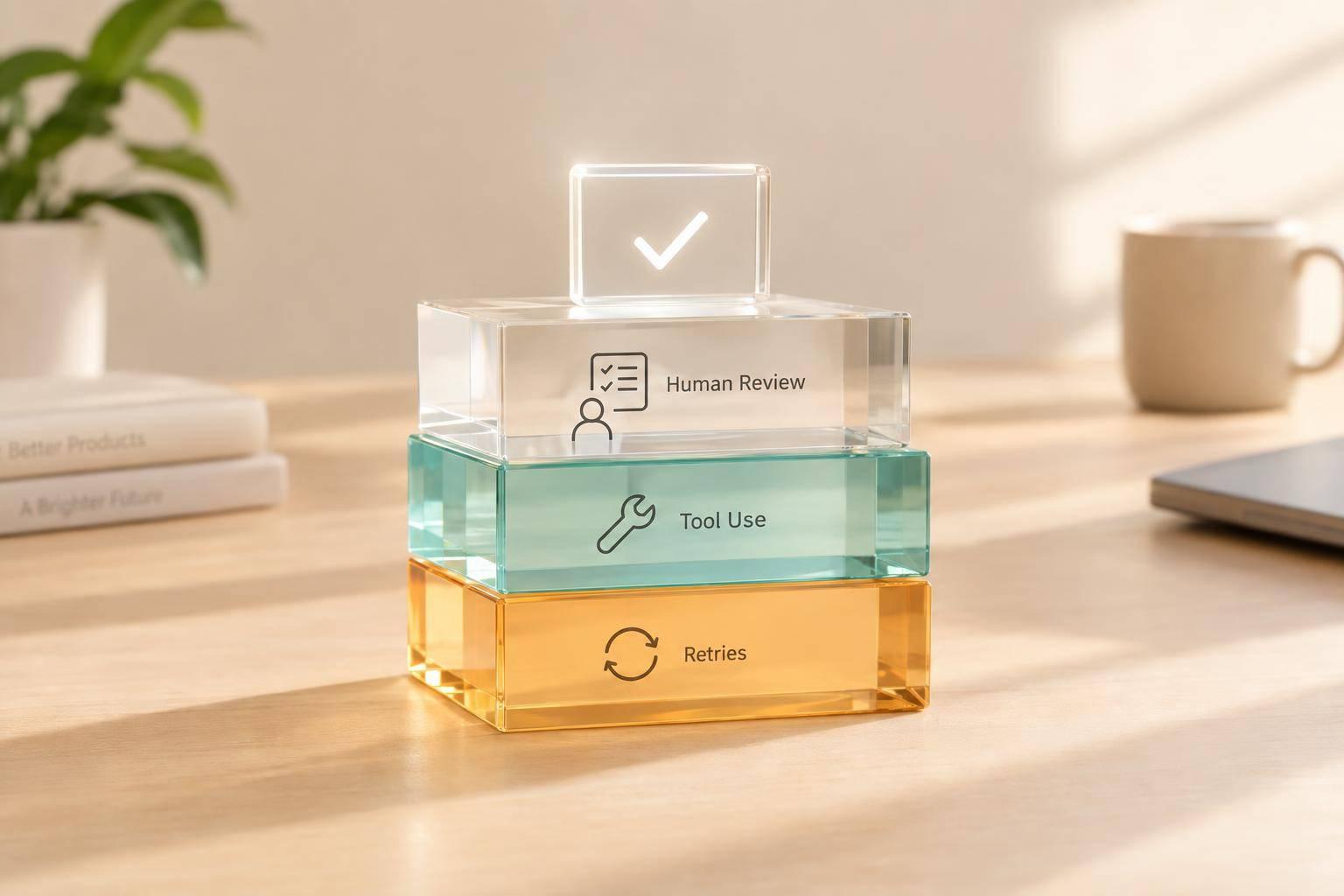
I judge AI agent costs by accepted results - not cheap responses. Divide all delivery costs by the number of accepted tasks: £1,200 spent on 800 accepted tasks means £1.50 per successful task.
Here’s what I include:
- All delivery costs: model calls, tools, retries, recovery and human review - even for tasks that fail.
- Accepted results only: count each task once, using the same quality checks.
- Separate tracking: first-pass success, failures, fallbacks and human hand-offs.
I compare tasks of similar difficulty and match approval checks to risk. Your target is lower total cost, without cutting quality or adding risk. If no tasks pass, the cost per success is undefined - not £0.
::: @figure 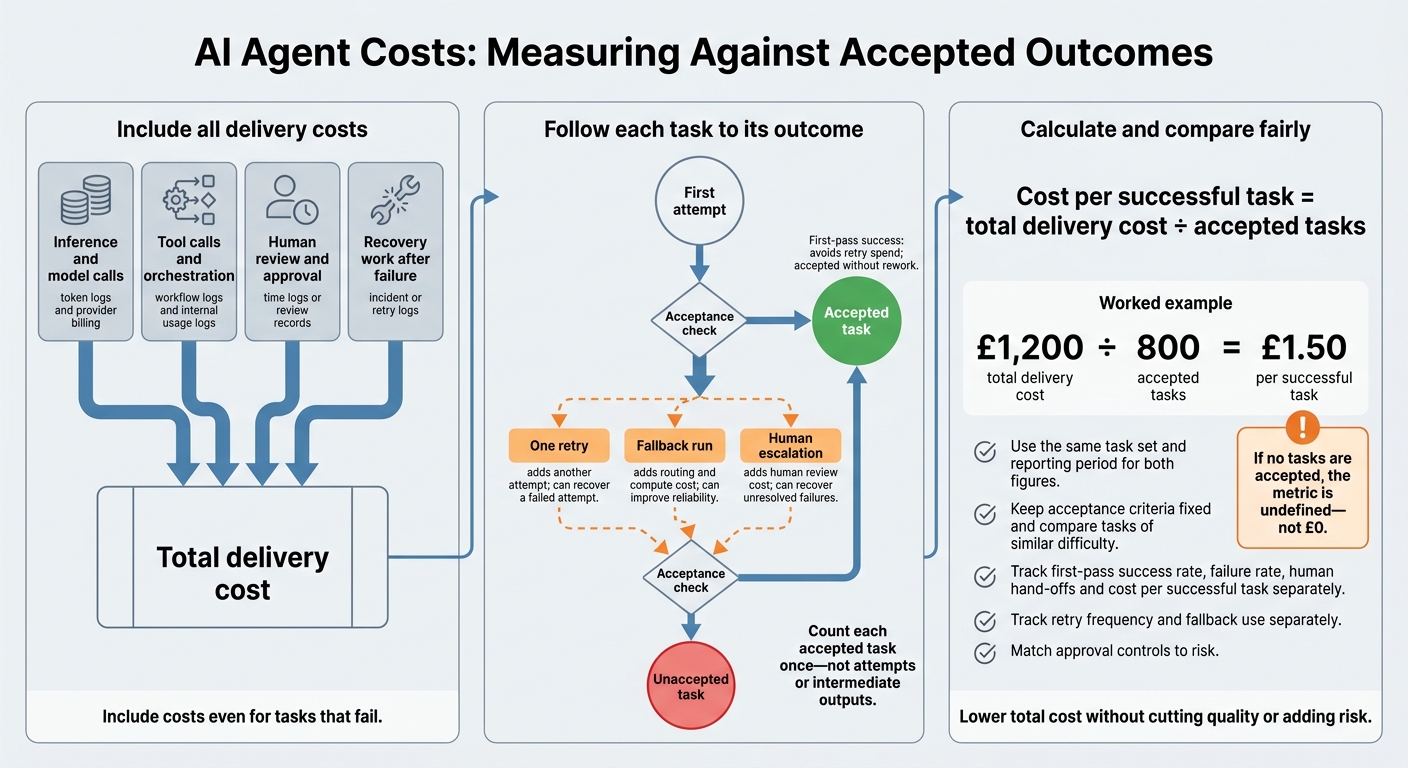 {AI Agent Cost per Successful Task}
:::
{AI Agent Cost per Successful Task}
:::
The Real Cost of AI Agents in 2026 (Token Prices vs the Loop)
How do you calculate cost per successful task?
Calculate total delivery cost ÷ accepted tasks, using the same task set and reporting period for both figures. If no tasks are accepted, the metric is undefined, not £0.
The total must include every cost needed to reach acceptance - not just model spend.
Which automated and human costs should you include?
Include automated work, hand-offs, human review and recovery after failed attempts. Keep these costs separate by source so you can see what goes towards model use, human review and recovery work.
| Cost source | Treatment | Telemetry needed |
|---|---|---|
| Inference and model calls | Include in numerator | Token logs and provider billing |
| Tool calls and orchestration | Include in numerator | Workflow logs and internal usage logs |
| Human review and approval | Include in numerator | Time logs or review records |
| Recovery work after failure | Include in numerator | Incident or retry logs |
Which tasks count as successful?
Count each task once when it meets the agreed acceptance criteria. Don't count attempts or intermediate outputs.
£1,200 total delivery cost ÷ 800 accepted tasks = £1.50 per successful task.
With the baseline clear, you can examine how retries and quality thresholds affect the cost.
How do failures, retries and quality thresholds affect costs?
Once you know what counts in the numerator and denominator, look at the failure rate. A cheap attempt can still lead to a costly accepted task if failures need extra work.
When do retries and human escalations add costs?
A more capable model can cost less overall if it avoids repeated retries, extra guardrails and human intervention [1].
Every retry, fallback and escalation adds to the cost before a task is accepted. The same task can cost very different amounts depending on where it fails and who fixes it.
| Execution path | Cost effect | Success effect | Required controls |
|---|---|---|---|
| First-pass success | Avoids retry spend | Accepted without rework | Schema validation and clear prompts |
| One retry | Adds another attempt | Can recover a failed attempt | Bounded retry logic and idempotency |
| Fallback run | Adds routing and compute cost | Can improve reliability | Routing logic and access to a more capable model |
| Human escalation | Adds human review cost | Can recover unresolved failures | Defined escalation criteria |
Track first-pass success, retry frequency, fallback use and human escalations separately. Add checkpoints at critical hand-offs to catch failures early and avoid rerunning the whole process [1].
Cost comparisons only work when success means the same thing in each workflow.
Why keep acceptance criteria consistent?
Compare workflows using the same acceptance standard and similar task types. Stricter thresholds can increase validation effort. Looser thresholds can make costs look lower without improving delivery quality.
Route routine work to cheaper models only with strict schema validation [1].
How can UK businesses measure and reduce task costs?
Build the dashboard using the retry and escalation data you already collect. Use the agreed acceptance criteria as your reporting baseline.
What should the dashboard report?
Track each task from its first attempt through to acceptance. Assign automated spend and staff time to each task, with both expressed in £.
Report first-pass success rate, failure rate, human hand-offs and cost per successful task as separate metrics. Review them on a fixed weekly or monthly schedule, then tighten approval controls where rework is highest.
Which controls cut costs without lowering quality?
Match approval controls to risk to reduce rework and hand-offs:
- Low-risk work: Use post-action audits and execution logs.
- Medium-risk work: Use threshold-based approval, supported by performance metrics and confidence scores.
- High-risk actions: Require human sign-off, a rationale and a rollback plan.
- Critical actions: Require dual authorisation, an audit trail and identity verification.
Measure savings only against accepted outcomes.
Conclusion: measure costs against accepted outcomes
Cost per accepted task = total delivery cost ÷ accepted tasks. Include failed attempts, retries, validation and human correction in the total. Count each accepted task once, no matter how many attempts it took.
Keep acceptance criteria fixed and compare tasks of similar difficulty before deciding whether a change costs less. A lower bill means little if the work was easier or the quality threshold was looser.
Optimise total cost alongside business value, quality and risk. Cheaper generation only saves money when extra checking and correction don’t outweigh those savings.
FAQs
How do failed tasks affect the cost of successful ones?
Failed tasks still cost money. You pay for the first failed attempt and each retry. Every retry uses more compute resources, tokens and function invocations, pushing up the cost of getting a successful result.
Without idempotency, retries can also trigger duplicate actions or other side effects. Fixing these may require costly manual work or corrective steps.
Hokstad Consulting helps optimise these workflows through AI strategy and custom agent implementation.
When should I stop retrying and involve a human?
Stop retrying once a task reaches its predefined attempt limit, typically three to five attempts. Also pause retries for high-risk actions that are hard to reverse, such as financial refunds, production configuration changes or access to regulated data. In either case, pause the workflow at an approval gate for human review.
Hokstad Consulting helps businesses design these workflows, optimise agent performance and set guardrails to control costs and keep outcomes reliable and secure.
How can I test stricter quality checks without distorting costs?
Log all errors, but sample only 10–20% of normal requests. This cuts telemetry volume and ingestion costs while keeping the data needed to spot problems. Use lower-cost models for routine tasks, with fixed schemas and clear acceptance criteria. Reserve high-end models for checking a sample of outputs.
Run simulations in non-critical environments to estimate the budget impact before applying stricter quality thresholds to production workflows.