
When your private cloud workload increases, you need to decide: scale vertically by upgrading a single server’s resources (CPU, RAM, storage) or scale horizontally by adding more servers. Each method has its strengths and limitations, and the choice depends on your application’s architecture, budget, and performance needs.
Key Points:
- Vertical Scaling: Increases a single server’s capacity. Simpler to implement but limited by hardware constraints. Best for monolithic apps like databases. May involve downtime and lacks redundancy.
- Horizontal Scaling: Adds more servers to distribute workloads. Offers better fault tolerance and scalability but requires complex setups (e.g., load balancers). Ideal for stateless apps and fluctuating traffic.
Quick Comparison:
| Factor | Vertical Scaling (Scale-Up) | Horizontal Scaling (Scale-Out) |
|---|---|---|
| Scalability Limit | Limited by hardware capacity | Virtually unlimited (add nodes) |
| Fault Tolerance | Low (single point of failure) | High (redundancy across servers) |
| Downtime | Required for upgrades (~5 mins) | Minimal to none (rolling updates) |
| Cost | Cheaper initially, costly long-term | Higher upfront, economical at scale |
| Complexity | Simple to manage | Requires orchestration tools |
For legacy systems or predictable workloads, vertical scaling works well. For dynamic, modular apps or high-traffic periods, horizontal scaling is more effective. Many organisations use a mix of both to balance performance and reliability.
::: @figure 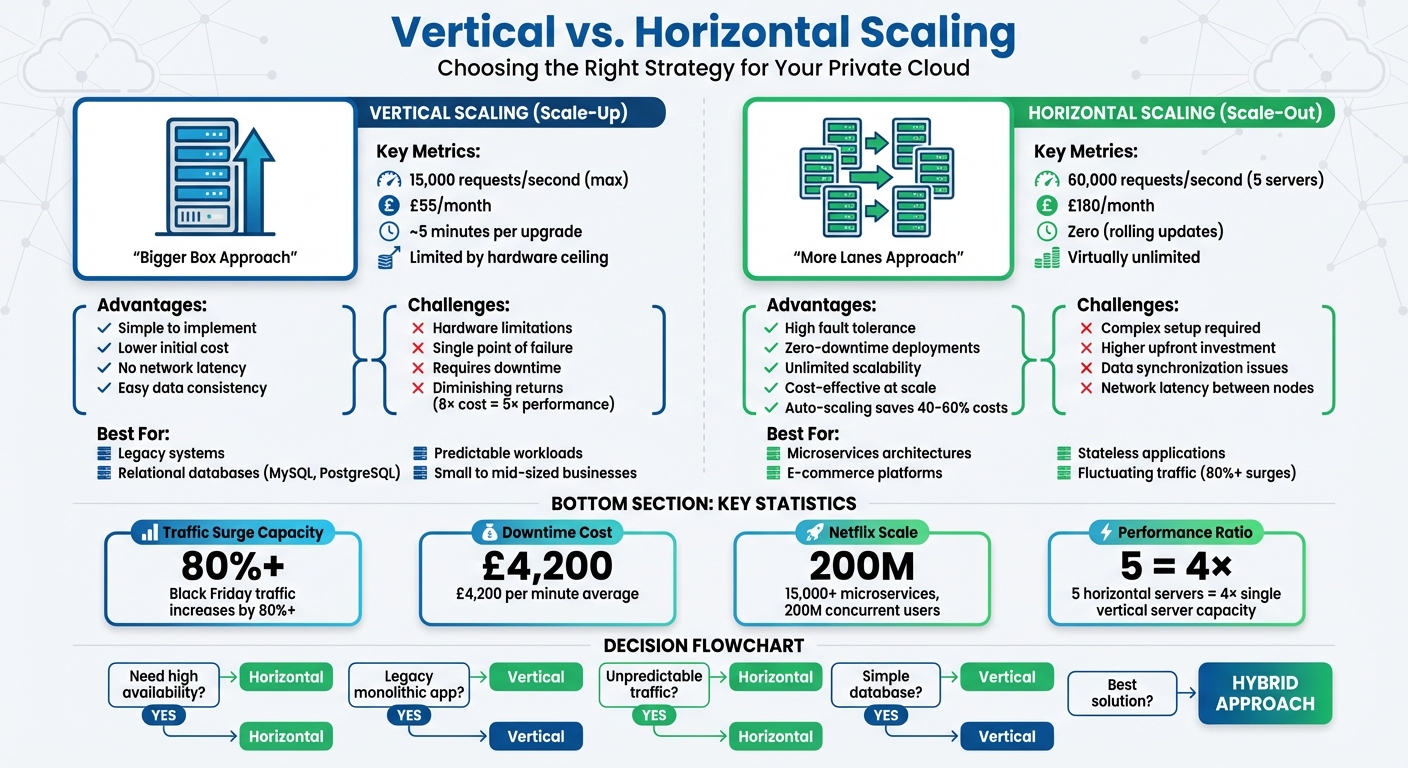 {Vertical vs Horizontal Scaling: Key Differences and Performance Metrics}
:::
{Vertical vs Horizontal Scaling: Key Differences and Performance Metrics}
:::
Vertical Vs Horizontal Scaling: Key Differences You Should Know
Vertical Scaling in Private Clouds
Vertical scaling in a private cloud involves increasing the resources of an existing virtual machine (VM) instead of deploying additional ones. This means enhancing a server's CPU, RAM, or storage capacity to manage more demanding workloads. Platforms like VMware and OpenStack make this possible using virtualisation software, allowing administrators to adjust resource allocations without altering the underlying physical hardware.
In OpenStack, vertical scaling is managed through flavours
- predefined templates that determine the CPU, memory, and storage allocated to a VM. For example, flavours range from m1.tiny (1 virtual core, 512 MB RAM) to m1.xlarge (8 virtual cores, 16 GB RAM) [6]. If your workload surpasses its current flavour, you can resize the VM to a larger one. However, this upgrade is only feasible if the physical host has enough free resources to accommodate the change [6].
This approach is particularly suited to monolithic applications, such as MySQL or PostgreSQL databases [3][7]. Since all the data resides on a single machine, it eliminates the synchronisation challenges often encountered in distributed systems.
Let’s delve into the benefits and drawbacks of vertical scaling.
Advantages of Vertical Scaling
The key advantage of vertical scaling lies in its straightforwardness. With only one machine to manage, there’s no need for complex configurations like load balancers or concerns about maintaining data consistency across multiple nodes. For smaller workloads, this approach can also be more cost-effective, as upgrading hardware is generally less expensive than re-engineering an application for distributed deployment [4].
Another benefit is the immediate performance improvement. When you allocate additional CPU or RAM to a VM, the application can utilise these resources right away. This makes vertical scaling a great option for quickly addressing performance bottlenecks, such as a database running low on memory during peak activity [2]. Moreover, since everything operates within a single system, inter-process communication is swift, without the network delays that can occur in multi-node environments [1].
Challenges of Vertical Scaling
The biggest challenge is the hardware limitations of private clouds. If a VM requires more resources than any single server in your cluster can provide, you’ve reached the maximum scaling capacity [6][7]. Unlike public clouds, where resources can be scaled almost endlessly, private clouds demand careful resource planning.
Another concern is the lack of redundancy. A vertically scaled VM represents a single point of failure - if it crashes, the entire workload goes offline. This can pose significant risks for critical applications [3]. Additionally, vertical scaling often involves downtime. Whether it’s upgrading physical components or resizing a VM, these changes usually require scheduled maintenance windows to avoid service interruptions [1][7].
Horizontal Scaling in Private Clouds
Horizontal scaling takes a different route compared to vertical scaling. Instead of upgrading a single server, this approach involves adding more machines to your resource pool and spreading the workload across them [3][7].
Horizontal scaling is like adding more lanes to a highway to accommodate more traffic. Each lane represents a server and the overall capacity increases as more lanes are added[3].
This method shifts the focus from upgrading hardware to efficiently distributing the workload.
The process relies heavily on load balancers to ensure requests are spread evenly across servers, preventing any single server from being overwhelmed [3][10]. In private cloud environments running containerised applications, tools like Kubernetes simplify this through features like the Horizontal Pod Autoscaler (HPA). The HPA monitors metrics such as CPU usage, memory consumption, or other custom indicators, then automatically adjusts the number of running pod replicas to meet demand [8][11].
For horizontal scaling to work effectively, application design plays a crucial role. Applications need to be stateless, with session data stored externally in systems like Redis [9][10]. Database workloads can also scale horizontally by using techniques like sharding or partitioning [9][10].
Netflix demonstrates the power of horizontal scaling on a massive scale. By 2025, it employs thousands of AWS EC2 instances to serve over 200 million concurrent users. Its video encoding system, for example, uses 100 servers working in parallel to process a single title, achieving processing speeds nearly 10 times faster than a vertical setup [10]. Shopify also relies on horizontal scaling during flash sales, handling spikes of up to 50,000 concurrent shoppers per merchant. Auto-scaling groups allow Shopify to add capacity within seconds to handle these surges [10].
Advantages of Horizontal Scaling
One of the biggest advantages of horizontal scaling is its fault tolerance. By distributing workloads across multiple servers, there’s no single point of failure - if one server goes down, the others can continue to handle requests [5][10]. This resilience is critical when downtime costs for enterprises average around £4,200 per minute [10].
Horizontal scaling also enables zero-downtime deployments. Rolling updates allow individual servers to be upgraded while others continue to manage traffic, ensuring continuous availability [10]. Additionally, scalability is practically limitless. For example, a cluster of five horizontally scaled servers can handle up to 60,000 requests per second, compared to just 15,000 for a single vertically scaled server [10]. This elasticity is vital during events like Black Friday, where content delivery traffic can surge by over 80% [10].
Challenges of Horizontal Scaling
Despite its benefits, horizontal scaling brings its own set of challenges. Managing a cluster of servers requires load balancers, regular health checks, and advanced orchestration tools [5][7]. Communication between nodes can also introduce latency, which needs to be carefully managed [5][7].
Data consistency is another hurdle. Distributing state across multiple servers makes synchronisation difficult, especially under the constraints of the CAP theorem, which forces a trade-off between consistency, availability, and partition tolerance [5][10]. Finally, overseeing a large number of servers demands more sophisticated monitoring tools and operational expertise compared to managing a single, powerful server [7].
Vertical vs. Horizontal Scaling: Key Differences
Building on the earlier discussion of benefits and challenges, let's directly compare vertical and horizontal scaling. At its core, vertical scaling involves increasing the capacity of a single machine, while horizontal scaling focuses on adding multiple machines or nodes. These approaches differ significantly in terms of fault tolerance, costs, and complexity.
Vertical scaling is essentially the 'bigger box' approach: make the machine stronger and let your existing code run faster.– Xenoss [10]
For example, a single vertically scaled server might handle up to 15,000 requests per second at peak capacity. By contrast, a cluster of five horizontally scaled servers can process 60,000 requests per second [10]. However, achieving this enhanced performance with horizontal scaling introduces added complexity. It requires tools like load balancers, health checks, and orchestration systems - elements that are unnecessary in a vertical setup.
Cost considerations also vary as scaling needs grow. Vertical scaling is often a more affordable starting option, with a basic setup costing around £55 per month compared to £180 for a horizontal configuration with load balancing. But as demands increase, upgrading a single server can lead to significant cost inefficiencies - an eightfold cost increase might only yield a fivefold performance improvement [10]. Horizontal scaling, on the other hand, becomes more economical at larger scales by leveraging standard, lower-cost hardware.
Another critical difference lies in downtime. Vertical scaling typically requires about five minutes of downtime during upgrades. In contrast, horizontal scaling can achieve zero downtime by using rolling updates [10]. For businesses where every minute of downtime costs an average of £4,200, this advantage can be game-changing [10].
Comparison Table
| Factor | Vertical Scaling (Scale-Up) | Horizontal Scaling (Scale-Out) |
|---|---|---|
| Scalability Limit | Hard ceiling (limited by hardware capacity) | Theoretically limitless (add more nodes) |
| Fault Tolerance | Low (single point of failure) | High (redundancy across multiple nodes) |
| Implementation Ease | High (minimal architectural changes) | Low (requires load balancing and distributed design) |
| Data Consistency | Simple (data resides on one system) | Complex (requires synchronisation across nodes) |
| Downtime | Required for hardware upgrades (~5 minutes) [10] | Minimal to zero (via rolling updates) [10] |
| Short-term Cost | Lower (component upgrades) | Higher (new servers plus infrastructure) |
| Long-term Cost | Less cost-effective at high tiers | More economical for massive growth |
| Management Complexity | Simple (one machine to monitor) | Complex (requires orchestration and health checks) |
These distinctions make it clear that the choice between vertical and horizontal scaling depends heavily on specific needs, including performance demands, budget constraints, and tolerance for complexity. The next section will explore scenarios where each scaling method is most appropriate.
Use Cases for Scaling in Private Clouds
When to Choose Vertical Scaling
Vertical scaling is a great fit for legacy and monolithic applications. These older software systems often aren't built to operate across multiple machines, making them ideal for a single, more powerful server. Instead of overhauling the code - an expensive and time-consuming process - upgrading the server's CPU and memory can handle increased workloads effectively [10][13].
Relational databases like MySQL, PostgreSQL, and MongoDB also thrive in a vertically scaled setup. Keeping all data on one machine eliminates network delays and simplifies tasks like maintaining ACID compliance and ensuring data consistency. This is especially important for critical systems such as financial platforms, inventory management tools, and customer relationship software [14][10].
For small to mid-sized businesses with steady, predictable growth, vertical scaling offers a simple and cost-efficient solution. Modest hardware upgrades can deliver noticeable performance improvements without the complexity of managing a server cluster [14][3][7]. Another advantage is the low latency achieved through internal, on-chip communication [7][10].
While vertical scaling works well for stable, predictable workloads, modern applications often demand the adaptability provided by horizontal scaling.
When to Choose Horizontal Scaling
Horizontal scaling is the go-to choice for dynamic and modular environments. Microservices architectures are a prime example - they're designed to allow each service to scale independently, making them perfect for this approach [11][17].
Applications that experience fluctuating traffic levels, such as e-commerce platforms or streaming services, benefit greatly from horizontal scaling. For instance, during high-demand periods like Black Friday or Christmas, traffic can surge by over 80%. Adding or removing nodes dynamically ensures these platforms can handle spikes without downtime [10].
Stateless workloads, such as web servers and API endpoints, are particularly well-suited to horizontal scaling. Since any node can handle incoming requests, this setup not only boosts performance but also enhances reliability. If one node goes offline, others seamlessly take over, preventing interruptions. This is crucial for businesses, as downtime can cost an average of £4,200 per minute [10].
Benefits and Challenges of Scaling Strategies
Benefits of Each Scaling Method
Let’s take a closer look at what each scaling method brings to the table. Vertical scaling is often the go-to solution for legacy systems and relational databases. Why? Because it’s straightforward and doesn’t require significant architectural changes. For example, boosting a server’s RAM or upgrading its CPU is a relatively simple process. This makes it a reliable choice for systems where maintaining data consistency is a top priority. As OpenMetal Documentation explains, Typically it is more cost-effective to scale up, or vertically, rather than scaling out, or horizontally... due to the cost of hardware to scale up being relatively low compared to re-architecting a software system
[4].
On the other hand, horizontal scaling offers almost limitless growth potential. By spreading workloads across multiple servers, it enhances fault tolerance and ensures high availability. This is crucial in situations where downtime is costly - think £4,200 per minute in some cases [10]. Horizontal scaling also shines in environments with unpredictable traffic. For instance, using auto-scaling can cut costs by 40–60% compared to static resource allocation [15]. A great example of this approach is Netflix, which relies on horizontal scaling to manage global content delivery through over 15,000 microservices. Interestingly, Netflix also uses vertical scaling for specific, high-performance tasks like encoding [3][15]. While both methods offer considerable benefits, they aren’t without their challenges.
Challenges of Each Scaling Method
Despite their advantages, both scaling strategies come with their own set of hurdles. Vertical scaling, while simple and cost-effective initially, hits a ceiling when the hardware’s maximum capacity is reached. Once you’ve maxed out the CPU, RAM, or storage, the only option is to replace the entire machine - an upgrade that can come with steep costs. For instance, an 8× increase in spending might only result in a 5× performance improvement [10]. Another drawback? Vertical upgrades often require planned downtime, which can disrupt operations.
Horizontal scaling, on the other hand, involves a higher level of complexity. It requires advanced tools like load balancers and orchestration platforms (e.g., Kubernetes) to ensure everything runs smoothly across multiple servers. Coordinating data across distributed nodes is another challenge, as it can lead to issues like dirty reads or synchronisation delays. The increased communication between nodes can also introduce latency and expand the system’s vulnerability to security threats [7]. That said, horizontal scaling often proves more cost-efficient in the long run, especially for large and intricate systems [12][16].
Choosing the Right Scaling Strategy
Key Decision Factors
When it comes to deciding on a scaling strategy, the choice between vertical and horizontal scaling depends heavily on the unique demands of your private cloud environment. Several operational factors come into play, and understanding these can help shape a strategy that works for your infrastructure.
Application architecture is one of the most important considerations. For stateless applications - like microservices and APIs - horizontal scaling is often the best fit. These applications can handle requests across multiple instances without relying on shared states. On the other hand, legacy monolithic applications, built to run on a single machine with shared states, are typically better suited for vertical scaling.
Downtime tolerance is another critical factor. If your systems require constant availability, vertical scaling can present challenges. Upgrading hardware often leads to downtime, which can be costly, particularly for businesses where interruptions are not an option [10]. Horizontal scaling, however, avoids this issue by enabling rolling updates that keep services running while increasing capacity.
Hardware limitations also play a significant role. Physical servers and virtual machines have fixed limits on CPU, RAM, and storage. Once these resources are maxed out, vertical scaling is no longer viable. Additionally, high-end hardware often comes with diminishing returns; for example, an 8× cost increase might only deliver a 5× performance boost [10]. At this point, horizontal scaling becomes the only practical option.
Reliability and redundancy are equally important. Vertical scaling doesn't inherently provide redundancy, making it vulnerable to single points of failure. In contrast, horizontal scaling spreads the load across multiple nodes, offering built-in fault tolerance. This is particularly crucial during high-traffic events, such as Black Friday, when content delivery traffic can surge by over 80% [10]. In such scenarios, horizontal scaling's ability to handle spikes is not just useful - it’s essential.
Operational complexity and data consistency also influence the choice. As highlighted in Microsoft's Azure Well-Architected Framework:
The goal of cost optimising scaling is to scale up and out at the last responsible moment and to scale down and in as soon as it's practical[13].
For many private cloud environments, a hybrid approach often works best. This involves scaling application tiers horizontally for greater flexibility while scaling core databases vertically to ensure data consistency. By tailoring the approach to each component, a hybrid strategy can help your private cloud scale effectively and efficiently.
These factors form the foundation for crafting a scaling strategy that aligns with your infrastructure’s specific needs.
Conclusion
When deciding on a scaling approach, focus on what aligns best with your operational requirements rather than chasing a one-size-fits-all solution. Vertical scaling keeps things straightforward by upgrading the CPU, RAM, or storage of existing servers. This makes it ideal for legacy systems and databases that depend on strong data consistency. However, it does come with limitations, such as hardware caps and the risk of a single point of failure [3][7].
On the other hand, horizontal scaling provides room for significant growth and enhanced availability, though it introduces more complexity [3][10]. Many organisations opt for a hybrid strategy, blending the best of both worlds. This allows them to use horizontal scaling for fault-tolerant systems while reserving vertical scaling for components that require consistency.
Cost is another key factor. Vertical scaling can become less efficient as you reach higher tiers, with an eightfold cost increase offering only a fivefold performance improvement [10]. While horizontal scaling demands a larger upfront investment in tools like load balancers and orchestration systems, it offers more predictable costs as you grow. Considering that IT downtime can cost an average of £4,200 per minute [10], the added reliability of horizontal scaling often justifies the extra complexity.
FAQs
What is the difference between vertical and horizontal scaling in private clouds?
Vertical scaling, often called scaling up
, means boosting the capacity of a single server. This could involve adding more CPU cores, increasing memory, or expanding storage to manage heavier workloads. In contrast, horizontal scaling, or scaling out
, focuses on adding multiple servers or instances. By spreading the workload across several nodes and using a load balancer, this approach distributes the demand more evenly.
While vertical scaling is easier to set up, it comes with hardware limitations and the risk of a single point of failure unless additional safeguards are in place. Horizontal scaling, though more resilient and capable of handling larger demands, requires a more intricate setup. This includes designing stateless applications and implementing effective load balancing.
Hokstad Consulting supports UK organisations in determining the best scaling approach. Whether it's about maximising the efficiency of existing systems or building scalable, distributed solutions, they tailor their strategies to meet specific business needs.
How can I choose the best scaling method for my application in a private cloud?
When deciding between vertical scaling and horizontal scaling, your choice will largely hinge on your application's workload, traffic patterns, and budget.
For stateless applications - those capable of running multiple identical instances - horizontal scaling is often the go-to solution. By adding more virtual machines (VMs) or pods, you can spread the workload across multiple resources. This not only helps manage traffic spikes but also boosts fault tolerance. It’s particularly handy for applications with fluctuating or event-driven demand, as you can adjust resources up or down to align with your needs, keeping expenses in check.
On the other hand, stateful services or legacy systems tied to specific hardware or licences might benefit more from vertical scaling. This method involves enhancing the CPU, memory, or storage of a single node, making it suitable for workloads requiring substantial resources in a single instance. However, vertical scaling has its limits and often comes with higher per-unit costs. Regularly reviewing costs and optimising resources is crucial to avoid overspending.
To make the right choice, evaluate whether your application is stateless or stateful, how predictable your traffic patterns are, and what your budget allows. Hokstad Consulting can assist in crafting a scaling strategy tailored to your private cloud, ensuring you strike the right balance between performance, reliability, and cost.
What are the cost differences between vertical and horizontal scaling in private clouds?
Vertical scaling means boosting the resources - like CPU, RAM, or storage - of a single server or virtual machine. While this can enhance performance, it often comes with a hefty price tag. Larger, high-performance machines are typically much more expensive and can end up being underused during periods of low activity. In private cloud environments, this method can quickly run into hardware limitations, often requiring over-provisioning just to avoid performance bottlenecks. The result? Wasted resources and inflated costs.
Horizontal scaling takes a different approach by adding more servers or instances to share the workload. This method can help manage costs more effectively by using smaller, more affordable instances and scaling down unused capacity when demand decreases. In fact, it can cut costs by as much as 80% in some scenarios. However, it’s not without its challenges - networking and orchestration can add complexity, making it crucial to monitor usage closely to avoid unnecessary spending.
Ultimately, vertical scaling often leads to higher and less adaptable costs, while horizontal scaling provides better efficiency and savings - especially when combined with smart autoscaling and careful tracking of resource usage.