Managing vendors manually is outdated and inefficient. Automated vendor monitoring replaces spreadsheets and emails with real-time data, predictive analytics, and centralised dashboards. This modern approach saves time, reduces errors, and improves oversight by:
- Cutting manual tasks: Procurement teams can save 30–40% of their time.
- Improving accuracy: Automation minimises errors from manual data entry.
- Strengthening risk management: Predictive analytics flag issues early.
- Boosting compliance: Detailed audit trails simplify regulatory checks.
- Enhancing efficiency: Dashboards provide instant performance insights.
Automation is essential for handling complex supply chains, enabling organisations to monitor vendors continuously, reduce costs by 15–25%, and focus on building better partnerships.
How to Automate Vendor Management Effectively
Benefits of Automating Vendor Monitoring
::: @figure 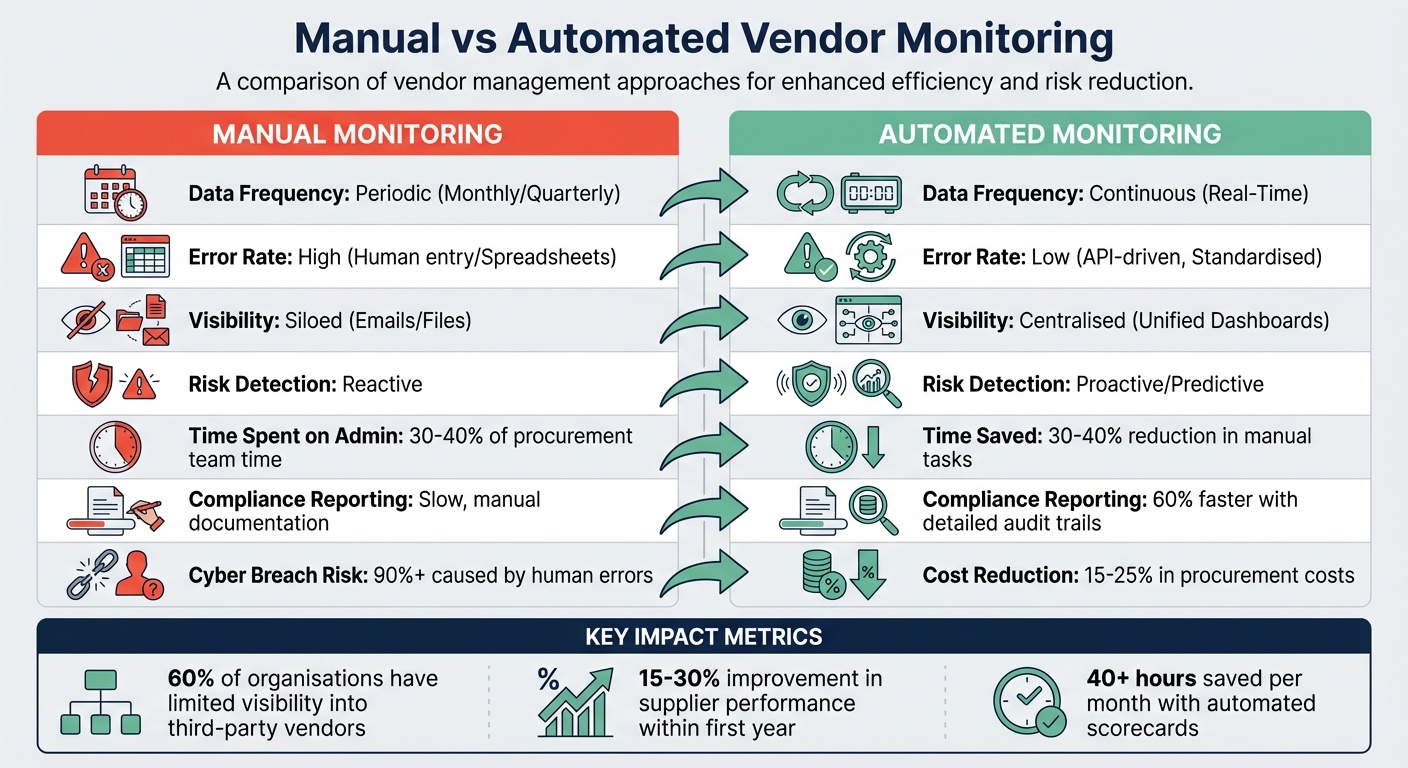 {Manual vs Automated Vendor Monitoring: Key Differences and Benefits}
:::
{Manual vs Automated Vendor Monitoring: Key Differences and Benefits}
:::
Automating vendor monitoring addresses the inefficiencies of manual processes, offering substantial advantages in several key areas.
Efficiency and Time Savings
Procurement teams often spend 30–40% of their time chasing missing documents, sending reminders, and updating spreadsheets manually [1]. Automation takes over these repetitive tasks, streamlining operations. With automated systems, reminders for compliance documents are triggered automatically, responses are collected without manual intervention, and records are updated seamlessly.
This shift can reduce procurement costs by 15–25% [1]. By freeing up time, staff can focus on more strategic tasks, like negotiating better contracts or building stronger vendor relationships. Additionally, centralised dashboards provide instant access to vendor performance data, making oversight more efficient.
Accuracy and Real-Time Data
Manual data entry is prone to errors, and human mistakes are responsible for over 90% of cyber breaches [2]. Automation minimises these risks by integrating data directly through APIs, applying consistent scoring criteria, and evaluating vendors against objective benchmarks for compliance, security, and financial health.
Real-time monitoring boosts operational capabilities further. AI-driven systems continuously scan news, regulatory updates, and industry reports, flagging potential risks immediately. Alerts via platforms like Slack, email, or webhooks ensure swift action when critical issues arise. For example, a healthcare provider using automated monitoring for over 200 vendors handling sensitive patient data reported a 60% reduction in compliance reporting time and avoided penalties during audits over two years [2].
| Feature | Manual Monitoring | Automated Monitoring |
|---|---|---|
| Data Frequency | Periodic (Monthly/Quarterly) | Continuous (Real-Time) |
| Error Rate | High (Human entry/Spreadsheets) | Low (API-driven, Standardised) |
| Visibility | Siloed (Emails/Files) | Centralised (Unified Dashboards) |
| Risk Detection | Reactive | Proactive/Predictive |
These real-time insights are invaluable in maintaining compliance and managing risks effectively.
Compliance and Risk Management
Automation simplifies compliance by maintaining detailed audit trails and logging every vendor interaction, risk score update, and assessment. This centralised record-keeping is especially critical for organisations in regulated industries. It also integrates smoothly with DevOps workflows, ensuring continuous oversight without disrupting operations.
Predictive analytics adds another layer of protection. By analysing historical data and external sources, machine learning models can identify patterns that signal potential future risks. With 60% of organisations admitting to limited visibility into their third-party vendors [2], automation helps close this gap. It ensures high-risk suppliers are prioritised for review while reducing the burden on manual processes, enabling better focus and resource allocation.
Features to Look for in Vendor Monitoring Tools
When selecting a vendor monitoring tool, it's important to focus on features that improve efficiency and enhance risk management. The best platforms combine automation and analytics to eliminate manual processes and provide meaningful insights. Here's a closer look at some essential features that can elevate vendor monitoring.
Automated Scorecards and KPI Tracking
Top-tier tools use AI to extract contract obligations, automatically assigning responsibilities and deadlines. This helps prevent missed commitments, a common issue that can cost organisations up to 9.2% of their annual revenue due to poor contract management [3]. Real-time SLA computation offers immediate insights, replacing the need for periodic reviews. RAG (Red/Amber/Green) dashboards highlight any performance deviations as they happen [3][4].
Integration with ERP or procurement systems is another critical feature. It ensures that at least 80% of vendor performance metrics are quantitative, reducing bias and providing a clear picture of performance trends [6][1]. This standardisation gives teams instant access to performance insights [5][1]. Automated assessments conducted regularly also encourage vendors to maintain high service standards, simplifying decisions around renewals and negotiations [5][4].
But monitoring performance is just one part of the equation - anticipating potential risks is equally important.
Risk Monitoring and Predictive Analytics
Continuous risk monitoring sets advanced tools apart from basic ones. These tools keep an eye on financial stability, cybersecurity risks, and regulatory compliance by scanning news feeds and industry reports for early warning signs [3]. AI-powered anomaly detection identifies patterns that could indicate risks - such as declining credit ratings or security vulnerabilities - before they lead to larger issues [4].
Predictive analytics takes vendor management to the next level by shifting the focus from reactive to proactive strategies. Machine learning models analyse historical and external data to predict problems like financial instability or compliance failures. This is especially valuable as many organisations struggle with unexpected costs and delays due to poor vendor visibility [5][2]. By addressing risks early, predictive analytics ensures smoother operations and sets the foundation for better data presentation.
Customisable Dashboards and Mobile Access
Data presentation should be flexible and user-friendly. Look for tools with customisable dashboards that let users focus on key metrics, filter data by vendor type, and set alerts based on specific thresholds. Mobile-friendly access is another must-have, enabling procurement teams to monitor vendor performance, approve actions, and respond to alerts while on the move. This level of accessibility ensures that critical performance data is always within reach, supporting continuous and effective oversight.
How to Implement Vendor Monitoring Automation
Ditch those manual spreadsheets and switch to automated vendor monitoring with a clear plan. This involves defining success metrics, picking the right technology for your setup, and ensuring vendors are integrated into your systems. By doing so, vendor management becomes a continuous and strategic operation that builds on the advantages we've already discussed.
Define KPIs and Performance Benchmarks
Start by aligning your metrics with your business goals. Different types of vendors need different evaluation criteria - strategic partners might be assessed on innovation, while commodity suppliers are judged on cost and delivery. Focus on just 3–5 key KPIs that truly matter. Overloading with metrics can make the system too cumbersome to use.
Tie these KPIs to your Service Level Agreements (SLAs) to give yourself legal leverage if performance falters. A weighted scoring model can help prioritise what's most important. For example, you might assign 40% weight to quality and 10% to service responsiveness. Be specific with thresholds: excellent performance might mean over 98% on-time delivery, while anything under 95% is unacceptable. Companies using structured scorecards often see supplier performance improve by 15–30% within the first year [7].
| KPI Category | Example Metric | Benchmark Target |
|---|---|---|
| Quality | Defect Rate | < 1% |
| Delivery | On-Time Delivery | > 98% |
| Reliability | System Uptime | 99.9% |
| Cost | Price Increase | ≤ 2% annually |
Automate data collection wherever possible. Pull data directly from purchase orders, invoices, and vendor reporting tools. Include qualitative metrics too, like communication effectiveness, by using rating scales alongside the hard numbers.
Once your KPIs are in place, the next step is finding a tool that integrates seamlessly with your current systems.
Select the Right Automation Tool
Your automation tool must work well with your existing infrastructure. For businesses operating in cloud environments, ensure it integrates with systems like ERP, procurement platforms, and DevOps pipelines. Don’t overlook compliance - ensure the tool meets GDPR standards and offers UK data residency options if you're managing sensitive vendor data. This is crucial since 60% of organisations admit to lacking full visibility into their third-party vendors [2].
Look for tools that provide 24/7 support and dedicated account managers, especially for critical vendor relationships. Scalability is also essential - your vendor portfolio will likely grow, and the tool should handle increased complexity without needing a complete overhaul.
For businesses managing cloud infrastructure, choose tools that integrate with existing cost management and compliance frameworks. Hokstad Consulting, for example, offers expertise in DevOps transformation and automation, helping organisations select and configure tools that align with their cloud architecture. This ensures smooth integration into deployment cycles and monitoring systems.
Once you've chosen the right tool, the next step is onboarding your vendors and setting up continuous monitoring.
Onboard Vendors and Monitor Continuously
Vendor onboarding is the foundation of a good working relationship. From the start, clearly communicate expectations around performance, data-sharing, and reporting. Set up automated data feeds to update vendor metrics in real time, cutting out the delays and errors that come with manual spreadsheets.
Adjust monitoring frequency based on the vendor's importance. High-impact vendors may need daily performance checks, while lower-tier suppliers might only need weekly or monthly reviews. Use dashboards with red/amber/green indicators for quick performance insights - stakeholders shouldn't have to dig through lengthy reports to identify issues.
| Maturity Level | Characteristics | Automation Level |
|---|---|---|
| Initial | Informal, reactive, inconsistent | None (Manual) |
| Defined | Formalised processes, documented | Some automation |
| Managed | Data-driven, active monitoring | High automation, continuous |
Continuous monitoring transforms vendor oversight into an ongoing process rather than a periodic task. Automated alerts can notify stakeholders if a vendor's uptime drops below 99.9% or if delivery times exceed SLA requirements. This proactive approach helps prevent small issues from snowballing into major operational problems.
Best Practices for Vendor Monitoring Automation
Once your automation system is up and running, maintaining its effectiveness requires consistent effort. These practices help keep your vendor monitoring system efficient, aligned with your operations, and capable of addressing issues before they escalate.
Regular Auditing and Performance Reviews
Automation isn't a set and forget
solution. Schedule regular reviews to ensure data accuracy and assess vendor performance. Automated scorecards can save 40+ hours a month by streamlining this process[12]. Use structured vendor reviews with median scoring and RAG (Red, Amber, Green) alerts to quickly identify potential issues[12].
Between formal reviews, incorporate market intelligence on factors like credit ratings, sanctions, and cyber security posture to maintain continuous risk monitoring[12]. This approach catches problems that might otherwise go unnoticed during periodic check-ins. Tools like performance quadrant visualisation allow you to map vendors by contract spend and performance scores, making it easier to spot risks or opportunities for consolidation[12].
Integrate performance data into renewal workflows, ensuring decisions on renegotiation, remediation, or replacement are based on verified performance metrics rather than default renewals[12]. This prevents underperforming vendors from slipping through the cracks simply because their contracts weren’t reviewed.
By continuously refining these processes and linking them with DevOps workflows, you can act on emerging risks in real time.
Integrate Automation with DevOps and Hosting
Building on regular audits, connecting vendor data with your cloud and DevOps pipelines enhances operational responsiveness. For organisations managing cloud infrastructure, vendor monitoring should be closely tied to your operational systems. By linking vendor performance metrics to DevOps pipelines and hosting environments, you enable continuous performance evaluation[9]. This data can feed directly into your operational dashboards, providing a real-time view of vendor reliability.
Hokstad Consulting, for example, specialises in DevOps transformation and cloud cost engineering. They help businesses integrate vendor monitoring into existing infrastructure, ensuring performance data seamlessly connects with deployment cycles, cost management systems, and monitoring tools. This means that if a hosting vendor's performance dips, your DevOps team gets immediate alerts within their existing workflows.
A cross-functional approach ensures collaboration between Procurement, Legal, and Finance teams[12]. This unified system enables everyone - from technical teams to procurement specialists - to work from the same data set, improving decision-making across departments.
Incident Response and Risk Mitigation
Automation also plays a critical role in incident response, speeding up the resolution of vendor-related issues. Real-time alerts allow teams to respond immediately to third-party cyber risks[8]. Using machine learning algorithms, you can automate incident detection and response by identifying patterns that signal emerging problems with vendors[8].
Set up automated workflows to handle repetitive tasks like compliance checks and communication when performance thresholds are breached[11]. Alerts for supplier risks can notify teams of potential disruptions, cutting response times from hours to minutes and preventing small issues from escalating into major crises[10].
These measures close the automation loop, reinforcing the importance of vendor monitoring as a strategic function across your organisation.
Conclusion
Automated vendor monitoring transforms oversight by focusing on proactive risk management rather than reactive measures. This shift brings tangible benefits, such as saving over 40 hours per month with automated scorecards[12], gaining 24/7 real-time visibility through continuous monitoring to detect vulnerabilities[8], and ensuring compliance with regulations like GDPR using AI-driven risk scoring[8]. By automating these processes, organisations can reduce manual tracking, speed up incident responses, and simplify audit trails.
To get started, it’s essential to define key performance indicators (KPIs) and select tools that offer predictive analytics and customisable dashboards. Vendors should be onboarded for real-time monitoring using tools like RAG (Red, Amber, Green) alerts and performance quadrants. These features help identify underperforming, high-cost suppliers well before contract renewals[10][12].
Once implemented, integrating these systems with DevOps and hosting platforms enhances operational efficiency. When vendor performance data feeds directly into operational dashboards, technical teams receive instant alerts within their existing workflows. This reduces response times from hours to just minutes[10]. Regular audits, combined with machine learning for detecting incidents, ensure your monitoring evolves to address new risks instead of focusing solely on past issues[12].
For organisations looking for more tailored solutions, Hokstad Consulting provides expert guidance. They specialise in custom automation, strategic cloud migration, and AI agent integration, ensuring that monitoring systems align seamlessly with deployment cycles and cost management strategies. Their approach delivers noticeable improvements in vendor performance and infrastructure efficiency.
Shifting from manual to automated, data-driven vendor oversight is no longer just a nice-to-have - it’s a necessity for organisations managing complex supply chains. This strategic move not only reduces risks but also strengthens your ability to stay competitive in an increasingly intricate business environment.
FAQs
Which vendor KPIs should we automate first?
Start by automating the KPIs that are essential for keeping an eye on real-time performance and managing costs effectively. Begin with system uptime and support response times - these are key to ensuring your services remain reliable and meet user expectations.
Next, turn your attention to automating cloud cost metrics, such as expenses related to compute, storage, and data transfers. Keeping these under control can help prevent unexpected budget overruns.
Finally, focus on KPIs tied to compliance and risk management. For example, automating tasks like third-party risk assessments can help you stay on top of regulatory requirements and reduce the chances of disruptions.
How do we integrate vendor monitoring with our ERP and DevOps tools?
To connect vendor monitoring with ERP and DevOps tools effectively, automation platforms are key. By leveraging APIs, automation scripts, and real-time monitoring tools, you can synchronise vendor data across systems effortlessly. This ensures a smooth flow of data, accurate tracking of performance metrics, and regular updates without delays. The result? Less manual work, better visibility, and improved efficiency across ERP and DevOps operations.
What data do vendors need to share for real-time risk monitoring?
Real-time risk monitoring relies on vendors sharing detailed, actionable data that provides immediate insight into operations and potential vulnerabilities. This includes information such as system performance metrics, security alerts, incident reports, and access logs.
By sharing this data in formats compatible with automation tools, organisations can quickly identify risks like misconfigurations or security threats. This approach allows for faster responses, helping to maintain both operational stability and compliance.