
In modern CI/CD pipelines, vulnerabilities can spread as fast as code is deployed. With over 40,000 new CVEs disclosed in 2025 and an average of 131 vulnerabilities reported daily, prioritising risks is critical. Traditional CVSS scores often overwhelm teams with low-risk alerts, while only 5% of vulnerabilities are actively exploited. To address this, tools now focus on context-based scoring, helping teams prioritise threats based on business impact, exposure, and active threats. Here's a breakdown of six leading tools for vulnerability risk scoring in CI/CD pipelines:
- Qualys VMDR: Uses a three-level scoring system (QVS, QDS, ARS) to focus on actual business risks. Integrates with CI/CD tools like Jenkins and GitHub Actions, with automation features for patching and remediation.
- Rapid7 InsightVM: Introduced the Active Risk scoring model (0–1,000 scale) for precise prioritisation. Offers strong CI/CD integration and automation through InsightConnect workflows.
- Tenable: Employs Vulnerability Priority Rating (VPR) to focus on the top 1.6% of critical risks. Includes features like shift-left scanning and AI-driven remediation steps.
- Snyk: Developer-focused, with a Risk Score (0–1,000) that incorporates reachability analysis and exploit prediction. Provides automated fixes and integrates directly into CI/CD pipelines.
- Syxsense: Combines vulnerability management with endpoint security. Focuses on compliance frameworks and automates patching within CI/CD workflows.
- Trivy: Open-source tool for scanning containers, IaC, and Kubernetes. Relies on vendor-specific severity ratings, with fast scanning and CI/CD-friendly automation.
Quick Comparison:
| Tool | Scoring Model | Key Features | CI/CD Integration | Target Environments |
|---|---|---|---|---|
| Qualys VMDR | QVS, QDS, ARS | Context-based prioritisation, automated patching | Jenkins, GitHub Actions | Cloud, on-premises, hybrid |
| Rapid7 InsightVM | Active Risk (0–1,000) | Threat intelligence, InsightConnect workflows | Jenkins, ServiceNow | Multi-cloud, hybrid setups |
| Tenable | VPR (0.1–10.0) | AI-driven remediation, shift-left scanning | Kubernetes, Docker registries | Cloud, containers, IaC |
| Snyk | Risk Score (0–1,000) | Reachability analysis, automated fixes | GitHub Actions, GitLab | Containers, code, IaC, Kubernetes |
| Syxsense | CVSS-based with compliance focus | Endpoint security, patch automation | API-based integration | Endpoints, servers |
| Trivy | CVSS (Low to Critical) | Open-source, IaC and Kubernetes scanning | GitHub Actions, GitLab | Containers, IaC, Kubernetes |
Choosing the right tool depends on your needs. For developer-heavy teams, Snyk offers precise remediation. Budget-conscious teams might find Trivy ideal, while enterprises with complex infrastructures could benefit from Qualys VMDR or Rapid7 InsightVM.
::: @figure 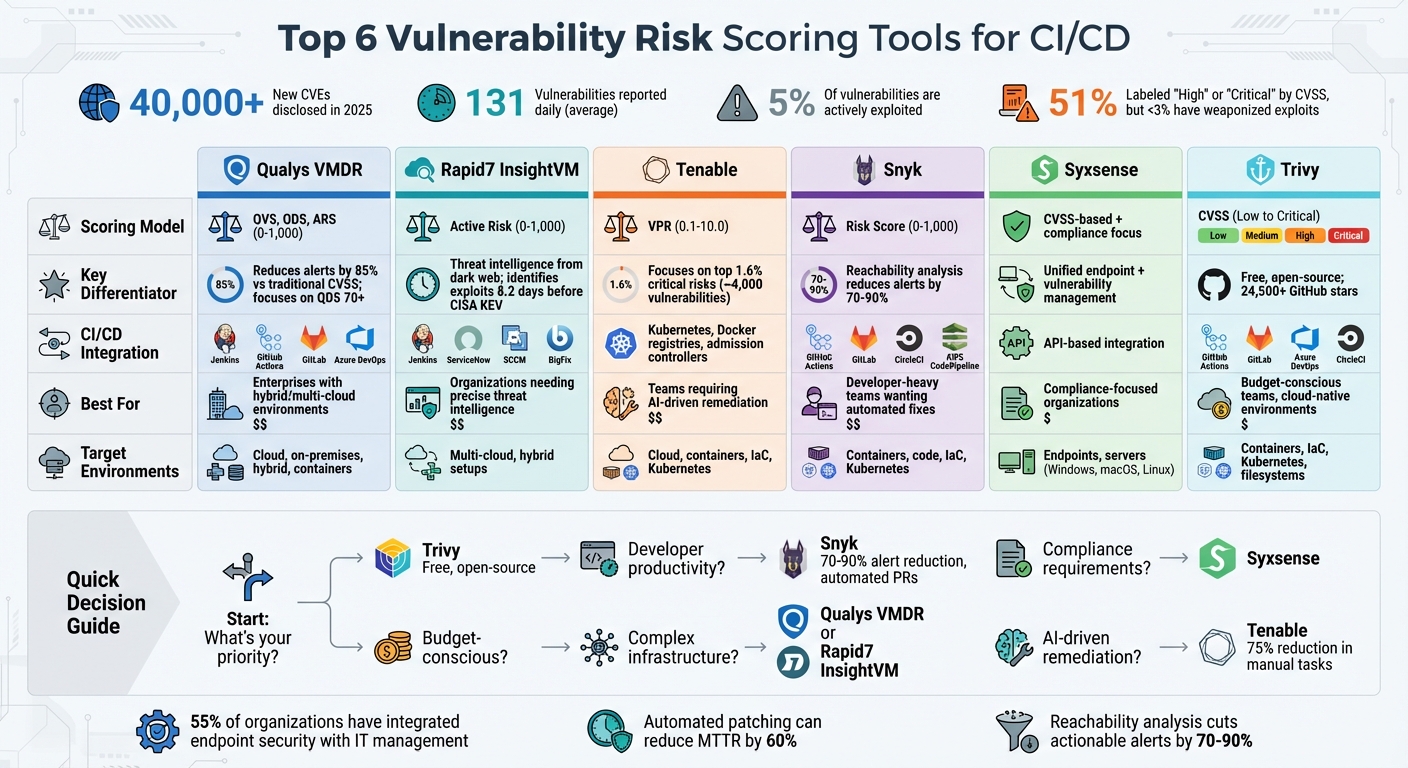 {Vulnerability Risk Scoring Tools Comparison for CI/CD Pipelines}
:::
{Vulnerability Risk Scoring Tools Comparison for CI/CD Pipelines}
:::
Secure Your CI/CD: Trivy Image & Filesystem Scans in GitLab Pipelines
1. Qualys VMDR
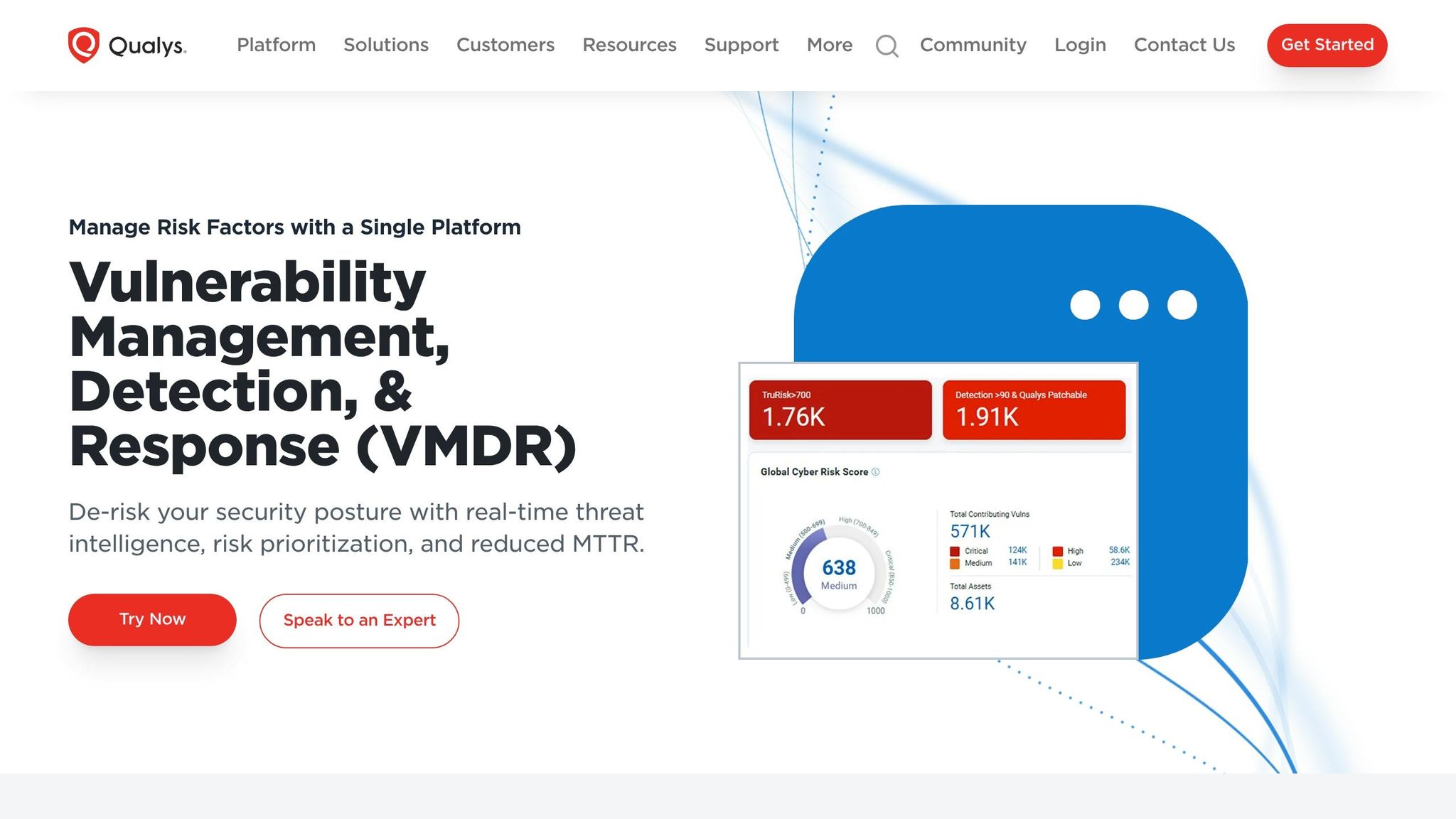
Qualys VMDR (Vulnerability Management, Detection, and Response) takes a smarter approach to risk assessment by using context-driven scoring instead of relying solely on static CVSS ratings. Rather than treating every vulnerability marked as Critical
the same, it uses the Qualys TruRisk framework to assess actual business risk. This is crucial because although 51% of vulnerabilities are labelled as High
or Critical
by CVSS, less than 3% have weaponised exploits or evidence of active exploitation [7]. Here's how VMDR stands out with its scoring system, integration options, automation tools, and multi-environment capabilities.
Scoring Methodology
VMDR uses a three-level scoring system to prioritise vulnerabilities effectively:
- Qualys Vulnerability Score (QVS): This measures the likelihood of exploitation for each CVE. It combines CVSS base scores with additional data, such as CISA KEV status, exploit maturity, and live threat intelligence from 25 global sources, including the Dark Web and GitHub [4][6][7].
- Qualys Detection Score (QDS): This takes the highest QVS from related CVEs and adjusts it based on environmental factors, such as whether a vulnerable service is disabled [6][8].
- Asset Risk Score (ARS): A 0–1,000 rating that considers the criticality of the asset and its exposure to the internet. For example, assets discoverable via Shodan are automatically assigned higher scores [4][8].
This system can reduce the number of vulnerabilities needing immediate attention by up to 85% compared to traditional CVSS-based methods [7]. Qualys suggests prioritising vulnerabilities with a QDS of 70 or higher [6][7], demonstrating how this tailored approach focuses on threats that are actively dangerous, not just theoretically risky.
Integration Capabilities
VMDR integrates seamlessly into CI/CD pipelines using tools like QScanner and TotalAppSec. It supports popular development platforms such as Jenkins, GitHub Actions, GitLab, Azure DevOps, Bamboo, and TeamCity [9]. This allows security checks to occur early in the development process, scanning code, dependencies, and container images before production, while maintaining visibility throughout the software lifecycle [1][11]. API integrations also help speed up vulnerability assessments [9].
For remediation, VMDR connects with ITSM tools like ServiceNow and Jira, automatically assigning tickets with 96% accuracy based on asset tags and risk scores. This can cut the mean time to remediation by up to 60% [10]. Developers benefit from in-tool guidance, as remediation suggestions appear directly in IDEs like Visual Studio Code and Git repositories, removing the need to navigate between applications [1][9].
Automation Features
Qualys Flow (QFlow) provides a no-code interface for automating tasks, such as isolating high-risk instances or closing insecure groups [11]. The Patch Now
feature lets users initiate remediation straight from the prioritisation dashboard [5]. Organisations using Qualys Patch Management have been able to patch CISA's top 15 exploited vulnerabilities of 2021 up to 60% faster than those relying on traditional methods [12].
Multi-Environment Support
VMDR is designed for flexibility, supporting on-premises systems, hybrid clouds, containerised environments, and mobile endpoints - all from a single platform [10][11]. It uses Cloud Agents for real-time monitoring, virtual scanner appliances for network devices, and Network Passive Sensors for environments where active scanning could be disruptive [11]. API-based Cloud Connectors inventory resources across AWS, Azure, GCP, and Oracle Cloud [11]. With a knowledge base covering over 85,000 CVEs, all findings are normalised into the TruRisk scoring system, ensuring consistent risk assessment across different environments [11].
Qualys VMDR reflects the growing need for context-aware risk prioritisation, making it an essential tool for modern CI/CD workflows.
2. Rapid7 InsightVM
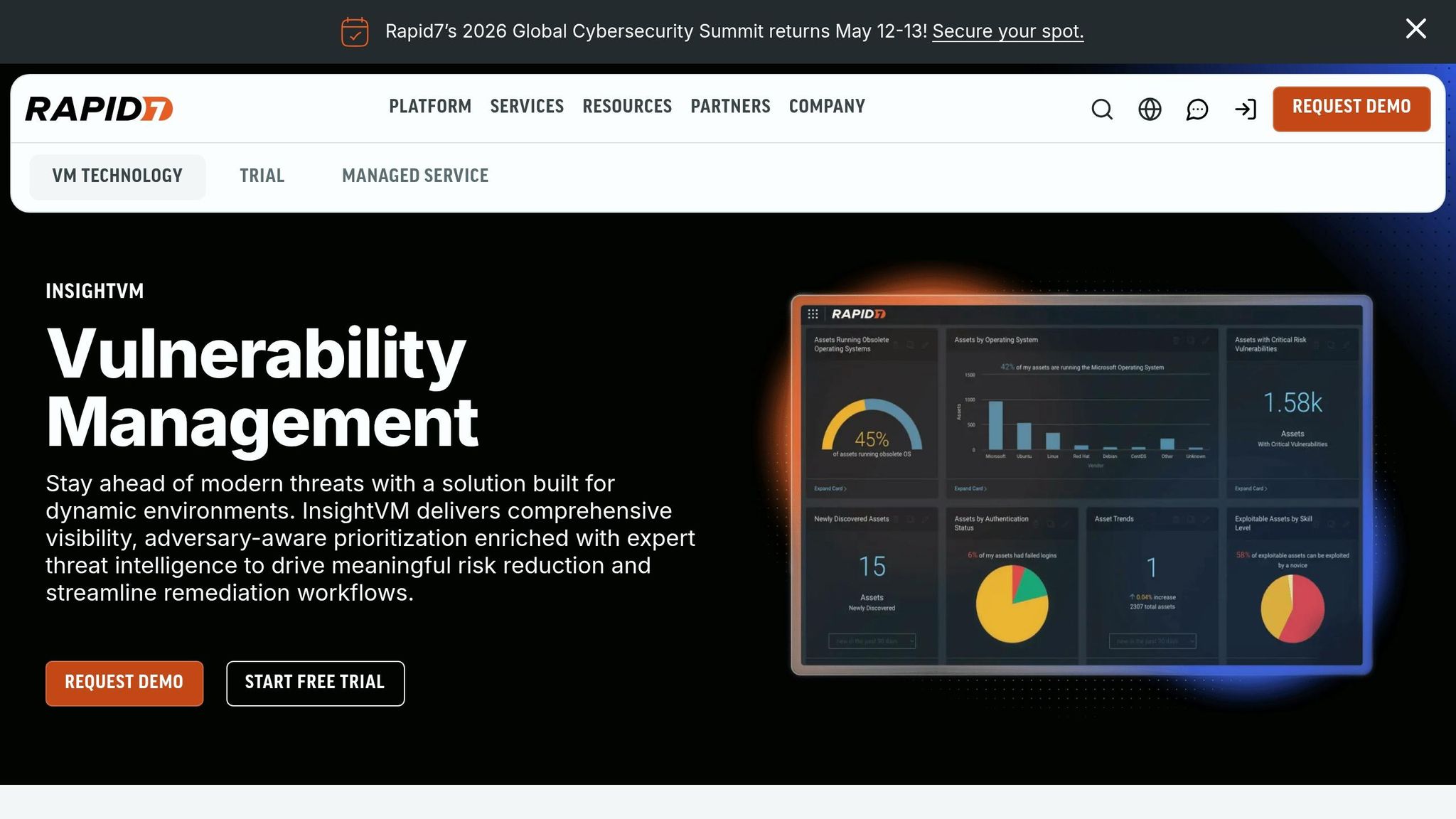
Rapid7 InsightVM has introduced a new vulnerability risk scoring model called Active Risk, replacing all previous models, including RealRisk, Temporal, and Weighted, as of 21 January 2026 [13]. This scoring system uses a 0–1,000 scale, offering much finer detail compared to the traditional 1–10 CVSS. This allows for precise filtering, such as narrowing down vulnerabilities with scores between 792–950 [28,34]. This shift makes InsightVM particularly appealing for CI/CD pipelines that demand precise risk management.
Scoring Methodology
The new Active Risk model combines technical severity with real-world threat intelligence to create a more informed risk score. It starts with CVSS v3.1 as its base and integrates threat intelligence from sources like AttackerKB, Metasploit, ExploitDB, and Project Lorelei, including insights from dark web activity [13]. The system also adjusts scores based on whether a vulnerability is actively exploited, using data from CISA's Known Exploited Vulnerabilities list and Rapid7's own research, while also considering the vulnerability's age [28,30].
Active Risk uses the latest CVSS score with intelligence from threat feeds like AttackerKB, Metasploit, ExploitDB... to provide security teams with a threat-aware vulnerability risk score.- Rapid7 Documentation [13]
Business context is incorporated using Asset Criticality Tags. For example, assets tagged as Very High
criticality double the base risk score, while Very Low
assets halve it [31,33]. Similar to Qualys VMDR's approach, this ensures that only the most critical vulnerabilities are prioritised. Additionally, any end-of-life operating systems or software automatically receive a maximum CVSS score of 10.0 to highlight their critical risk level. Vulnerability definitions are updated every six hours, ensuring teams always have the latest information [15].
Integration Capabilities
InsightVM integrates seamlessly into CI/CD pipelines using the InsightVM Container Scanner plugin for Jenkins, which automates the scanning of Docker images during the build process [35,38]. Its RESTful API enables programmatic control, allowing teams to trigger scans, retrieve results, and manage exceptions. Native integrations with Jira and ServiceNow simplify remediation workflows, while partnerships with Microsoft SCCM and IBM BigFix streamline patch management [13]. These features make remediation faster and more efficient.
Automation Features
Automation plays a central role in InsightVM, particularly through its Remediation Hub, which offers a unified interface for prioritising tasks across hybrid environments [17]. InsightConnect workflows can handle up to 10,000 assets, enabling teams to automate large-scale remediation efforts [17]. For Jenkins users, the assessContainerImage step can be configured to fail builds or mark them as unstable when issues like malware kits or high CVSS scores are detected [16]. Additionally, dynamic asset discovery ensures that all assets across AWS, Azure, VMware, and mobile environments are identified and tracked automatically [14].
Multi-Environment Support
InsightVM is designed to work across on-premises systems, hybrid cloud environments, and containerised setups. Distributed Scan Engines and the Rapid7 Insight Agent enable coverage across diverse architectures [14]. For modern microservices, containerised Scan Engines can be deployed, while API-based cloud connectors inventory resources across AWS, Azure, and GCP [28,36]. The platform also supports Reverse
communication, where the Scan Engine initiates contact with the Security Console, making it suitable for environments with strict inbound traffic rules [14]. These capabilities make InsightVM a strong contender for CI/CD vulnerability management in complex environments.
3. Tenable Nessus and Tenable One
In the world of CI/CD, Tenable's solutions stand out by cutting through the noise, helping teams zero in on vulnerabilities that truly matter.
Tenable achieves this by using its Vulnerability Priority Rating (VPR), which addresses the shortcomings of traditional CVSS scores. While CVSS marks about 60% of all CVEs as High
or Critical
, Tenable's VPR focuses on the top 1.6% of vulnerabilities that pose the most serious risks [18][22]. This precision narrows the scope to around 4,000 critical vulnerabilities, making risk management more focused and actionable. Here’s a closer look at how VPR works, along with its integration and automation features.
Scoring Methodology
VPR operates on a scale from 0.1 to 10.0 and updates nightly, covering more than 280,000 unique vulnerabilities [22]. It combines technical severity with threat intelligence to predict the likelihood of exploitation in the near term. The system evaluates factors like exploit code maturity (from Unproven
to High
), threat intensity, and recency alongside CVSS impact scores [18][19]. Impressively, Tenable's research team identifies exploited vulnerabilities an average of 8.2 days before they appear on CISA's KEV list [23], giving organisations a critical head start.
Tenable also incorporates the Asset Criticality Rating (ACR), a simple 1–10 scale that measures an asset’s importance to your organisation. When paired with VPR, it produces an Asset Exposure Score (AES), which ranges from 0 to 1,000, offering clear insight into which systems demand immediate attention [18][20]. For cloud environments, Tenable uses the NIST Common Configuration Scoring System (CCSS) to evaluate misconfigurations, adding another layer to its vulnerability management approach [21]. Additionally, generative AI scans web content to contextualise CVEs - highlighting threats like ransomware or zero-day exploits - and generates remediation steps in plain language [18][22].
Integration Capabilities
Tenable One Cloud Exposure brings automation to vulnerability detection across the entire container lifecycle. From local Docker setups to CI/CD pipelines during build and test phases, and even container registries on major cloud platforms, the platform ensures comprehensive coverage [23]. Its API allows programmatic access to Kubernetes cluster data and vulnerability insights, making it easy to integrate findings into wider security workflows [23][24]. Teams can also set up admission controllers to enforce security policies, ensuring that containers failing baseline requirements never make it to production [23].
Automation Features
Tenable takes automation to the next level, streamlining vulnerability management in CI/CD processes.
One standout feature is shift-left container scanning, which identifies vulnerabilities early in development. The platform also supports triggered agent scans for transient or remote assets, maintaining continuous coverage in dynamic environments [19]. Tenable’s ExposureAI, powered by generative AI, automatically creates threat summaries and detailed remediation instructions [18][22]. Marcos Saiz, CISO at TB Consulting, highlights the impact:
Tenable One has helped our engineers reduce the time spent on manual tasks by 75%, which allows them to focus on actual engineering work[24]
This reduction in manual effort - by an impressive 75% - frees up engineers to focus on more strategic tasks, a crucial advantage in fast-paced CI/CD workflows where both speed and precision are critical.
4. Snyk
Snyk takes a developer-focused approach to vulnerability risk scoring, moving away from traditional CVSS-based methods. Instead, it uses a Risk Score ranging from 0 to 1,000. By adopting a probabilistic model, Snyk evaluates the likelihood of exploitation, focusing only on vulnerabilities that pose actual risks [26]. This is crucial because over 95% of vulnerabilities are unlikely to be exploited, with genuine threats concentrated in the top 1% [26].
Scoring Methodology
Snyk's Risk Score is built from two subscores: Impact and Likelihood.
- Impact considers CVSS metrics like Confidentiality, Integrity, Availability, and Scope, alongside Business Criticality, a customisable attribute that reflects the importance of a project to your organisation [25].
- Likelihood uses objective data like Exploit Maturity, the Exploit Prediction Scoring System (EPSS) (updated daily), and Social Trends - activity on platforms like X (formerly Twitter) that may indicate potential exploitation [25][28].
Snyk further refines this likelihood through Reachability Analysis, which checks if your code actually calls the vulnerable function, and Transitive Depth, distinguishing between direct and indirect dependencies [25][26]. For teams using Snyk AppRisk, runtime context such as whether a vulnerability is Deployed
, Loaded
, or Public-facing
adds even more precision [29]. These layers of detail make Snyk's scoring system a powerful tool for seamless integration into CI/CD workflows.
Integration Capabilities
Snyk's scoring system is designed to integrate effortlessly into CI/CD pipelines. It works natively with popular platforms like Jenkins, GitHub Actions, Azure Pipelines, CircleCI, AWS CodePipeline, and GitLab [30][31]. Teams can use Snyk's native integrations for simplicity or opt for the Snyk CLI for more advanced configurations. The CLI is particularly suitable for large-scale deployments, offering stable releases and the ability to test preview features [30].
One standout feature is that pipeline-based testing doesn’t require importing repositories via source control integration, unlike PR checks [32]. Snyk also connects with tools like Jira and Slack for automated alerts, ensuring teams stay updated without needing to switch platforms.
Automation Features
Snyk's automation tools simplify vulnerability management even further. The snyk test command can automatically fail builds based on specific criteria. For instance, using --fail-on=upgradable blocks vulnerabilities with available fixes, while --severity-threshold=high prevents critical risks from progressing to production [33].
PR Checks scan code in real-time, offering actionable remediation advice before merging [27]. When vulnerabilities are found, Snyk can generate one-click pull requests to apply the necessary fixes, reducing manual workload. Stuart Larsen, Security Engineer at MongoDB, highlights Snyk's impact:
Before Snyk, our approach to open source security was slow and time-consuming... There are only a few security engineers at the company, but hundreds of developers; we will never scale with them, so we must proactively enable them[35].
The snyk monitor command creates a snapshot of the dependency tree, alerting teams to newly discovered vulnerabilities in existing deployments. Meanwhile, the snyk-delta tool ensures builds fail only for new vulnerabilities introduced in a specific commit, avoiding disruptions from existing backlogs [33]. For Java and JavaScript projects, enabling Reachability Analysis helps prioritise vulnerabilities that are actually reachable by the application's code, reducing false positives and developer fatigue [34].
Need help optimizing your cloud costs?
Get expert advice on how to reduce your cloud expenses without sacrificing performance.
5. Syxsense Vulnerability & Endpoint Management
Syxsense offers a unified platform that combines endpoint security with IT management, reflecting a growing trend where 55% of organisations have already integrated these functions[36]. Rather than treating vulnerability scoring as a standalone task, Syxsense weaves it into a broader endpoint management strategy that works across all major operating systems. Its integration with CI/CD processes ensures that vulnerabilities are assessed and addressed throughout the development lifecycle, keeping pace with rapid CI/CD cycles.
Scoring Methodology
Syxsense uses a risk-based prioritisation model for vulnerability management within CI/CD environments. This approach aligns vulnerability assessments with compliance frameworks like PCI DSS, HIPAA, ISO, SOX, and CIS Benchmarks (Levels 1–3). By doing so, it helps teams evaluate not just the technical severity of vulnerabilities but also their potential regulatory impact. The platform’s Zero Trust Evaluation Engine continuously monitors device posture, quarantining non-compliant devices immediately to stop threats from spreading[36].
Integration Capabilities
With an open API, Syxsense integrates seamlessly into existing management and security tools used in DevOps environments. Its cloud-based design supports multi-environment deployments, ensuring continuous management and security of endpoints across diverse setups[36]. As Omdia highlights:
Organisations are increasingly turning to proactive security solutions to provide a modern foundation for their operational cyber-risk management strategies and to validate and optimise how existing security solutions address key security controls[36].
Automation Features
The Syxsense Cortex™ platform automates the entire vulnerability management process, from scanning to remediation. It comes equipped with pre-built remediation options and uses AI and machine learning to predict and respond to potential threats[37]. By automating routine workflows, the platform reduces manual intervention, allowing teams to focus on higher-level security tasks[36]. This automation also integrates seamlessly with DevSecOps workflows, ensuring smoother operations within the CI/CD pipeline.
6. Trivy
Trivy is an open-source security scanner licensed under Apache-2.0. With over 24,500 stars on GitHub, it's a popular choice for organisations seeking a cost-free solution for detecting vulnerabilities. Trivy scans container images, filesystems, Git repositories, and Kubernetes clusters. It also identifies misconfigurations in Infrastructure as Code frameworks like Terraform, CloudFormation, and Kubernetes manifests [38][41].
Scoring Methodology
Trivy relies on security advisories from OS vendors such as Red Hat, Debian, and Ubuntu. This approach helps minimise false positives since vendors often backport security fixes to older package versions. According to Trivy's documentation:
The severity is taken from the selected data source since the severity from vendors is more accurate... Red Hat evaluates the severity more accurately. That's why Trivy prefers vendor scores over NVD.[39]
If vendor-specific severity ratings aren't available, Trivy uses CVSS scores, followed by NVD data, and finally labels the risk as unknown. Users can opt for the precise
mode, which focuses on reducing false positives, or the comprehensive
mode, which aims to catch more vulnerabilities by reducing false negatives. For CI/CD pipelines, the --severity and --exit-code flags allow builds to fail automatically when HIGH
or CRITICAL
vulnerabilities are detected [39].
Integration Capabilities
Trivy supports Azure DevOps and GitHub Actions, as well as integrations with Buildkite, Dagger, Semaphore, CircleCI, Woodpecker CI, and Concourse CI [40]. GitLab users benefit from native integration, where vulnerabilities are displayed directly in merge requests using standard templates [41]. It also works with major cloud registries like AWS ECR, Azure ACR, Google GCR, and Harbour. Additionally, Trivy can act as a Kubernetes admission controller through Kyverno or OPA Gatekeeper to enforce compliance policies. Scans typically take 10–30 seconds, while cached scans are even faster, completing in under 15 seconds, making it ideal for CI/CD pipelines [41].
Automation Features
Trivy's --ignore-unfixed flag excludes vulnerabilities without available patches, preventing pipeline failures over unresolvable issues. It can also generate a Software Bill of Materials (SBOM) in CycloneDX or SPDX formats, enhancing supply chain security compliance. Teams can use a .trivyignore file to suppress specific CVEs that are non-exploitable in their context, with an option to set expiration dates for regular reviews [41][42]. These automation features ensure Trivy integrates seamlessly into modern CI/CD workflows.
Advantages and Disadvantages
Let’s break down the key strengths and limitations of each tool discussed, keeping in mind that no single solution fits all scenarios.
Each tool offers distinct benefits for managing vulnerabilities in CI/CD pipelines, but they also come with trade-offs.
Snyk is tailored for developer-focused workflows, using its Risk Score (0–1,000) to incorporate reachability analysis. This reduces actionable alerts by 70–90%, helping teams prioritise vulnerabilities that pose real threats to applications [44][45]. However, its licensing starts at around £20 per developer per month, which can become costly for larger organisations [3].
Trivy, a free and open-source tool, shines with its broad capabilities across containers, IaC, secrets, and Kubernetes. Its fast scanning makes it ideal for rapid CI/CD pipelines [43]. On the downside, Trivy relies on CVSS severity levels rather than adaptive risk-based scoring, which can lead to an overload of alerts compared to tools that include exploit prediction models.
Qualys VMDR and Rapid7 InsightVM provide enterprise-grade solutions, excelling in asset discovery and threat intelligence. They are well-suited for multi-environment setups but require substantial financial investment, with pricing typically determined through quotes [3]. Additionally, their complexity can result in longer implementation times compared to lightweight tools.
| Tool | Scoring Methodology | Integration Capabilities | Automation Features | Multi-Environment Support |
|---|---|---|---|---|
| Qualys VMDR | Context-driven prioritisation with threat intelligence and asset criticality [1] | Multi-cloud (AWS, Azure, GCP), hybrid environments, QScanner integration [1] | Automated lifecycle scanning (code to runtime); drift detection [1] | Containers, VMs, cloud workloads, on-premises |
| Rapid7 InsightVM | Risk-based scoring with exploit maturity | Cloud, on-premises, and container environments | Automated remediation workflows and ticketing | Multi-cloud and hybrid deployments |
| Tenable | VPR (Vulnerability Priority Rating) with threat intelligence | Cloud platforms, containers, on-premises infrastructure | Automated scanning schedules and compliance reporting | AWS, Azure, GCP, Kubernetes, VMs |
| Snyk | Risk Score (0–1,000) using EPSS, reachability, business context [25] | IDEs, SCMs, CI/CD platforms, container registries [35] | One-click automated fix PRs; daily score updates [25][35] | Containers, code, IaC, Kubernetes |
| Syxsense Vulnerability & Endpoint Management | CVSS-based with patch priority scoring | Windows, macOS, Linux endpoints | Automated patch deployment and remediation | Endpoints and servers across platforms |
| Trivy | CVSS severity levels (Low to Critical) [43] | GitHub Actions, GitLab, Harbor, AWS Security Hub [43] | CLI-based gating via exit codes; IaC misconfiguration detection [43] | Containers, IaC, Kubernetes, VM images, filesystems |
Ultimately, the right tool depends on your organisation’s needs. Budget-conscious teams might lean towards Trivy’s cost-free model, while developer-heavy environments could benefit from Snyk’s precise remediation. For enterprises with complex infrastructures, the depth offered by Qualys VMDR or Rapid7 InsightVM could be essential.
Conclusion
Select a tool that aligns with your organisation's workflow and security goals. For developer-centric teams, Snyk integrates directly into pull requests and IDEs, enabling automated fixes without disrupting workflows. This approach can help mitigate risks while improving developer productivity.
For teams seeking a lightweight or open-source option, Trivy is an excellent choice. It scans containers, infrastructure as code, and secrets quickly, making it ideal for cloud-native environments or those prioritising simplicity over advanced enterprise features.
If your organisation operates across complex, multi-layered infrastructures, tools like Qualys VMDR or Rapid7 InsightVM stand out. These solutions excel at asset discovery and threat management across hybrid cloud setups. Alternatively, for teams aiming to consolidate tools, platforms that combine SAST, SCA, and IaC scanning into a single workflow can simplify security management.
Integrating security early in the development cycle is key. Features like reachability analysis and automated remediation can significantly reduce noise, with reachability analysis cutting actionable alerts by 70–90% [45], helping to combat alert fatigue. As AppSec expert Suphi Cankurt cautions:
If developers learn to ignore SCA results, the tool becomes useless[44]
Begin by tackling critical vulnerabilities to avoid overwhelming your team, gradually expanding coverage as processes mature. Since only 5% of vulnerabilities are actively exploited [2], prioritisation is crucial. The right tool should enhance your CI/CD pipeline by reducing unnecessary alerts, offering clear guidance, and integrating smoothly into your existing workflows - without causing deployment delays.
FAQs
How is risk scoring different from CVSS?
Risk scoring takes vulnerability assessment a step further than CVSS by considering the broader context. It evaluates factors like asset importance, exploitability, and potential business impact. While CVSS delivers a standardised severity score ranging from 0 to 10 based on technical criteria, risk scoring provides a more customised perspective. This approach helps prioritise vulnerabilities based on their real-world threat level and potential repercussions, enabling teams to better align their efforts with their unique security and operational priorities.
Which tool fits my CI/CD pipeline best?
When choosing the right tool, it all comes down to what you need. PipeGuard shines when it comes to pipeline-specific security. It offers detailed scoring, pinpoints misconfigurations, uncovers secrets and vulnerabilities, and even provides fix suggestions along with maturity assessments. On the other hand, Trivy takes a broader approach. It scans container images, filesystems, git repositories, and Kubernetes clusters, checking for vulnerabilities, misconfigurations, secrets, and licence issues.
If you’re looking for in-depth pipeline scoring, go with PipeGuard. But if you need a tool that can handle multiple targets and offers seamless integration options, Trivy is the way to go.
How do I set build-fail thresholds without slowing releases?
To establish build-fail thresholds while keeping releases on track, incorporate automated security checks into your CI/CD pipeline. Set up these tools to scan elements like dependencies, container images, or infrastructure as code. Then, define risk score thresholds that will trigger a build failure if surpassed. By embedding these quick, automated checks early in the process, you can identify problems promptly without disrupting your deployment schedule.