
Want to save up to 90% on cloud costs? AWS Spot Instances are a game-changer for batch processing. These instances tap into unused Amazon EC2 capacity at a fraction of the price of On-Demand instances. The trade-off? AWS can reclaim them with a two-minute warning. But for fault-tolerant tasks like data analysis, media rendering, or machine learning, this is a manageable risk.
Key Insights:
- Massive Savings: Spot Instances cost up to 90% less than On-Demand.
- Perfect for Batch Jobs: Ideal for fault-tolerant tasks that can handle interruptions.
- Real Results: Companies like Arm and Lyft cut compute costs by 40% and 75%, respectively.
- Tools to Simplify: AWS Batch automates resource management, rescheduling tasks if interruptions occur.
- Mitigating Interruptions: Strategies like diversifying instance types and checkpointing ensure smooth operations.
Spot Instances are a cost-effective solution for scalable workloads. With the right strategies, you can minimise disruptions while slashing expenses significantly.
Create Amazon EC2 Spot Instances Step-by-Step
The Problem: High Costs of On-Demand Instances for Batch Processing
On-Demand instances can be up to 10 times more expensive than Spot instances [2][1], creating a massive financial strain for organisations managing scalable batch workloads. Since batch processing often involves compute-heavy tasks requiring hundreds of parallel nodes, costs can escalate quickly as data volumes grow, putting significant pressure on IT budgets [1].
Adding to the challenge is the issue of static pricing. On-Demand rates stay fixed regardless of global usage levels [5], forcing organisations to pay for guaranteed availability that many fault-tolerant batch tasks don’t actually need [5][8]. As Tipu Qureshi, AWS Senior Cloud Support Engineer, explains:
With Spot Instances, you can save up to 90% of costs by bidding on spare Amazon Elastic Compute Cloud (Amazon EC2) instances [2].
These high On-Demand costs also limit the number of concurrent instances organisations can afford, delaying batch job completion and slowing down time-to-insight [1]. To put this into perspective: running 100 m5.large instances on On-Demand would cost around £6,912 per month, while the same workload on Spot instances could cost as little as £691 [10]. This stark difference underscores the inefficiency of On-Demand pricing for fault-tolerant tasks.
Workloads Affected by High Costs
Certain types of batch workloads are particularly vulnerable to these cost challenges. For example:
- Data analytics and ETL pipelines: These require substantial parallel processing power, with high vCPU and memory requirements [5][8].
- CI/CD tasks: Automated software builds and testing cycles can quickly rack up costs when using On-Demand instances [8].
- Media processing: Tasks like video rendering or large-scale image transformations often involve compute-heavy operations that can take hours or even days [2][1].
Other examples include machine learning model training, scientific research applications like genomic sequencing, and financial services tasks such as claims processing or risk modelling [1][8][2]. These workloads share a key trait: they’re fault-tolerant and can be broken into smaller, independent steps. This makes the high reliability guarantees of On-Demand instances unnecessary - and expensive - for such use cases [9][10]. Addressing these inefficiencies calls for a more flexible and cost-effective approach.
The Solution: Using AWS Spot Instances for Batch Workloads
AWS Spot Instances allow organisations to access spare EC2 capacity at a fraction of the cost of On-Demand instances. This approach provides the same performance as On-Demand options but comes with the condition that AWS may reclaim these instances with just a two-minute warning if demand for capacity rises[1]. Despite this, Spot Instances are an excellent choice for certain workloads, especially batch processing.
Batch workloads are inherently fault-tolerant, meaning they can handle interruptions without losing data. They simply need to finish at some point, making them a perfect match for the cost savings offered by Spot Instances.
The real-world benefits are striking. Since 2014, the NFL has saved over $20 million by using Spot Instances to run simulations for their annual season schedule[7]. Mike North, NFL VP of Broadcasting Planning, highlighted this success:
Leveraging Spot Instances to build the season schedule has enabled the NFL to save over $20 million since 2014.[7]
Other organisations have seen similar results. Lyft reduced its monthly compute costs by 75% with minimal changes to its codebase, while Delivery Hero slashed costs by 70% by running Kubernetes workloads on Spot capacity[7].
How Spot Instances Work
Spot pricing is based on a supply-and-demand model. AWS adjusts prices gradually, reflecting trends in spare capacity over time[5]. Users pay the current Spot price for each hour their instance runs, with rates usually 70% to 90% lower than On-Demand pricing.
AWS manages pools of unused EC2 capacity across various instance types and Availability Zones. When you request Spot Instances, AWS allocates capacity at the prevailing Spot price. If On-Demand demand increases, AWS may reclaim the capacity, providing a two-minute interruption notice. This gives applications time to save their state or shut down gracefully. This predictable pricing and interruption system integrates seamlessly with AWS Batch, improving workload resilience.
Adding Spot Instances to Batch Processing
AWS Batch makes it easier to harness the cost benefits of Spot Instances for batch jobs. The service automatically provisions the right quantity and type of compute resources based on your job queue and specified instance types[1]. Once a job is submitted, AWS Batch takes care of provisioning the required instances, running the containerised workload, and scaling down when the job is finished.
In cases where a Spot Instance is reclaimed, AWS Batch reschedules the job automatically and retries up to 10 times to minimise disruption[1][4]. By using the SPOT_PRICE_CAPACITY_OPTIMIZED allocation strategy and spreading workloads across multiple capacity pools, organisations can reduce the impact of price fluctuations and interruptions by up to 80%[2].
Challenges of Using Spot Instances and How to Address Them
Spot Instances offer impressive cost savings, but they come with their own set of challenges that require careful planning. The biggest concern? Instance interruptions. AWS can reclaim capacity with as little as two minutes' notice. However, interruptions are relatively uncommon - less than 5% of Spot Instances are interrupted by AWS before customers intentionally terminate them[11]. With the right approach, these interruptions can be handled effectively without major disruptions.
Managing Spot Interruptions
Handling interruptions starts with diversification and strategic allocation. Workloads should be distributed across at least 10 different instance types and all Availability Zones within a region[8]. This increases the chances of finding available capacity when one pool is reclaimed.
Using allocation strategies like price-capacity-optimized or capacity-optimized can make a big difference. These strategies prioritise launching instances from the largest capacity pools, reducing the likelihood of interruptions by up to 80%[4]. Additionally, breaking long jobs into smaller tasks - no longer than 30 minutes - can help minimise the impact of interruptions[4].
AWS also provides a rebalance recommendation
signal ahead of the two-minute interruption notice. This gives you a chance to launch replacement capacity before the interruption occurs[8][12]. For critical workloads, it’s wise to have a fallback plan. For example, interrupted Spot jobs can automatically resubmit to an On-Demand queue, ensuring they still get completed even if Spot capacity is unavailable[3].
With these strategies in place, interruptions become manageable, allowing workloads to continue running smoothly.
Maintaining Reliability and Performance
Successfully managing interruptions is key to maintaining operational stability while enjoying the cost benefits Spot Instances provide.
Best practices make Spot Instances a reliable option. Scott Horsfield, Sr. Specialist Solutions Architect for EC2 Spot, highlights this:
When you follow the best practices, the impact of interruptions is insignificant because interruptions are infrequent and don't affect the availability of your application.[11]
For longer-running batch jobs, checkpointing is a game-changer. By regularly saving progress to S3 or DynamoDB, tasks can pick up where they left off instead of starting over. Monitoring the Instance Metadata Service for the instance-action signal enables in-instance scripts to perform graceful shutdowns when interruptions are imminent[11]. For Kubernetes workloads, the AWS Node Termination Handler can automatically cordon and drain nodes upon detecting an interruption signal[11].
Need help optimizing your cloud costs?
Get expert advice on how to reduce your cloud expenses without sacrificing performance.
Cost Savings: Spot Instances vs On-Demand Instances
::: @figure 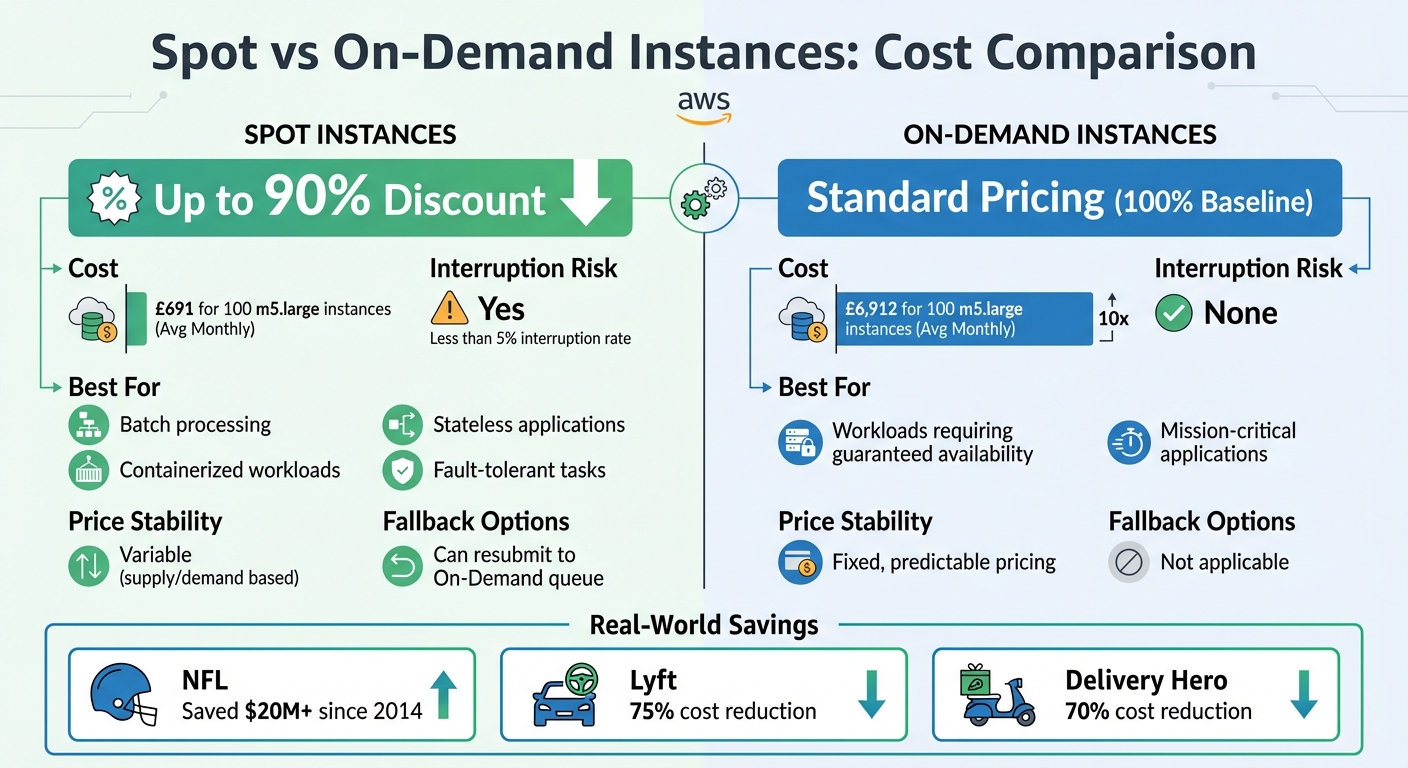 {AWS Spot vs On-Demand Instances: Cost Comparison for Batch Workloads}
:::
{AWS Spot vs On-Demand Instances: Cost Comparison for Batch Workloads}
:::
When it comes to reducing cloud costs, Spot Instances offer an impressive advantage, particularly for batch workloads.
Spot Instances can slash batch processing costs by as much as 90% compared to On-Demand pricing. This makes them an excellent choice for organisations aiming to optimise their cloud spending. They work especially well for tasks like containerised applications, stateless processes, or batch jobs equipped with checkpoints. These types of workloads can adapt to interruptions without compromising results.
As mentioned earlier, spreading workloads across multiple capacity pools is another effective way to minimise both price swings and the likelihood of interruptions. This strategy pairs well with interruption management techniques, helping to turn potential disruptions into manageable inconveniences rather than expensive setbacks.
Here’s a quick comparison of Spot Instances and On-Demand Instances:
| Feature | Spot Instances | On-Demand Instances |
|---|---|---|
| Average Cost | Up to 90% discount | Standard pricing |
| Interruption Risk | Subject to potential interruptions | None |
| Best For | Batch processing, containerised workloads, stateless applications | Workloads requiring guaranteed availability |
| Price Stability | Variable based on supply and demand | Fixed, predictable pricing |
| Fallback Options | Can resubmit to On-Demand queue [3][13] | Not applicable |
Hokstad Consulting: Cloud Cost Optimisation Services
When it comes to batch workloads, the right strategy and expert guidance can make a huge difference. Implementing Spot Instances effectively requires deep knowledge of recovery-focused architectures and cross-cloud cost strategies. Hokstad Consulting specialises in helping UK businesses create and deploy batch processing systems that handle interruptions as routine events, not failures. Their solutions focus on resilient workload designs using stateless architecture, idempotent operations, and well-planned checkpointing.
Their cloud cost engineering services often lead to 30-50% reductions in cloud expenses. They achieve this by pinpointing workloads ideal for Spot Instances and setting up automated lifecycle management. This includes conducting detailed cloud cost audits to identify batch jobs, CI/CD pipelines, and containerised applications that can benefit from Spot capacity. With expertise across AWS, Azure, and GCP, they navigate pricing fluctuations and interruption signals to identify the most stable and cost-efficient regions for your workloads. Their approach aligns seamlessly with the batch workload strategies mentioned earlier.
Hokstad Consulting also builds tailored automation solutions, using tools like AWS EventBridge for interruption alerts, Lambda for replacing instances, and Karpenter for managing Kubernetes nodes. Their migration services are designed to ensure zero downtime, transitioning your systems to cost-optimised architectures without disrupting operations. They also implement hybrid capacity strategies, combining a stable base of On-Demand instances with Spot capacity to balance savings and performance.
To top it off, they offer a No Savings, No Fee
model, where fees are capped as a percentage of the actual savings achieved. This eliminates financial risk while giving you access to expert DevOps support, ongoing infrastructure monitoring, and continuous optimisation as your batch workloads grow and evolve.
Conclusion
Spot Instances can slash costs by up to 90% compared to On-Demand pricing, as demonstrated by examples from the NFL and Lyft [7]. These savings, however, hinge on implementing the right strategies.
The secret lies in diversifying instance types across multiple capacity pools, using the SPOT_CAPACITY_OPTIMIZED allocation strategy, and ensuring workloads can handle interruptions. Techniques like checkpointing or keeping job runtimes under 30 minutes make operations more reliable and cost-efficient. Arm's experience showcases how these methods can lead to substantial cost reductions [6].
For UK businesses, achieving these savings often requires expertise. Partnering with specialists like Hokstad Consulting can simplify the process. Their cloud cost engineering services typically reduce expenses by 30–50%. Plus, their No Savings, No Fee
model ensures you only pay if you see results, with fees tied to the actual savings achieved.
Whether you're dealing with large-scale data processing, CI/CD pipelines, or containerised workloads, Spot Instances offer one of the most effective ways to cut cloud costs while maintaining performance. They are a smart choice for any organisation looking to optimise batch processing in the cloud.
FAQs
How do AWS Spot Instances help lower costs for batch processing workloads?
AWS Spot Instances offer a smart way to slash cloud expenses for batch processing tasks. They provide access to unused EC2 capacity at discounts of up to 90% compared to standard On-Demand rates. This makes them ideal for workloads that are flexible and can tolerate interruptions.
These instances shine in scenarios like data processing, simulations, and large-scale computations - situations where keeping costs low is a priority. Since these tasks can often be distributed or restarted, Spot Instances allow businesses to manage cloud expenses effectively without sacrificing performance for compatible applications.
How can I minimise disruptions when using Spot Instances for batch workloads?
To minimise the risk of disruptions when using Spot Instances, there are a few strategies you can put into action. One effective method is using Auto Scaling groups. These groups can automatically replace interrupted instances, helping your workload continue without major hiccups. Also, make sure to store important data in external storage systems rather than on local instances. This way, you can avoid losing data if an instance gets interrupted.
Another approach is to design your workloads to handle interruptions gracefully. For example, you can use techniques like checkpointing, which involves saving progress at regular intervals. This allows tasks to pick up where they left off if there’s an interruption. Adding retries into your process can also ensure tasks resume efficiently. These strategies let you take advantage of Spot Instances' cost savings while keeping your operations running smoothly.
What kinds of workloads are ideal for using AWS Spot Instances?
AWS Spot Instances are a great fit for fault-tolerant workloads that can manage occasional interruptions. Examples include batch processing, genomic sequencing, animation rendering, claims processing, large-scale data transformations, media processing, and multi-part data analysis.
Because Spot Instances come with substantial cost savings but can be reclaimed by AWS on short notice, they work best for tasks where interruptions won't derail the entire operation. Using these instances allows businesses to cut cloud costs while effectively managing compute-heavy tasks.