
Release governance and compliance are critical for managing software releases effectively, but they serve different purposes:
- Release Governance: Focuses on aligning release decisions with business goals and managing risks. It sets internal policies, roles, and processes to ensure releases are strategic and predictable.
- Release Compliance: Ensures releases meet external legal and regulatory standards, such as GDPR or HIPAA. It involves specific checks to avoid fines, protect data, and maintain security.
Key Differences:
- Governance is proactive, focused on strategy and internal priorities.
- Compliance is reactive, ensuring adherence to external laws and standards.
- Governance allows flexibility; compliance is rigid and mandatory.
Together, governance and compliance create a system that balances speed and control, ensuring releases are both efficient and legally compliant.
The Secure Cloud Cast (E5) | Compliance and Governance with Advanced Cluster Management, Pt. II
What is Release Governance?
Release governance involves setting up policies, processes, and tools that ensure release decisions align with an organisation's overall strategy and risk tolerance. It defines clear boundaries for acceptable actions and identifies who has the authority to make key decisions.
At its heart, governance bridges the gap between business priorities and technical execution. It outlines what’s needed to achieve strategic goals, providing a framework for decision-making and accountability [2]. Rather than just imposing rules, governance ensures that every release decision supports the organisation’s broader objectives and risk management approach.
Good governance doesn’t wait for problems to arise - it actively monitors standards and adapts practices, especially in fast-paced DevOps environments. This alignment helps achieve goals like maintaining quality, managing risks, and ensuring predictable release cycles.
Main Objectives of Release Governance
Release governance is built around a few key goals that keep deployment strategies on track. Quality assurance is a top priority, ensuring that every release meets established standards before it goes live. This often involves a standard checklist to confirm each release is complete and up to the required quality.
Governance also focuses on identifying and addressing risks before they become issues. Tools like Azure Policy or AWS Artifact can automate policy enforcement, ensuring consistent application of standards while reducing manual effort. Additionally, governance improves release predictability by fostering transparency. It clarifies roles and responsibilities, making decision-making processes easier to follow throughout the release cycle.
Examples of Governance Practices
In practice, governance takes on various forms in release management. For instance, change management boards review significant changes to ensure they’re thoroughly evaluated before deployment. Similarly, release roadmaps convert business priorities into actionable technical plans, offering a clear view of long-term objectives.
Automated quality gates within CI/CD pipelines are another example. These gates enforce rules about which resources can be deployed and in which regions. As AWS explains:
By automating governance, organisations help ensure a standardised, consistent approach to risk management, compliance, and security.[1]
This kind of automation turns governance into a tool for efficiency rather than a hurdle. Teams can move faster while staying within the necessary controls. By embedding governance directly into DevOps workflows, automated quality gates ensure standards are upheld without slowing down progress.
What is Release Compliance?
Release compliance ensures that software releases adhere to specific legal standards, regulatory requirements, and internal policies. While governance provides the overall framework for decision-making, compliance is more focused on following externally imposed rules that organisations are legally or industry-bound to meet [3]. Essentially, compliance is about ensuring that these rules are followed, contrasting with the broader strategy of governance discussed earlier.
The primary goal of release compliance is to deploy changes securely while managing risks related to quality, security, and accuracy. Compliance mechanisms act as a safeguard, ensuring that vulnerabilities or unauthorised configurations don't make their way into live systems. It specifically targets technical and regulatory risks, confirming that all necessary checks have been completed.
To achieve this, compliance systems rely on measurable checks and validations. For instance, they might assess system properties like open ports and validate these against pre-defined rules, such as only allowing ports 80 and 443. This process creates an audit trail, demonstrating that the organisation has followed all required protocols [3].
Here's a startling statistic: 70% of applications include flaws in third-party code, and 25% of organisations have faced regulatory fines exceeding £200,000 [4][5].
Main Elements of Compliance in Releases
Compliance in software releases typically revolves around three core areas: data protection, industry-specific regulations, and security protocols.
Data Protection: Laws like GDPR dictate how organisations handle personal data, especially for EU citizens. These regulations require explicit consent for data collection, the right to request data deletion, and strict controls over how data is processed.
Industry-Specific Regulations: Different sectors have their own standards. For example:
-   [PCI DSS](https://en.wikipedia.org/wiki/Payment_Card_Industry_Data_Security_Standard) governs payment card security in finance and e-commerce.
-   HIPAA ensures the confidentiality of medical records in healthcare.
-   [SOX](https://en.wikipedia.org/wiki/Sarbanes%E2%80%93Oxley_Act) (Sarbanes-Oxley) focuses on the integrity of financial reporting for publicly traded companies.
-   [ISO-27001](https://en.wikipedia.org/wiki/ISO/IEC_27001) provides a framework for managing information security across various industries [\[3\]](https://martinfowler.com/articles/devops-compliance.html)[\[6\]](https://pathlock.com/learn/data-privacy-guide-to-definitions-regulations-and-compliance).
- Security Protocols: These are the technical measures underpinning compliance. Examples include vulnerability scanning integrated into CI/CD pipelines, cryptographic signing to verify code integrity, and segregation of duties to prevent developers from approving their own code changes. However, only 15% of organisations report that all developers receive security training, leaving a significant gap in compliance preparedness [4].
How Compliance Differs by Industry
Compliance requirements vary significantly between industries. Heavily regulated sectors like finance, healthcare, and government face much stricter rules compared to less regulated ones. For example, in Australia, the Privacy Principles apply to government bodies and private organisations with annual revenues exceeding £2.4 million [6].
In financial services, organisations must navigate multiple frameworks simultaneously. These include SOX for financial controls, PCI DSS for payment security, and the EU's Digital Operational Resilience Act (DORA), which addresses ICT risk management [3][8]. Healthcare providers focus on HIPAA to safeguard patient data, while public sector entities in the US adhere to FedRAMP standards or obtain Authority to Operate (ATO) certifications. These certifications categorise cloud services into Low, Moderate, and High impact levels, depending on the potential consequences of a data breach [7].
The complexity of compliance often leads to delays. In large organisations or government sectors, manual compliance processes can take six to nine months before a new service is cleared for production [3]. To address this, many organisations are turning to automated compliance checks embedded within CI/CD pipelines. This approach helps maintain high standards without slowing down deployment timelines.
Main Differences Between Release Governance and Compliance
::: @figure 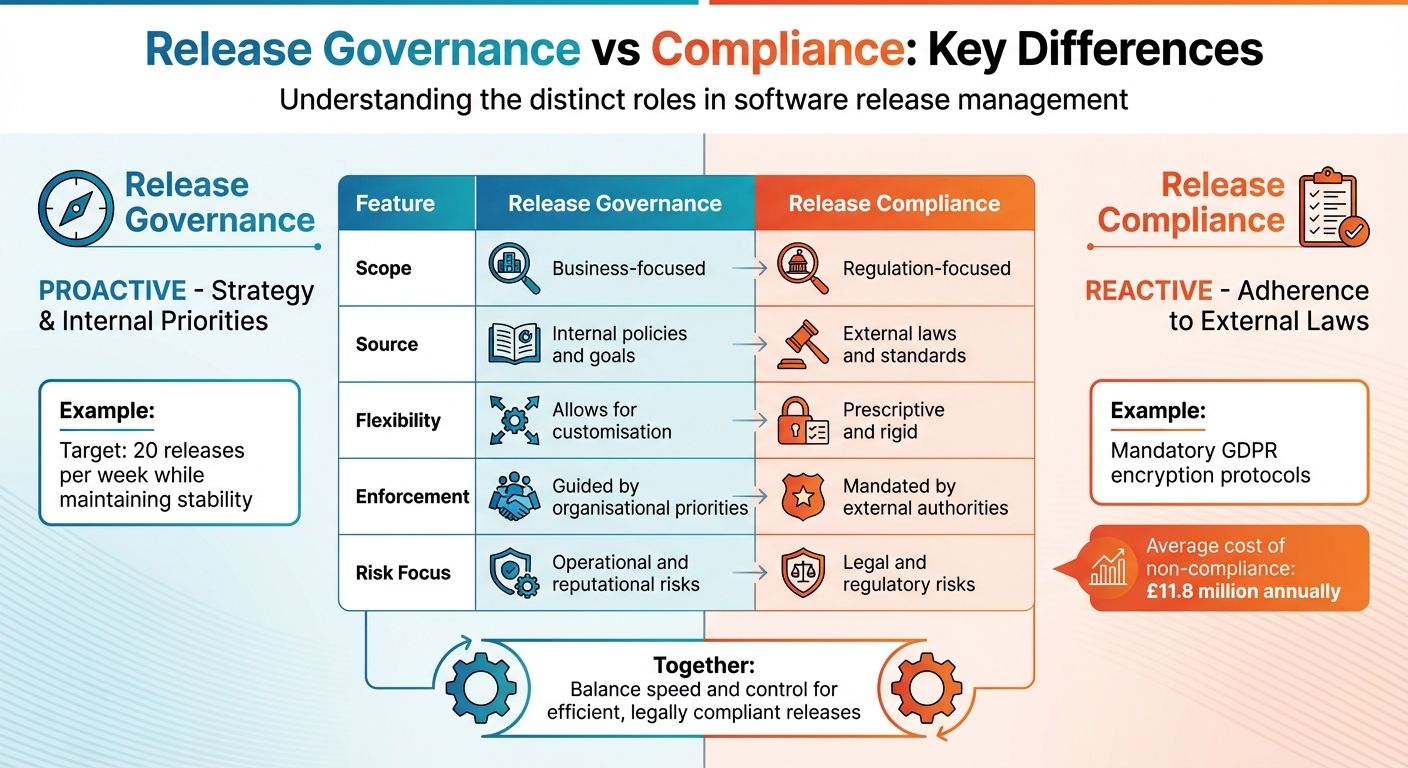 {Release Governance vs Compliance: Key Differences Comparison Chart}
:::
{Release Governance vs Compliance: Key Differences Comparison Chart}
:::
Governance and compliance play distinct roles in release management, each addressing different aspects of organisational operations. Governance focuses on what - outlining strategic direction, decision-making authority, and accountability within the organisation. Compliance, however, deals with how - ensuring adherence to external laws, regulations, and industry standards [2]. This distinction becomes clearer when explored through practical examples.
Governance is shaped by internal strategies, driven by business objectives and stakeholder priorities. In contrast, compliance is dictated by external mandates such as GDPR, PCI DSS, HIPAA, or other industry-specific regulations. These mandates are enforced through audits, certifications, and regulatory reporting [9].
Another key difference lies in flexibility. Governance frameworks, like the UK Corporate Governance Code, often adopt a comply or explain
approach, allowing organisations to tailor policies to their specific needs [11]. Compliance requirements, on the other hand, are rigid and non-negotiable. Failure to meet these standards can result in significant penalties, with the average annual cost of non-compliance estimated at £11.8 million [10].
Governance vs Compliance Comparison Table
| Feature | Release Governance | Release Compliance |
|---|---|---|
| Scope | Business-focused | Regulation-focused |
| Source | Internal policies and goals | External laws and standards |
| Flexibility | Allows for customisation | Prescriptive and rigid |
| Enforcement | Guided by organisational priorities | Mandated by external authorities |
| Risk Focus | Operational and reputational risks | Legal and regulatory risks |
Examples of the Differences
To illustrate: a governance team might set an internal target for deployment frequency, such as achieving 20 releases per week while maintaining system stability. This goal aligns with broader business objectives and can be adjusted to suit organisational needs. Compliance, however, ensures that each of those releases adheres to GDPR requirements, such as implementing specific encryption protocols and data-handling standards - legal obligations that leave no room for flexibility [2].
Another example: governance might guide the selection of cloud services based on strategic priorities and allocate funding accordingly. Meanwhile, compliance ensures those chosen cloud services meet ISO/IEC 27001 certification standards and provide the necessary audit trails to demonstrate adherence [9].
Looking ahead, as of 1 January 2026, UK boards will be required to issue an annual declaration on the effectiveness of material controls
under Provision 29 of the UK Corporate Governance Code. This compliance requirement operates within the larger framework of governance [11].
How Governance and Compliance Work Together in Releases
Governance and compliance act as two sides of the same coin, working together to strengthen the release process. Governance lays the groundwork by defining roles, responsibilities, and decision-making authority across teams. Compliance then builds on this foundation, ensuring that standards like GDPR, SOX, or HIPAA are met.
This partnership becomes especially effective in DevOps environments. By embedding compliance through Policy as Code within CI/CD pipelines, issues can be caught early, reducing the cost and time of fixes. Automated governance ensures a balance between speed and control, enabling fast but compliant deployments [1]. This integration also ensures that practical controls are embedded throughout the release pipeline.
Take automated guardrails as an example. Governance might establish rules like budget limits or standardised naming conventions to prevent unauthorised releases. Compliance mechanisms then step in to validate these rules directly within the pipeline. During key phases - build, integration, and deployment - controls such as static code analysis, automated policy checks, role-based access controls (RBAC), and automated audit logging work together to secure processes. These measures also create tamper-proof records, simplifying audits for compliance teams.
This approach doesn’t just streamline validations - it also transforms audit readiness. As discussed earlier with governance frameworks, tools that automatically log audit trails using cryptographically secure, immutable records ensure organisations are always prepared for audits. For UK-based releases, this includes meeting UK GDPR and Data Protection Act 2018 requirements, such as ensuring data residency and adhering to localised formats like DD/MM/YYYY for audits.
Real-time monitoring and drift detection add another layer of security, helping teams quickly recover and prevent configuration drift. By translating complex regulations into straightforward policies that automated systems can enforce, organisations reduce manual effort. This allows teams to focus on innovation while staying firmly within regulatory boundaries.
Implementing Governance and Compliance Frameworks in DevOps
Steps to Align Governance and Compliance
To align governance and compliance within your DevOps practices, start by embedding compliance checks directly into your CI/CD pipelines. Assign specific teams or individuals to handle tasks like approving changes, reviewing security scan results, and verifying regulatory compliance before code progresses through the pipeline.
Automating policy checks is essential, especially for frameworks like the UK GDPR and the Data Protection Act 2018. This includes ensuring correct data residency, adhering to date formats (DD/MM/YYYY), using the appropriate currency (£), and maintaining 24-hour timestamp formats in audit logs.
Introduce governance gates at key stages of your pipeline - such as build, integration, and post-deployment testing. These gates act as checkpoints to maintain quality and stability. Once these processes are in place, the next step is to integrate tools that automate governance and compliance checks throughout your CI/CD pipeline.
The Role of Tools in Governance and Compliance
Tools like policy engines and infrastructure-as-code platforms are critical for automating governance and compliance. For example:
- Open Policy Agent (OPA): This tool uses the Rego policy language to create custom rules, making it particularly effective for UK organisations managing cross-border data flows under GDPR.
- Terraform Sentinel: It offers built-in compliance frameworks to prevent infrastructure changes that violate governance policies.
- Cloud Custodian: This tool uses YAML-based policies to manage cloud resources. It can automatically address non-compliant configurations, such as shutting down instances that fail to meet predefined criteria.
These tools integrate seamlessly with your CI/CD pipelines, performing compliance checks at every stage without slowing down deployments.
Case Study: Implementing Governance and Compliance
Let’s look at how a UK financial services firm successfully implemented governance and compliance frameworks. The firm, which managed sensitive customer data across multiple cloud environments, faced the challenge of meeting strict regulatory requirements while maintaining rapid deployment cycles.
To tackle this, they established governance frameworks with clear approval hierarchies. Routine updates required team lead approval, while changes involving customer data needed sign-offs from both security and compliance teams.
The firm deployed Open Policy Agent to automatically enforce GDPR rules, ensuring customer data stayed within UK data centres and all processing activities were logged. Terraform Sentinel was configured to block infrastructure changes that didn’t align with governance policies, such as creating resources in unapproved regions or using improper naming conventions. Meanwhile, Cloud Custodian monitored their AWS environment, automatically shutting down any non-compliant instances.
Within the CI/CD pipeline, every code commit triggered automated compliance checks. During the build phase, static code analysis identified security vulnerabilities and coding standard issues. Integration tests ensured data handling complied with regulatory requirements. Post-deployment monitoring confirmed that systems operated within the defined parameters. The result? A 60% reduction in compliance review times and zero regulatory violations over 18 months.
For organisations looking to implement similar frameworks, expert guidance from Hokstad Consulting can provide tailored strategies and solutions to meet your specific needs.
Conclusion
Release governance and compliance are two sides of the same coin in effective DevOps release management. Governance establishes the strategic framework - policies, guardrails, and decision-making structures that align innovation with business objectives. Compliance, on the other hand, ensures adherence to legal obligations, such as GDPR or the Data Protection Act 2018, by maintaining audit trails and collecting evidence.
Together, these elements create a system where agility and control coexist.
Automated governance facilitates a balance between agility and control, providing assurance and accountability while enabling innovation and rapid deployment.- AWS DevOps Guidance [1]
The secret to successful release management lies in weaving governance and compliance directly into your CI/CD pipelines. Governance sets the direction, while compliance ensures execution, making audit-readiness a continuous process. By adopting this shift-left approach, security and regulatory checks become seamless parts of the developer workflow. This reduces reliance on manual processes while maintaining high standards.
Ignoring this balance can lead to serious consequences. Over-reliance on manual compliance often results in security theatre
- activities that appear to enhance safety but fail to deliver meaningful improvements and cause deployment delays [3]. On the flip side, neglecting governance can lead to shadow IT, where teams bypass official protocols to meet deadlines, ultimately creating technical debt and exposing the organisation to compliance risks. Striking this balance is essential for fostering innovation while maintaining regulatory integrity in every release.
FAQs
How does release governance enhance deployment predictability?
Release governance lays out clear deployment plans with specific milestones and schedules. This creates a transparent roadmap for all stakeholders, making it simpler to predict release timelines and expected results.
With consistent standards and detailed planning in place, release governance helps minimise uncertainty, enabling teams to achieve more dependable and timely deployments.
What are the common compliance challenges faced by businesses across industries?
Compliance hurdles are a shared concern across industries, even though the specific rules differ. Organisations need to stay ahead of changing regulations like GDPR, UK data sovereignty laws, or tailored standards such as SOX for financial reporting and HIPAA for healthcare data. Operating across borders only adds to the complexity, as businesses must navigate varying national laws while meeting tight audit timelines.
Some of the biggest challenges include maintaining up-to-date policy libraries, establishing unalterable audit trails, and ensuring role-based access controls and encryption meet requirements like ISO 27001 or PCI DSS. In fast-moving environments, limited resources and reliance on manual processes can lead to mistakes, which heighten the risk of penalties - such as a £250,000 fine for a HIPAA violation - and potential damage to a company’s reputation.
For organisations relying on cloud-based systems, additional obstacles arise, such as managing costs, enforcing tagging policies, and demonstrating compliance with data protection laws. Automating governance tasks - like dynamic secret management and generating detailed audit logs - can significantly cut down on manual work, enhance transparency, and support ongoing compliance. By embracing these methods, UK businesses can better manage risks while staying nimble in their operations.
How can automation support governance and compliance in DevOps?
Automation weaves governance and compliance directly into the DevOps pipeline, turning what used to be manual, end-of-cycle checks into seamless, code-driven processes. With tools that support policy-as-code, role-based access control, and immutable audit logging, organisations can maintain compliance with standards like UK GDPR or ISO 27001 across every stage - be it building, testing, or deploying.
By automating tasks such as real-time policy enforcement, audit logging, and artefact validation, businesses can cut down on manual workloads significantly. Automated testing tools also integrate compliance checks early in the development process, catching potential issues sooner and reducing defects after release. This approach not only shortens deployment cycles but also ensures organisations stay aligned with regulatory requirements without sacrificing speed or efficiency.