
Where you host your cloud services directly affects your costs. Regions with cheaper electricity, land, and labour - like US East - offer lower prices, while areas with higher expenses, such as São Paulo, can cost up to 55% more. But cost isn’t the only factor.
Key considerations:
- Compliance: Laws like GDPR may force data to stay within specific regions, even if they’re pricier.
- Performance: Distance from users increases latency, harming user experience.
- Service Availability: Not all regions offer the same features or instance types.
To save money:
- Place latency-sensitive apps closer to users.
- Move non-critical workloads (e.g., analytics) to cheaper regions.
- Use cost-saving options like spot instances or reserved capacity.
- Minimise data transfer fees by processing data locally or caching.
Hidden costs like data transfer fees and cross-region setups can inflate your bill. A well-planned regional strategy balances cost, compliance, and performance to optimise your cloud spend.
Cloud Data Transfer Costs Explained | Optimizing Egress & Cross-Region Traffic
Why Cloud Pricing Varies by Region
The cost of cloud services can differ widely depending on the region, and this boils down to three main factors: the physical costs of running data centres, the impact of local regulations, and the dynamics of supply and demand.
Infrastructure and Operating Expenses
One of the clearest reasons for regional price differences lies in the varying costs of maintaining data centres. As AWS puts it:
In regions where the cost of land, fibre, electricity and taxes is less – we pass those savings on to our customers [4].
Essentially, if a region has expensive real estate, high electricity prices, or costly labour, cloud services there will naturally cost more.
For example, India offers competitive pricing, with EC2 services priced at just 93% of the US baseline [3]. On the other hand, Brazil’s São Paulo region sees EC2 costs soar to 131% of the US baseline [3]. South America, in general, has the highest price increases, averaging 54.8 percentage points above US prices [3]. These differences often reflect local challenges, like higher cooling costs in warmer climates or elevated wages for data centre staff.
Regions with high demand, particularly in the US, benefit from economies of scale. As Adrien Mauduy from Opsima explains:
High-demand regions, particularly in the US benefit from scale efficiencies, enabling AWS to offer lower prices. Conversely, smaller or emerging regions typically bear higher costs due to reduced operational leverage [3].
But infrastructure costs are just one part of the equation - local regulations also play a significant role.
Regulatory and Compliance Costs
On top of operational expenses, regulatory requirements can lead to higher prices, especially in regions with strict data protection laws. For instance, areas governed by regulations like GDPR in the EU often see increased AWS pricing. This is because maintaining local infrastructure and complying with these laws adds to operational overheads [3]. Sovereign cloud services, which cater to stringent compliance needs, typically come with a 15% to 30% price premium compared to standard public cloud offerings [6]. These higher costs stem from the need for screened personnel, isolated infrastructure, and compliance-heavy processes.
Many compliance laws also require data to remain within national borders. This means organisations often have no choice but to use specific, potentially pricier, local regions. By 2028, it’s predicted that 65% of countries will have adopted digital sovereignty plans [6], which could make these compliance-driven costs even more widespread.
Market Demand and Regional Competition
Market forces also play a big role in shaping cloud pricing. Providers often adjust their rates based on local demand and competition. In well-established, high-demand regions, economies of scale help keep prices relatively low. This is evident in foundational services like EC2 and Lambda, which show only minor global price variations of 7–10%. However, more specialised services can see significant regional price swings [3]. For instance, SageMaker costs in Hong Kong can reach 281% of the US baseline, while RDS services in Brazil are priced at 164% of the US baseline - a 64% increase [3].
Providers may also use pricing strategies to encourage adoption in emerging markets or to respond to local competition [3]. This is why even neighbouring regions can show notable price differences. For example, AWS services in Ireland are often cheaper than in Frankfurt [4].
All these factors - operational costs, regulatory requirements, and market dynamics - combine to create the regional pricing variations seen across the cloud industry.
Cloud Cost Differences Between Regions
::: @figure 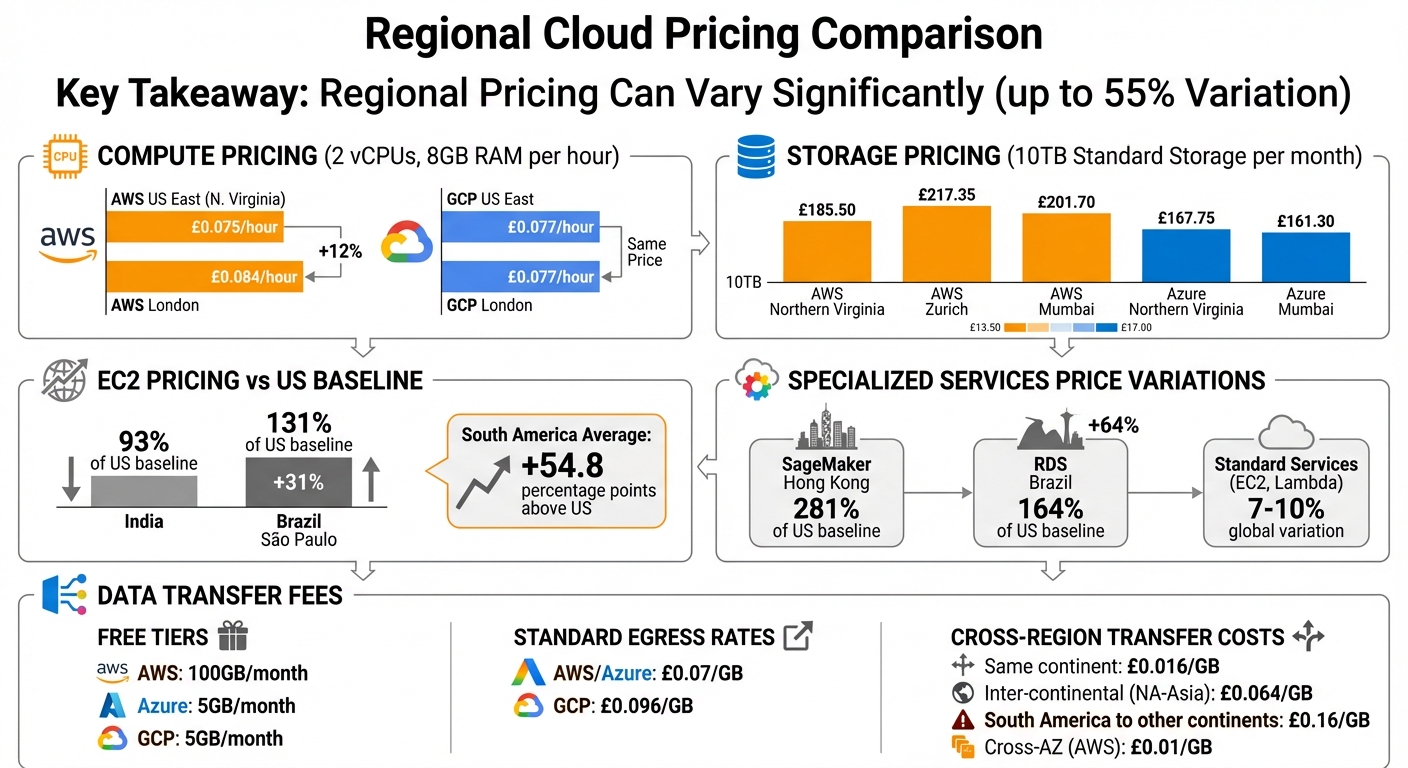 {Cloud Service Regional Pricing Comparison: AWS, Azure, and GCP}
:::
{Cloud Service Regional Pricing Comparison: AWS, Azure, and GCP}
:::
Regional Pricing Comparison Table
Looking at actual pricing highlights how regional choices can affect costs. Even small differences in per-unit prices can add up significantly when dealing with large-scale operations.
For example, a compute instance with 2 vCPUs and 8GB of RAM on AWS costs about £0.075 per hour in US East (Northern Virginia), but the same instance costs £0.084 per hour in London - a 12% increase. Meanwhile, Google Cloud Platform keeps its pricing consistent, charging approximately £0.077 per hour in both US East and London regions. Storage pricing shows even more variation. For 10TB of standard storage per month, AWS charges around £185.50 in Northern Virginia, £217.35 in Zurich, and £201.70 in Mumbai. On the other hand, Azure offers lower storage rates in some regions, with Mumbai costing about £161.30, compared to £167.75 in Northern Virginia.
These price differences may seem minor, but they can have a significant impact when scaled. For instance, hosting a serverless data lake in Tokyo could be 12% more expensive than in the US, largely due to regional price variations for services like Kinesis and Lambda [4].
Beyond these standard rates, other costs, such as data transfer fees, can further drive up expenses.
Hidden Costs: Data Transfer and Multi-Region Setup
Beyond the base pricing, data transfer fees often lead to unexpected expenses. While cloud providers typically offer free internet egress tiers - 100GB per month on AWS and 5GB per month on both Azure and GCP - costs rise quickly once these limits are exceeded. Standard egress rates usually start around £0.07 per GB for AWS and Azure, climbing to approximately £0.096 per GB for GCP.
Cross-region transfers add another layer of complexity. For example:
- Transferring data within the same continent might cost about £0.016 per GB.
- Inter-continental transfers, like between North America and Asia, can reach £0.064 per GB.
- Transfers from South America to other continents are even higher, at roughly £0.16 per GB [7].
Even within a single provider's infrastructure, cross-availability-zone traffic often incurs fees. On AWS, this typically costs around £0.01 per GB, a cost that is often overlooked in distributed applications.
Multi-region setups can also inflate monthly expenses. Replicating data across continents for disaster recovery or reducing latency involves not just duplicate storage costs but also the ongoing expense of synchronising data between regions. These hidden fees can quickly add up, making it essential to carefully evaluate the true cost of a multi-region cloud architecture.
Need help optimizing your cloud costs?
Get expert advice on how to reduce your cloud expenses without sacrificing performance.
How to Reduce Cloud Costs by Region
Selecting the Best Region for Your Workloads
When choosing a cloud region, start by filtering for any mandatory data residency laws. After that, weigh the proximity to your users against costs, especially for latency-sensitive applications like gaming or mobile apps. Hosting closer to your users reduces network delays and improves performance. On the other hand, for workloads like batch processing or analytics, which aren't as sensitive to latency, prioritising a lower-cost region makes more sense. A hybrid approach often works well: place customer-facing frontends near users for better responsiveness, while running backend analytics or processing tasks in a more budget-friendly, distant region [2][5].
Another factor to consider is service availability. Ensure that the features or services you need are offered in your chosen region before making a commitment. Pricing calculators can help you compare costs, compliance needs, latency, and available features across different regions [1][5]. You might find it helpful to create a comparison matrix to evaluate these aspects. Don’t forget to account for data transfer fees, which can add up - typically around £0.014 per GB or more for transfers between regions [2][10].
Once you've picked the optimal region, the next step is to fine-tune your compute options to save even more.
Using Spot Instances and Reserved Capacity
After narrowing down the right region, explore compute options that offer cost flexibility. Spot instances, for example, can cut costs by up to 90% compared to on-demand pricing [8][15]. These instances use spare computing capacity that cloud providers would otherwise leave idle. However, they come with a catch - they can be interrupted with as little as two minutes' notice. This makes them ideal for fault-tolerant and stateless workloads like batch jobs or data processing.
For workloads that require consistent performance, commitment-based discounts like Savings Plans or Reserved Instances are a great option, offering savings of up to 72% [8][15]. These plans require you to commit to a certain usage level for one or three years. Generally, a three-year commitment provides bigger discounts, especially with all-upfront payments.
To maximise savings, flexibility is key. Tools like EC2 Fleet can automatically select the lowest-cost combination of on-demand and spot instances across multiple availability zones [8]. If your organisation operates across various environments, consider using Savings Plans for production and development, while sticking to on-demand pricing for less frequently used sandbox environments [15]. To stay adaptable, purchase Savings Plans in smaller increments that align with changing workload demands [8].
Caching and Local Data Processing to Reduce Transfer Fees
Reducing data transfer costs starts with processing data close to its source. For data-intensive applications like big data or machine learning, running your application near the data source is critical [9].
Caching can also significantly lower costs. Services like ElastiCache or DynamoDB Accelerator (DAX) reduce the need for repeated cross-region data fetches [9]. Using a CDN like CloudFront helps by terminating SSL/TCP sessions closer to users and running edge compute functions for request handling. Additionally, deploying Gateway VPC endpoints for services like S3 and DynamoDB allows for local processing without extra hourly or per-GB fees [2][5][9][12]. For cross-region S3 access, IPv6 combined with Egress Only Internet Gateways offers one of the lowest transfer rates, around £0.014 per GB [14].
Monitoring your data flows is essential to identifying cost-saving opportunities. Use VPC Flow Logs to track which resources generate the most traffic and ensure they are located in the same availability zone as their NAT gateways to avoid cross-AZ charges [11]. By modelling your data transfers, you can optimise costs based on the data volume, its origin, and how it's processed [13].
Cloud Cost Reduction with Hokstad Consulting
Cloud Cost Engineering for 30-50% Savings
Hokstad Consulting specialises in cutting cloud costs by focusing on smarter workload placement, regional pricing differences, and efficient infrastructure management. Their cloud cost engineering service aims to achieve savings of 30–50% by identifying where workloads should be hosted versus their current locations. For UK businesses, this often translates to keeping customer-facing applications in London for low latency while moving backend processes, analytics, or development environments to more cost-effective regions like US East.
To make this happen, they rely on automated CI/CD pipelines and Infrastructure as Code, which help eliminate configuration errors and prevent over-provisioning. By closely monitoring instance sizes and scaling them to match actual demand, businesses can avoid paying for unused resources. Hokstad Consulting also reworks network architectures to reduce data transfer fees, using techniques like rerouting, compression, and caching.
For businesses worried about upfront expenses, Hokstad Consulting offers a No Savings, No Fee
model, ensuring that fees are tied directly to the savings achieved. This approach not only reduces costs but also lays the groundwork for smooth cloud migrations.
Cloud Migrations with Minimal Downtime
Migrating infrastructure across regions comes with risks, especially when downtime can cost businesses around £4,300 per minute [16]. Nearly 75% of organisations overshoot their migration budgets due to unexpected costs, such as data transfer fees and service interruptions. Hokstad Consulting tackles these challenges head-on by using blue–green deployments. This method ensures one environment continues running the current workload while the new environment is prepared and tested in parallel, allowing for a seamless switch with virtually no downtime.
The migration process begins with a detailed analysis of regional price differences - these can vary by as much as 40% - to identify which workloads can be moved without affecting user experience. Services that aren’t latency-sensitive, such as batch processing or data warehousing, are prime candidates for relocation. During the migration, automated scaling and right-sizing ensure resources are used efficiently, keeping costs under control.
Regular Cloud Cost Audits and Improvements
The benefits of migration don’t stop once the move is complete. Hokstad Consulting provides ongoing audits - typically every three or six months - to ensure your cloud strategy evolves alongside changing regional pricing. These audits are designed to catch inefficiencies like orphaned resources and misconfigured scaling before they drive up costs. They also uncover new opportunities to optimise workloads.
One key aspect of these reviews is tagging governance, which ensures resources are properly labelled for accurate cost tracking across regions. For UK businesses, automated tools can be configured to shut down non-essential environments, like development and testing, outside of standard working hours (9:00–17:00). This simple step can save money without disrupting productivity.
For example, a storage audit might reveal cost differences like 10TB of storage on Azure costing £161.30 per month in Mumbai compared to £173.90 in Zurich. While the difference may seem small, it scales significantly as data volumes grow, making these audits a critical part of long-term cost management.
Conclusion
Regional cloud pricing plays a key role in shaping your cloud budget. To manage these costs effectively, it's crucial to understand where your workloads run and why. Reducing inter-region transfers can help avoid unnecessary charges, while placing latency-sensitive applications closer to your customers and running backend processes in more cost-effective regions can lay the groundwork for smarter spending.
These thoughtful decisions pave the way for targeted cloud cost management. Hokstad Consulting, for example, specialises in cloud cost engineering, employing strategies like blue-green migrations and regular audits to deliver savings of 30–50% while eliminating inefficiencies. Their No Savings, No Fee
model ensures businesses only pay when tangible results are achieved.
With a well-planned regional strategy, your cloud expenses can shift from being a financial burden to becoming a competitive advantage.
FAQs
How do compliance regulations influence the choice of cloud region?
Compliance regulations are a key consideration when choosing a cloud region. Laws like the UK-specific GDPR extensions, the broader EU GDPR, and various data sovereignty rules often dictate that sensitive or personal data must be stored and processed within specific jurisdictions. For instance, a UK-based organisation might opt for the UK South
or UK West
Azure regions, or the London AWS region, to align with GDPR residency requirements.
These regulations also influence how systems are designed. Businesses often adopt measures such as data replication within approved regions, encryption (both at rest and in transit), and stringent access controls to meet legal and audit standards. Non-compliance can lead to hefty fines, legal disputes, and damage to reputation, making consistent monitoring and automated compliance checks a necessity.
Hokstad Consulting helps UK organisations tackle these challenges by crafting cloud strategies that ensure compliance while balancing cost and performance effectively.
How can I reduce unexpected cloud costs?
To keep cloud costs in check, begin by reviewing your current usage to make sure your resources are properly aligned with your actual needs. Regularly monitor usage and automate tagging to spot and address inefficiencies quickly. Setting budgets and activating alerts can help you stay on top of spending.
Consider using options like reserved instances or spot instances offered by your cloud provider to cut costs. Additionally, reduce unnecessary data transfers and avoid storage waste by adopting FinOps-style governance practices. These steps not only help you manage expenses but also ensure your infrastructure continues to meet your business requirements effectively.
Why do cloud service costs differ between regions?
Cloud service pricing isn't uniform across the globe - it varies depending on regional infrastructure and operational costs. Things like land prices, electricity rates, labour expenses, taxes, and the availability of network infrastructure all play a role in shaping these costs. Providers adjust their pricing to reflect these regional differences.
Beyond infrastructure, market demand and the level of competition in a particular area also influence costs. By taking these factors into account, businesses can make informed choices about which regions best suit their budget and performance goals, potentially trimming costs while still meeting their operational needs.