
API gateways act as intermediaries between clients and backend services, making them critical to securing distributed systems. However, they can become vulnerable without proper access controls. Role-Based Access Control (RBAC) addresses this by assigning permissions to roles (e.g., Admin, Developer, Viewer) instead of individual users. This simplifies management, reduces risks, and ensures users only access what they need.
Key Takeaways:
- RBAC Basics: Roles are tied to permissions (like GET, POST) and linked to users or service accounts.
- Why It Matters: Prevents over-permissioning, reduces security risks, and aligns access with job functions.
- Integration: Works with authentication methods like JWT, OAuth 2.0, and API keys.
- Implementation Steps:
- Define roles and permissions.
- Enforce policies using Identity and Access Management (IAM) systems.
- Use centralised configuration for consistency.
- Advanced Tips: Combine RBAC with Attribute-Based Access Control (ABAC) for nuanced access and automate policies with Infrastructure as Code (IaC).
- Monitoring: Log access, audit roles regularly, and track anomalies to maintain security.
RBAC streamlines access management and strengthens API gateway security, making it a scalable solution for organisations of any size.
Role Based Access Control RBAC with API Gateway and OPA
RBAC Components in API Gateways
Let’s dive into the key components of Role-Based Access Control (RBAC) in API gateways and how they tie into authentication. At its core, RBAC relies on four main elements: users, roles, permissions, and resources.
Roles, Permissions, and Users
In the context of API gateways, these components work together to manage access with precision. Users can be human administrators or automated service accounts, such as those used for CI/CD pipelines or monitoring tools interacting with the gateway's Admin API [7]. Each user is assigned one or more roles, which group permissions based on specific responsibilities. Typical roles include:
- Super Admin: Full access to all configurations.
- API Provider: Manages services and routes.
- Viewer: Limited to read-only access [3][2].
Permissions specify the actions a role can perform - such as Create, Read, Update, or Delete - on defined resources like Routes, Services, Plugins, Upstreams, and Consumers [7][1]. For instance, a Policy-Developer
role might have read access to /routes but create access to /services. Many gateways also support workspaces, which are logical divisions allowing teams to manage their APIs independently, ensuring no overlap or interference with other teams' configurations [7][3].
When multiple rules overlap, gateways use precedence models to determine which authorisation applies. For example, Kong Gateway evaluates permissions by prioritising specific rules: first, the current endpoint in the current workspace; then, wildcard endpoints in any workspace; followed by any endpoint in the current workspace; and finally, wildcard endpoints across all workspaces [7]. This layered approach ensures that detailed rules take precedence over broader ones, offering fine-grained control.
With these components in place, RBAC becomes even more effective when integrated with authentication systems.
Integration with Authentication Methods
RBAC doesn’t just stop at defining roles and permissions - it also integrates seamlessly with authentication frameworks to create a comprehensive security setup. Acting as the authorisation layer that follows authentication, RBAC works with various methods to enforce access policies.
For instance, JWTs (JSON Web Tokens) can embed roles and permissions directly within the token payload. This allows real-time authorisation without needing to query external databases [1]. Similarly, OAuth 2.0 maps scopes and claims from the Identity Provider to gateway roles, ensuring access policies align with the authenticated user's identity [5].
For automated processes, API keys can be tied directly to RBAC roles. Additionally, tools like LDAP or Active Directory can synchronise external directories to assign roles automatically [1][2]. This layered system - combining identity verification, authentication, and role-based authorisation - creates a scalable security framework that adapts to organisational needs while maintaining centralised oversight.
How to Implement RBAC in API Gateways
::: @figure 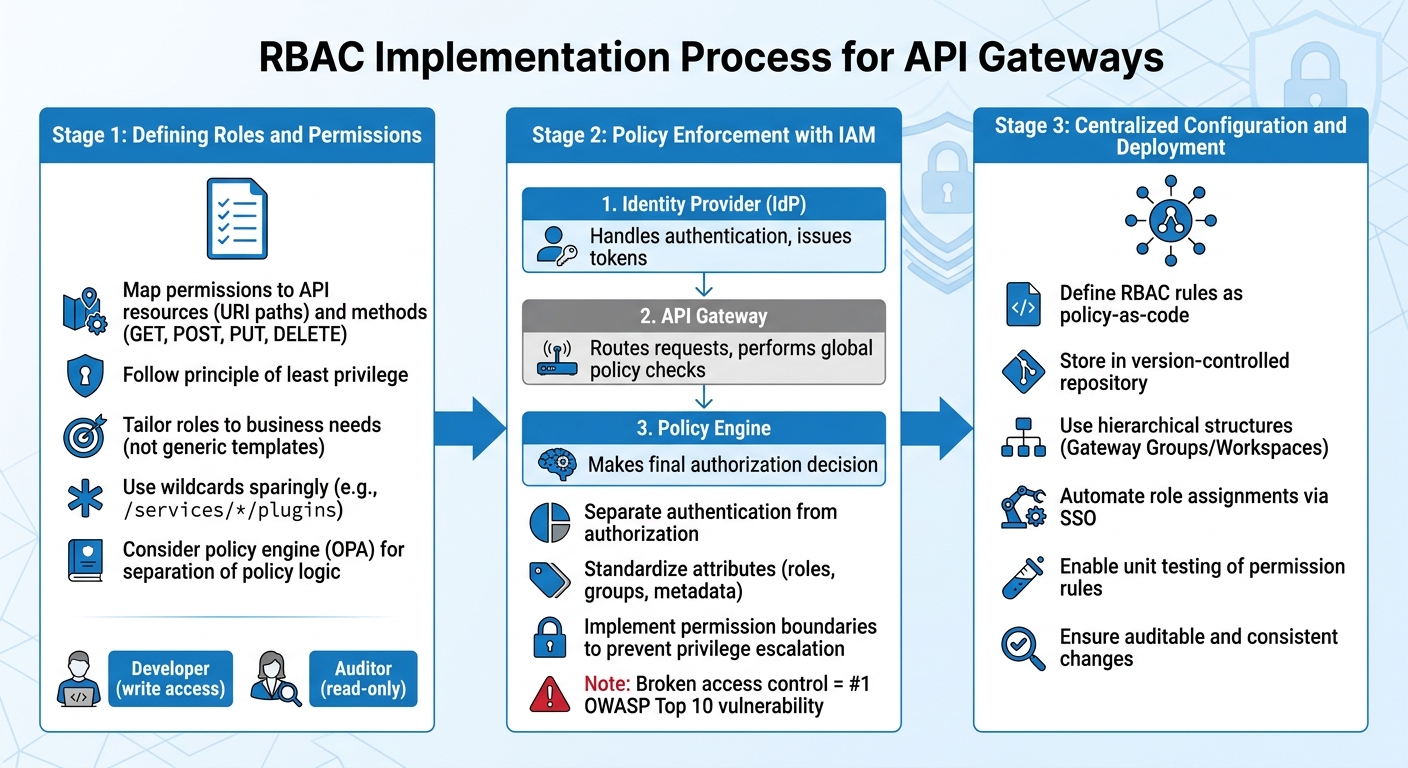 {RBAC Implementation Steps for API Gateways}
:::
{RBAC Implementation Steps for API Gateways}
:::
Implementing RBAC (Role-Based Access Control) in API gateways requires careful planning and execution. The process revolves around three key steps: defining roles and permissions, enforcing policies, and ensuring consistent configuration across all environments. Let’s break these down.
Defining Roles and Permissions
The foundation of secure inter-service communication lies in clearly defining roles and permissions. Begin by mapping specific permissions to API resources (like URI paths) and methods (e.g., GET, POST, PUT, DELETE) while adhering to the principle of least privilege [7]. Each role should be tailored to actual business needs rather than relying on generic templates. For example, a Developer role might require write access to certain API endpoints, whereas an Auditor role would only need read access.
Wildcards (e.g., /services/*/plugins) can simplify policy management, but they should be used sparingly. Whenever possible, opt for explicit definitions to maintain tighter control.
For more advanced setups, consider separating policy logic from application code by using a dedicated policy engine. As Bobur Umurzokov, Technology Writer at API7.ai, puts it:
OPA (Open Policy Agent) is a policy engine and a set of tools that provide a unified approach to policy enforcement across an entire distributed system. It allows you to define, manage, and enforce policies centrally from a single point
[1].
Policy Enforcement with IAM
Once roles are defined, the next step is enforcing them through a robust identity and access management (IAM) framework. Policy enforcement ensures that only authorised requests make it to backend services. This is achieved through a layered approach:
- Identity Provider (IdP): Handles user authentication and issues tokens.
- API Gateway: Manages initial request routing and performs global policy checks.
- Policy Engine: Makes the final authorisation decision by evaluating each request against defined policies.
To keep tokens lightweight, separate authentication from authorisation. Use the IdP solely for verifying identity, while real-time policy evaluations happen at the gateway or service level. Standardising attributes like roles, groups, and metadata across identity sources ensures consistency in RBAC policies.
In complex systems, consider implementing permission boundaries. These ensure that a user’s effective permissions are limited to the intersection of their assigned roles and predefined limits, reducing the risk of privilege escalation. This is especially important given that broken access control ranks as the top vulnerability in the OWASP Top 10 [8]. Strong backend enforcement is critical to mitigate such risks.
Centralised Configuration and Deployment
To maintain consistency across distributed gateways, centralise your policy management. Define RBAC rules as policy-as-code in a version-controlled repository. This not only ensures auditable and consistent changes but also allows for unit testing of permission rules before deployment.
Using hierarchical structures, such as Gateway Groups or Workspaces, can help scale policy application. For instance, roles defined in a default
workspace can automatically propagate to new workspaces unless explicitly overridden. This reduces administrative workload while preserving granular control.
Automating role assignments through SSO-based systems is another way to minimise manual errors. By assigning roles based on IdP group memberships at login, you can streamline the process and enhance accuracy.
Centralising configurations not only simplifies deployments but also strengthens monitoring and auditing capabilities, ensuring your RBAC implementation remains secure and efficient.
Monitoring and Auditing RBAC Policies
Once RBAC policies are centrally configured, it’s crucial to keep an eye on them. Without proper monitoring, issues like misconfigurations, unauthorised access, or privilege escalation can slip through unnoticed.
Logging and Auditing Access
Effective RBAC compliance starts with detailed logging. Make sure every authenticated request is recorded, including user IDs, timestamps, accessed resources, and the results of those actions. This creates a clear audit trail, which not only satisfies regulatory requirements but also boosts visibility.
Different compliance frameworks have specific log retention rules. For example:
- SOC 2: Logs must be kept for a minimum of one year.
- PCI DSS: Requires one year of retention, with three months of logs readily accessible.
- HIPAA: Mandates retention for at least six years [10].
To stay compliant, adopt the retention policy of the strictest framework your organisation follows.
Maintaining log integrity is equally important. Use techniques like write-once storage, immediate log shipping to external SIEM platforms (e.g., Splunk or Elasticsearch), or cryptographic log signing to prevent tampering [10]. Tools like jq can help filter audit logs for specific RBAC-related events, such as RoleBinding creations or attempts to modify ClusterRoles without authorisation [10].
As Nawaz Dhandala from OneUptime explains:
RBAC audit logging transforms opaque permission systems into observable security controls.[10]
Detecting Anomalies in RBAC Usage
Detailed logs form the foundation for real-time monitoring, which is key to spotting anomalies quickly. For instance, frequent 403 Forbidden
errors from a single user can indicate misconfigured permissions, privilege escalation attempts, or even automated tools using incorrect credentials [10]. To address such issues, forward critical events - like the creation of a cluster-admin binding - to external webhooks for immediate alerts [10].
When using gateways like Kong, remember that precedence models rank rules from specific to general [7]. This means a broad allow
policy could unintentionally override a more specific deny
rule. Ensure your monitoring setup accounts for these hierarchies to avoid security gaps.
Additionally, integrating metrics into dashboards can provide live insights into policy enforcement. Tools like OPA Gatekeeper, for example, offer metrics such as gatekeeper_violations and gatekeeper_request_count, which can be visualised in Grafana [9].
To prepare for unexpected failures, keep a documented runbook for emergency recovery. Regularly review access patterns to identify unused roles, overly permissive permissions, and areas where tighter controls are needed. This proactive approach helps maintain a secure and efficient RBAC system.
Advanced RBAC Strategies for API Gateways
As your API grows in complexity, basic Role-Based Access Control (RBAC) may no longer suffice. Combining RBAC with Attribute-Based Access Control (ABAC) and automating policies using Infrastructure as Code (IaC) can help maintain robust and scalable security.
Combining RBAC with ABAC
RBAC is great for broad access control but struggles to handle nuanced, context-specific requirements. This is where ABAC steps in. Instead of relying only on roles, ABAC evaluates additional attributes like IP address, time of access, or resource ownership before granting permissions [11].
This combination prevents the problem of role explosion
, where too many specific roles are created to address various scenarios. For instance, instead of having separate roles like 'EditorMorning' and 'EditorEvening', you can use a single 'Editor' role and apply ABAC rules to check the time of access. As Zuplo explains:
RBAC works well for broad access decisions... But RBAC starts to break down when your authorization requirements become more granular[11].
Your API gateway acts as the Policy Enforcement Point (PEP), intercepting requests to validate both the user's role and relevant environmental attributes before forwarding the request to the backend. This layered approach helps defend against vulnerabilities like Broken Object Level Authorization (BOLA), which has been a top concern on the OWASP Top 10 since 2021 [11]. By ensuring that users not only have the correct role but also meet specific access conditions, you can close common security gaps [11].
To manage this hybrid model, tools like Open Policy Agent (OPA) serve as the Policy Decision Point (PDP), enabling you to define authorisation logic as policy-as-code
, separate from your application code [11]. In early 2026, the OpenID Foundation approved the AuthZEN Authorization API 1.0 as a Final Specification, standardising how API gateways interact with authorisation engines [11]. As Gartner recommends, adopting standards like AuthZEN can improve interoperability and reduce dependency on specific vendors [11].
When implementing this model, let your gateway handle broader checks (e.g., Is this user an editor?
) and leave detailed, business-specific logic to your backend code [11]. It's also crucial to audit endpoints for vulnerabilities like BOLA, especially in cases where users could manipulate URLs to access data they shouldn't. Incorporating ABAC attributes like resource_owner in these high-risk areas can significantly strengthen your defences [11].
Once you've built a robust access control framework, automating RBAC with Infrastructure as Code can simplify ongoing management.
Automating RBAC with Infrastructure as Code (IaC)
Manually configuring RBAC across multiple environments can lead to inconsistencies and errors. Infrastructure as Code solves this by letting you define policies in declarative formats like Rego or Cedar. This approach supports versioning, peer reviews, and quick rollbacks, ensuring more reliable security management.
Store your RBAC and ABAC policies in version control systems to ensure uniform deployment across environments like development, staging, and production [12]. Use JSON or YAML files to define API gateway routes and their corresponding RBAC settings, making deployments repeatable and predictable [11]. Environment variables (e.g., KONG_ENFORCE_RBAC=on) can also help toggle or test security configurations without requiring a full redeployment [4].
A 'policy-first' mindset allows you to update authorisation rules directly, avoiding the need to redeploy applications for every change [12]. By integrating mechanisms like JWT or mTLS into your gateway's authorisation policies, you can block unauthorised requests before they even reach your backend services [12]. Treating authorisation as part of your infrastructure not only centralises security but also prevents accidental bypasses of critical checks in backend systems [11].
Conclusion
Summary of RBAC Benefits
Role-Based Access Control (RBAC) offers a practical way to secure API gateways while streamlining management and reducing risks. Instead of juggling countless individual permissions, administrators can manage a handful of roles. Updates to these roles automatically apply across the board, cutting down on administrative workload and minimising errors [5][6]. With a centralised system, your API gateway becomes a unified enforcement point, ensuring consistent policy application across all backend services. This also keeps authorisation logic separate from application code, making the system easier to maintain [1].
RBAC is built to grow with your organisation. Adding new team members or creating new roles is straightforward and doesn’t compromise security [12][6]. It also supports the principle of Separation of Duties, ensuring no single person can independently carry out sensitive tasks, which reduces the risk of fraud [5].
Next Steps for Businesses
If you’re not already using RBAC, it’s time to assess your current security setup. Begin with a staged rollout, focusing first on critical systems and high-risk areas [5]. This phased approach allows you to address potential issues early and fine-tune your policies before expanding further.
Adopt a default deny strategy, where access is blocked unless explicitly granted through a role. Avoid using wildcard permissions, and make it a habit to audit roles every 90 days to prevent unnecessary access from creeping in. For organisations managing cloud infrastructure or DevOps workflows, Hokstad Consulting (https://hokstadconsulting.com) offers support in fine-tuning RBAC setups. They can also assist with cloud cost management and automation, helping you create a security framework that balances protection with operational efficiency.
FAQs
What’s the difference between authentication and RBAC authorisation at the gateway?
Authentication is the process of verifying a user's identity, typically through credentials like usernames, passwords, or tokens. It answers the question: Who are you?
.
RBAC (Role-Based Access Control) authorisation, however, focuses on determining what actions or resources an authenticated user is permitted to access. This is based on the roles assigned to them, effectively answering: What are you allowed to do?
. Together, they work at the gateway level to manage identity and permissions.
How do I stop wildcard RBAC rules from accidentally granting too much access?
Avoid using wildcards (*) in RBAC permissions, as they can grant unnecessary access. Instead, explicitly define permissions for specific resources and actions. Regular audits of policies are essential, especially for high-privilege roles like admin, to eliminate overly broad permissions. Focus on the principle of least privilege to reduce exposure to risks and, where feasible, implement namespace-specific roles for better control. Regular reviews combined with tools like Open Policy Agent (OPA) can help enforce stricter access controls and guard against privilege escalation.
When should I add ABAC on top of RBAC for my APIs?
When your APIs require more adaptable, context-sensitive access control, it's a good idea to layer Attribute-Based Access Control (ABAC) on top of Role-Based Access Control (RBAC). ABAC shines in situations where decisions depend on dynamic factors, such as resource attributes or environmental conditions, which RBAC's fixed role structure can't handle effectively.