
If your data must stay secret past 2030, old public-key crypto is a risk now. I’d treat this as a planning problem with a deadline: the UK NCSC expects discovery and an initial migration plan by 2028, priority moves by 2031, and old quantum-vulnerable algorithms retired by 2035.
Here’s the short version:
- AWS and Google Cloud are ahead on built-in PQC support today.
- Azure is stronger on governance than on PQC features right now.
- HSMs such as Thales Luna and Entrust nShield give tighter key custody, but they need more in-house skill and process.
- Vault and CipherTrust are best seen as control layers, not complete quantum-safe answers on their own.
- For most UK teams, the first step is still the same: list your RSA and ECC use, rank long-life data first, then map each workload to KMS, HSM, or an overlay tool.
If I strip the article down to the buying decision, I’d compare these options on four points:
- PQC support: who already offers ML-KEM, ML-DSA, or SLH-DSA
- Key custody: provider-run KMS vs customer-run HSM
- Hardware level: whether root keys sit in FIPS 140-3 Level 3 hardware
- Migration work: how much code, PKI, and process change you’ll need
Quick take: if you want the lowest lift inside one cloud, start with native KMS. If you need tighter custody for banking, NHS, public sector, or critical systems, move root keys into HSM-backed setups. If you run across several clouds, add a policy layer on top.
The 2026 Guide to Upgrading Enterprise PKI and HSMs for Post Quantum Security
Need help optimizing your cloud costs?
Get expert advice on how to reduce your cloud expenses without sacrificing performance.
Quick comparison
::: @figure 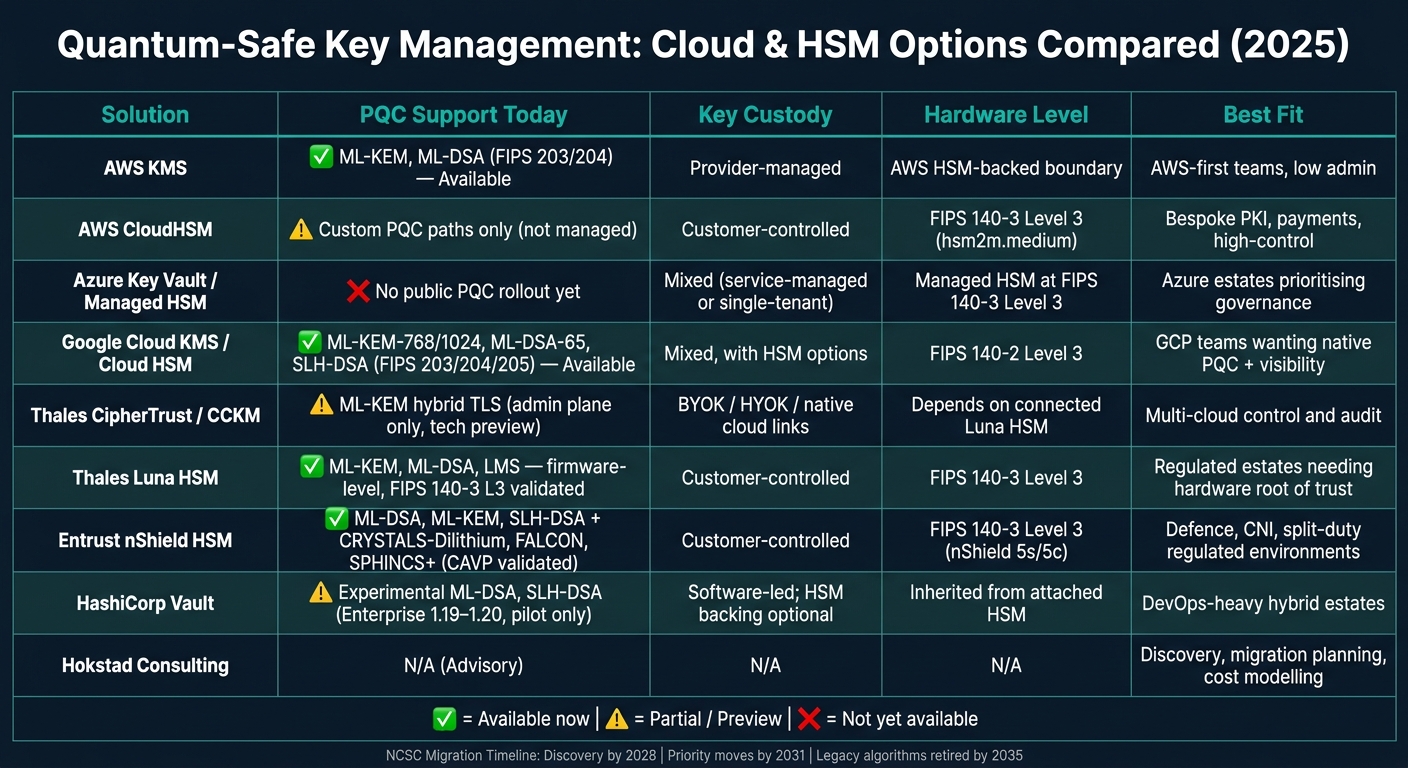 {Quantum-Safe Key Management: Cloud & HSM Options Compared (2025)}
:::
{Quantum-Safe Key Management: Cloud & HSM Options Compared (2025)}
:::
| Option | PQC status today | Key custody | Hardware level | Best fit |
|---|---|---|---|---|
| AWS KMS | Built-in PQC features available | AWS-managed | AWS HSM-backed service boundary | AWS-first teams wanting low admin load |
| AWS CloudHSM | Custom PQC paths, not managed PQC key types | Customer-controlled | FIPS 140-3 Level 3 on newer models | Bespoke PKI, payment, high-control use |
| Azure Key Vault / Managed HSM | No public full PQC rollout yet | Mixed: service-managed or single-tenant HSM | Managed HSM at FIPS 140-3 Level 3 | Azure estates that need governance first |
| Google Cloud KMS / Cloud HSM | Strong built-in PQC support | Mixed, with HSM options | Cloud HSM at FIPS 140-2 Level 3 | GCP teams wanting native PQC plus migration visibility |
| Thales CipherTrust / CCKM | PQC mainly on admin plane | BYOK / HYOK / native links | Depends on connected HSM | Multi-cloud control and audit |
| Thales Luna HSM | Firmware-level PQC support | Customer-controlled | FIPS 140-3 Level 3 | High-control regulated estates |
| Entrust nShield HSM | Firmware PQC plus option pack | Customer-controlled | FIPS 140-3 Level 3 on new models | Strong custody and split-duty controls |
| HashiCorp Vault | Experimental PQC in parts | Software-led, with HSM support possible | Depends on attached HSM | Hybrid estates needing one policy layer |
| Hokstad Consulting | Advisory, not a custody platform | N/A | N/A | Discovery, planning, automation, £ cost modelling |
So if I were making the first call today, I’d do three things in order: inventory crypto use, rank data by how long it must stay secret, and pick the control model before picking the product.
1. AWS Key Management Service (KMS) and AWS CloudHSM
PQC Standards Support
AWS KMS supports hybrid post-quantum TLS key exchange with ML-KEM (FIPS 203) alongside classical ECDH, plus quantum-resistant digital signatures with ML-DSA (FIPS 204) [1][4][8][9]. AWS offers ML_DSA_44, ML_DSA_65 and ML_DSA_87, giving teams a trade-off between security level and performance [6][7][9].
The ML-DSA key material and signing operations are protected inside FIPS 140-3 Level 3 validated HSMs [9]. For data at rest, AWS KMS already uses AES-256-GCM, so PQC has more impact on key exchange and digital signatures than on storage encryption [4][21][22].
AWS CloudHSM doesn't provide managed PQC key types out of the box. But it does let customers build their own PQC workflows through PKCS#11, JCE and OpenSSL on validated hardware [12][14][15]. The hsm2m.medium model is FIPS 140-3 Level 3 certified, while hsm1.medium is FIPS 140-2 Level 3 and now sits in the older category [13].
So the big split isn't just PQC support. It's who holds the wheel.
Key Control Model
The main difference comes down to hardware control. With AWS KMS, AWS runs the underlying HSMs, while customers manage policies, permissions and how keys are used. With AWS CloudHSM, customers get dedicated, single-tenant HSMs in their own AWS account, and AWS cannot access the keys [14][16][18].
That matters when you need:
- custom cryptography
- strict separation of duties
- support for regulated workloads
There's also a middle option: the CloudHSM-backed custom key store in KMS. This setup lets organisations use CloudHSM keys through KMS APIs while keeping key material customer-controlled and non-exportable [10][11][17]. To run a custom key store, you need an active CloudHSM cluster backed by at least two HSMs in separate Availability Zones [10].
That choice shapes how migration tends to play out.
Migration Readiness
Once you've settled the control model, the next step is deciding where to start. For most organisations, AWS KMS is the easier first move because it brings lower overhead, broad AWS service integration and native support for ML-KEM and ML-DSA [1][19][20].
CloudHSM makes more sense when the job is more specialised, such as a bespoke certificate authority, long-lived signing keys, or hybrid classical/PQC certificate chains [12][14][15]. Neither service, on its own, gives you a full quantum-safe answer. They are custody and control platforms that help you move through the shift.
A sensible starting point is a cryptographic inventory. From there, map RSA and ECC dependencies to KMS or CloudHSM based on key lifespan, sensitivity and application compatibility.
2. Azure Key Vault and Azure Managed HSM
PQC Standards Support
Azure Key Vault is still, at its core, a classical key management service. It supports RSA and EC, and in Premium it also supports HSM-backed octet and AES symmetric keys. Azure’s current guidance leans towards AES-256 for data that needs longer-term protection [23][26][27].
Native PQC support is still limited, and Azure has made it clear that support will not appear across all services at the same time [24][25][29]. So, right now, Azure is stronger on control, governance and key handling than on built-in PQC operations.
Key Control Model
The split between the two services is pretty clear. Azure Key Vault is a multi-tenant service. Microsoft runs the underlying infrastructure, while customers manage access, policy and usage. Azure Managed HSM, by contrast, is a single-tenant service built for dedicated HSM-backed key control [30].
Managed HSM includes local RBAC for key lifecycle tasks such as:
- create and import
- delete
- backup and restore
- wrap and unwrap
- sign and verify
That makes Managed HSM the stronger option for workloads where key sovereignty and audit trails matter most during the migration period [31]. Key Vault is still the better choice for general application secrets, certificates and keys, especially when broad service integration and lower operational effort matter more.
Hardware Assurance
The main difference comes down to custody. Managed HSM keeps keys inside dedicated, FIPS 140-3 Level 3 validated HSMs [30]. Key Vault does offer HSM-backed choices, but they are more limited and only available for selected Premium-tier key types [23][28].
Migration Readiness
Azure’s main strength for quantum-safe migration is not immediate PQC support. It is the fact that it gives teams a central place for governance and automation. Key Vault supports policy-based rotation, versioning, and integration with Entra ID and CI/CD pipelines, which helps with phased migration for long-lived keys and certificate chains [24].
A sensible starting point is to centralise certificate storage in Key Vault now, while getting application code ready to work with PQC-capable TLS libraries once those libraries become available.
The catch is that this still depends on Azure’s roadmap. Any organisation setting migration dates needs to account for the fact that Azure’s PQC position is still developing. That leads straight to the next issue: whether built-in cloud controls are enough, or whether multi-cloud orchestration makes more sense.
3. Google Cloud KMS and Cloud HSM
Google Cloud is ahead of Azure on native PQC support. It already exposes that support in KMS and HSM workflows.
PQC Standards Support
Google Cloud KMS supports NIST-standardised PQC algorithms, with support moving from preview to general availability. That includes ML-KEM-768 and ML-KEM-1024 (FIPS 203) for key encapsulation, ML-DSA-65 (FIPS 204) for digital signatures, and SLH-DSA-SHA2-128S (FIPS 205) [2][33][36][37].
Google also offers X-Wing, a hybrid KEM that combines ML-KEM-768 with X25519. In plain terms, it gives teams a bridge between old and new: they can keep compatibility in place while adding quantum-resistant protection [33].
This matters most when the same cryptographic policy needs to work across both software-backed and hardware-backed keys.
Key Control Model
Cloud KMS and Cloud HSM use one API, so applications can switch between software-backed and hardware-backed keys without having to redo integrations [39][40]. That keeps the move simpler, especially for teams that don't want crypto changes to ripple through every app.
Cloud KMS also sits underneath CMEK for more than 30 Google Cloud services used for data-at-rest encryption. For stricter control, Cloud HSM offers both multi-tenant clusters and single-tenant instances. In the single-tenant model, keys belong to one customer only, and cryptographic operations remain inside the hardware module [38][40][44].
Hardware Assurance
Cloud HSM is validated to FIPS 140-2 Level 3 [41][42]. Keys generated inside the HSM are non-exportable and remain in the region where they were created. For FCA- or PRA-regulated organisations, and for workloads aligned with NCSC guidance, that's a big deal.
But hardware checks alone don't solve the migration problem. Teams also need to know what they have, what needs changing, and where to start.
Migration Readiness
The console includes PQC insights. These charts group keys as post-quantum, non-post-quantum, or hybrid, which makes it easier to see the current cryptographic posture and spot which keys need work first [32].
Google recommends a staged approach:
- Start with long-lived data and digital signatures, where HNDL risk is highest [34][35]
- Then move to high-volume transactional encryption, with PQC running alongside classical algorithms during the transition [34][35]
Google's roadmap also includes quantum-safe key import, which helps organisations that run on-premises HSMs or work across multiple clouds during a phased move [34]. For hybrid and multi-cloud estates, Cloud EKM integrations with partners such as Thales and Fortanix support a broader key-management approach [43][45].
Google's part in this comparison comes down to native PQC depth plus migration tooling. You get PQC visibility, hybrid key support, and cross-cloud import in one platform. That sets up the next issue: whether native cloud controls are enough, or whether a broader key-management layer is the better fit.
4. Thales CipherTrust Manager and CipherTrust Cloud Key Manager
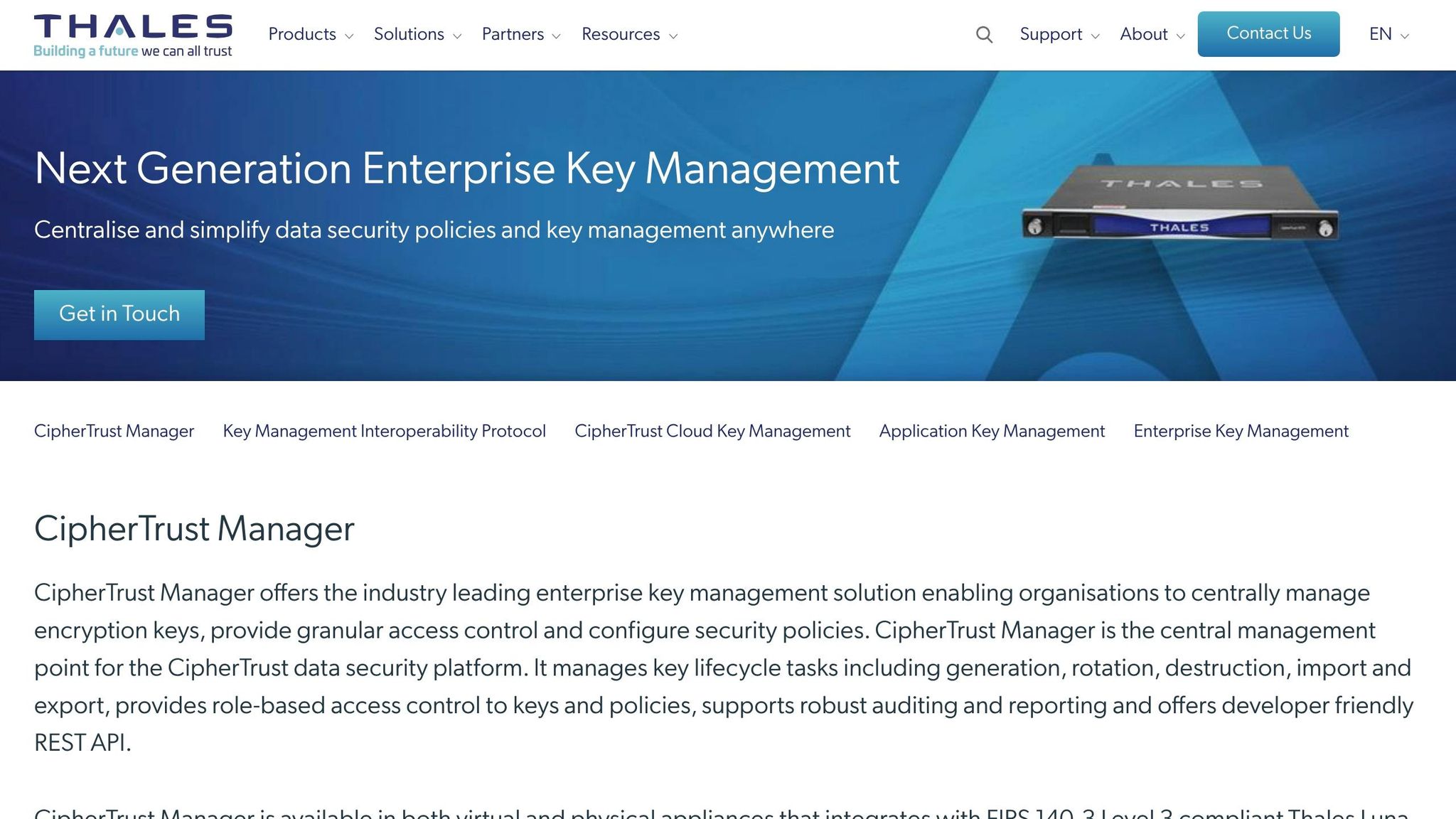
Thales brings key policy and lifecycle management into one place across hybrid and multi-cloud estates. CipherTrust Manager runs the control plane, while CCKM handles the cloud links. When quantum-safe key governance needs to stretch across more than one cloud, Thales sits above cloud-native KMS as a policy layer, rather than trying to replace it.
PQC Standards Support
At the moment, CipherTrust Manager's PQC support protects the management plane, not application data. Releases 2.20.0 and 2.21.0 added ML-KEM-based TLS for web and SSH channels, which helps cut HNDL risk on admin channels. Hybrid ciphers such as X25519MLKEM768 and SecP256r1MLKEM768 are still in technical preview and limited to pilot use today [46][48][51][53][64][65][67].
So the picture is pretty clear: administration traffic gets quantum-safe transport, while application encryption remains as it is.
Key Control Model
CCKM supports native keys, BYOK and HYOK across the main cloud providers. It integrates with AWS KMS External Key Store (XKS), Google Cloud External Key Manager (EKM), Oracle Cloud external key management and SAP Data Custodian KMS [59][60][55][61].
With HYOK, the cloud can reference the key, but it never holds the raw key material. That's a big deal for UK financial services and public-sector workloads, where sovereignty and regulatory alignment often need to be shown in plain terms.
Hardware Assurance
CipherTrust Manager can run as a virtual appliance, but for regulated workloads Thales advises keeping root keys in a Luna HSM. Luna T-Series HSMs have achieved FIPS 140-3 Level 3 validation with PQC-enabled firmware version 7.15.1, with support for ML-KEM, ML-DSA and LMS algorithms [5][51].
In practice, that gives teams two clear paths:
- BYOK keys for AWS, Azure and SAP can be generated inside the HSM and then wrapped for cloud import.
- HYOK keys stay inside the HSM the whole time, while CCKM manages references and policies without exposing raw key material to the cloud [47][54][56][57].
That setup gives organisations a clean audit trail for HSM-protected root keys on UK-controlled infrastructure, even when the protected data sits in overseas cloud regions.
Migration Readiness
CCKM's Key Aging Reports and lifecycle synchronisation across cloud accounts give security teams cross-cloud visibility into key age. That's a practical starting point for spotting long-lived RSA keys that should move up the replacement list [62][49][50].
Because CCKM already manages native, BYOK and HYOK keys under one policy framework, moving to quantum-safe alternatives does not mean rebuilding the governance model from scratch. The main change is the algorithm set in use [49][57][58]. That's where the migration upside sits. And for workloads that need hardware-rooted custody as well as orchestration, the next layer sits in the HSM itself.
5. Thales Luna HSM
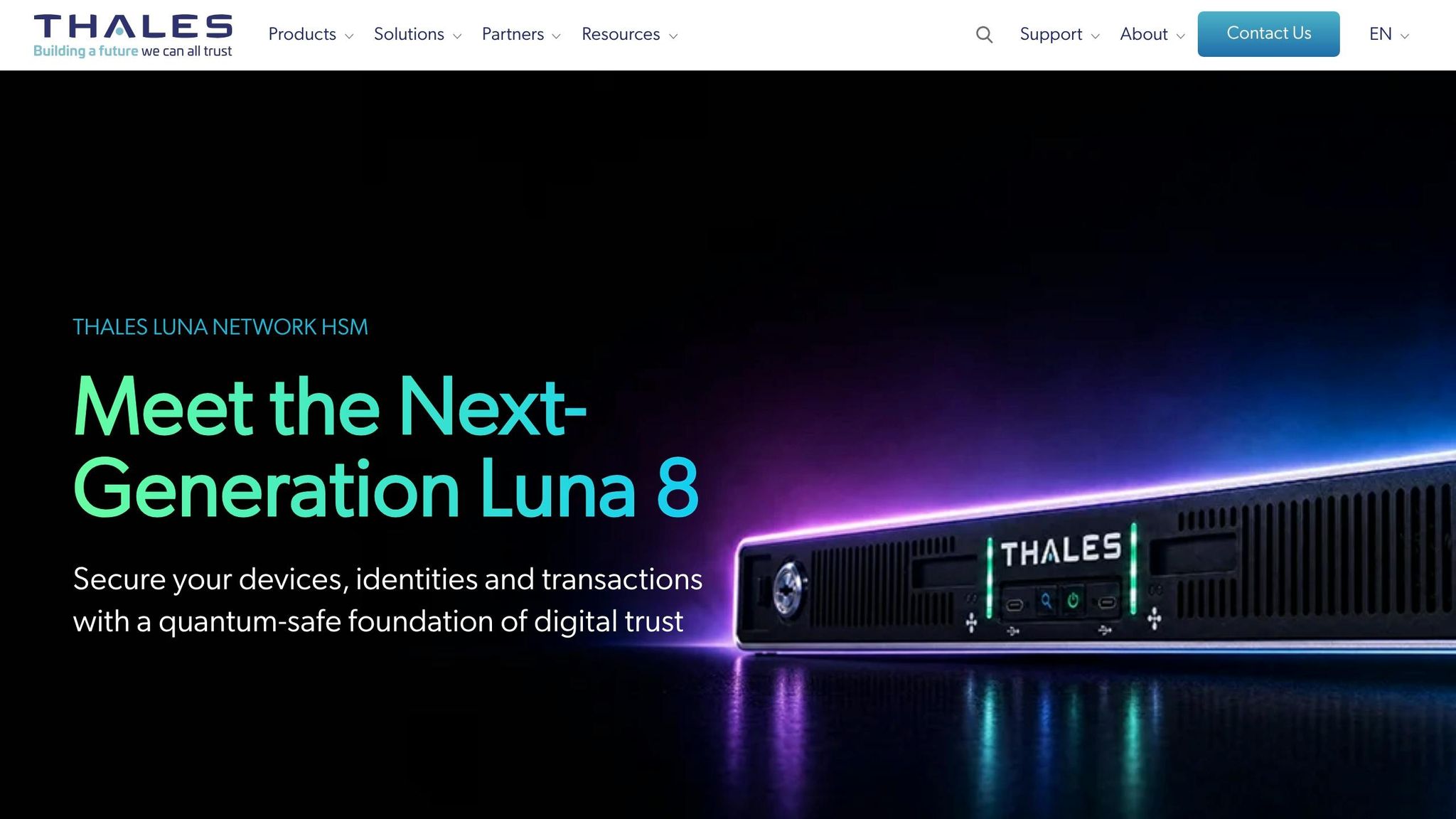
Where CipherTrust handles policy, Luna HSM delivers the hardware root of trust. In integrated systems, Luna HSM is the piece that keeps core key operations tied to customer-controlled hardware.
PQC Standards Support
Luna 7 and Luna 8 support ML-KEM and ML-DSA at firmware level, so there’s no need to swap out hardware to start using these schemes [68][72][66][63]. From firmware version 7.8.9 onwards, Luna also adds LMS/HSS hash-based signatures. That lines up with NIST SP 800-208 and fits long-life code-signing and PKI use cases [68][71][69][66].
The PQC Functionality Module extends this further by adding more algorithms through current OpenSSL interfaces. That means teams can bring in PQC features without large code rewrites [69][74].
Key Control Model
Luna HSM uses a partition-based model. Each partition has its own keyspace and its own security domain, which helps keep duties and assets separate. Raw key material stays inside hardware controlled by the customer [68][72][73][66].
Partitions also support:
- secure cloning
- backup and restore
- high-availability replication
Those features matter when teams need both control and uptime across production systems [68][70][72].
Hardware Assurance
Luna HSM variants are validated to FIPS 140-3 Level 3 [75][76]. They also hold Common Criteria EAL4+ certification against the eIDAS Protection Profile EN 419 221-5. That makes them suitable for qualified signature creation devices and trust service providers working under UK- and EU-aligned eIDAS regimes [77][78].
Put simply, these certifications show that the platform can support regulated key custody while giving organisations a path towards quantum-safe migration.
Migration Readiness
Teams can run RSA or ECC alongside ML-KEM and ML-DSA at the same time. That makes hybrid cipher suites for TLS and key exchange possible during the move to PQC [72][66][63].
For many UK organisations, the migration path is fairly clear:
- turn on hybrid TLS first for high-risk services
- update PKI hierarchies to use ML-DSA or LMS for long-lived certificates
- move database encryption and IoT credentials to PQC algorithms over time
The key point is that all of this can stay anchored to the same Luna HSM hardware throughout the changeover [67][72][66][63].
For complex multi-cloud DevOps pipelines, Hokstad Consulting can help with HSM sizing, HA topology and cloud cost engineering where larger PQC keys affect latency and capacity.
That hardware-first model sets the baseline for the next HSM options.
6. Entrust nShield HSM
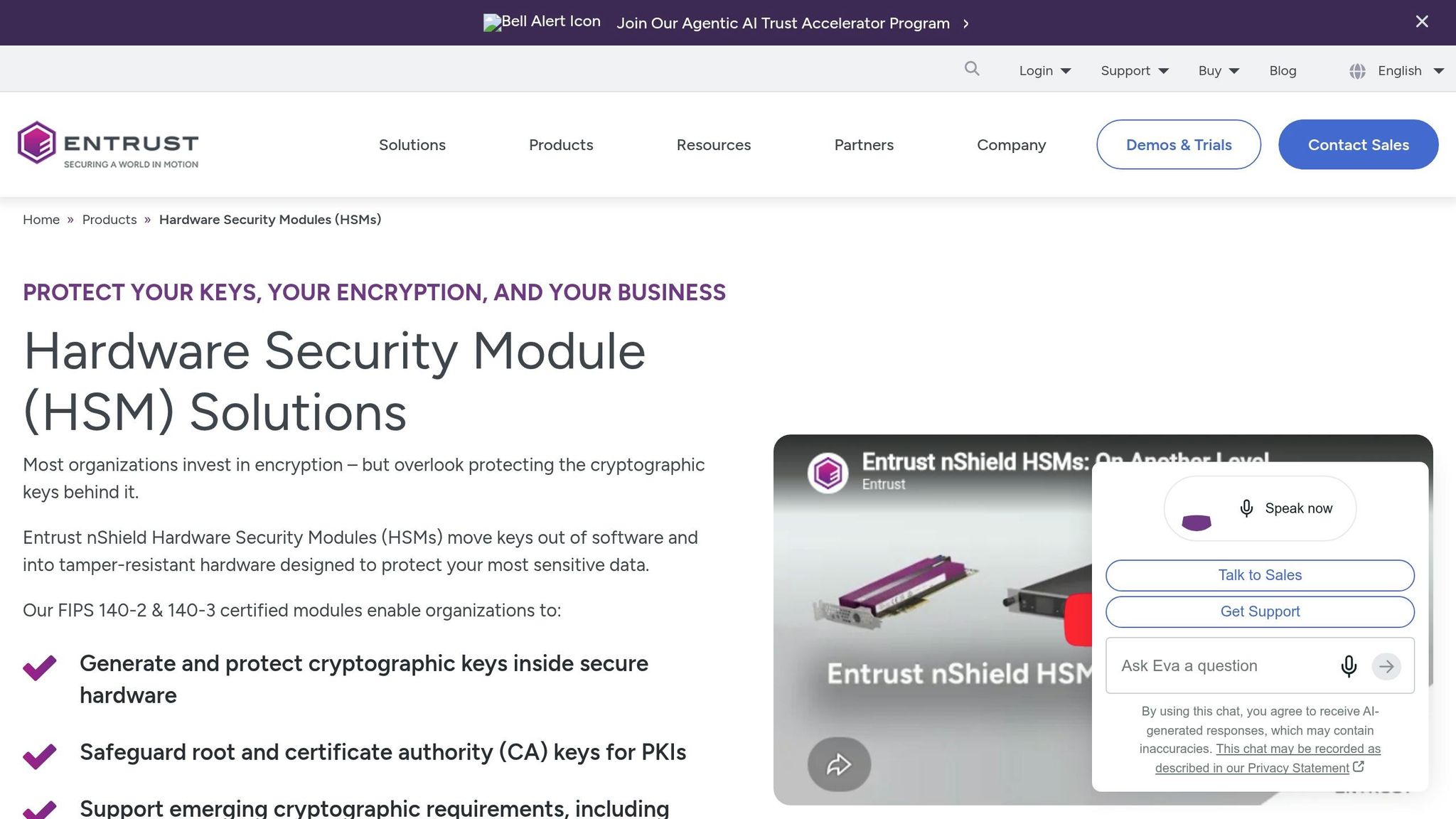
Entrust nShield sticks closely to a hardware-rooted model. Its standout feature is Security World governance, paired with firmware-level PQC support. While some HSM vendors focus first on supporting as many algorithms as possible, nShield puts the emphasis on smart-card-based control of the cryptographic root of trust.
PQC Standards Support
nShield HSMs support NIST-selected PQC through firmware and an optional add-on pack. Native firmware in version 13.8.0 and later adds ML-DSA, ML-KEM, and SLH-DSA inside the HSM engine, with implementations validated under NIST's Cryptographic Algorithm Validation Program (CAVP) and submitted to the Cryptographic Module Validation Program (CMVP) for FIPS 140-3 Level 3 certification [80][82][88].
If you need broader algorithm support sooner, the nShield Post-Quantum Option Pack (PQC Option Pack) extends coverage using the open-source liboqs library and Entrust's CodeSafe SDK. That setup allows CRYSTALS-Dilithium, FALCON, SPHINCS+, and CRYSTALS-Kyber to run inside the FIPS 140 Level 3 boundary [79][81][83][84][87].
Key Control Model
The Security World architecture sits at the heart of nShield key management. It uses layered key protection, and raw key material does not leave secure hardware in plaintext [97][98].
Control is enforced through ACS and optional OCS smart cards, which support multi-party approval and separation of duties for both Security World configuration and application keys [97][99]. In practice, that means no single person gets unchecked control over the keys. For regulated teams, that matters a lot.
For cloud and hybrid deployments, the Cloud Integration Option Pack (CIOP) carries this model into AWS, Azure, and Google Cloud. It lets nShield HSMs anchor keys for cloud workloads while keeping the cryptographic root of trust in hardware the organisation controls [85]. That's a strong fit for regulated cloud and hybrid estates where separation of duties can't be treated as an afterthought.
Hardware Assurance
The nShield 5s and 5c models carry FIPS 140-3 Level 3 and Common Criteria EAL4+ certification against EN 419 221-5, which gives them QSCD status under eIDAS [90][91][94][95].
Older nShield XC and Connect XC models hold FIPS 140-2 Level 3 with Common Criteria EAL4+ [92][93]. Both product lines also carry UKCA marking, which is important for UK organisations that need clear, standards-based hardware assurance in regulated sectors [92][93].
Migration Readiness
nShield is built for coexistence during migration. RSA or ECC can run alongside ML-DSA and ML-KEM in the same Security World, which makes phased migration possible without disrupting live services and while keeping the same trust anchor in place [80][86][89].
The CodeSafe SDK also supports custom hybrid schemes [81][86][89]. That gives teams some room to shape migration paths around existing systems instead of forcing a hard cutover.
There is a trade-off, though. PQC keys are larger and slower than RSA or ECC, so it's worth testing against service-level objectives before rollout [81][86]. In cloud and hybrid estates, small performance changes can ripple out fast. For more involved environments, Hokstad Consulting can help size capacity and model PQC-related throughput and cost impacts.
7. HashiCorp Vault
Vault sits a layer above infrastructure-native key services. It brings policy, secrets, and key usage into one place across hybrid estates. In practice, it's a software-first key and secrets platform for teams that want policy control inside infrastructure they run themselves, with the option to add HSM backing where stricter assurance is needed. It can also plug into external HSMs or cloud KMS services for those setups.
PQC Standards Support
Vault encrypts data at rest with AES-256-GCM. But the main quantum issue sits with its asymmetric cryptography, which still depends on RSA-2048 and ECDSA-P-256. Both are exposed to Shor's algorithm and fall into the harvest-now, decrypt-later risk window.[102]
Vault Enterprise 1.19 added experimental ML-DSA signing in the transit engine and X25519MLKEM768 post-quantum key agreement for Go-based TLS. Version 1.20.x then added experimental SLH-DSA.[107][109][112][113] Right now, that support should be treated as pilot-only, not production-ready at scale.
So Vault is best seen as a transition platform rather than a fully quantum-safe endpoint.
Key Control Model
Vault's key control model is centred on policy and access control, not direct hardware custody. Keys in the transit and PKI engines are stored inside Vault's AES-256-GCM encrypted barrier and scoped by namespace, mount path, and policy. Fine-grained RBAC then controls which teams or services can create or use given keys.[105][110]
For firms with data residency rules, Vault can run fully inside infrastructure they control, with all key usage audited through a single API and log.[110] That makes oversight much easier. Instead of chasing records across several systems, teams can trace access and usage in one place.
Where hardware-backed assurance is required, Vault Enterprise supports PKCS#11-based HSMs as managed key providers for transit and PKI operations. It also supports a PKCS#11 seal that passes master key and unseal operations to an external HSM.[101][108] In other words, the root of trust can live in hardware the organisation controls, while Vault handles policy enforcement and access governance across hybrid and multi-cloud workloads.[100][103][104]
Hardware Assurance
Vault itself is software, so its hardware assurance depends on what it is connected to. When it is set up with a FIPS 140-2 certified HSM through the PKCS#11 seal and seal wrap feature, the effective security level for critical security parameters matches that of the HSM.[111][104][114]
Without an HSM, the cryptographic boundary is software-defined. That's fine for many workloads, but it won't meet the bar for regulated settings that require certified hardware custody of root keys. Put simply, Vault only reaches regulated-hardware assurance when an HSM sits underneath it.
Migration Readiness
Vault's main strength here is not deep native PQC support. It's the control it gives teams during a staged migration. The transit engine can host several key types side by side, including RSA, ECDSA, Ed25519, and ML-DSA. That lets applications move signing and other cryptographic calls in steps instead of through one big cutover.[102][107][109]
Vault's audit logs and RBAC also make it easier to see which workloads still depend on classical keys, so teams can rank migration work in a sensible order. Root CAs and code-signing keys can move into HSM-backed custody now, which gives security teams a practical place to start without ripping apart current cloud workflows.[101][104][106][108]
8. Hokstad Consulting
Hokstad Consulting is an advisory and engineering partner for quantum-safe key management. Its main role is simple: turn cryptographic change into a migration plan that teams can actually run.
It doesn’t focus on key custody. Instead, Hokstad works on planning and delivery: building cryptographic inventories, setting the order of migrations across cloud and on-premises systems, and modelling the cost of moving to PQC-ready infrastructure with GBP-based cost breakdowns. That makes it a good fit when governance, spend, and delivery risk all need to be weighed at the same time.
Its core services for a PQC transition include:
- cryptographic discovery
- migration planning
- DevOps automation for key rotation and certificate issuance
- cost modelling, including extra HSM capacity, higher KMS request volumes, and performance overhead from larger keys
For UK organisations dealing with data residency and sector-specific rules, Hokstad also maps key management decisions to UK compliance and sector requirements.
Its AI and automation work carries this into day-to-day operations. That includes automated monitoring of cryptographic posture, flagging non-PQC endpoints and certificates as they appear, and supporting custom vault-based workflows for new key types. It also helps teams run classical and PQC algorithms in parallel and plug key lifecycle tasks into CI/CD pipelines.
This kind of support matters most when teams need to compare cryptographic options in plain terms: control, readiness, and operational overhead.
How the Options Differ Across Four Key Criteria
The comparison comes down to four practical questions: who holds the keys, which platforms already support PQC, how strong the hardware boundary is, and how much of the move can be automated.
1. PQC Standards Support
This is where the gap shows up first. Native cloud KMS tools, dedicated HSMs, and orchestration layers are not all at the same stage. Google Cloud and AWS already offer native PQC features. Azure has not announced a public rollout yet.
| Solution | PQC algorithms available | Standards alignment | Status |
|---|---|---|---|
| AWS KMS | ML-DSA (44/65/87), ML-KEM for hybrid TLS | FIPS 204; hybrid PQC TLS | Available |
| Google Cloud KMS | ML-DSA-65, SLH-DSA-SHA2-128S, ML-KEM | FIPS 203, 204, 205 | Available |
| Azure Key Vault / Managed HSM | Classical RSA/ECC | None confirmed | No public PQC |
| Thales Luna HSM | ML-DSA, ML-KEM, LMS | FIPS 140-3 L3 validated | Validated |
| Entrust nShield HSM | Dilithium, FALCON, SPHINCS+, Kyber | NIST-identified algorithms | Validated |
| Thales CipherTrust Manager | ML-KEM-768/1024 hybrid key exchange | FIPS 203 hybrid | Tech preview |
| HashiCorp Vault | Depends on HSM or library underneath it | Inherited | No native PQC |
So the split is pretty clear. If you want native PQC today, AWS KMS and Google Cloud KMS are ahead in the public cloud. If you want hardware-backed PQC with direct control, Thales Luna HSM and Entrust nShield HSM are further along than the software-led options.
2. Key Control Model
This is less about algorithms and more about custody. Put simply: who is in charge of the key material?
Provider-run multi-tenant KMS gives you speed and easier setup, but the provider runs the service boundary. Customer-run single-tenant HSM gives you tighter ownership because the keys stay inside hardware your organisation controls. Then there are orchestration layers sitting on top of both models.
Thales CipherTrust Manager and CCKM support BYOK and HYOK across cloud providers, which gives teams more room to set policy without giving up cloud use. By contrast, on-premises Luna and nShield HSMs offer the highest level of key ownership because key material stays inside hardware the organisation controls[53][78].
For a UK bank, NHS body, or government supplier, that difference matters. It can shape audit scope, supplier risk, and even how easily you can prove control to a regulator.
3. Hardware Assurance
For regulated UK workloads, FIPS 140-3 Level 3 is the benchmark most teams look for in practice.
Thales Luna T-Series and Entrust nShield 5 both meet that bar, with PQC mechanisms validated through NIST's module programme[115][116][90]. AWS CloudHSM (hsm2m.medium) and Azure Managed HSM also reach FIPS 140-3 Level 3[13][27].
That said, not every layer in the stack gives the same hardware boundary. CipherTrust Manager and HashiCorp Vault are software control planes. Their assurance comes from the HSMs underneath them, not from the software layer on its own.
In plain terms, software can help you manage keys, rotate them, and apply policy. But if you need the strongest tamper-resistant boundary, the HSM is still doing the heavy lifting.
4. Migration Readiness and Crypto-Agility
This is where many teams hit the messy part. The question is not just, does the platform support PQC? It is also how hard is it to move from one algorithm family to another without breaking everything around it?
Cloud-native tools such as Google Cloud KMS keep existing APIs in place while adding PQC key types, which lets applications move to new algorithms without major rewrites[3][2]. That lowers friction for teams that want to start using PQC without rebuilding their full application stack.
Orchestration platforms such as CipherTrust Manager support policy-driven rotation across key types[118][119]. That can help if you are trying to manage a mixed estate across cloud and on-prem systems.
Vault can handle same-algorithm rotation natively, but cross-algorithm moves, such as ECC to ML-DSA, need extra tooling[117][120]. So if your estate is full of older signing and encryption patterns, Vault may still fit, but you should expect more engineering work.
Entrust nShield needs close planning in strict FIPS 140 Level 3 Security Worlds, where unapproved algorithms may mean setting up a new Security World or replacing keys[95][96][121]. That is the kind of detail that can slow a migration if it is missed early.
No single platform wins across all four criteria. In practice, the strongest fit is often a layered model: HSM-rooted keys, orchestration through Vault or CipherTrust, and cloud KMS for application integration. The trade-offs are fairly direct: speed, control, and operational effort.
Pros and Cons
Across the four criteria above, the big trade-off comes down to custody versus day-to-day effort.
Put simply: the more control you want over keys and hardware, the more work your team usually has to take on. Go with a managed service, and life gets easier operationally, but you give up some control.
The table below strips the earlier comparison back to purchase choices and operating trade-offs.
| Solution | Main Pros | Main Cons | Best-Fit Use Case |
|---|---|---|---|
| AWS KMS | Managed integration with AWS services; automatic key rotation; pay-as-you-go pricing | Multi-tenant HSMs; AWS lock-in; PQC delivery depends on AWS's roadmap | UK organisations running on AWS that want managed encryption without dedicated HSM custody |
| AWS CloudHSM | Single-tenant HSMs; customer-held key material; PKCS#11/JCE access; support for legacy algorithms | High operational overhead; specialist crypto skills required; higher cost than KMS | UK payment processor or bank needing direct key custody or custom PKI operations |
| Azure Key Vault / Managed HSM | Managed HSM is single-tenant and customer-controlled | No confirmed PQC timeline; sovereignty gap for regulated workloads | NHS Trust or government supplier on Azure needing key sovereignty |
| Google Cloud KMS / Cloud HSM | Native PQC depth across KMS and HSM; dedicated HSM for sensitive keys | Multi-tenant KMS shares provider infrastructure; lock-in through Google-specific APIs; PQC delivery depends on Google's roadmap | UK organisations running data analytics or AI workloads on GCP |
| Thales CipherTrust Manager / CipherTrust Cloud Key Manager | Cross-cloud policy control with BYOK and HYOK support | Software control plane; assurance depends on underlying HSMs; additional licensing and integration effort | UK enterprises running multi-cloud or hybrid estates needing consistent audit reporting |
| Thales Luna HSM | Hardware root of trust; firmware-upgradable PQC support | Operational overhead; firmware and key ceremony management; specialist skills required | Large UK bank, telco or government agency needing on-premises HSMs as a root of trust |
| Entrust nShield HSM | Security World architecture for strong key custody; support for multiple PQC schemes | Security World constraints can complicate migration; high operational and skills overhead | Organisations needing a tamper-resistant hardware boundary, such as defence or critical national infrastructure |
| HashiCorp Vault | Strong multi-cloud secret and key orchestration; flexible policy engine | No native PQC; cross-algorithm rotation needs extra tooling; HA and DR add operational complexity | DevOps-heavy UK teams managing secrets across hybrid estates and layering Vault with cloud KMS or HSMs |
| Hokstad Consulting | Reduces HSM/KMS operational overhead through DevOps automation and cloud cost engineering; bridges security requirements and engineering delivery | Advisory support rather than a platform; scope and timelines vary by project | UK organisations that need migration planning, automation and cost engineering |
A pattern starts to show up pretty fast.
- Managed cloud KMS tools cut admin work, but they often come with provider lock-in and less direct control.
- Dedicated HSM options give you tighter custody, but they demand more time, more process, and people who know what they’re doing.
- Overlay tools and advisory support can help tie mixed estates together, though they add another layer to run or buy.
That’s why some platforms fit regulated workloads better, some suit fast-moving engineering teams, and a few can stretch across both. The right choice depends on how much custody you need, how ready you want to be for PQC, and how much operating load your team can carry.
Conclusion
Put simply, this comes down to four decision factors: cloud footprint, regulatory and residency obligations, operational capacity, and PQC urgency.
If you're working in a single-hyperscaler estate, native KMS is often the starting point. If sovereignty rules are tighter, HSM-backed custody tends to make more sense. And if you're dealing with a multi-cloud setup, you'll need orchestration and steady policy across the board.
Across all of these options, the main issue is readiness, not perfection. No platform is quantum-safe end to end today. That means the point isn't to find some final answer now. It's to get ready for migration. The NCSC's guidance makes this a time-bound issue, and the clock is nearer than many organisations think, especially if they still haven't inventoried their cryptographic dependencies [122][52][123][38].
The first move is a cryptographic inventory. After that, define who owns key governance and map out a staged migration path. If you need help with inventory, automation, and cost-aware migration planning, Hokstad Consulting is a practical option.
The trade-off is simple: more control means more complexity.
FAQs
What is harvest now, decrypt later?
Harvest now, decrypt later is a cyberattack tactic where attackers gather and store large volumes of encrypted sensitive data today.
Then they sit on it, waiting for future quantum computing to crack current encryption standards so they can decrypt that data later. To cut this risk, organisations are urged to use hybrid key exchanges that combine classical encryption with quantum-safe options.
How do I choose between KMS and HSM?
Choose based on security, compliance, and day-to-day operating needs. A KMS is a virtual, API-driven service that scales well and fits neatly into cloud workloads. An HSM is specialised hardware built for tamper-resistant physical security and tighter control.
In most cases, KMS is cheaper and simpler to run. HSMs, on the other hand, are often needed in heavily regulated sectors where physical key protection matters more.
That’s why many organisations don’t treat this as an either-or decision. They use both:
- HSMs for root keys
- KMS for data encryption keys
Which keys should we migrate first?
Start with a full inventory of your cryptographic assets, then flag the ones that need long-term protection.
In CI/CD pipelines, focus first on the assets most at risk, especially code signing and artefact validation. A clear map of your current algorithms, key sizes, and encryption methods makes it much easier to judge risk and plan a quantum-safe migration without throwing day-to-day work off course.