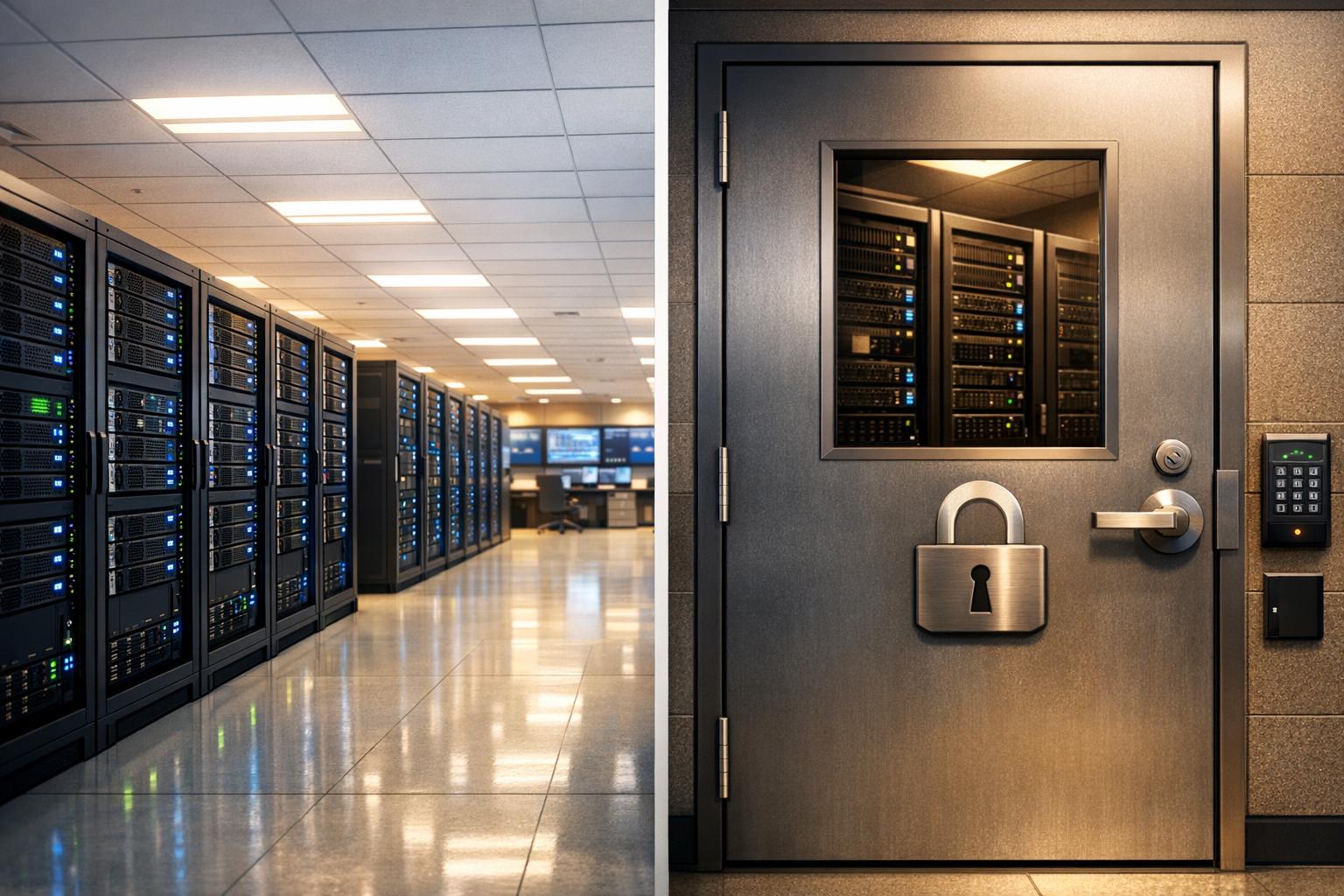
Downtime can cost businesses up to £80,000 per minute, making disaster recovery (DR) a critical investment. Your choice between public and private hosting directly impacts costs, recovery speed, and compliance. Here’s the gist:
- Public hosting: Pay-as-you-go pricing with low upfront costs. Ideal for flexibility but can lead to unpredictable expenses due to storage, data transfer, and scaling.
- Private hosting: High initial investment with predictable long-term costs. Offers better control and security but lacks scalability.
Key Metrics:
- RTO (Recovery Time Objective): Maximum acceptable downtime.
- RPO (Recovery Point Objective): Allowable data loss timeframe.
Quick Comparison
| Factor | Public Hosting | Private Hosting |
|---|---|---|
| Upfront Costs | Low | High |
| Ongoing Costs | Variable | Predictable |
| Scalability | High | Limited |
| Control | Limited | Full |
| Best For | Fluctuating demands | High security & compliance needs |
Takeaway: Public hosting suits businesses needing flexible scaling, while private hosting works for those prioritising control and stability. Evaluate your RTO, RPO, and budget to choose the right DR strategy.
Disaster Recovery Strategies
Disaster Recovery Costs in Public Hosting
Public cloud disaster recovery operates on a consumption-based billing model. Instead of investing in redundant hardware that often remains unused, you pay only for what you use. This transforms disaster recovery from a fixed capital expense into a flexible operating cost, eliminating the need to maintain idle hardware [3].
With this pay-as-you-go system, costs scale directly with your usage. For instance, AWS Elastic Disaster Recovery charges £0.022 per source server per hour, which works out to about £16 per server each month [1]. Azure Site Recovery offers a similar model, charging £20 per instance monthly after a 31-day free trial [5]. Google Cloud, on the other hand, takes a slightly different route, billing around £0.000021 per GiB per hour for virtual machine (VM) management [2].
The actual costs depend on factors like data change rates and storage needs. For example, in an AWS setup with 100 servers, 30TB of storage, and a daily data change rate of 3.3%, the monthly bill was £5,100. This figure included £1,630 for replication services, £1,140 for staging volumes, £1,475 for snapshots, and £840 for replication servers [1]. Storage costs also vary based on performance tiers: standard SSD-backed storage (gp3) costs about £0.064 per GB monthly, while snapshots are priced at roughly £0.040 per GB monthly [1].
What Makes Up Public Hosting DR Costs
Several components contribute to the overall cost of disaster recovery in public hosting:
- Replication Infrastructure: This includes low-cost compute instances and staging disks that facilitate continuous data transfer. These resources operate constantly, forming the baseline expenses [1].
- Storage Costs: These depend on retention policies and data churn. Higher data change rates lead to more frequent snapshots, increasing costs. High-performance SSD storage is pricier than cold storage but is necessary for staging areas that require quick access during failover [1][2].
- Compute Charges: These spike during disaster recovery drills or failover events. While steady replication uses minimal compute resources, a full-scale recovery or drill activates high-capacity instances. For example, an eight-hour drill for 100 servers costs around £98, including £23 for upgraded storage and £75 for instance launches [1].
- Data Transfer Fees: Often overlooked, these charges can add up during failover events, particularly for initial synchronisation or secondary region failovers. Compressed data transfers can help reduce costs, but this remains a key factor when budgeting [2][5].
- Management and Support: Many providers recommend higher-tier support plans, such as Business or Enterprise levels, for production workloads. These add extra monthly fees on top of replication costs [1][2][5].
Benefits and Drawbacks of Public Hosting for DR
Public hosting offers clear advantages for disaster recovery, but it also comes with challenges. One of the biggest benefits is the elimination of substantial upfront costs. AWS highlights how this model shifts fixed capital expenses to variable operating costs [3].
Another advantage is flexibility. Costs scale with your needs - add 10 servers, and your expenses increase proportionally. Azure’s 31-day free trial for new instances further lowers the barrier to expanding disaster recovery coverage [5]. Automated tools manage replication, snapshots, and failover processes, reducing the need for dedicated staff to handle physical infrastructure.
However, cost predictability can be an issue. While baseline replication expenses are stable, storage costs grow with data volumes and change rates. For organisations experiencing rapid data growth, disaster recovery costs can rise faster than expected. Data transfer fees, especially during regional failovers or frequent drills, add another layer of unpredictability.
Long-term costs can also spiral if not carefully managed. For instance, retaining daily snapshots for 90 days is significantly more expensive than a 30-day retention period. Without proper oversight, teams may over-provision resources or adopt overly aggressive retention policies, inflating monthly bills [1][2].
Disaster Recovery Costs in Private Hosting
Private hosting for disaster recovery operates on a capital expenditure model, meaning organisations make a significant upfront investment in dedicated infrastructure instead of paying monthly fees based on usage. This approach provides predictable long-term costs but requires a hefty initial outlay. For instance, small businesses (100–500 employees) typically allocate between £60,000 and £150,000 annually for in-house disaster recovery. Mid-sized organisations (500–2,000 employees) might spend £170,000 to £455,000 per year, while large enterprises (2,000+ employees) often dedicate £535,000 to over £1.4 million annually, which can represent 15–25% of their IT budgets [6].
Cloud has changed the economics of disaster recovery. Some years back, only the biggest organisations could fully implement DR because it was so expensive to duplicate infrastructure and systems...
– Phil Goodwin, Research Director, IDC [8]
Unlike the variable costs associated with public cloud services, private hosting offers relatively stable expenses once the infrastructure is in place. However, this stability comes with limitations. Scaling down during periods of low demand is challenging, and unexpected hardware failures or capacity needs can lead to unplanned expenses. Below, we break down the primary cost categories involved in private hosting disaster recovery.
What Makes Up Private Hosting DR Costs
Setting up a private disaster recovery system involves several key cost components:
- Hardware Costs: These range from approximately £16,000 to £395,000 annually and cover secondary servers, storage arrays, and networking equipment configured for failover.
- Software Licensing: Tools like orchestration platforms, replication licences, and backup software add between £4,000 and £198,000 per year.
- Personnel Costs: Dedicated disaster recovery teams and testing efforts cost between £20,000 and £316,000 annually.
- Facilities Costs: Maintaining a secondary site, including redundant power, cooling systems, and security, typically costs £12,000 to £316,000 per year.
- Connectivity Costs: High-bandwidth, redundant network connections for real-time data replication add an additional £8,000 to £158,000 annually [6].
For organisations aiming for near-zero Recovery Time Objectives (RTO), costs can rise by 40–60% due to the need for continuously operational, mirrored backup systems. Similarly, achieving minimal Recovery Point Objectives (RPO) through advanced real-time data replication may increase costs by another 30–50% [6].
While these costs are substantial, private hosting offers distinct advantages alongside its challenges.
Benefits and Drawbacks of Private Hosting for DR
Private hosting provides a predictable cost structure and complete physical control over the disaster recovery environment. This control allows organisations to customise configurations, making it easier to support specialised or legacy applications that may not align with standardised cloud solutions [6]. Keeping sensitive data in-house enhances security and helps meet regulatory compliance requirements, while also eliminating concerns about third-party access. Additionally, private setups are less reliant on external internet connectivity, a critical advantage during widespread outages.
On-site disaster recovery can be up to 40% more cost-effective than traditional off-site solutions. Studies show private disaster recovery setups can reduce recovery time by 46%, cut downtime by 34%, and improve the availability of critical on-site applications by up to 53% [7].
However, these benefits come with some significant drawbacks. The high upfront investment can be a major hurdle, especially for smaller businesses. Unlike the flexible pay as you go
model of public cloud services, private infrastructure incurs fixed costs even during low-risk periods. This lack of flexibility highlights the trade-off between long-term cost control and adaptability. Additionally, maintaining the infrastructure involves ongoing hardware upgrades, regular testing (such as Bubble Tests
and dry runs), and other manual processes, which can pull IT teams away from strategic projects, increasing opportunity costs [6][7].
As with all things cloud vs on-premise, it's the decision between fixed costs/capex and recurring costs/opex for cloud or managed DR services.
– Richard Blanford, CEO, Fordway [8]
For businesses navigating these trade-offs, expert guidance can make a significant difference. Firms like Hokstad Consulting provide tailored insights to help organisations make informed decisions.
Public vs. Private Hosting: DR Cost Comparison
::: @figure 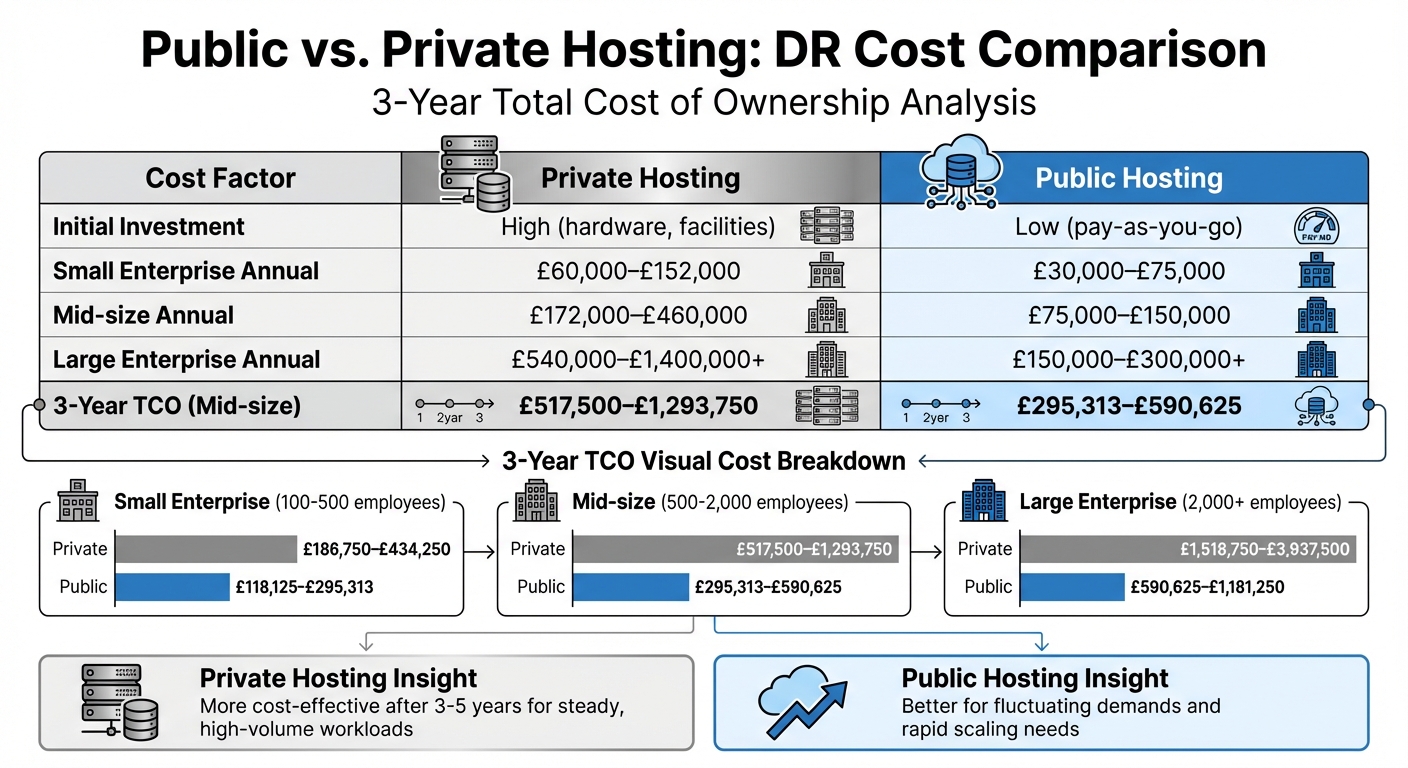 {Public vs Private Hosting Disaster Recovery Cost Comparison}
:::
{Public vs Private Hosting Disaster Recovery Cost Comparison}
:::
When it comes to disaster recovery (DR), choosing between public and private hosting can have a big impact on your organisation's budget over time. Public hosting tends to lure businesses with its low upfront costs and flexibility, while private hosting appeals to those seeking predictable expenses after the initial investment. The decision ultimately hinges on factors like company size, budget priorities, and long-term recovery needs. To help clarify these trade-offs, let’s dive into the cost breakdown and explore some often-overlooked hidden expenses.
Cost Comparison Table: Public vs. Private DR
The financial differences between public and private hosting become more apparent when you look at the total cost over a three-year period. For smaller companies with 100 to 500 employees, private hosting costs fall between £186,750 and £434,250, whereas public hosting ranges from £118,125 to £295,313. For mid-sized organisations (500–2,000 employees), private hosting can cost about £517,500 to £1,293,750, compared to £295,313 to £590,625 for public hosting. Larger enterprises with over 2,000 employees see even starker differences, with private hosting costing £1,518,750 to £3,937,500, while public hosting remains between £590,625 and £1,181,250 [6].
| Cost Factor | Private Hosting | Public Hosting |
|---|---|---|
| Initial Investment | High (hardware, facilities) | Low (pay-as-you-go) |
| Small Enterprise Annual | £60,000–£152,000 | £30,000–£75,000 |
| Mid-size Annual | £172,000–£460,000 | £75,000–£150,000 |
| Large Enterprise Annual | £540,000–£1,400,000+ | £150,000–£300,000+ |
| 3-Year TCO (Mid-size) | £517,500–£1,293,750 | £295,313–£590,625 |
For organisations with steady, high-volume workloads, private hosting can become more cost-effective after three to five years. On the other hand, public hosting remains a better fit for businesses that need flexibility to handle fluctuating demands or rapid scaling [6].
Hidden Costs and Long-Term Expenses
While the numbers in the table provide a solid foundation, hidden costs can significantly alter the financial picture. Private hosting often comes with additional expenses like maintaining facilities and periodic hardware upgrades. There’s also the cost of IT staff being pulled away from strategic initiatives to manage infrastructure [6][8].
Public hosting has its own set of hidden costs. Data transfer fees, for instance, can quickly add up, especially during disaster recovery scenarios. Vendor lock-in is another concern, as it could limit your bargaining power over time. Plus, unexpected usage surges - whether from disaster recovery drills or real incidents - can lead to surprise bills, making long-term budgeting more complex [6].
Understanding these nuances is key to making the right choice for your organisation’s disaster recovery strategy.
How to Reduce Disaster Recovery Costs
Strategically managing your disaster recovery (DR) setup can significantly lower costs without sacrificing the protection your systems need. Whether you're using public cloud services or private hosting, there are practical ways to trim expenses while maintaining efficiency and readiness.
Reducing Public Hosting DR Costs
Public cloud platforms offer several cost-saving opportunities. One of the most effective is right-sizing your resources. Conducting regular DR audits ensures you're not paying for more capacity than you actually need. For instance, Canva managed to cut its computing costs by 46% between 2023 and 2025 by using AWS's AI-driven cost management tools [9]. Similarly, ASOS saved 25–40% on cloud expenses by leveraging Azure's automated cost management features during 2024–2025 [9].
Choosing the right DR strategy for each workload can also bring significant savings. For non-critical applications, a backup-and-restore model is often more economical than maintaining active configurations like warm standby or active–active setups. Real-world examples include LawnStarter, which reduced storage costs by 55% through automated data policies and by identifying unused resources [9], and Olli Salumeria, which slashed its DR costs by 80% after switching to an elastic cloud-based model [9]. Additionally, the Department for Transport lowered rack management costs by 45% by migrating its SAP and Unit4 Business World systems to AWS during the pandemic [9].
Reducing Private Hosting DR Costs
Private hosting requires a different approach to cost reduction, focusing on automation and resource efficiency. Implementing Infrastructure as Code (IaC) can eliminate manual errors - reducing them by up to 90% - and speed up deployments by 75% [9]. This level of automation not only improves accuracy but also frees up your team to focus on more valuable tasks while maintaining disaster recovery readiness.
Another key strategy is consolidating workloads and performing regular audits to optimise hardware use. This ensures that idle capacity is eliminated and resources are fully utilised. For compliance, automated checks integrated into CI/CD pipelines can help meet UK regulatory standards without increasing operational complexity. These optimisations can lead to a 95% reduction in downtime caused by infrastructure issues and reduce overall spending by 30–50% [9].
For more tailored advice on reducing disaster recovery costs and streamlining your cloud infrastructure, visit Hokstad Consulting at https://hokstadconsulting.com.
Choosing Between Public and Private Hosting for DR
When deciding on a disaster recovery (DR) hosting approach, it’s crucial to align your Recovery Time Objective (RTO) and Recovery Point Objective (RPO) with your business requirements. Keep in mind that aiming for smaller RTO and RPO values often increases both the complexity and cost of your DR setup, requiring more advanced solutions [4].
Your choice of hosting model also plays a big role in determining cost predictability and scalability. Public hosting provides a flexible, pay-as-you-go structure with the ability to scale quickly. While this model reduces upfront costs, it can lead to unpredictable long-term expenses due to fluctuating usage patterns. On the other hand, private hosting is ideal for organisations with strict compliance needs or those requiring consistent, dedicated performance. However, this comes with a higher initial investment and limited scalability because it relies on physical infrastructure.
Recent data shows that 44% of organisations have experienced major outages [8]. This highlights why your DR strategy should be based on actual business risks rather than simply opting for the cheapest solution. For example, a retail business with seasonal traffic spikes might benefit from the flexibility of public cloud hosting, whereas a financial services company handling sensitive data may prioritise the control and security of private hosting.
To make an informed decision, evaluate the potential costs of downtime. Conduct a Business Impact Analysis to calculate losses, including lost revenue and less obvious impacts like reputational damage. This analysis will help you determine whether your business requires instant failover capabilities or if a backup-and-restore model is sufficient. Combining this analysis with a comparison of hosting costs ensures that your DR solution fits both your operational needs and budget.
If navigating these decisions feels overwhelming, Hokstad Consulting offers expert guidance. They specialise in cloud cost engineering and strategic migration services, helping businesses optimise their DR setups while cutting cloud costs by 30–50%. Their expertise spans public, private, and hybrid environments, ensuring your systems get the protection they need. Learn more at https://hokstadconsulting.com to discover how professional advice can align your DR strategy with your goals and budget.
FAQs
How do disaster recovery costs differ between public and private hosting?
When comparing disaster recovery costs between public and private hosting, the key differences come down to pricing structure, control, and security.
Public hosting tends to be more budget-friendly at the outset and allows for quick scalability. However, over time, ongoing costs can add up, and you’ll have less direct control over both data security and the recovery process.
On the other hand, private hosting usually comes with a higher price tag but offers much greater control, the ability to customise, and stronger security measures. This makes it a solid option for businesses that handle sensitive data or need tailored disaster recovery solutions. For organisations in the UK, the decision often hinges on whether the priority is cost savings or having a more robust, customised approach to disaster recovery.
What are the best ways to reduce disaster recovery costs in a public cloud environment?
Reducing disaster recovery costs in a public cloud setup boils down to making processes more efficient and optimising resources. By leveraging automation and infrastructure as code (IaC), you can simplify recovery tasks, minimise manual intervention, and ensure a swift and dependable failover when needed.
Another key strategy is right-sizing resources. Using automated monitoring tools can help pinpoint and remove underutilised or redundant assets, which can significantly lower expenses. For some organisations, adopting a hybrid or private cloud approach might strike the right balance between performance, security, and cost-effective disaster recovery solutions.
Why would a business opt for private hosting even though it costs more initially?
Private hosting is an excellent option for businesses that place a high value on strong security, full control over their data, and performance tailored to their needs. It's particularly important for industries such as finance or healthcare, where meeting strict regulatory requirements is non-negotiable.
Although the initial costs might be steeper, private hosting provides bespoke solutions that enhance reliability and flexibility. In the long run, it’s an investment in operational stability and the assurance that your data is in safe hands.