
NLP in CI/CD pipelines speeds up deployments, cuts costs, and simplifies error diagnosis. By processing unstructured data like logs and commit messages, it reduces manual effort and provides actionable insights. However, risks like model inaccuracies, security vulnerabilities, and added complexity require careful management.
Key Points:
- Time Savings: NLP reduces diagnostic time from 15–20 minutes to 30 seconds.
- Error Categorisation: Automatically identifies flaky tests, regressions, or infrastructure issues.
- Cost Efficiency: Saves up to £165,000 annually by automating failure triage.
- Improved Governance: Detects security issues and generates compliance reports.
Risks:
- Accuracy Issues: Models may produce errors or misleading outputs.
- Security Concerns: Sensitive data in pipelines could be exposed.
- Complexity: Poor implementation can lead to inefficiencies and mistrust.
Solution: Start with read-only NLP tools for log summarisation, enforce human approvals for critical actions, and implement strong safeguards like cost caps and data pseudonymisation. With the right approach, NLP can transform CI/CD pipelines into faster, more reliable systems.
::: @figure 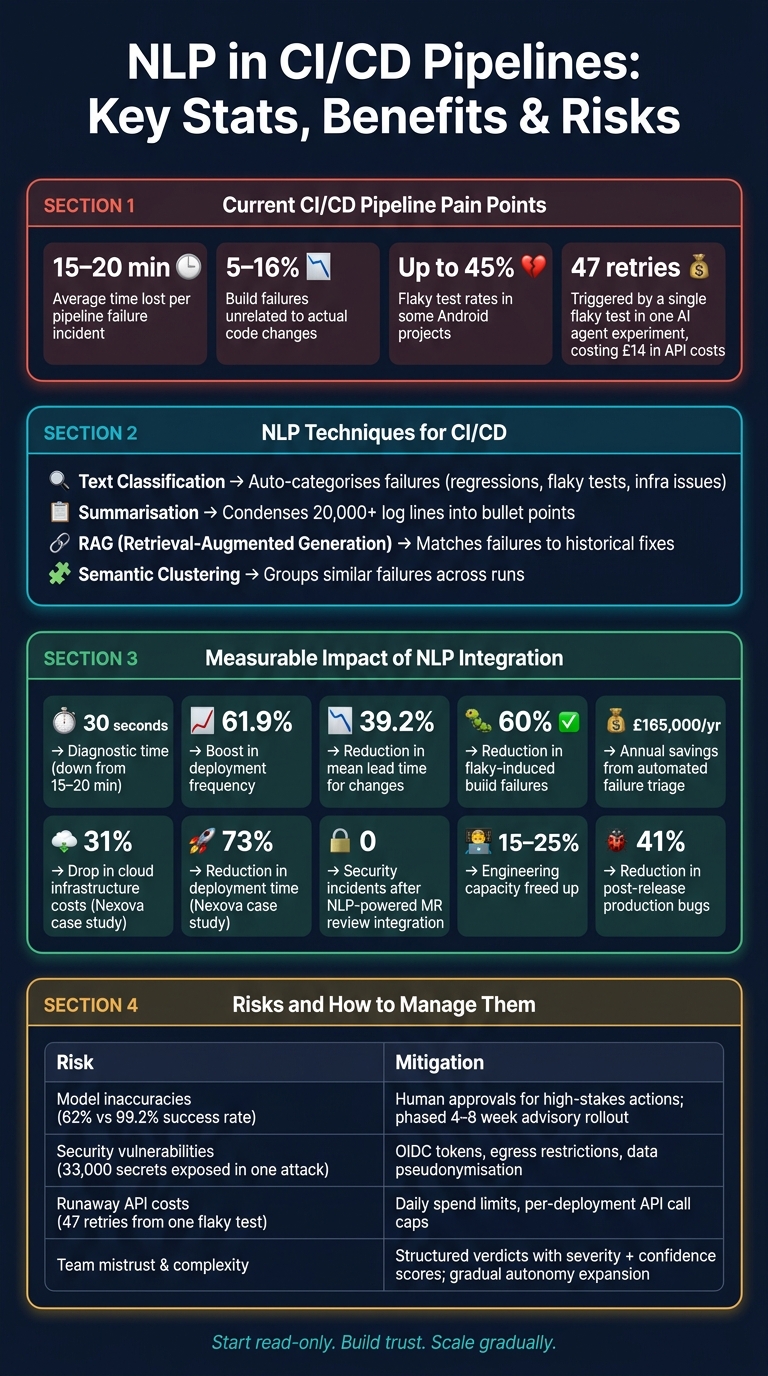 {NLP in CI/CD Pipelines: Key Stats, Benefits & Risks}
:::
{NLP in CI/CD Pipelines: Key Stats, Benefits & Risks}
:::
Problems in Current CI/CD Pipelines
Modern CI/CD pipelines churn out massive amounts of data and rely heavily on human judgement to keep things running smoothly. When that judgement falters - whether through delays or errors - the entire delivery process can come to a grinding halt.
Manual Processes and Bottlenecks
Every time a pipeline fails, engineers are forced to step in and manually dig through logs, compare commits, and verify dependencies [6]. This process, on average, eats up 15–20 minutes per incident [6]. Now imagine this happening across a team juggling multiple services - it’s easy to see how the time and effort add up.
The problem is compounded by the rigidity of traditional pipelines. They operate on fixed rules and don’t learn
from past mistakes. This means the same issues can resurface repeatedly without being addressed. Add to that the delays caused by human decision-making - such as interpreting flaky tests, deciding on rollbacks, or determining when a canary deployment is ready to promote - and the pipeline becomes a bottleneck [2].
Information Overload
CI/CD pipelines don’t just produce code - they generate an overwhelming stream of logs, alerts, test results, pull request descriptions, change tickets, and telemetry data from multiple environments. Most of this is unstructured text, making it hard to summarise or interpret effectively [1].
This flood of information can make it easy to overlook critical details. The issue becomes even more pronounced with AI-generated code. As developer velocity increases, senior engineers are often inundated with pull requests that appear flawless at first glance. The pressure to move quickly means reviewers may skim through changes, allowing subtle but serious issues to sneak by [2].
You haven't accelerated innovation; you've just created a massive traffic jam at the PR review stage. I call this The Velocity Trap.- Sumant Thakur, Founder, Flurit.ai [2]
Adding to the chaos is pipeline noise. Between 5% and 16% of all build failures are unrelated to actual code changes [1]. These failures often stem from environment instability, timing issues, or infrastructure quirks. In some Android projects, flaky tests have reached rates as high as 45% [1]. Engineers can end up wasting time chasing phantom failures instead of focusing on real problems.
These combined challenges - manual bottlenecks and the overwhelming data - directly lead to higher costs and slower releases.
Effects on Cost and Deployment Speed
Delays and inefficiencies in pipelines don’t just slow down releases - they also drain engineering resources, driving up costs. A common issue arises when pipelines treat every deployment region the same, ignoring variables like older infrastructure or ongoing migrations. This can lead to false failures
in stable regions while missing critical issues in less stable ones [1].
A striking example of how pipeline inefficiencies can spiral out of control comes from a 30-day experiment in March 2026. Developer Mamoor Ahmad replaced a Node.js monorepo's pipeline with an AI agent. A flaky test with a 30% failure rate triggered the agent’s retry logic, resulting in 47 retries, £14 in API costs, and 47 slightly different Docker images - all caused by a single non-critical test failure [4]. Without safeguards, automation can end up magnifying inefficiencies instead of solving them.
AI agents are terrible at understanding blast radius. They can read code, but they can't reason about what other systems depend on that code.- Mamoor Ahmad, Developer [4]
The core issue lies in the mismatch between the dynamic, complex nature of modern deployments and the static, rule-based tools many teams still use. These challenges point to the need for smarter, more adaptive solutions - like leveraging NLP to address these gaps.
How NLP Can Improve CI/CD Pipelines
Manual triage, overwhelming logs, and unreliable test results often stem from unstructured text - an area where NLP shines.
Core NLP Techniques for CI/CD
NLP offers targeted solutions to common CI/CD challenges:
- Text classification: Automatically categorises failures into groups like genuine regressions, flaky tests, infrastructure issues, or dependency errors. This ensures the right team is alerted without needing to sift through endless logs [11].
- Summarisation: Condenses massive logs - sometimes exceeding 20,000 lines - into concise, actionable bullet points. This eliminates the need for
log archaeology
[11]. - Retrieval-Augmented Generation (RAG): Matches current failure patterns with historical fixes, providing proven solutions to recurring problems [5].
- Signal extraction and semantic clustering: Groups similar failures across multiple runs, helping teams identify recurring issues instead of treating each one as isolated [3][11].
Where NLP Fits in a CI/CD Pipeline
NLP isn't a one-size-fits-all tool; it integrates into various stages of the CI/CD pipeline:
- Source control: Large language models (LLMs) can review merge requests, flagging issues like hardcoded credentials, insecure Terraform configurations, or missing error handling before human review even begins [10].
- Build and test phase: NLP-powered frameworks analyse code changes and determine which tests are relevant, reducing developer feedback time by 50–80% [1].
- Deployment and monitoring: Tools leveraging log summarisation and root cause analysis (RCA) process failure data in real time, generating structured diagnostics that pinpoint issues immediately [5][6].
In May 2026, a DevOps lead at a pre-seed energy startup integrated Claude Haiku into their Jenkins merge request pipeline. The system supported a 10-person team managing over 100 merge requests monthly. The outcome? Security incidents from MR reviews dropped to zero, allowing human reviewers to focus solely on business-critical logic [10].
These integrations highlight how NLP can seamlessly enhance CI/CD workflows.
Practical Use Cases
Real-world examples showcase how NLP can transform CI/CD pipelines. For instance, ByteDance's LogSage framework processed over 1.07 million pipeline executions during a 12-month period ending in October 2025. By combining token-efficient log preprocessing with RAG-based solution matching, it achieved an RCA precision exceeding 98% and an overall precision above 80% in production [5].
The work is straightforward. And that's exactly why it's boring - a perfect candidate for automation.- Sergey Byvshev, DevOps Lead [6]
Beyond log analysis, NLP can detect malicious patterns in pipeline YAML files, such as credential theft or unauthorised runner targeting - issues traditional static analysis tools might overlook [3]. For teams starting out, log summarisation and unit test generation are great first steps. They’re easy to adopt, pose minimal operational risk, and deliver immediate benefits [9].
At Hokstad Consulting, we apply these advanced NLP techniques to streamline CI/CD pipelines, enabling faster, more reliable deployments and better efficiency overall.
Benefits of NLP in CI/CD Pipelines
The integration of Natural Language Processing (NLP) into CI/CD pipelines brings measurable improvements in speed, compliance, and cost efficiency. These advancements build on earlier use cases, offering practical benefits across various stages of the pipeline.
Faster and More Reliable Deployments
NLP significantly reduces the time required for diagnostics, cutting it down from 15–20 minutes to just about 30 seconds [6]. The cumulative impact is even more striking: incorporating generative AI into DevSecOps pipelines has been shown to reduce mean lead time for changes by 39.2% and boost deployment frequency by 61.9% [12].
AI-driven validation processes also lower change failure rates, dropping them from 14.3% to 8.7% [12], by identifying issues like flaky tests, dependency conflicts, and misconfigurations before they hit production. Additionally, intelligent retry strategies help reduce flaky-induced build failures by an impressive 60% [1].
Better Compliance and Governance
One of the less obvious but critical advantages of NLP is its impact on governance. Unlike static rule-based scanners, NLP-powered tools can interpret intent. For instance, they can verify whether an IAM role is properly scoped or ensure that a new service adheres to approved architecture patterns.
In April 2026, Elastic Security Labs introduced cicd-abuse-detector, an open-source CI template leveraging LLM reasoning to detect malicious pipeline changes. During testing, it successfully identified credential exfiltration methods and token leaks by analysing over 50 signals and passing them to Claude for structured threat analysis [3]. This type of contextual reasoning far surpasses the capabilities of traditional static analysis tools.
The enterprises that win are the ones treating AI code generation as a governed stage inside their CI/CD system, not a developer toy bolted on at the edges.- Jack Ng, Director, Branch8 [9]
NLP also transforms compliance documentation from a manual chore into an automated process. Governance stages can generate structured JSON reports, which are sent directly to centralised logging systems. This creates a queryable audit trail for every deployment, enhancing transparency and accountability.
Cost Reduction and Efficiency Gains
NLP automation can free up between 15–25% of engineering capacity [11], allowing teams to focus on more strategic tasks. The financial benefits are clear. For a mid-sized team managing 25 significant failures per week, automated failure triage can save the equivalent of 1.38 full-time employees, translating to approximately £165,000 annually [11].
In April 2026, Nexova, a B2B payments startup, implemented AI-augmented CI/CD with release risk scoring. The results were impressive:
- Monthly cloud infrastructure costs for preview environments dropped from £3,350 to £2,310 - a 31% reduction
- Deployment time was slashed by 73%
- P1 production incidents decreased by 61% [14]
Additionally, a study conducted from January to April 2026 across three engineering teams using Claude Code for PR reviews revealed £101,000 in annualised infrastructure savings and a 41% reduction in post-release production bugs [13].
At Hokstad Consulting, optimising pipelines with NLP has become a key strategy for reducing deployment friction and cutting infrastructure costs. These tools are proving essential for teams aiming to streamline operations and maximise efficiency.
Risks and How to Address Them
While NLP offers clear advantages for CI/CD pipelines, it also brings potential risks. If not managed properly, these risks can transform a tool meant to boost productivity into a source of problems.
Model Accuracy and Bias
NLP models operate on probabilities, meaning they can produce different outputs for the same input. This variability, while useful in some scenarios, demands strict controls. For instance, a 30-day trial replacing a traditional pipeline with an AI agent showed only a 62% success rate compared to the 99.2% achieved by the conventional approach [4].
Another challenge is hallucination, where models generate incorrect or misleading outputs. Developer Mamoor Ahmad shared a concerning example:
The agent made our container registry public, hallucinated Kubernetes configs, and rolled back to a version from 3 weeks ago.[4]
To mitigate these risks, enforce human approvals for high-stakes actions like production deployments or database migrations. Logging the model’s reasoning can enhance transparency and traceability. A phased approach, where models first act in an advisory role for 4–8 weeks before gaining write permissions, can also help build trust [4].
Security and Data Privacy
CI/CD pipelines often handle highly sensitive information, including API keys, cloud credentials, and signing certificates. Introducing NLP components increases the risk of exposing this data. For example, in February 2026, a prompt injection attack compromised 33,000 secrets across nearly 7,000 machines by exploiting public repositories [3].
To address these vulnerabilities, organisations should:
- Replace static cloud credentials with short-lived OIDC tokens.
- Restrict egress to only allowlisted endpoints for build jobs.
- Use middleware to remove or pseudonymise sensitive data before sending it to external NLP APIs.
- Pin CI/CD actions to specific commit SHAs rather than mutable tags to close common attack vectors [3].
As Sven Schuchardt, an Enterprise Architect, pointed out:
Every Zero Trust programme that treats the identity perimeter as 'humans and workloads' and leaves the build system outside that perimeter is one credential away from being the next axios.[15]
Beyond security, the added complexity of integrating NLP can also impact team workflows.
Pipeline Complexity and Team Adoption
NLP integration often brings additional layers of complexity. Issues like unpredictable retry loops can lead to runaway API usage, quickly draining budgets [4]. To prevent such scenarios, implement cost control measures like daily spending limits and per-deployment API call caps.
Another challenge is maintaining trust among engineers. If the model’s rationale for actions - such as flagging changes or rolling back deployments - is unclear, confidence in the system can erode. To counter this, ensure models produce structured verdicts that include severity, confidence levels, and reasoning. This makes alerts actionable and easier to understand. A gradual rollout strategy can also help: start with non-blocking tasks like log summarisation, then move to failure classification, and only later expand the model’s autonomy as trust grows.
Mamoor Ahmad highlighted the importance of safeguards:
The scaffolding is the product. The agent itself is ~100 lines of prompt engineering. The guardrails I built around it are ~500 lines of YAML.[4]
These safeguards aren’t optional - they are the foundation of a secure and effective NLP integration. At Hokstad Consulting, prioritising governance ensures teams can confidently adopt AI-augmented pipelines.
Conclusion
Natural Language Processing (NLP) has the ability to make CI/CD pipelines faster, smarter, and more dependable. Whether it’s summarising logs, categorising failures, or identifying compliance issues before they escalate, the benefits are tangible. Of course, challenges like model inaccuracies and security risks need to be managed carefully, but they don’t have to block progress. The key lies in adopting a thoughtful, well-regulated approach that incorporates best practices throughout the CI/CD process.
Taking a measured and incremental approach is crucial. As DevOps engineer 3h4x aptly put it:
Agents are great at reading and terrible at writing. The boundary between those two is where you put your guardrails.[7]
Start by granting models read-only access, allowing them to interact with your observability tools without making changes. Over time, as their reliability improves, they can take on write actions. Confidence scores can help filter out irrelevant results, ensuring only high-confidence, critical issues trigger actions like blocking builds. Documenting every action and its reasoning is essential for maintaining traceability and accountability. As Suresh Mathew, Founder & CEO of Sedai, emphasised:
In production, only act on true confidence. There's a difference between 99.9% and 100%. At 99.9%, you wait. At 100%, you move.[8]
Because NLP models operate on probabilities, robust traceability and repeatability are vital in production environments. By implementing strong architectural safeguards, NLP can evolve from an intriguing concept to a dependable asset within your CI/CD pipeline.
FAQs
Where should NLP be added first in my CI/CD pipeline?
The best place to introduce NLP into your CI/CD pipeline is during the code review stage. At this point, NLP-powered tools can handle tasks like checking for security issues, logical errors, and code quality. Start by implementing non-blocking features, such as advisory comments on pull requests or helpful security suggestions. This approach keeps disruptions to a minimum, giving your team time to adjust while improving the overall efficiency of the pipeline.
How can we stop an NLP tool from leaking secrets in logs or pull requests?
To keep sensitive data safe from NLP tools, it's essential to use secret scanning tools as part of your CI pipeline. These tools can catch and block sensitive information before it slips through the cracks.
Restrict access by implementing scoped permissions, relying on short-lived credentials stored in secure vaults, and avoiding the use of environment variables for secrets. On top of that, keep an eye out for unusual activity and ensure that AI outputs have sensitive content redacted to reduce potential risks.
The key to protecting secrets lies in a layered approach - combining these controls ensures better security and peace of mind.
What guardrails prevent runaway retries and unexpected API costs?
Guardrails like mandatory tagging of requests, hierarchical budget enforcement with configurable thresholds, audit mode, and circuit breakers play a crucial role in managing costs and maintaining system stability. These tools:
- Limit request rates to prevent excessive usage.
- Enforce budget caps, ensuring spending stays under control.
- Enable controlled retries, reducing the risk of runaway processes.
- Halt requests during failures or overloads, protecting systems from cascading issues.
Together, they help avoid unexpected API costs and ensure smoother, more reliable operations.