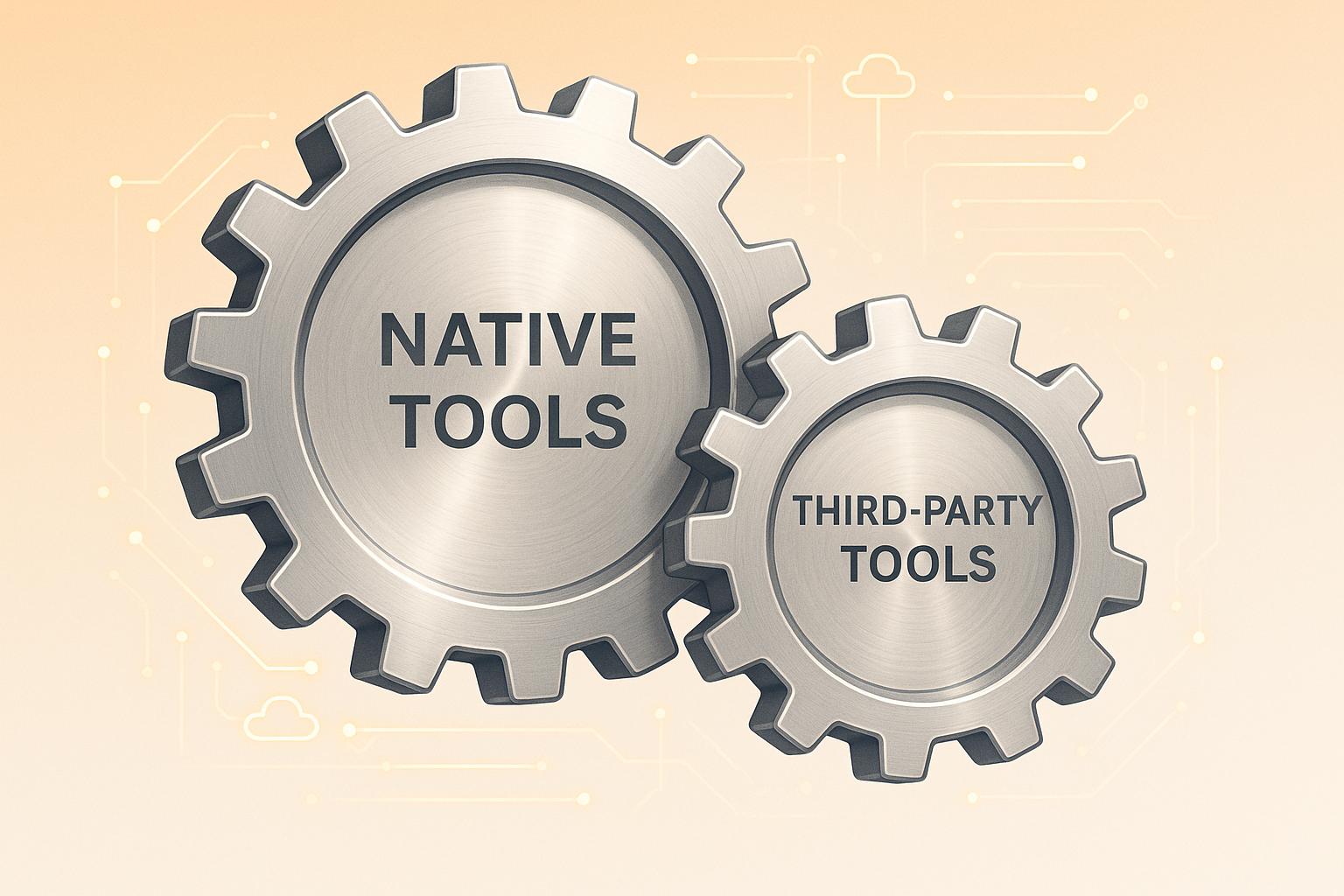
Managing cloud costs effectively can save organisations significant money, but choosing the right tools is key. Native tools, like AWS Cost Explorer or Azure Cost Management, are built into cloud platforms and work well for single-cloud setups. They’re free or low-cost and offer basic features like cost breakdowns, budget alerts, and optimisation recommendations. However, they struggle with multi-cloud environments, advanced analytics, and real-time updates.
Third-party platforms, such as CloudHealth or Finout, provide a unified view across multiple clouds, Kubernetes, and on-premise systems. They offer advanced features like granular cost allocation, virtual tagging, anomaly detection, and automation for tasks like rightsizing. These tools are ideal for larger organisations with complex setups but come with subscription costs and require more setup and maintenance.
Quick Comparison
| Criteria | Native Tools | Third-Party Tools |
|---|---|---|
| Cost | Free or included with cloud platforms | Subscription-based, often tied to usage |
| Coverage | Single cloud | Multi-cloud, Kubernetes, on-premise |
| Automation | Limited (manual actions required) | Advanced (automated optimisation, alerts) |
| Analytics Depth | Basic (service-level insights) | Advanced (team, product, feature-level views) |
| Best For | Small teams, single-cloud setups | Large teams, multi-cloud or Kubernetes users |
For small teams or single-cloud users, native tools are often sufficient. Larger organisations or those with multi-cloud setups benefit from the advanced capabilities of third-party platforms. Start with native tools, and as complexity or spend grows, consider third-party options to improve visibility and optimise costs.
Top 10 Cloud Cost Management Tools in 2023
Native Cloud Provider Cost Monitoring Tools
Major cloud platforms like AWS, Azure, and Google Cloud offer built-in cost monitoring tools - AWS Cost Explorer and Budgets, Azure Cost Management + Billing, and Google Cloud's Cost Management. These tools directly access billing data from the platform, saving users the hassle of additional setup.
Main Features and Advantages
These native tools provide detailed historical usage and cost breakdowns, often segmented by service, account, region, or tag. For example, AWS Cost Explorer offers 13 months of historical data along with 12-month forward forecasts, making it easier for teams to analyse trends and plan budgets effectively [1].
Another useful feature is the ability to set spending limits, such as £10,000 per month, and trigger alerts at thresholds like 50%, 80%, and 100%. These alerts, sent via email or platforms like Microsoft Teams, ensure both engineers and finance teams stay informed [1].
Cost-saving suggestions are also built in, with recommendations for rightsizing, Reserved Instances, Savings Plans, or other commitment discounts. These help organisations reduce expenses by optimising resources for consistent workloads.
One of the biggest draws of native tools is their minimal or no additional cost. Being part of the platform, they integrate seamlessly with identity and access management, tagging systems, and APIs. This eliminates the need for extra software or complex integrations. Since these tools are the source of billing data, they provide direct and authoritative access to usage and pricing information, typically updated daily.
However, despite these strengths, native tools come with some notable limitations.
Limitations and Problems
Native tools are restricted to single-cloud environments. For example, AWS tools only show AWS costs, Azure tools only display Azure costs, and so on. Organisations using multiple cloud providers or hybrid setups must manually consolidate reports from each platform, often resorting to exporting data into spreadsheets. This process is not only time-consuming but also prone to errors [3].
Customisation options are limited as well. Dashboards often offer fixed or minimally adjustable views, with basic filtering capabilities. This makes it difficult to allocate costs by specific business dimensions like customer segments or product features. As a result, many teams end up relying on external business intelligence tools or crafting custom queries for more detailed insights [5].
Data latency is another issue. Most native tools update on a 24-hour cycle, meaning today’s cost spikes might not appear in dashboards until the following day [1]. Additionally, cost data can be scattered across multiple dashboards and services, requiring significant platform expertise to set up effective views and alerts.
Finally, while some providers now include basic anomaly alerts, most native tools lack advanced forecasting or what-if
simulation features. These capabilities are often essential for identifying deeper cost optimisation opportunities.
Although native tools are simple and cost-efficient, their limitations make them less suitable for complex organisational needs.
When to Use Native Tools
Native tools work best for straightforward, single-cloud setups. For instance, a UK-based start-up running entirely on AWS with a handful of accounts can likely meet its cost monitoring needs using AWS Cost Explorer and Budgets. These tools are also ideal for organisations in the early stages of cloud adoption or FinOps maturity, where the primary focus is on establishing basic visibility, enforcing tagging, and setting budget alerts.
For UK organisations looking to avoid extra SaaS costs or additional vendor complexity - especially in regulated industries where procurement and security reviews can be challenging - native tools are a practical choice. However, as organisations grow and adopt multi-cloud or hybrid architectures, or when they require detailed cost analysis for business decisions, these tools might become too restrictive.
To make the most of native tools, UK teams should start by defining a clear tagging or labelling standard. This should include elements like environment (prod/test), application, team, and cost centre. Enforcing these standards through policies and CI/CD checks ensures accurate cost allocation. Setting per-project or per-department budgets in GBP, with alerts at 50%, 80%, and 100% of the budget, and linking these alerts to collaboration tools like Microsoft Teams or Slack, can help maintain effective cost governance [1].
Regularly exporting cost and usage data to a central reporting database or data warehouse allows finance teams to combine cloud costs with other business data for more comprehensive analysis.
For UK organisations needing assistance with tagging, budgeting, or account structures, Hokstad Consulting offers expert services. They specialise in optimising DevOps, cloud infrastructure, and hosting costs. Their team can create custom reports and automations using native APIs, serverless functions, and AI tools to address issues like anomaly detection or multi-account reporting [3].
Third-Party Cost Monitoring Platforms
Third-party cost monitoring platforms bring together data from multiple providers and environments to offer a single, unified view of cloud expenditure. This approach eliminates the tedious and error-prone task of manually combining reports from various sources - a challenge that grows as cloud usage scales. Beyond this consolidation, these platforms introduce advanced features that make managing costs more efficient.
Advanced Features and Functions
Unlike native tools that focus on individual providers, third-party platforms provide a broader perspective with advanced automation options. They standardise billing data across providers, offering insights into total spend, trends, and cost metrics all in one dashboard. For UK organisations working in GBP, this means finance teams can view monthly costs across all providers without worrying about currency conversions or mismatched data formats. At the same time, engineering teams can drill into specifics like costs by service, cluster, or environment - all from the same interface.
These platforms also excel in providing detailed cost breakdowns. They go beyond basic tagging by enabling precise cost allocation across teams, products, features, or even individual engineers. For example, tools like Finout offer virtual tagging
, allowing costs to be allocated without the need to physically retag resources. This is especially valuable for large enterprises where retagging can be both technically complex and politically sensitive. Such granularity is crucial for accurate chargeback or showback models, helping business units understand their actual cloud consumption.
For organisations using Kubernetes, container cost allocation is now a must-have. Platforms like Finout, Yotascale, and Harness can attribute costs down to the level of namespaces, deployments, services, and even individual pods. This data can then be mapped to specific business units or products, offering the kind of visibility needed to make informed decisions in microservices-heavy architectures.
Many platforms also include automated optimisation features. These go beyond simple recommendations by taking direct actions, such as shutting down non-production environments after hours, adjusting instance types, managing Reserved Instances or Savings Plans, and optimising Spot instance usage. For example, CloudCheckr claims its tools can cut cloud costs by up to 30% through such automated actions [2]. Industry data suggests that organisations adopting FinOps tools typically save 15–25% in the first year when combined with process improvements [3].
Some platforms extend their capabilities to SaaS spend management. Tools like Apptio Cloudability can consolidate invoices from SaaS vendors alongside cloud costs, giving organisations a comprehensive view of their total operational expenditure.
Additionally, many platforms integrate with CI/CD pipelines and infrastructure-as-code tools, enabling cost impacts to be assessed during deployments. This allows changes - like adjusting instance types - to be implemented seamlessly within existing workflows. Integrations with tools like Slack, Microsoft Teams, Jira, or ServiceNow ensure cost anomalies and optimisation tasks are quickly routed to the right teams, embedding FinOps practices into daily operations.
Disadvantages of Third-Party Platforms
One of the main drawbacks is the subscription cost, which is often based on a percentage of cloud spend, a tiered monthly fee, or per-resource pricing. For example, enterprise-focused tools like CloudHealth or Apptio Cloudability can start at several thousand pounds per month for mid-sized organisations and scale with usage. Some newer vendors, such as nOps and certain Spot.io services, offer pricing models tied to a share of the savings they generate. Regardless of the model, the cost must be offset by measurable savings or improved governance.
Implementation complexity is another hurdle. Setting up a third-party platform requires connecting multiple cloud accounts, Kubernetes clusters, SaaS systems, and identity providers. Establishing cost allocation rules and automation policies can take weeks or months, depending on the estate's complexity. Even with features like virtual tagging
, some organisations may need to clean up their existing infrastructure before fully benefiting from these tools.
Data governance and security are also important considerations. Sharing detailed billing and configuration data with an external vendor raises concerns about data protection and compliance. Organisations handling regulated data need to conduct thorough vendor assessments, ensure proper agreements are in place, and verify that data residency, encryption, and access controls comply with UK and EU regulations. Using least-privilege access roles and scoped API keys can help mitigate risks but adds further complexity.
There’s also the matter of operational overhead. Teams must learn how to use the new tool, maintain mappings and policies, and keep integrations updated as cloud environments evolve. Overlapping features with native tools can also create confusion, leading to duplicated efforts or missed cost anomalies if governance isn’t clearly defined.
Finally, these platforms introduce another vendor relationship to manage, which includes contract negotiations, vendor risk reviews, and ongoing support. This can be especially burdensome for organisations in regulated industries with strict procurement and security processes.
Despite these challenges, third-party platforms remain highly beneficial for organisations with complex cloud environments.
When to Use Third-Party Tools
Third-party platforms are most valuable for organisations managing large, multi-cloud, or hybrid environments. These tools simplify the process of consolidating and normalising spend data, which would otherwise be a laborious and error-prone task. They’re also particularly useful for Kubernetes-heavy or microservices-based architectures, where native tools often fall short in providing granular cost visibility. For instance, a fintech company running numerous microservices across multiple Kubernetes clusters might struggle to trace costs accurately using native tools alone. A third-party platform can map these costs to specific products or customer segments, enabling better optimisation decisions.
Organisations with mature FinOps practices can also benefit greatly. When cross-functional teams need advanced analytics and automation to manage growing cloud costs, third-party platforms provide the tools to make FinOps a continuous, integrated discipline. They enable regular cost reviews, budgeting, and policy enforcement across teams, turning cloud cost management into an ongoing process rather than an ad-hoc activity.
Finally, these platforms are worth considering when native tools fail in areas like forecasting or cross-team visibility. If budget overruns are frequent, cost spikes go unnoticed until month-end, or engineering teams lack clarity on how deployments impact costs, a third-party platform can fill these gaps.
To assess whether a third-party tool is worth the investment, organisations should first baseline their current cloud and SaaS spend, including historical growth trends and any known inefficiencies. Running a time-limited pilot with a representative subset of workloads can help measure savings from actions like rightsizing and eliminating idle resources. Comparing these savings against the platform’s subscription cost can provide a clear picture of ROI, highlighting both direct financial benefits and indirect advantages like reduced manual effort and improved forecasting.
Need help optimizing your cloud costs?
Get expert advice on how to reduce your cloud expenses without sacrificing performance.
Direct Comparison: Native vs Third-Party Tools
When it comes to choosing between native and third-party cost monitoring tools, the decision often hinges on your organisation's cloud setup, team size, and operational needs. By understanding the strengths and weaknesses of each option, you can align your choice with your technical environment and financial objectives.
Main Comparison Factors
Coverage is a key differentiator. Native tools excel at providing detailed insights into a specific cloud platform. However, if you're managing workloads across multiple providers or combining Kubernetes clusters with traditional cloud services, native tools can become cumbersome, requiring you to juggle separate interfaces and data formats. By contrast, third-party platforms consolidate data from multiple sources - like AWS, Azure, GCP, Kubernetes, and even on-premises systems - into a single, unified view. This is particularly helpful for UK organisations navigating complex multi-cloud environments with costs calculated in GBP.
Analytics depth is another major consideration. Native tools offer basic cost breakdowns by service, account, or region, along with simple trend charts and forecasts. These are useful for answering straightforward questions like What was our EC2 spend last month?
or How much will we likely spend next quarter?
But when it comes to deeper insights, such as allocating costs to specific teams, products, or cost centres, native tools fall short. Third-party platforms step in here, providing advanced features like virtual tagging, business mapping, and detailed cost intelligence. These capabilities are invaluable for UK businesses aiming to align cloud expenses with departmental budgets or financial reporting.
Automation sets the two options apart further. Native tools typically offer alerts and recommendations that require manual action. On the other hand, third-party platforms automate tasks like rightsizing, shutting down idle resources, and addressing anomalies. Many FinOps vendors claim their tools can reduce cloud costs by 10–40% through such automation [2][3].
DevOps and FinOps workflow integration is another area where third-party solutions shine. Native tools integrate seamlessly within their cloud ecosystems, supporting features like IAM and basic APIs. However, they often lack the ability to embed cost data into broader processes, such as CI/CD pipelines or collaboration tools. Third-party platforms, designed with cross-functional workflows in mind, transform cost data into a real-time signal for engineering teams, moving cost management from a monthly finance exercise to a proactive development consideration.
Governance and policy enforcement also differ significantly. Native tools offer per-cloud budgets, alerts, and basic guardrails but lack a centralised way to enforce policies across multiple providers or business units. Third-party platforms address this gap by centralising governance, enabling consistent policies, role-based access, and budget controls across an entire cloud estate. For UK enterprises with complex organisational structures, this centralisation simplifies tagging strategies, cost allocation, and compliance with financial controls - all from one platform. The table below highlights these differences for easy reference.
Comparison Table: Native vs Third-Party Tools
| Factor | Native Tools | Third-Party Tools |
|---|---|---|
| Coverage | Detailed insights for a single cloud; limited multi-cloud support | Unified visibility across multi-cloud and hybrid environments |
| Cost | Free or included with the cloud platform | Subscription or usage-based fee, often tied to cloud spend |
| Analytics Depth | Basic cost breakdowns and forecasts | Advanced allocation, business mapping, and detailed dashboards |
| Automation | Alerts and manual interventions | Automated rightsizing, idle resource shutdown, and anomaly fixes |
| DevOps Integration | Works within native cloud services | Seamlessly integrates with CI/CD, ticketing, and collaboration tools |
| Governance | Per-cloud budgets and basic guardrails | Centralised policies, role-based access, and unified compliance |
| Data Freshness | Updates may lag by up to 24 hours | Often near real-time or hourly updates |
| Best For | Single-cloud setups and small teams | Multi-cloud, hybrid, and container-heavy environments; mature FinOps practices |
Matching Tools to Organisation Types
Not every organisation requires the same level of cost monitoring sophistication. Factors like cloud spend, team size, and architectural complexity play a big role in determining the right tool. Below is a practical guide tailored for UK organisations, with thresholds expressed in GBP for local relevance:
| Organisation Profile | Annual Cloud Spend (GBP) | Team Size | Recommended Approach | Rationale |
|---|---|---|---|---|
| UK SME, single cloud | <£240k–£360k | <10 engineers | Native tools with disciplined tagging and budgets | At this scale, the cost and complexity of third-party tools may not be justified. |
| Mid-sized UK organisation, single/dual cloud | £360k–£1.8M | 10–50 engineers | Start with native tools; consider third-party if needed | Useful for managing multiple accounts or business units where chargeback is a priority. |
| Large UK enterprise or high-growth scale-up | >£1.8M–£2.4M | >50 engineers | Third-party platform for multi-cloud and FinOps maturity | Comprehensive visibility and automation justify the investment, alongside native tools. |
| Kubernetes-heavy or microservices architecture | Any (typically >£500k) | Varies | Third-party platform with container cost allocation | Native tools often lack the granularity needed for Kubernetes environments. |
For UK organisations, the decision often comes down to ROI. At lower spend levels (e.g., <£240k–£360k annually), the cost of third-party tools may outweigh the benefits. However, for higher spend levels (e.g., >£1.2M–£1.8M annually), even modest savings from improved optimisation and governance can easily cover the cost of these tools [2][3][4].
Many experts suggest a hybrid approach: start with native tools and, as your cloud spend, team size, or multi-cloud complexity grows, integrate third-party platforms to handle the increased workload efficiently [2][3][6].
Organisations at the start of their FinOps journey may find native tools, combined with disciplined tagging and budgeting, sufficient for their needs. But as teams mature - embracing cross-functional collaboration and continuous optimisation - third-party solutions can provide the depth and automation required to maintain progress over the long term.
How to Choose the Right Cost Monitoring Approach
Choosing the right cost monitoring approach depends on your organisation's specific needs. Factors like your cloud setup, team capabilities, and financial goals all influence whether native tools, third-party platforms, or a hybrid approach will work best. The goal is to align your tools with your current FinOps capabilities and scale them as your organisation grows.
What to Consider When Choosing
Start by assessing your cloud footprint. If you’re working with a single cloud provider and relatively simple architectures, native tools like AWS Cost Explorer or Azure Cost Management might suffice. But if you’re juggling multiple cloud providers, Kubernetes clusters, or a mix of on-premises and cloud systems, you’ll likely benefit from third-party platforms. These tools offer unified visibility, consolidating data across providers to save you from switching between dashboards or reconciling inconsistent formats.
Next, evaluate your FinOps maturity. Teams just starting out should focus on basic practices like standardising tagging, setting budgets, and generating simple reports. Native tools are often enough at this stage - they’re free, integrated with your cloud console, and answer straightforward questions like, “What did we spend on storage last month?” As your processes mature and you face more complex challenges, such as allocating costs to specific teams or automating optimisation, third-party platforms become more useful.
Consider your team capacity and skills. Advanced platforms often require time and expertise to set up and maintain. Smaller teams may find it challenging to make full use of these tools, especially if they’re still mastering basics like tagging. On the other hand, larger teams with more resources can leverage advanced features like virtual tagging, anomaly detection, and rightsizing to achieve meaningful savings.
Don’t overlook governance and compliance needs, especially for UK organisations in regulated industries like finance, healthcare, or the public sector. If you require detailed audit trails, strict departmental accountability, or comprehensive reporting for internal billing, third-party platforms often provide the level of control and transparency that native tools lack.
Finally, think about the budget threshold where third-party tools make sense. For organisations with monthly cloud spend under £20,000–£30,000, native tools combined with disciplined manual practices are usually sufficient. But once spending hits six figures or you’re dealing with frequent cost overruns, third-party platforms can often deliver savings of 20–30% in unoptimised environments, making their licence fees a worthwhile investment.
A hybrid approach can also be effective. Use native tools for basic tasks like billing data and simple dashboards, and bring in third-party platforms for areas where native tools fall short - such as multi-cloud reporting or Kubernetes cost allocation. This strategy allows you to avoid over-investing early on while still scaling into advanced features as your needs grow.
With these considerations in mind, it’s important to follow a structured implementation plan.
Steps for Implementation
Adopt a phased approach to implementation, starting with clear goals. For example, you might aim to reduce monthly cloud spend by a specific percentage, improve cost allocation accuracy, or cut down the time spent on manual reporting. These objectives help measure progress and justify investments in tools.
Begin by establishing a baseline. Quantify your current cloud spend across providers, teams, and products. Identify how much of your spending is untagged or unallocated - this is often a major issue for organisations without strong tagging practices. Understanding where you stand will make it easier to track improvements and demonstrate ROI.
Set up tagging and account structure standards early. Define key tags like environment, application, owner, cost_centre, and project, ensuring they align with your organisation’s financial and operational structure. Enforce these standards through infrastructure-as-code templates, CI/CD checks, or policy engines to prevent untagged resources. For legacy systems, use bulk tagging scripts or temporary virtual tagging in third-party tools to improve visibility while cleaning up physical tags. Make tagging easier for teams by providing clear runbooks, dashboards highlighting untagged resources, and regular reviews tied to project cycles.
When testing third-party platforms, start with a pilot project. Focus on a small subset of accounts or teams to evaluate the platform’s ease of use, integration, and potential savings. Key metrics to track include time saved on reporting, the percentage of unallocated spend, and trends in cost efficiency (e.g., cost per transaction or per GB processed). For UK organisations, ensure the platform meets data residency and regulatory requirements.
Integrate cost monitoring into DevOps workflows for continuous optimisation. Automate budget and anomaly alerts in tools like Slack or Microsoft Teams to ensure cost spikes are treated with urgency. Add cost checks to CI/CD pipelines to flag deployments that might breach budgets or fail tagging requirements. Make cost metrics part of your existing observability tools, linking performance and cost data for better decision-making. Over time, introduce predictive and automated optimisation, such as tools that manage spot instances or rightsize resources, while keeping human oversight where governance requires it.
If your pilot shows clear ROI, expand your approach across the organisation. Standardise tagging, integrate tools, and establish a formal FinOps function that bridges engineering and finance. Regularly review and refine your policies, tool configurations, and architecture to adapt to business changes, new cloud services, and UK-specific cost pressures.
How Hokstad Consulting Can Help
Expert guidance can make all the difference when navigating cloud cost monitoring. Hokstad Consulting specialises in helping UK organisations develop tailored strategies for managing cloud costs effectively.
They can assess your current FinOps maturity and identify gaps in your tooling and processes. Hokstad Consulting works with organisations to design tagging structures and account strategies that ensure accurate cost allocation and reporting in GBP. Their expertise in automation and infrastructure-as-code allows them to embed cost checks directly into your workflows, making cost management a proactive part of engineering.
For businesses struggling with high cloud spend, Hokstad Consulting offers cost engineering services that can reduce expenses by 30–50%. They achieve this through rightsizing, automation, and resource optimisation. Whether you’re exploring third-party platforms, configuring native tools, or adopting a hybrid approach, Hokstad Consulting provides the technical expertise and practical experience to maximise your ROI.
Their flexible engagement options, including consulting services, ongoing support, and a no savings, no fee
model, make it easier for UK businesses to access expert help without upfront risk. By partnering with Hokstad Consulting, you can transition from ad-hoc cost tracking to a mature, tool-supported FinOps practice that delivers measurable savings, better governance, and continuous improvement.
Conclusion
Deciding between native and third-party cost monitoring tools calls for a thoughtful, layered approach. Native tools like AWS Cost Explorer, Azure Cost Management, and Google Cloud Billing offer precise billing data, basic forecasting, and budget alerts at no extra cost. These tools are well-suited for smaller organisations, single-cloud setups, or teams just beginning their FinOps journey. However, as cloud costs climb into the hundreds of thousands of pounds annually - or when managing multi-cloud environments, Kubernetes workloads, or intricate cost allocation needs - native tools alone often fall short in preventing overspending.
Third-party platforms step in to address these gaps, offering advantages like unified multi-cloud views, detailed cost allocation, automated optimisation, and anomaly detection. For UK organisations with substantial cloud expenses, the savings achieved through these platforms can often justify their cost.
The best results typically come from a layered strategy. Engineers can rely on native tools for quick, day-to-day checks, while FinOps and finance teams use third-party platforms for consolidated reporting, forecasting, and chargeback across multiple clouds and SaaS services. This approach combines the accuracy of provider billing data with the enhanced analytics, tagging normalisation, and automation capabilities of third-party tools. For UK multi-cloud users, native tools can serve as the source of truth for individual platform bills, while third-party solutions provide an overarching dashboard that summarises total monthly spend in GBP, broken down by business unit and environment.
At its core, effective cost monitoring is a FinOps capability. It empowers engineering, finance, and leadership teams to make informed decisions that balance performance, resilience, and cost. The real savings come not just from the tools themselves but from embedding regular spend reviews, clear ownership, and accountability into everyday operations. As organisations evolve, the focus often shifts from relying solely on native tools to adopting a more integrated toolchain that incorporates governance, automation, and cultural change.
To get started, use native tools to establish basic visibility, set initial budgets and alerts, and inventory all cloud and SaaS spending. Identify weak points, such as untagged resources, untracked SaaS contracts, or gaps in multi-cloud reporting. Consider a time-limited trial of one or two third-party platforms to confirm potential savings and ensure they align with your processes before making a long-term commitment. For UK organisations, it’s essential to choose tools that support reporting and budgeting in GBP, align with UK accounting cycles, and address VAT treatment and internal chargeback requirements.
Hokstad Consulting specialises in helping UK organisations design and implement tailored cost monitoring strategies. They integrate these strategies into CI/CD pipelines, infrastructure-as-code, and operational workflows. Hokstad Consulting assists clients in evaluating native versus third-party options, building business cases in GBP, and implementing automation - including AI-driven agents - for ongoing optimisation and anomaly detection.
With flexible engagement models, including consulting services, ongoing support, and a no savings, no fee
approach, Hokstad Consulting can help reduce cloud costs by 30–50% through rightsizing, automation, and resource optimisation. By partnering with them, you can move from ad-hoc cost tracking to a mature, tool-supported FinOps practice that delivers measurable savings, improved governance, and continuous improvement - all without upfront risk.
FAQs
What should I consider when deciding between native and third-party tools for monitoring cloud costs?
When deciding between native cloud provider tools and third-party solutions for monitoring costs, it's essential to consider factors like features, budget, and how well each option fits your business requirements.
Native tools - those offered directly by your cloud provider - are often well-integrated with your current infrastructure and might come at no extra charge or be included in your subscription. However, they can sometimes fall short when it comes to advanced features or customisation.
On the flip side, third-party tools typically stand out for their advanced capabilities. These might include compatibility across multiple cloud platforms, more detailed analytics, and customised reporting options. While they offer deeper insights and greater flexibility, they usually come with added costs and may take more effort to integrate into your systems.
The best choice ultimately comes down to your organisation's specific needs. Are you looking for straightforward cost tracking, or do you require advanced tools to fine-tune your spending? If you're aiming to optimise savings and improve efficiency, reaching out to experts like Hokstad Consulting can provide the guidance you need to make the best decision for your goals.
How do third-party tools improve cost monitoring for organisations using Kubernetes or multi-cloud setups?
Third-party tools make it easier to keep track of costs in Kubernetes and multi-cloud setups by providing centralised visibility across various providers. This allows organisations to monitor and fine-tune their spending more effectively. These tools can spot resources that are either underused or over-provisioned, automate cost-saving measures, and send real-time alerts to tackle inefficiencies as they arise.
They also streamline resource allocation and boost deployment efficiency, helping businesses cut down on avoidable expenses. By using these solutions, organisations can save money while still ensuring strong performance and scalability.
How can an organisation successfully implement a hybrid approach to cloud cost monitoring?
To set up a hybrid approach for cloud cost monitoring, the first step is to assess your organisation's specific needs and current infrastructure. A mix of native cloud provider tools and third-party solutions can provide a well-rounded perspective, combining the advantages of both.
Native tools are deeply integrated with their respective cloud platforms, offering detailed insights into usage and expenditure. However, their scope may be limited if you're working with multiple cloud providers. This is where third-party tools shine - they consolidate data from various platforms, providing a unified view and more advanced analytics.
For a successful implementation, start by establishing clear objectives for cost monitoring. These might include pinpointing unnecessary expenses or improving resource allocation. Make it a habit to review your hybrid setup regularly to ensure it continues to align with your business goals and budget. If you're unsure where to begin or need tailored advice, experts like Hokstad Consulting can help you design cost-effective solutions that meet your specific needs.