
Managing cloud costs across providers like AWS, Azure, and GCP can be complex. Multi-cloud cost standards simplify this by offering structured frameworks for cost allocation, transparency, and optimisation. Here's what you need to know:
- What they are: Rules and KPIs to track and manage cloud spending effectively.
- Why they matter: They prevent billing surprises, reduce waste, and improve cost visibility.
- Who benefits: CTOs, finance teams, engineers, and business leaders all gain better control over cloud budgets.
- How they work: Through tagging, account structures, and tools like the FinOps Framework.
Key insights:
- Organisations can reduce costs by up to 40% with proper monitoring and tagging.
- High-performing teams achieve 95%+ tagging compliance and detect anomalies within 1 hour.
- Tools like AWS Service Control Policies and Azure Policy enforce cost management rules.
For businesses seeking expert help, firms like Hokstad Consulting offer tailored solutions, including a No Savings, No Fee
model, ensuring measurable results. Start by implementing clear tagging policies and monitoring tools to take control of your cloud expenses.
𝐎𝐩𝐭𝐢𝐦𝐢𝐳𝐢𝐧𝐠 𝐌𝐮𝐥𝐭𝐢-𝐂𝐥𝐨𝐮𝐝 𝐄𝐧𝐯𝐢𝐫𝐨𝐧𝐦𝐞𝐧𝐭𝐬: 𝐒𝐭𝐫𝐚𝐭𝐞𝐠𝐢𝐞𝐬 𝐟𝐨𝐫 𝐂𝐫𝐨𝐬𝐬-𝐂𝐥𝐨𝐮𝐝 𝐂𝐨𝐬𝐭 𝐌𝐚𝐧𝐚𝐠𝐞𝐦𝐞𝐧𝐭
Core Dimensions of Multi-Cloud Cost Analysis
To effectively manage cloud expenses, organisations need to break down costs into clear categories that reveal who is spending, what they’re spending on, and why. These dimensions form the backbone of precise cost allocation across various cloud providers.
Cloud Providers and Accounts
It’s crucial to understand how each cloud provider structures its billing. For example, AWS uses organisations and accounts, Azure relies on management groups, subscriptions, and resource groups, while GCP employs organisations, folders, and projects. Leonardo Matsumota from AWS highlights the importance of this structure:
The account structure should accurately reflect how AWS services are used in the organisation. This is the first step for cost allocation[5].
Where possible, set up dedicated accounts or subscriptions for different teams or environments. This approach provides a high level of accuracy with less effort compared to resource-level tagging.
Service and Environment Costs
Costs should be categorised by service type (e.g., compute, storage, network), region, and lifecycle stage (e.g., Production, Development, Staging, Testing, Sandbox). This distinction helps separate operational expenses from those related to research and development. For example, transitioning from IaaS to PaaS often consolidates costs by bundling management, storage, and security into a single service tier. This kind of clarity can lead to better architectural decisions.
Team Ownership and Tagging
When separating costs at the account level isn’t feasible, tagging becomes essential for detailed cost attribution. High-performing organisations use tags to allocate over 90% of their cloud costs, achieving Level 4 maturity when more than 80% of resources are tag-compliant [1]. Tags typically fall into these categories:
- Business tags: Owner, Cost Centre, Project
- Technical tags: Environment, Application ID
- Security tags: Compliance level
- Automation tags: Schedule, Created Date
The FinOps Foundation explains the importance of tagging:
Allocation is a core process that uses hierarchies, tags, and labels to accurately assign technology costs to specific owners, departments, or projects for showback and chargeback purposes[1].
To maintain consistency, establish a tagging dictionary before rolling out tags. Provider tools like AWS Service Control Policies or Azure Policy can enforce tagging rules by blocking the creation of untagged resources. Keep in mind that tags only apply from the moment they’re activated, so it’s best to implement them early in your cloud journey.
Key Benchmarks and Metrics for Cost Optimisation
::: @figure 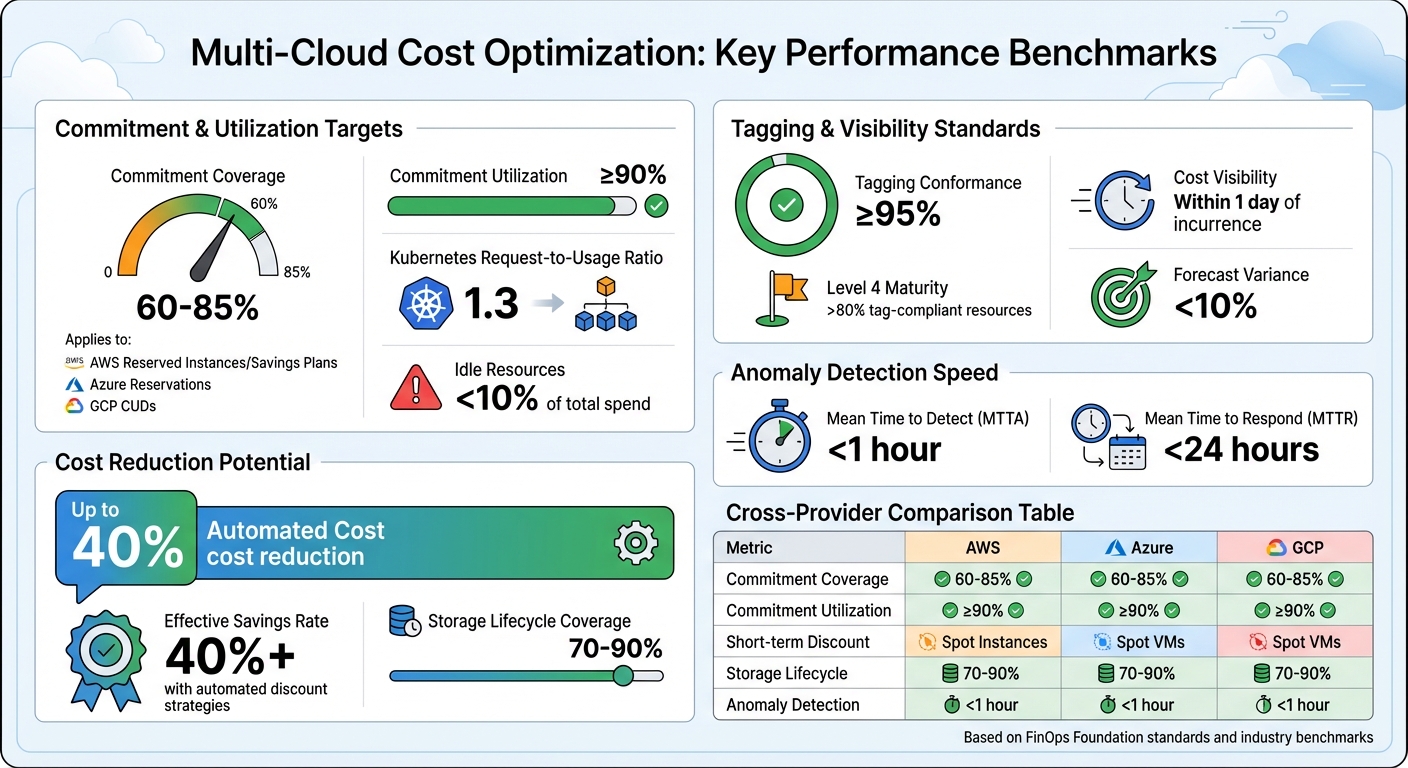 {Multi-Cloud Cost Optimization Benchmarks and Key Performance Metrics}
:::
{Multi-Cloud Cost Optimization Benchmarks and Key Performance Metrics}
:::
To keep costs under control, it's essential to measure performance against industry standards. These benchmarks highlight inefficiencies and guide targeted improvements.
Utilisation and Commitment Rates
When it comes to commitment coverage - how much of your workloads are covered by Reserved Instances or Savings Plans - the sweet spot is between 60% and 85% [7][8]. This range strikes a balance between maximising savings and maintaining flexibility for fluctuating demand. Meanwhile, utilisation rates for these commitments should hit 90% or higher, ensuring you're not paying for unused capacity [7].
In Kubernetes environments, an efficient request-to-usage ratio is 1.3 [7]. This means resource requests should be about 30% higher than actual usage. Additionally, idle resources should account for less than 10% of total spend [8]. Mikhail Malamud from Cloudaware sheds light on their monitoring process:
We run nightly multi-cloud scans... pulling in AWS CUR, Azure EA, and GCP billing. We've set up policies to flag anything missing critical tags, idle compute that's been over 48 hours untouched, reservation utilisation that dips under 70%, plus any spend anomalies above 15% of baseline[8].
Organisations that automate rightsizing and cost management can slash expenses by up to 40% compared to manual methods [9]. Automated discount strategies can also achieve an Effective Savings Rate of 40% or more [6]. Additionally, robust tagging practices ensure efficient cost tracking.
Tagging Coverage Standards
To accurately allocate costs, aim for 95% or higher tagging conformance [7][8]. This means nearly all resources should carry tags based on your tagging dictionary. The FinOps Foundation warns against partial tagging strategies:
Having a tagging strategy that is only partially implemented or enforced will lead to incomplete and incorrect data which will lead to mistrust of the costs[1].
Speed matters too. High-performing teams make costs visible to end users within one day of being incurred [1], enabling quick responses to anomalies. For spending anomalies, a Mean Time to Detect (MTTA) of less than one hour and a Mean Time to Respond (MTTR) under 24 hours are key benchmarks [7].
Comparative Metrics Across Providers
Understanding how different cloud providers perform in various areas can help optimise workload placement. Key benchmarks across AWS, Azure, and GCP include:
| Metric Category | AWS | Azure | GCP |
|---|---|---|---|
| Commitment Coverage Target | 60–85% (RIs/Savings Plans) | 60–85% (Reservations) | 60–85% (CUDs) |
| Commitment Utilisation | ≥90% | ≥90% | ≥90% |
| Short-term Discount | Spot Instances | Spot VMs | Spot VMs |
| Storage Lifecycle Coverage | 70–90% | 70–90% | 70–90% |
| Anomaly Detection (MTTA) | <1 hour | <1 hour | <1 hour |
Top-performing FinOps teams also aim for a forecast-to-actual variance of under 10% [8]. Iurii Khokhriakov from Cloudaware highlights the importance of planning:
Don't wait for invoices to tell you there's a problem. Pull... historical spend patterns for similar workloads - show exactly how compute and egress ramped last time you did a multi-region rollout[8].Need help optimizing your cloud costs?
Get expert advice on how to reduce your cloud expenses without sacrificing performance.
Compliance and Governance Best Practices
Strong compliance and governance practices are essential for managing multi-cloud costs effectively. They help set clear guidelines to avoid overspending while ensuring accountability across teams. This involves defining, implementing, and monitoring how cloud resources are managed, ensuring operations remain efficient and scalable [11]. Let’s break down the key elements that tie compliance and governance to multi-cloud cost strategies.
FinOps Operating Models
The FinOps framework revolves around three interconnected phases: Inform, Optimise (removing inefficiencies and improving processes), and Operate (tracking performance metrics and enforcing policies) [2]. This cycle thrives on collaboration between finance, engineering, and business teams. As the FinOps Foundation aptly states:
Everyone takes ownership for their cloud usage[13].
Creating a Cloud Centre of Excellence (CCoE) or a dedicated FinOps team is crucial for maintaining cost awareness across the organisation [12][3]. These central teams establish standards, provide tools, and deliver training, while individual engineering teams remain responsible for their workloads and spending. With this setup, cost allocation becomes so precise that teams typically face minimal queries - often none - per reporting period [1]. This structured approach sets the stage for effective enforcement and budgeting practices.
Policy Enforcement and Budgeting
Building on the FinOps framework, policy enforcement begins with cloud-native tools. Start by implementing audit-only
rules, which highlight non-compliance without interrupting engineering workflows. Over time, you can transition to stricter deny
policies for mandatory tagging [11].
Automation is key here. Use tools like AWS Service Control Policies (SCPs), Azure Policy, or GCP Organisation Policy Service to enforce tags such as 'Cost Centre', 'Environment', and 'Business Owner' at the time of resource creation. Additionally, set up anomaly alerts to detect budget variances early [11][1][2]. Linking cloud costs to business metrics - like cost per customer order - provides meaningful context when spending fluctuates [3].
Shared Cost Allocation Strategies
Certain costs, such as egress charges, support fees, and centralised networking, can’t be directly assigned to specific teams. Without a proper allocation strategy, these shared costs may either go unnoticed or unfairly burden certain departments [1]. There are three main ways to handle this:
- Fixed allocation: Assign a set percentage to each business unit.
- Proportional split: Allocate costs based on each team’s direct spending.
- Proxy metrics: Use data like network traffic or CPU usage to divide costs [13].
In early stages, organisations often keep shared costs within a central budget. As governance processes mature, they typically shift to automated, real-time allocation using proxy metrics for more detailed tracking. Documenting the shared cost allocation process clearly is vital [13].
Microsoft Learn highlights that integrating policy and governance into daily operations can amplify the impact of FinOps efforts [11]. By embedding these practices into routine workflows, organisations can maintain financial control while aligning with broader strategic goals.
Hokstad Consulting's Approach to Multi-Cloud Cost Standards
Navigating the complexities of multi-cloud environments requires more than theoretical expertise - it demands practical solutions and a partner willing to share the financial risk. Hokstad Consulting combines technical know-how with a business-focused mindset to help organisations manage and reduce cloud costs effectively. Here's how they put their approach into action.
Cloud Cost Engineering
Hokstad Consulting translates industry standards into tangible savings through its cloud cost engineering service. This service aims to cut cloud expenses by an impressive 30-50% by leveraging audits, automation, and customised strategies. The process begins with a detailed evaluation of your multi-cloud setup - whether you're using AWS, Azure, GCP, or a hybrid configuration. They pinpoint inefficiencies and design solutions tailored to your specific workload needs and service usage. This could involve techniques like advanced caching, optimised resource allocation, or automated monitoring systems that help prevent unexpected cost increases.
No Savings, No Fee Model
One of the standout features of Hokstad Consulting's approach is their No Savings, No Fee model. Unlike traditional consulting firms that charge daily rates ranging from £400 to £2,347 for benchmarking services [10][14], Hokstad Consulting ensures you only pay a percentage of the savings they achieve for you. If no savings are realised, you pay nothing. This structure aligns their goals with yours, ensuring their success directly depends on delivering measurable cost reductions.
Tailored Solutions for Multi-Cloud Environments
Hokstad Consulting understands that no two cloud strategies are the same. That's why they offer tailored solutions for public, private, and hybrid cloud setups. Their services include seamless cloud migrations without downtime, thorough security assessments, and performance optimisation. They even incorporate AI strategies within DevOps to ensure cost efficiency is maintained. Their flexible engagement models - whether project-based, retainer-based, or savings-based - mean their approach can adapt to your business needs and preferences.
Conclusion and Key Takeaways
Multi-cloud cost standards are all about creating clarity, boosting efficiency, and supporting steady growth. With standardised tagging strategies and frameworks like FOCUS™, you can establish a single, reliable source for multi-cloud billing data. This ensures that every pound spent is clearly linked to a specific owner, department, or project, leaving no room for ambiguity [1][15].
FOCUS™ is a BIG DEAL. FOCUS will remove the complexity and overhead involved when trying to normalise various billing taxonomies making it immensely beneficial across all companies and across all industries.– Tracy Woo, Principal Analyst [15]
But the benefits don’t stop at just cost transparency. By embedding cost considerations early in the development process - a proactive shift-left
approach - you can avoid costly design errors, minimise waste, and dodge unexpected billing surprises. This can be a game-changer for IT budgets, where unchecked cloud waste can quickly spiral out of control [17][4].
The result? Better financial control, smarter resource use, and stronger compliance practices.
Key Benefits of Multi-Cloud Cost Standards
Adopting multi-cloud cost standards delivers practical results in three main areas:
- Financial Control: High tagging compliance ensures precise cost allocation to departments and business units [1].
- Resource Optimisation: Commitment-based purchasing strategies - like using Reserved Instances for predictable needs and pay-as-you-go for spikes - improve cost efficiency [17][4].
- Compliance and Governance: Establishing a central FinOps team and enforcing mandatory metadata policies across all cloud providers strengthens governance [4][1].
These practices not only streamline operations but also set the stage for long-term success.
Next Steps for Implementation
Start by evaluating your current multi-cloud cost strategy. Implement a mandatory tagging policy with key tags like 'Cost Centre', 'Environment', and 'Business Owner' to track and manage future expenses effectively [1]. To take it further, consider adopting the FOCUS™ framework to standardise billing data across different providers [15].
If you're concerned about the financial risks of these changes, Hokstad Consulting offers a No Savings, No Fee model. This means you only pay a percentage of the savings they help you achieve - making it a win-win situation [16].
FAQs
How does tagging help manage cloud costs effectively?
Tagging is an incredibly effective way to get a handle on cloud costs. By assigning metadata - like project names, environments, or cost centres - to your cloud resources, you can easily track usage, allocate costs to the right teams or projects, and pinpoint where expenses are coming from. It’s all about making cloud spending more transparent, which helps with budgeting and keeping costs under control.
When done consistently, tagging can also pave the way for automation and detailed reporting. Tasks like breaking down costs or enforcing policies become far simpler. Plus, it’s key for implementing practices like showback and chargeback, which encourage accountability and stronger financial oversight. In multi-cloud setups, tagging becomes even more crucial, offering better resource visibility and helping organisations spend smarter while cutting down on waste.
What are the main advantages of adopting the FinOps Framework for managing cloud costs?
The FinOps Framework provides a structured approach to managing cloud costs, helping organisations make the most of their cloud investments. It empowers teams to make real-time, data-informed decisions, ensuring cloud spending aligns with business goals.
By encouraging collaboration between technical, financial, and operational teams, the framework creates a sense of shared financial responsibility across the organisation. This teamwork not only improves transparency but also ensures everyone is on the same page when it comes to managing cloud budgets.
Moreover, the framework highlights practical strategies for cutting unnecessary costs. It helps businesses pinpoint areas where savings can be made and refine their processes, leading to smarter resource use and improved returns on cloud services.
What is the 'No Savings, No Fee' model, and how does it work?
The 'No Savings, No Fee' model ensures you only pay when actual, measurable cost reductions are achieved through optimisation efforts. In other words, if no savings are made, you won’t be charged a penny.
This setup gives businesses the freedom to explore potential cost-cutting opportunities without taking on any financial risk. It’s a straightforward, results-focused way to manage cloud expenses more efficiently.