
Hybrid cloud security monitoring is a growing challenge for organisations as they juggle on-premises systems, private clouds, and public cloud resources. The complexity of managing multiple environments increases risks, widens the attack surface, and creates compliance headaches. This article explores key security challenges and solutions for hybrid cloud setups, focusing on visibility gaps, inconsistent policies, and data protection.
Key Takeaways:
- Visibility Gaps: Separate monitoring tools for on-premises and cloud systems lead to blind spots, especially at network boundaries.
- Compliance Risks: Hybrid setups complicate regulatory requirements like GDPR, especially with data sovereignty concerns.
- Policy Drift: Fragmented identity models and manual changes create exploitable gaps for attackers.
- Solutions: Unified monitoring platforms, AI-driven anomaly detection, and a mix of agent-based and agentless tools improve security.
Hybrid cloud environments require a unified approach to monitoring, combining AI-powered tools with centralised data collection. This ensures better threat detection, compliance, and policy management across all systems.
::: @figure 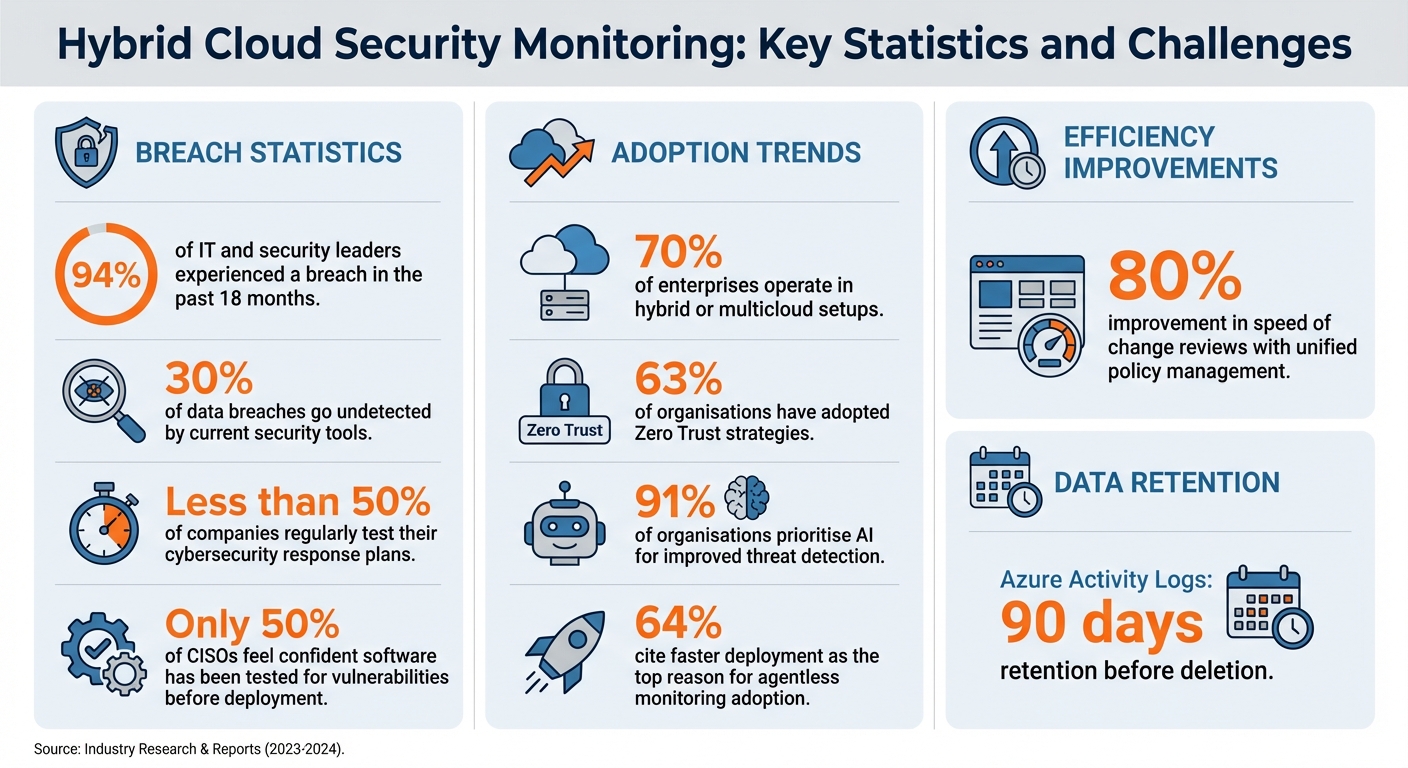 {Hybrid Cloud Security Monitoring: Key Statistics and Challenges}
:::
{Hybrid Cloud Security Monitoring: Key Statistics and Challenges}
:::
Security Challenges in Hybrid Cloud Monitoring
Visibility Gaps Across Environments
One of the biggest hurdles in hybrid cloud security is achieving consistent visibility across diverse systems. Most organisations rely on separate monitoring tools for different environments - like Nagios for on-premises setups and AWS CloudWatch for public cloud workloads. This results in inconsistent metrics and naming conventions, creating blind spots. These gaps are especially risky at network boundaries, such as VPC connections or Direct Connect endpoints, where traditional monitoring tools often fail to capture critical security data.
The stakes are high: over 30% of data breaches go undetected by current security and observability tools, and a staggering 94% of IT and security leaders reported experiencing a breach in the past 18 months [4]. The challenges grow even more complex in microservices architectures, where tracing context can be lost as requests move across organisational boundaries. This loss of end-to-end visibility makes it nearly impossible for security teams to monitor threats across the entire application delivery chain.
The techniques used to monitor devices and infrastructure no longer work. There are no tap points, and it is often prohibitively inefficient to route cloud traffic through inspection choke points.– Mike Rothman, Analyst, Securosis [3]
These visibility challenges also complicate compliance efforts, especially when monitoring spans multiple jurisdictions with differing legal requirements.
Data Sovereignty and Compliance Risks
Hybrid cloud environments bring a host of regulatory and compliance headaches. With workloads spread across multiple regions, tracking data residency becomes a logistical nightmare. For UK organisations, this is particularly concerning under GDPR, as sensitive data may cross borders and fall under conflicting legal frameworks [2]. This complexity makes maintaining audit trails and ensuring compliance even harder.
Manual compliance processes are no longer enough to address these challenges. Alarmingly, only 50% of CISOs feel confident that their software has been thoroughly tested for vulnerabilities before deployment [7]. Automated logging and continuous auditing, which could mitigate these issues, remain underdeveloped in many organisations. On top of that, data gravity - where data’s location adds latency and egress costs - can render telemetry less effective for real-time threat detection [6].
Inconsistent Security Policies
Hybrid cloud environments often operate with fragmented identity models - think AWS IAM policies, Azure RBAC, and on-premises Active Directory. These inconsistencies create exploitable gaps for attackers to move laterally within systems [8]. Adding to the problem is tool sprawl, where organisations use a patchwork of security tools that fail to integrate effectively, creating silos [1][10].
Policy drift is another major issue. When manual changes are made outside of Infrastructure as Code templates, runtime states can diverge from intended security baselines [2]. This often causes friction between on-premises teams, who manage traditional firewall rules, and cloud teams, who favour agile, declarative policies [9]. Organisations that adopt unified policy management have seen up to an 80% improvement in the speed of change reviews thanks to automated analysis [9]. However, many UK businesses still struggle with fragmented approaches, leaving gaps that expose their hybrid infrastructure to vulnerabilities. Like visibility and compliance issues, inconsistent policies weaken security across the board.
Need help optimizing your cloud costs?
Get expert advice on how to reduce your cloud expenses without sacrificing performance.
Securing the Hybrid Cloud Data Center
Security Metrics for Hybrid Cloud Monitoring
Clear security metrics are essential for addressing the visibility challenges and policy inconsistencies inherent in hybrid cloud environments.
Anomaly Detection and Threat Identification
Spotting unusual activity means keeping an eye on clear indicators of potential breaches. For instance, risky sign-ins - like those from anonymous IPs, leaked credentials, or malware-linked sources - should immediately trigger alerts [13]. Similarly, organisations need to monitor anomalous API calls that might suggest unauthorised access, data collection, or resource mapping attempts [11]. These behaviours often signal attackers probing the infrastructure before launching full-scale attacks.
Modern monitoring tools increasingly rely on machine learning to detect threats that traditional rule-based systems might overlook [5]. For example, AI-driven systems can flag impossible travel
scenarios, where a single account logs in from geographically distant locations within an improbable timeframe, or identify password spraying attacks targeting multiple accounts [13][17]. By analysing vast amounts of data in real time, these tools help organisations identify anomalies more quickly [5]. Despite these advancements, fewer than half of companies regularly test their cybersecurity response plans [5], leaving many unprepared to respond effectively when threats are detected.
Access Logs and Identity Management
In hybrid cloud setups, identity management becomes a critical security boundary. Comprehensive monitoring should include failed login attempts, multi-factor authentication (MFA) status, and dormant accounts that attackers may exploit for persistent access [11][13]. Aggregating logs from platforms like Azure Active Directory, AWS CloudTrail, and on-premises Active Directory into a centralised Security Information and Event Management (SIEM) system is crucial for correlating activity across environments [13][15][16].
Identity is always the primary perimeter.– Microsoft Azure Well-Architected Framework [14]
Monitoring external credential use and unauthorised changes to Identity and Access Management (IAM) policies can help detect privilege escalation attempts [11]. For instance, Azure Activity Logs are typically retained for 90 days before deletion [13], so routing these logs to long-term storage is essential for forensic investigations. Additionally, implementing Just-In-Time (JIT) access policies and ensuring synchronised timestamps across systems - using approved Network Time Protocol (NTP) sources - are vital for accurate incident reconstruction [13][17]. Encryption metrics can further enhance data security alongside log analysis.
Encryption and Data Protection Status
To protect data, it’s essential to ensure that data in transit is secured with TLS 1.2 or higher and that stored data uses AES 256 encryption [18][5]. Beyond basic encryption practices, organisations should monitor how often cryptographic keys are rotated and keep track of certificate expiration dates to maintain cryptographic integrity [18][19].
Another important metric is the percentage of data stores with default encryption enabled, as well as the coverage of automated data discovery tools [18]. These tools help scan, label, and inventory sensitive data - like personally identifiable information (PII) or payment card details - across on-premises and cloud environments. Monitoring for bulk data downloads or unusual access spikes during off-hours can also help detect potential data exfiltration attempts [18]. With 63% of organisations adopting Zero Trust strategies [5], these encryption and data protection measures are key to maintaining a secure hybrid cloud infrastructure.
Best Practices for Secure Monitoring in Hybrid Clouds
To ensure robust security monitoring in hybrid environments, organisations need to move beyond patchwork solutions. The focus should be on strategies that provide a seamless view of operations and leverage intelligent threat detection. These approaches help mitigate visibility gaps, compliance challenges, and inconsistent policies.
Unified Visibility Across Environments
A unified view of hybrid infrastructure begins with consolidating telemetry into a single platform. This is increasingly critical as businesses adopt multicloud strategies.
The key is to use solutions that collect data from platforms like AWS, Azure, GCP, and on-premises systems, all while adhering to standardised data models. This ensures metrics are comparable across varied environments. Stephen Elliot, Group Vice President at IDC, highlights this need:
Dynamic multicloud environments consist of diverse and evolving technologies. The platform must be able to ingest all observability, security, and business data, put it in an accurate context in real time[7].
In addition to internal systems, monitoring should extend to external components such as DNS, CDNs, and network routing. For example, deploying probes at VPC connections, Direct Connect endpoints, and on-premises egress points can capture critical data like latency and packet loss that traditional tools might overlook [12]. Simulating user workflows with synthetic transactions across environments can also help detect integration issues that occur during transitions [12].
Tools like Azure Arc can further streamline governance by integrating on-premises systems into the cloud monitoring framework [20].
Once the data is consolidated, AI-powered detection can take security monitoring to the next level.
AI-Driven Anomaly Detection
Artificial intelligence shifts security monitoring from reactive to proactive by analysing behaviour patterns and flagging unusual activity in real time. Unlike static systems that rely on predefined signatures, AI evaluates context - such as login times, locations, and data access patterns - to detect advanced threats like zero-day attacks and Advanced Persistent Threats (APTs) [22][25][26].
The adoption of AI in this space is growing rapidly, with 91% of organisations prioritising it for improved threat detection and prevention [25]. For instance, FinEdge Enterprises successfully used User and Entity Behaviour Analytics (UEBA) to detect anomalies, such as unexpected file transfers and unauthorised permission changes, enabling them to intervene before a breach occurred [25].
AI-powered automation can detect security drift, ensuring configurations remain secure over time.– Dan Fallon, Director for the Intelligence Community, Nutanix [24]
To maximise the effectiveness of AI-driven systems, organisations should gather at least 30 days of baseline data on user behaviour - such as working hours and frequently accessed resources - before enabling automated responses [26]. Instead of blocking users outright during risky sign-ins, triggering multi-factor authentication can provide a balanced approach between security and usability [26]. Regularly retraining AI models ensures they stay accurate as the hybrid environment evolves [23].
While AI enhances detection, the choice of monitoring methods also plays a crucial role in securing hybrid environments.
Agent-Based vs Agentless Monitoring
When it comes to monitoring, a mix of agent-based and agentless approaches often works best. Each method has its strengths, and combining them can provide comprehensive coverage [27][28].
- Agent-Based Monitoring: This method offers deep visibility into system-level details like processes, memory, and files. It also allows for active responses, such as isolating compromised systems, even without constant network connectivity. However, agents can consume system resources and require more effort to deploy and manage, especially in dynamic environments like serverless functions [27][28].
- Agentless Monitoring: This approach is faster to deploy and uses cloud APIs, making it ideal for monitoring transient workloads and uncovering
shadow IT.
However, it lacks the granular detail of agent-based tools and is generally limited to passive alerts rather than active intervention [27].
| Approach | Ease of Deployment | Visibility Depth | Overhead | Compliance Support |
|---|---|---|---|---|
| Agent-Based | Moderate | High | Higher | Strong |
| Agentless | Easy | Moderate | Lower | Moderate |
With over 70% of enterprises operating in hybrid or multicloud setups [27], many are turning to agentless tools for their speed - 64% cite faster deployment as the top reason for adoption [27]. However, agent-based monitoring is still crucial for high-value workloads requiring deep inspection [27][28]. For tasks like scanning new containers in CI/CD pipelines, agentless tools can streamline processes without delaying deployment cycles [27].
In environments with limited internet access, using a Log Analytics gateway can simplify data collection from on-premises systems before transmitting it to the cloud. This approach reduces firewall complexities and ensures telemetry data is only shared when it adds value [21][6].
Implementing Security Solutions with Hokstad Consulting

Securing hybrid cloud environments demands a deep understanding of both on-premises and cloud infrastructures. Hokstad Consulting brings expertise in DevOps transformation, cloud security, and tailored automation to create monitoring systems that work seamlessly across these platforms. Their approach starts with a thorough audit to lay the groundwork for customised solutions.
Tailored Security Audits
Hokstad Consulting conducts detailed security audits to uncover visibility gaps and compliance risks in hybrid environments. These audits assess key areas like access controls, encryption practices, configuration drift, and policy inconsistencies across various platforms.
The result? A detailed roadmap that prioritises vulnerabilities based on their potential business impact. Instead of generic advice, you’ll receive specific, actionable recommendations tailored to your infrastructure. This could range from enhancing identity management and closing telemetry gaps to addressing data sovereignty challenges. These insights are then used to design robust monitoring systems that align with your unique needs.
Custom Hybrid Monitoring Setups
After the audit, the next step is building monitoring solutions that address the identified vulnerabilities. Hokstad Consulting develops systems that unify telemetry data from multiple sources into a single platform. This includes using AI-driven anomaly detection, which relies on baseline behaviour models to reduce false positives. For organisations adopting OpenTelemetry, Hokstad Consulting can help future-proof your observability stack, making it easier to adapt to new platforms without rewriting application code [6].
The goal is to ensure security alerts are not only accurate but also actionable, helping you detect and respond to threats quickly while avoiding unnecessary distractions.
Continuous Optimisation and Support
Security monitoring isn’t a one-and-done task - it requires ongoing refinement as your hybrid environment evolves. Hokstad Consulting provides continuous support through regular performance reviews, security audits, and updates to your systems. This includes retraining AI models to reflect changing usage patterns, fine-tuning agent deployments to reduce overhead, and ensuring compliance with new regulations. The focus is on maintaining strong security while simplifying operations across your hybrid infrastructure.
With this continuous optimisation and support, Hokstad Consulting ensures your monitoring systems stay agile and effective, ready to tackle emerging threats as they arise.
Conclusion: Securing Hybrid Cloud Environments
Hybrid cloud environments demand a fresh perspective on security monitoring. With 94% of organisations now running applications across multiple environments [1], the old perimeter-focused security model simply doesn’t cut it anymore. The challenges of visibility gaps and inconsistent policies make it crucial to adopt unified monitoring that covers every layer of your infrastructure.
The ever-changing threat landscape requires forward-thinking security strategies. Moving towards platform-focused security and AI-powered threat detection is no longer optional - it's necessary. As Mike Rothman from Securosis points out:
Security monitoring needs to change fundamentally to stay relevant – even viable – in this cloud age[3].
Key to a strong hybrid cloud security strategy are principles like continuous monitoring, automated remediation, and Zero Trust. Together, these form the backbone of a resilient security framework.
Protecting hybrid environments effectively requires expertise that bridges both on-premises and cloud platforms. Hokstad Consulting addresses these challenges with a streamlined approach - offering tailored security audits, custom monitoring solutions, and ongoing optimisation. By simplifying operations while maintaining strong security, they allow businesses to focus on their priorities instead of juggling fragmented tools.
The real question is how quickly you can implement comprehensive hybrid cloud security monitoring. With threats evolving and compliance requirements tightening, working with experts who understand the complexities of hybrid architectures can make all the difference. This proactive approach ensures your hybrid environment remains secure and ready to face whatever comes next.
FAQs
What should we monitor first in a hybrid cloud?
In hybrid cloud setups, it's essential to pay close attention to the network boundaries where your on-premises systems link up with cloud platforms. These transition points are often the backbone of performance and security, yet they're easy to miss if you're relying on traditional monitoring tools.
To keep things running smoothly, you should also maintain visibility across all environments. This means keeping tabs on both application and infrastructure performance. One effective approach is to simulate user workflows across these environments. Doing so can help pinpoint any hiccups during transitions, giving you a clear picture to uphold both security and reliability.
How do we prove GDPR compliance across hybrid environments?
Proving GDPR compliance in hybrid environments demands a strong focus on monitoring, documentation, and control. To stay on top of requirements, it's crucial to implement continuous compliance monitoring and keep detailed audit trails. Automating processes also plays a big role, especially for tracking configuration changes and managing access controls in real time.
On top of that, having a clear governance framework is vital. This includes ensuring data sovereignty and carefully handling cross-border data flows. By combining these strategies, organisations can meet GDPR requirements across both on-premises and cloud systems, maintaining a seamless approach to compliance.
When should we use agent-based vs agentless monitoring?
Agent-based monitoring involves installing software directly on systems to provide detailed, real-time insights. This method is particularly useful for critical workloads that demand in-depth analysis or need to meet strict compliance requirements.
On the other hand, agentless monitoring gathers data using APIs or protocols, eliminating the need for software installation. This makes it a great choice for environments where quick deployment and scalability are priorities, such as dynamic or cloud-based systems.
If you need advanced threat detection or are focused on compliance, agent-based monitoring is the way to go. However, for minimal impact on system performance, agentless monitoring is a better fit. A hybrid approach can also be a smart choice, combining the strengths of both methods to balance security and efficiency.