
Graceful degradation ensures that when parts of a system fail, the core functions remain available instead of the entire system collapsing. This approach is vital for keeping services running during high traffic or failures, especially for critical operations like payments or authentication.
Key patterns that enable graceful degradation include:
- Circuit Breaker: Prevents cascading failures by halting requests to failing services and offering fallback responses.
- Fallback Responses: Uses cached or simplified data to maintain functionality when services fail.
- Timeouts and Smart Retries: Avoids prolonged waits and retry storms by setting time limits and retrying intelligently.
- Bulkhead Isolation: Segments resources to prevent one failure from affecting the whole system.
- Load Shedding: Rejects excess traffic early to protect critical services.
- Partial Functionality: Keeps essential features running by disabling non-critical ones.
- Asynchronous Workflows: Decouples processes to handle failures without blocking the entire system.
These patterns ensure systems remain usable, protect critical operations, and maintain user trust during disruptions. Each strategy comes with trade-offs, so combining them effectively is key to building resilient systems.
Graceful Service Degradation Patterns | Microservices Resilience & Fault-Tolerant Design
1. Circuit Breaker Pattern
The circuit breaker pattern helps maintain system stability by monitoring service dependencies for failures. When failures exceed a set threshold, it blocks further requests to the failing service. This prevents a single slow or failing dependency from overwhelming the system's threads and connections.
This pattern operates through three states:
- Closed: The system is functioning normally.
- Open: Requests fail immediately to avoid further strain.
- Half-Open: A limited number of test requests are sent to check if the service has recovered.
What makes the circuit breaker pattern stand out is its ability to detect recovery automatically, unlike simpler methods that might rely only on timeouts.
When the circuit breaker trips, users receive an immediate fallback response, such as cached data or basic features, instead of waiting through long timeouts. This approach aligns with the idea of graceful degradation, ensuring the system continues to function, albeit with reduced features. Netflix showcased this effectively between 2012 and 2018 with its Hystrix library. Their API gateway, managing over a billion calls daily, would switch to degraded content - like showing a generic popular shows
list instead of personalised recommendations - while maintaining an impressive 99.99% availability during downstream failures [3].
The open state also prevents excessive resource use, such as CPU and memory, by avoiding repeated failed attempts. This was evident during a 5-hour DynamoDB outage in September 2015. At its peak, error rates hit 55%, creating a feedback loop of retries. AWS eventually halted all requests manually to stop the cycle [3].
Proper configuration of the circuit breaker is crucial. Common settings include:
- A failure rate threshold of 50% over a sliding window of 10–20 calls.
- A wait time of 10–30 seconds before reattempting in the open state.
It's also important to exclude business-logic errors, such as Insufficient Funds
or 404 responses, from triggering the breaker to avoid unnecessary trips [4].
The circuit breaker pattern can prevent a caller service from retrying a call to another service when the call has previously caused repeated timeouts or failures.- AWS Prescriptive Guidance [6]
Next, we’ll discuss how fallback responses and simplified features work alongside the circuit breaker to enhance system resilience.
2. Fallback Responses and Degraded Features
Fallback responses build on the concept of circuit-breaker controls to keep systems functional when dependencies fail. Instead of allowing failed calls to linger and drain resources, they return an alternative response - like cached data, a simplified result, or a default value. This approach prevents cascading errors and ensures the system continues to operate.
Not all dependencies are equally critical. For instance, losing a personalisation service might be inconvenient, but a payments service failure could be catastrophic. Auxiliary services, such as recommendations or analytics, should fail open
by serving generic content, while essential services like authentication or payments must fail explicitly to avoid silent degradation. Misclassifying these dependencies can cause severe system issues, making proper categorisation essential for a well-executed degradation strategy.
Netflix provides a great example of fallback design. If its personalised recommendation service is unavailable, the system moves through a hierarchy of alternatives: cached personalised data → regionally popular content → globally popular content → a static Trending Now
list [1]. This ensures the interface remains functional at every level, minimising user disruption.
However, Amazon's experience highlights the risks of poorly designed fallbacks. In one instance, a shipping-speed service fell back to direct database queries when its cache failed. Unfortunately, the cache had been handling 10 times the database's capacity. When the caches failed simultaneously, the fallback caused a surge that overwhelmed the database, leading to a global fulfilment outage [2]. This underscores the importance of decoupling fallbacks from primary systems to avoid compounding failures.
To strengthen your system further, consider using HTTP directives like stale-if-error and stale-while-revalidate (RFC 5861). These allow CDNs to serve stale content automatically when the origin server is unreachable [2]. Adding an X-Served-Stale: true header can help downstream clients identify stale responses. Regular testing of fallback paths is also crucial. If fallback mechanisms are only used during emergencies, undetected bugs could linger. As Pete Hodgson wisely said: A kill switch nobody tests does not exist
[2]. Well-designed and frequently tested fallback systems are key to maintaining core functionality when it matters most.
3. Timeout and Smart Retry Patterns
Neglecting to set explicit timeouts can leave your system vulnerable to a single slow service dragging everything down. As Young Gao, Backend Engineer, aptly describes:
A service responding in 30 seconds instead of 30 milliseconds will kill you silently.[5]
For instance, imagine a service with 100 worker threads and a 30-second timeout. During a slowdown, its capacity drops to just 3.3 requests per second - a staggering 1,000× reduction compared to a 100 ms target [1]. To prevent this, always define timeouts explicitly. Many HTTP client libraries default to infinite timeouts, allowing requests to hang indefinitely, tying up threads [3].
Setting Effective Timeouts
A good rule of thumb is to set the request timeout to the P99.9 latency of the downstream service, adding a 20–30% buffer [1][3]. Additionally, implement an end-to-end system deadline. At each step, subtract the elapsed time and terminate calls when the remaining time is insufficient. Propagating deadlines across calls ensures no unnecessary computation is wasted.
Smart Retry Strategies
While timeouts are critical, retries also play a key role - but they must be handled carefully. Poorly managed retries can make problems worse, as seen in a 2015 incident involving AWS's US-East region. A brief network issue triggered retries from storage servers, overwhelming a metadata service in what's known as a retry storm.
This caused error rates to spike to 55% for nearly five hours [3]. The real issue wasn't the initial disruption - it was the uncoordinated retry behaviour.
Exponential Backoff with Jitter
The solution? Use exponential backoff with full jitter. This method spaces out retries progressively, adding random delays to prevent clients from retrying simultaneously. Marc Brooker, Senior Principal Engineer at AWS, explains:
Full Jitter (sleep a uniform random value in \[0, capped\]) gives the best overall behavior for typical load patterns.[1]
This approach can reduce total client workload by more than half compared to retries without jitter [3]. To further refine retries, use a retry budget. Google SRE standards suggest capping retries at around 10% of total traffic to avoid retry amplification
, where retries from multiple service layers compound the load. For example, in a five-layer call stack where each layer retries three times, a single request could result in 243 downstream calls (3⁵) [3]. Limiting retries to one layer, typically the outermost, is the most efficient solution.
Timeout Recommendations
| Timeout Category | Purpose | Recommended Value |
|---|---|---|
| Connection | Wait for TCP/TLS handshake | 1–3 seconds |
| Request | End-to-end wait for a response | P99.9 + 20–30% buffer [1] |
| Socket/Read | Wait on an open socket | Specific to I/O needs |
| Idle | Keep unused connections alive | Based on pool strategy |
Retry Best Practices
Only retry idempotent operations. For example, retrying a payment request could result in double charges for a customer [3][8]. Also, filter retries by status code. Transient errors like HTTP 503 or 504 are worth retrying, but most 4xx client errors (except 408 and 429) are unlikely to succeed on retry.
With timeouts and retries in place, the next step is to explore how bulkhead isolation can further improve fault tolerance.
4. Bulkhead and Resource Isolation
Even with well-designed timeouts and retries, a sluggish dependency can drain system resources - like threads, connections, or memory - leading to a complete system failure. The bulkhead pattern helps avoid this by dividing resources into separate, isolated pools, with each pool assigned to a specific dependency or group of services. This way, if one pool becomes overwhelmed, only that specific functionality is impacted, while the rest of the system remains functional.
The term bulkhead
comes from the watertight compartments on a ship. As The HLD Handbook explains:
Bulkheads are the walls between apartments... A slow dependency is the burst pipe. Without defences, it floods your thread pools, starves your other dependencies, and cascades upward until the entire system is down.[3]
This approach becomes essential in large-scale systems. Imagine a system with 30 dependencies, each boasting a 99.99% uptime. Without independent defences, the composite uptime drops to 99.7%, translating to about two hours of downtime each month [3]. Netflix faced a similar situation in February 2012 when their API gateway managed around 1 billion incoming calls daily, which expanded into billions of outgoing calls to dependencies. By wrapping each network-bound dependency in a HystrixCommand - each with its own 10-thread pool - they processed over 100,000 dependency requests per second. This prevented slowdowns in one service from triggering a system-wide outage [3].
Implementing Bulkheads
There are two primary methods for implementing bulkheads:
- Thread-pool isolation: Each dependency gets its own thread pool. This method ensures strong isolation but comes with some context-switching overhead [3].
- Semaphore isolation: A counter limits the number of concurrent calls, offering lower overhead. However, the calling thread remains blocked if the dependency is slow.
Here’s how these two methods compare:
| Feature | Thread-Pool Bulkhead | Semaphore Bulkhead |
|---|---|---|
| Isolation strength | Strong (dedicated threads) | Medium (limits concurrency only) |
| Overhead | Higher | Very low |
| Calling thread | Freed (async execution) | Blocked until call completes |
| Best use case | Async, slow, or risky work | Fast, synchronous, user-facing calls |
Practical Considerations
Bulkheads complement other resilience strategies by ensuring that even if one part of the system falters, others can keep running. However, they do require careful resource planning since each pool must handle its own peak load instead of sharing capacity. As OneNoughtOne puts it:
Bulkheads exchange resource efficiency for increased resilience.[9]
When combining bulkheads with other resilience patterns, always position the bulkhead as the outermost layer - the order should be: Bulkhead → Circuit Breaker → Retry. This ensures resource limits are applied first, preventing retry logic from overloading the system [4]. Lastly, avoid configuring bulkheads with unbounded queue sizes, as this can lead to resource exhaustion [9].
5. Load Shedding, Throttling, and Prioritisation
Expanding on resource isolation strategies, load shedding is a method used to protect your system when traffic becomes overwhelming. While bulkheads focus on isolating specific dependencies, load shedding, throttling, and prioritisation work to manage overall traffic, ensuring the system doesn’t buckle under pressure. In essence, load shedding involves rejecting excess requests as early as possible - ideally at the edge proxy or API gateway - before they consume valuable resources like compute power, memory, or downstream connections. A quick 503 response is far less harmful than accepting a request that can’t be completed.
The goal isn’t to handle every request but to ensure that the most important ones are processed effectively. This is where the distinction between throughput (the total number of incoming requests) and goodput (the requests successfully completed in a timely manner) becomes critical [2]. Without load shedding, growing latency can lead to retries, which in turn can overwhelm the system and reduce overall throughput. By prioritising requests intelligently, systems can focus on maintaining critical functions during high-traffic scenarios.
Google SRE employs a tiered approach to request prioritisation, categorising requests into four levels and shedding the least critical first:
| Criticality Class | Examples | Shed Order |
|---|---|---|
| CRITICAL_PLUS | Auth, Payments, Health Checks | Last - never shed under steady load |
| CRITICAL | User-facing reads, Checkout | Only after sheddable classes are gone |
| SHEDDABLE_PLUS | Recommendations, Search refinements | Second |
| SHEDDABLE | Batch jobs, Analytics, Prefetch | First |
This strategy was tested under extreme conditions during Black Friday/Cyber Monday 2024, when Shopify managed peak sales of £3.6 million per minute and processed 80 million requests per minute. Shopify used their open-source Semian library for resource-specific circuit breaking, proactively shedding non-essential features like recently viewed
and wish-lists
to ensure the checkout process remained uninterrupted [1].
From a cloud cost perspective, shedding requests at the edge is far more economical than letting them penetrate deeper into the system only to fail later. This reduces the need for costly over-provisioning or maintaining large headroom buffers for traffic spikes [1][10]. However, a key operational hurdle is tier inflation - where every team tends to classify their service as critical. To avoid this, it’s essential to agree on a dependency criticality map early on and to test kill switches regularly. This proactive approach ensures a system is genuinely resilient, rather than just appearing so on paper [2].
Next, we’ll look at partial functionality and read-only modes.
6. Partial Functionality and Read-only Modes
Service failures don’t always need to result in a complete shutdown. By enabling a read-only mode, users can still browse and view content, even if certain actions like writing or updating data are temporarily disabled. This approach ensures that safe and available features remain accessible while blocking operations that could pose risks.
A well-known example of this strategy in action is GitHub's October 2018 incident. During a 43-second network outage, a desynchronisation occurred between their US East Coast and West Coast data centres. To avoid the risk of data corruption, GitHub’s engineers shifted the platform into a read-only mode for just over 24 hours. While users couldn’t perform write operations - such as pushes, pull requests, or triggering webhooks - they could still browse repositories and access issues. This decision safeguarded 954 in-flight writes and protected data integrity for millions of accounts. However, it also led to a backlog of 5 million webhook events and 80,000 Pages builds, with approximately 200,000 webhook payloads being dropped due to internal time-to-live (TTL) limits [2].
GitHub explicitly chose 'frustrated but not defrauded' users.- HLD Handbook [2]
This example highlights the essence of graceful degradation. While preventing users from pushing code might be inconvenient, the alternative - corrupted or lost data - would be far worse. During instability, preserving data integrity should almost always take priority over maintaining write availability.
Tiered Feature Degradation
To make degradation decisions quicker and more consistent, features can be categorised into tiers based on their importance. Here’s an example:
| Feature Tier | Example Features | Degradation Strategy |
|---|---|---|
| Tier 0 (Critical) | Login, Checkout, Payments | Always prioritise; allocate maximum capacity |
| Tier 1 (Important) | Search, Product Details, Inventory | Serve from cache or use stale data if needed |
| Tier 2 (Optional) | Recommendations, Reviews, Live Chat | Disable under moderate load |
| Tier 3 (Non-essential) | Analytics, A/B Testing, Social Proof | Disable first; often silently removed |
How Read-only Mode Works
Read-only mode is typically implemented via a middleware layer. This layer intercepts mutating requests (like POST, PUT, or DELETE) and responds with a 503 Service Unavailable status, along with a Retry-After header. Meanwhile, GET requests continue to function, often served from read replicas or caches [7]. It’s also crucial to inform users clearly - whether through in-app banners or error messages - when certain features are temporarily unavailable.
For organisations aiming to build robust systems with effective graceful degradation, Hokstad Consulting provides expert guidance on optimising cloud infrastructure and maintaining high service availability.
The following table offers a comparison of how different patterns contribute to system resilience.
7. Asynchronous Workflows and Backpressure
In synchronous systems, when a downstream service slows down, the impact is felt immediately. Every stalled request consumes critical resources like threads, sockets, and connection pool slots, which can quickly lead to resource exhaustion. A single slow dependency can overwhelm a thread pool, affecting the overall availability of the service. To mitigate this, systems need a way to prevent blockages caused by isolated slowdowns.
Message queues offer a solution. By introducing a queue - such as Amazon SQS, RabbitMQ, or Kafka - producers and consumers are decoupled. This enables asynchronous processing and isolates slow dependencies. If a consumer lags behind, the queue absorbs the backlog instead of allowing the producer to become overwhelmed.
Fault tolerance is not error handling. It is resource consumption bounding - a set of hard constraints that cap how much of your system's capacity any single downstream failure can consume.- The Modern Backend [11]
This decoupling approach works particularly well for non-critical operations. For instance, a transactional outbox can be used to record events in a local outbox table within the same database transaction as the main operation. A background processor then handles event delivery independently. This ensures that even if a notification service fails, a critical operation like a user's checkout can still succeed [11].
Once asynchronous decoupling is in place, managing task flow becomes essential. This is where backpressure comes into play. Backpressure signals prompt the producer to slow down its request rate, helping to manage system load. Common techniques include returning an HTTP 503 response with a Retry-After header or implementing adaptive concurrency limits that reduce in-flight requests as latency increases. Netflix's PlayAPI demonstrates this effectively by prioritising user-initiated playback requests over background tasks such as pre-fetching. During congestion, lower-priority tasks are shed, and clients receive a quick 503 response, allowing them to retry or use cached content [1][5]. This approach aligns with the principle of graceful degradation, ensuring that core functions remain responsive even under heavy load.
However, asynchronous workflows come with trade-offs, such as eventual consistency and the risk of duplicate processing during retries. To address this, always use idempotency keys - typically client-generated UUIDs - to prevent duplicate actions during retries [11].
Selecting the right message broker is also crucial. Here’s a quick comparison of popular options:
| Broker | Latency | Ops Overhead | Best For |
|---|---|---|---|
| Amazon SQS | ~20ms | Zero (managed) | Low-to-medium volume, minimal setup |
| RabbitMQ | ~1ms | Moderate | Low-latency, flexible routing |
| Kafka | ~5ms | High | Event replay, very high throughput |
For many teams, Amazon SQS is a practical starting point. It requires no infrastructure management and is cost-effective for lower volumes [12]. By adopting asynchronous workflows and managing backpressure effectively, microservices architectures can maintain resilience and performance even during partial system failures.
Comparison Table
::: @figure 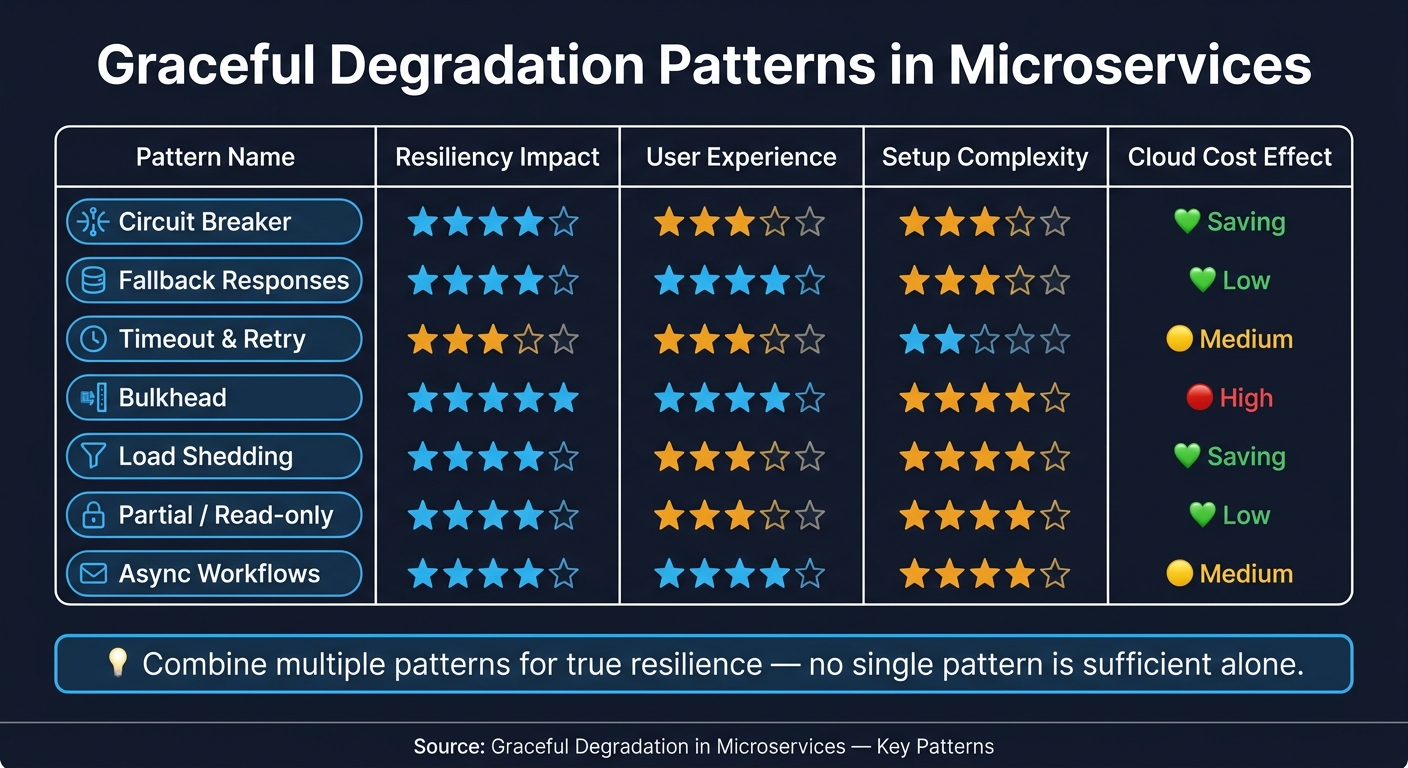 {Graceful Degradation Patterns in Microservices: At-a-Glance Comparison}
:::
{Graceful Degradation Patterns in Microservices: At-a-Glance Comparison}
:::
The table below provides a summary of the resiliency impact, user experience, setup complexity, and cloud cost effect for each graceful degradation pattern:
| Pattern | Resiliency Impact | User Experience | Setup Complexity | Cloud Cost Effect |
|---|---|---|---|---|
| Circuit Breaker | High – prevents cascading failures | Medium – fast error response | Medium | Saving – prevents wasted work |
| Fallback Responses | High – maintains availability | High – provides useful stale or default data | Medium | Low – leverages existing cache |
| Timeout & Retry | Medium – handles transient blips | Medium – prevents indefinite hangs | Low | Medium – additional retry load |
| Bulkhead | Very High – strongest isolation | High – protects core services | High | High – requires resource duplication |
| Load Shedding | High – protects overall capacity | Medium – some users receive 503 errors | High | Saving – rejects work early |
| Partial / Read-only | High – preserves data integrity | Medium – browsing works while writes are disabled | High | Low – serves reads from replicas |
| Async Workflows | High – decouples producer from consumer | High – provides fast acknowledgement | High | Medium – incurs queue infrastructure costs |
Each pattern has its strengths and trade-offs. For instance, bulkheads offer unparalleled isolation by separating resources, but they come with the cost of maintaining idle capacity. On the other hand, load shedding balances cost and resilience by rejecting excess requests early, ensuring the system doesn’t get overwhelmed.
Timeout and retry is a straightforward pattern that every service should implement as a baseline. However, it comes with a caveat: without a retry budget (limiting retries to around 10–20% of baseline traffic), a minor outage can spiral into a retry storm.
This was evident during the September 2015 AWS DynamoDB incident in the US-East region, where excessive retries magnified the problem.
For teams focused on cloud cost efficiency, circuit breakers and load shedding provide excellent resilience without significant expense. Meanwhile, bulkheads are worth considering only if a single component's failure could jeopardise the entire system. Ultimately, combining multiple patterns is essential to building a truly resilient system.
Conclusion
Graceful degradation goes beyond being a technical feature - it's a mindset that anticipates and manages partial failures. By prioritising this approach, you ensure users experience a dependable service, even when certain components falter. After all, most users prefer a simplified version of a service over a complete shutdown, making it essential to keep core functions intact during disruptions.
That said, resilience isn't just a technical matter; it’s a product decision as well. Determining which features should remain functional and which can be limited requires close collaboration across teams. Often, this alignment between technical and product teams is where the real challenge lies.
If your team is finding resilient system design tricky, Hokstad Consulting offers expert guidance. Their services span from creating automated CI/CD pipelines with built-in failure management to crafting cloud cost strategies that prevent degradation measures, like bulkheads or asynchronous workflows, from driving up expenses. With their cloud optimisation strategies, businesses can cut costs by 30–50%, demonstrating that resilience and efficiency can go hand in hand - all while adhering to UK business standards.
FAQs
How do I choose which features to degrade first?
To prioritise which features to scale back first, establish a clear plan that focuses on business impact. Start by organising services into priority levels: critical P0 features - such as authentication and payments - should always stay operational. Meanwhile, lower-priority elements, like analytics or A/B testing, can be turned off when needed. Leverage Service Level Objectives and feature flags to handle degradation dynamically, allowing adjustments without requiring redeployment.
What’s the safest way to implement fallbacks without overloading the database?
To prevent overwhelming the database, it's wise to handle external dependencies as soft dependencies. This means incorporating tools like circuit breakers, cached responses, and smart request shedding into your system. For read-heavy operations, consider serving outdated data from a cache or, if no cache is available, return a predefined static value instead.
When retrying failed requests, use exponential backoff with jitter to avoid creating sudden traffic surges. If you're looking for help in building robust, automated cloud solutions to manage these challenges, Hokstad Consulting offers the expertise you need.
How can I stop retries turning a small outage into a retry storm?
To prevent retry storms, it's better to rely on resilience patterns rather than basic retry loops. For instance, implementing exponential backoff can help by gradually increasing the wait time between retries, giving the system more time to recover. Adding jitter - randomising the intervals - further reduces the risk of synchronised retries that could overwhelm the system.
Another useful approach is the circuit breaker pattern. This temporarily blocks calls after repeated failures, giving the system a chance to stabilise before allowing requests again. Additionally, setting retry budgets ensures retries remain controlled and purposeful. Finally, make sure retries are only applied to transient errors, such as timeouts or server errors (5xx responses). Permanent errors, like 4xx client-side issues, should not trigger retries.