
Test data bottlenecks are slowing your CI/CD pipeline. Automating test data management can eliminate delays, improve accuracy, and ensure compliance with regulations like GDPR. Here's what you need to know:
- Test Data Basics: Test data is crucial for verifying software behaviour. It must be readily available, compliant, and realistic to ensure reliable test results.
- Why It Matters: Manual test data processes can take days, delaying releases. Automated solutions reduce this to minutes, improving pipeline efficiency while mitigating compliance risks.
- Challenges: Managing data volume, achieving production parity, and meeting strict compliance standards (e.g., GDPR) are common obstacles.
- Solutions: Use synthetic or anonymised data, automate provisioning, and adopt layered testing strategies tailored to pipeline stages.
- Tools: Options like Testcontainers, ephemeral environments, and database branching simplify data isolation and reduce flakiness in tests.
Data Automation (CI/CD) with a Real Life Example
Need help optimizing your cloud costs?
Get expert advice on how to reduce your cloud expenses without sacrificing performance.
Challenges of Managing Test Data in CI/CD
Integrating test data into CI/CD pipelines, while necessary, brings a host of technical, operational, and regulatory challenges. These issues can quietly disrupt workflows, turning test data into an unseen obstacle that hinders delivery efficiency.
Data Volume and Complexity
Large-scale production databases often compel teams to work with smaller subsets of data. While practical, this approach can miss critical edge cases and introduce shared-state issues. For example, a snapshot taken on a Tuesday might not capture a bug that appears on Friday. Similarly, shared QA environments can create data mutations that lead to false test failures, further complicating the process [2]. The financial impact of inefficient test data management is staggering, with enterprises losing an average of £3.4 million annually [1].
On top of these challenges, achieving production parity is a critical, yet often elusive, goal.
Production Parity and Data Accuracy
Recreating test environments that truly reflect production systems is no small feat. It’s not just about copying data - it’s about ensuring the test environment mirrors production-level data patterns, integrity, and edge cases. Without this alignment, the infamous it worked on my machine
problem continues to plague teams.
You cannot have continuous delivery with discontinuous data.- James Walker, Co-Founder, GoMask.ai [1]
Even the most thorough test suites can fail to identify issues if the test data is not representative of real-world conditions. This disconnect remains a significant barrier to delivering reliable software.
Equally important is ensuring that test data complies with strict security and regulatory standards.
Data Security and Compliance
Under GDPR, test environments are held to the same standards as production systems [3]. The financial risks are substantial, with GDPR fines totalling £1.0 billion in 2024 alone [3]. The Spanish Data Protection Authority has explicitly stated: The use of real personal data in test operations is fundamentally unacceptable, as this represents a violation of purpose
[3].
Organisations face multiple layers of compliance requirements when handling test data:
- Synthetic Data: This is considered the best option, as it contains no personal data and eliminates GDPR obligations entirely.
- Anonymisation: Involves permanently altering data to make re-identification impossible, ensuring compliance.
- Pseudonymisation: Replaces identifiers with artificial ones but still falls under GDPR regulations.
The challenges don’t end there. Article 17 of GDPR, which enforces the Right to Erasure, requires organisations to delete a data subject’s information from all test databases, backups, and container images within one month [3]. With 335 data breach notifications reported daily across the EU in 2024 - a rise of 8.3% from the previous year [3] - the urgency to secure test data has never been higher.
At Hokstad Consulting, we specialise in helping organisations meet these compliance demands while maintaining high-performing CI/CD pipelines. Our solutions include automated data masking and intelligent provisioning strategies designed to streamline workflows without compromising security or compliance.
Best Practices for Integrating Test Data
When tackling the challenges of data accuracy and compliance, using synthetic and anonymised data can help reduce costs, meet compliance requirements, and speed up development cycles. Here's how to approach it effectively.
Using Synthetic and Anonymised Data
Synthetic data creates artificial records that mimic real-world patterns, but without incorporating personal information. This reduces GDPR-related risks and ensures secure test environments [4]. For simpler projects or demonstrations, rule-based generation works well. However, for more complex scenarios, AI-powered model-based synthesis provides a higher level of realism by maintaining field correlations and intricate relationships [4].
If production-level accuracy is essential, anonymisation and masking methods can transform real data into compliant test data. Techniques like encryption, differential privacy, and field-level masking ensure that sensitive information is removed or altered irreversibly, making it safe for use in testing environments [4][1].
AI-driven tools now make it possible to analyse production data patterns and generate high-quality synthetic datasets in just minutes. This allows teams to shift left
- addressing data-related issues earlier in the development process [1][6].
Automating Test Data Provisioning
Manually managing test data often slows down CI/CD workflows. Self-service provisioning solves this by enabling data generation through API calls or automated steps in the pipeline [1]. By integrating data synthesis tools directly into CI/CD processes, developers can ensure that every pull request generates a fresh, compliant dataset [1][6].
Infrastructure-as-Code (IaC) plays a key role in this automation. Teams can define dataset structures, volumes, and transformation rules in configuration files like data_config.yml, which are stored alongside the application code. This approach ensures that data generation and masking policies are traceable and reproducible, treating them as part of the codebase itself [1][5].
To ensure consistency, all random number generators should use a single seed, such as a TESTDATA_SEED environment variable. This guarantees reproducible test data across environments. Additionally, creating a manifest file (e.g., manifest.json) for each dataset - with details like the seed, generator version, and checksums - helps teams replicate failures exactly as they occurred in CI [5].
Tailoring your data strategy to each pipeline stage can further enhance efficiency.
Implementing Layered Testing Strategies
To address the mismatch between test and production environments, consider adopting layered testing strategies that align with the needs of each stage in the pipeline.
Unit tests and static analysis focus on speed, typically running within 2–5 minutes. These tests rely on lightweight data substitutes like mocks, stubs, or in-memory data, which provide fast feedback without requiring full datasets [1].
Integration tests need more realistic data while still prioritising speed. These tests, which usually run in 5–10 minutes, can use masked subsets, containers, or ephemeral databases to achieve a balance between fidelity and efficiency. Tools like Testcontainers are particularly useful for creating isolated, clean data environments for each test run [1].
End-to-end and performance tests require the highest level of data realism. These tests, which can take 15–45 minutes, use realistic datasets, data factories, and masked personal information to simulate production-like conditions. This ensures accurate validation of system behaviour under real-world scenarios [1].
At Hokstad Consulting, we work with organisations to design these layered strategies, helping them balance speed, cost, and coverage while catching critical issues before deployment. This approach ensures that testing pipelines remain efficient without compromising on quality.
Tools and Techniques for Test Data Management
Once you've developed a layered testing strategy, the next step is selecting the right tools. Options like containerisation, ephemeral environments, and monitoring can significantly speed up your pipeline while ensuring data quality.
Docker and Testcontainers for Data Isolation
Testcontainers is an open-source library offering lightweight APIs to spin up real services - such as databases, message brokers, and other dependencies - within Docker containers specifically for testing [7][11]. Unlike in-memory solutions like H2, Testcontainers allows tests to run against production-grade services, reducing inconsistencies and catching syntax errors early [11].
This framework takes care of the entire container lifecycle, from starting and configuring containers to destroying them after tests. This disposable container approach helps prevent data pollution and conflicts, particularly in parallel test runs across multiple CI agents [9][11].
For those wary of potential security risks, such as mounting the host's Docker socket (/var/run/docker.sock) or using privileged containers in CI environments, Testcontainers Cloud offers an alternative. It shifts container management to cloud workers, using a lightweight agent and service account token for security [8][9][10][12].
Adopting Testcontainers Cloud was simple. It just worked out of the box and gave our entire dev team access to a scalable backend to run their tests, with zero configuration or additional steps.
- Nicolai Baldin, CEO and Founder of Synthesized [12].
The core libraries of Testcontainers remain free and open-source, while Testcontainers Cloud is available through Docker Pro, Team, and Business subscriptions, with additional runtime minutes offered via pay-as-you-go pricing [7][8].
Building on container isolation, ephemeral environments take efficiency even further.
Ephemeral Test Environments
Ephemeral environments push data isolation to the next level by creating temporary test setups that are automatically destroyed after each run. This eliminates issues tied to shared databases, where overlapping builds can cause flaky tests [11].
These environments use port randomisation to enable multiple test suites to run simultaneously on a single CI agent without interference [13]. To ensure consistency, ephemeral databases can be initialised with specific SQL scripts during startup [13].
For even faster execution, combine Testcontainers Cloud's Turbo mode
with build tool parallelisation, such as Maven's -DforkCount=N or Gradle's maxParallelForks, to distribute tests across multiple cloud workers [9][10].
Testcontainers Cloud fits greatly into Netflix's continuous efforts to make developer feedback loop faster by allowing developers to run their tests locally and more frequently regardless of their development environment.
- Roberto Pérez Alcolea, Productivity Engineering at Netflix [12].
To further optimise performance, reusing single container instances can reduce startup times while maintaining reliability [13].
Monitoring and Optimising Test Data Performance
Selecting tools is just one piece of the puzzle - real-time monitoring is crucial for maintaining efficient test data management. A tiered testing strategy can help: run lightweight smoke
tests on every commit for quick feedback, while reserving resource-heavy soak
tests for nightly builds [14]. This approach ensures developers get timely validation without unnecessary delays.
Use time series databases like InfluxDB and Telegraf to collect and analyse real-time metrics from your CI/CD pipeline [15]. Key metrics to track include build duration (to identify bottlenecks) and lead time for changes (to measure pipeline speed) [15]. Implement automated rollback features that activate if performance metrics show regressions after deployment [15].
These monitoring practices, combined with earlier strategies for accuracy and security, strengthen your CI/CD pipeline's overall reliability.
For example, one organisation using Develocity's Predictive Test Selection alongside Testcontainers reported saving 107 days of test execution time within the first month [12]. This highlights how smart test data management can significantly improve development speed and cut infrastructure costs.
Comparison of Test Data Approaches
::: @figure 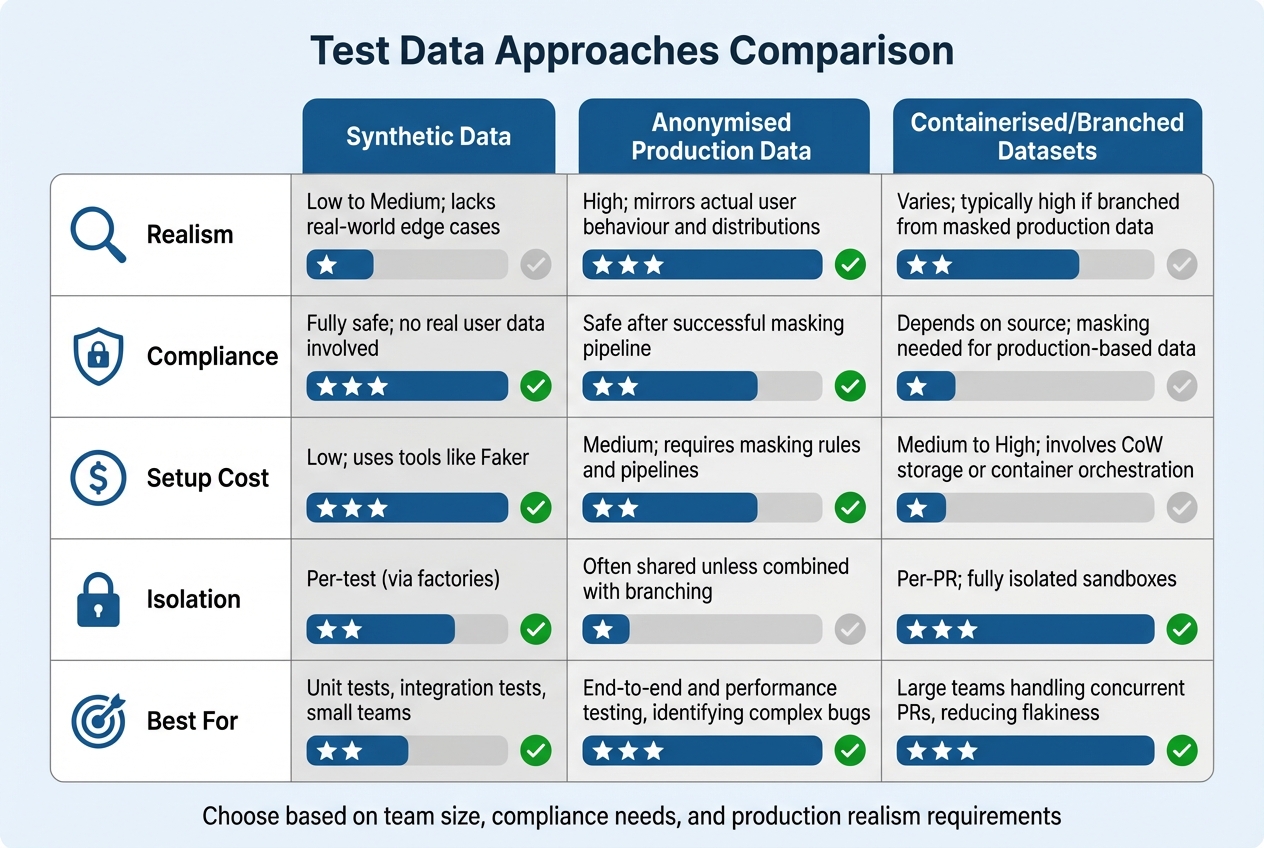 {Comparison of Test Data Approaches: Synthetic vs Anonymised vs Containerised Datasets}
:::
{Comparison of Test Data Approaches: Synthetic vs Anonymised vs Containerised Datasets}
:::
When deciding on a test data approach, it's essential to consider factors like team size, compliance requirements, and the level of production realism needed. Organisations often evolve through three stages: starting with synthetic data for its simplicity, incorporating anonymised production data for greater realism, and eventually adopting database branching for full isolation as they scale [6].
Below is a table that outlines the trade-offs between the main approaches to help you make an informed choice.
Comparison Table: Synthetic Data vs. Anonymised Production Data vs. Containerised Datasets
| Feature | Synthetic Data | Anonymised Production Data | Containerised/Branched Datasets |
|---|---|---|---|
| Realism | Low to Medium; lacks real-world edge cases [6] | High; mirrors actual user behaviour and distributions [6][16] | Varies; typically high if branched from masked production data [6] |
| Compliance | Fully safe; no real user data involved [6] | Safe after successful masking pipeline [6] | Depends on source; masking needed for production-based data [6] |
| Setup Cost | Low; uses tools like Faker [6] | Medium; requires masking rules and pipelines [6] | Medium to High; involves CoW storage or container orchestration [6] |
| Isolation | Per-test (via factories) [6] | Often shared unless combined with branching [6] | Per-PR; fully isolated sandboxes [6] |
| Best For | Unit tests, integration tests, small teams [6] | End-to-end and performance testing, identifying complex bugs [6][16] | Large teams handling concurrent PRs, reducing flakiness [6] |
This table serves as a guide to match your testing needs with the most suitable approach.
For smaller teams (2–5 engineers), synthetic data is often the most practical starting point. Using factory patterns like Factory Bot or Fishery helps keep setup costs low, especially when schemas are frequently changing [6]. As production traffic grows, teams can adopt a Golden Image
strategy, which involves creating a carefully masked production snapshot. This approach ensures compliance while capturing nuanced edge cases that synthetic data often misses [6][16].
Test data management is one of those things that doesn't matter until it suddenly matters a lot, and by the time it matters, you've already accumulated months of bad habits and technical debt.
For larger teams, database branching offers a powerful solution. Using Copy-on-Write (CoW) technology, it can clone a 40GB database in under a second by duplicating only the modified pages. This drastically reduces storage and provisioning costs while allowing multiple pull requests to share data pages efficiently [6]. Popular tools for these tasks include Neosync for data masking, Faker for generating synthetic data, and platforms like Neon or Database Lab Engine for database branching [6].
Choosing the right test data approach is a critical step in optimising your CI/CD workflow. It ensures your pipelines remain efficient, compliant, and scalable. For tailored solutions to improve your test data strategy, Hokstad Consulting (https://hokstadconsulting.com) provides expert guidance to help teams achieve their goals.
Conclusion and Key Takeaways
Incorporating test data into CI/CD workflows not only speeds up deployments but also ensures regulatory compliance. Moving away from manual, ticket-based database refreshes to a self-service, API-driven approach can cut down delays of 3–5 days while addressing inefficiencies[1]. Automating tasks like data masking and synthetic data generation helps maintain compliance across all non-production environments[1].
The right strategy will depend on your team’s size and specific compliance requirements. For smaller teams, synthetic data offers simplicity and quick provisioning. Storing data generation and masking policies in Git improves both reproducibility and traceability[1][17]. This not only simplifies data provisioning but also strengthens security practices.
By integrating compliance checks directly into your CI/CD pipeline, you can address security issues earlier in the process - a practice often referred to as shifting security left
[18]. Tracking metrics such as Deployment Frequency, Lead Time for Changes, Change Failure Rate, and Mean Time to Recovery provides actionable insights into how effective your test data strategy is[18].
From synthetic data and anonymisation to containerised datasets and ephemeral environments, each approach plays a role in creating a more efficient, secure, and compliant CI/CD process. If your organisation requires tailored advice on optimising test data workflows, Hokstad Consulting specialises in DevOps transformation and custom automation solutions to help cut costs and speed up deployments.
FAQs
How do I pick the right test data approach for my team?
Choosing the right test data approach hinges on your specific testing requirements and the objectives of your pipeline. You might explore options such as:
- Synthetic data: This provides realistic datasets without risking exposure of sensitive information.
- Masked data: Ideal for privacy-compliant testing, ensuring sensitive details are protected.
- On-demand data: Offers flexibility with real-time provisioning to suit dynamic testing needs.
Make sure your choice aligns with your team’s security protocols, the scope of your testing, and any automation requirements. This alignment is key to maintaining consistency and streamlining your CI/CD workflows.
What’s the safest way to meet GDPR rules in test environments?
The best way to stay compliant with GDPR in testing environments is to rely on anonymised or synthetic test data rather than using real personal data. This approach helps safeguard personal information while ensuring compliance with data privacy laws.
How can I make test data fast, repeatable, and non-flaky in CI?
To make test data in Continuous Integration (CI) fast, consistent, and dependable, Infrastructure as Code (IaC) can be a game-changer. It allows you to manage and automate the provisioning of test data, reducing variability and ensuring a stable environment every time.
By automating setup and teardown processes, you can eliminate delays and inconsistencies, creating a smoother and more reliable testing cycle. Additionally, using modern test data automation tools can simplify provisioning, cut down on manual errors, and make the process more repeatable.