
Managing access manually is outdated and risky. Automated Identity and Access Management (IAM) solutions simplify compliance by automating user permissions, enforcing access controls, and generating audit-ready logs. For UK businesses, this means meeting GDPR, PCI DSS, HIPAA, and other regulations more efficiently while avoiding fines and reputational damage.
Key Benefits of IAM Automation:
- Stronger compliance: Automatically enforce least-privilege access and role-based controls.
- Audit-ready logs: Generate tamper-proof records for GDPR, PCI DSS, and HIPAA.
- Reduced workload: Save up to 40% of IT team efforts with automated workflows.
- Improved security: Detect and address anomalies in real time, reducing risks.
Why it matters: Regulations like GDPR require technical measures to protect personal data. Manual processes often fail to meet these evolving standards, leading to compliance gaps. IAM automation ensures consistent enforcement, real-time monitoring, and streamlined audits, making compliance a proactive process.
How to Get Started:
- Assess gaps: Review current IAM and compliance practices for weaknesses.
- Choose tools: Select IAM solutions with features like MFA, audit logging, and real-time reporting.
- Automate workflows: Link IAM systems to HR platforms for seamless provisioning and deprovisioning.
- Monitor continuously: Use real-time insights and regular access reviews to maintain compliance.
IAM automation transforms compliance from a burden into a manageable, efficient process, allowing businesses to focus on growth while staying within regulatory boundaries.
Regulatory Challenges Solved by IAM Automation
Data Protection Regulations (GDPR)
Under GDPR Article 32, organisations are required to implement technical measures like pseudonymisation and encryption to safeguard personal data. Relying on manual access management often falls short of consistently meeting these standards, especially when proving that only authorised individuals have access to sensitive data. IAM automation addresses this by enforcing dynamic role-based access controls from a central system, ensuring a single, accurate view of access rights. Users are provisioned and deprovisioned based on their roles, aligning with principles like data minimisation and purpose limitation. With features such as multi-factor authentication (MFA) and real-time access monitoring, IAM systems can quickly flag orphaned accounts or excessive permissions, mitigating compliance risks. When auditors require proof of compliance, automated logs provide immediate and comprehensive evidence, eliminating the need for laborious manual documentation.
Industry-Specific Standards (PCI DSS, HIPAA)
In addition to GDPR, many industries face their own compliance hurdles. For example, PCI DSS Requirement 7 focuses on limiting access to cardholder data based on business needs, while Requirement 8 mandates unique user IDs and authentication. IAM automation enforces these standards through rule-based access controls, ensuring only authorised personnel can access payment systems and applying least-privilege principles organisation-wide. Similarly, healthcare organisations under HIPAA's Security Rule benefit from automated workflows that manage authentication for electronic protected health information (ePHI) while maintaining segregation of duties. A medtech startup in 2025 provides a compelling example: by automating role-based access policies and compliance scans, they successfully passed their first SOC 2 audit. IAM systems also generate detailed audit trails, documenting every interaction with sensitive data - meeting the rigorous record-keeping requirements of both PCI DSS and HIPAA.
Audit and Reporting Requirements
Regulations like GDPR, PCI DSS, and HIPAA demand detailed, tamper-proof records, which manual processes often fail to deliver reliably. IAM automation simplifies this by creating comprehensive, tamper-proof audit trails across all systems, ensuring organisations are always audit-ready. For instance, Canadian firm Orca and a fintech company significantly reduced their audit preparation times - by up to 50% - using automated reviews and detailed logs. Scheduled reminders for access reviews replace cumbersome manual processes, transforming compliance into a transparent, efficient workflow. Real-time reporting capabilities further empower compliance teams to detect and resolve issues as they arise, rather than uncovering them during annual audits.
These examples highlight how IAM automation tackles regulatory challenges across data protection, industry-specific standards, and audit requirements. By shifting compliance from a manual, reactive task to a proactive and streamlined process, organisations can focus more on their core operations while staying securely within regulatory boundaries.
Need help optimizing your cloud costs?
Get expert advice on how to reduce your cloud expenses without sacrificing performance.
Automation in IAM with Sailpoint | Manual IAM to Automation with Sailpoint | SailPoint IAM |Upptalk
How to Implement IAM Automation for Compliance
::: @figure 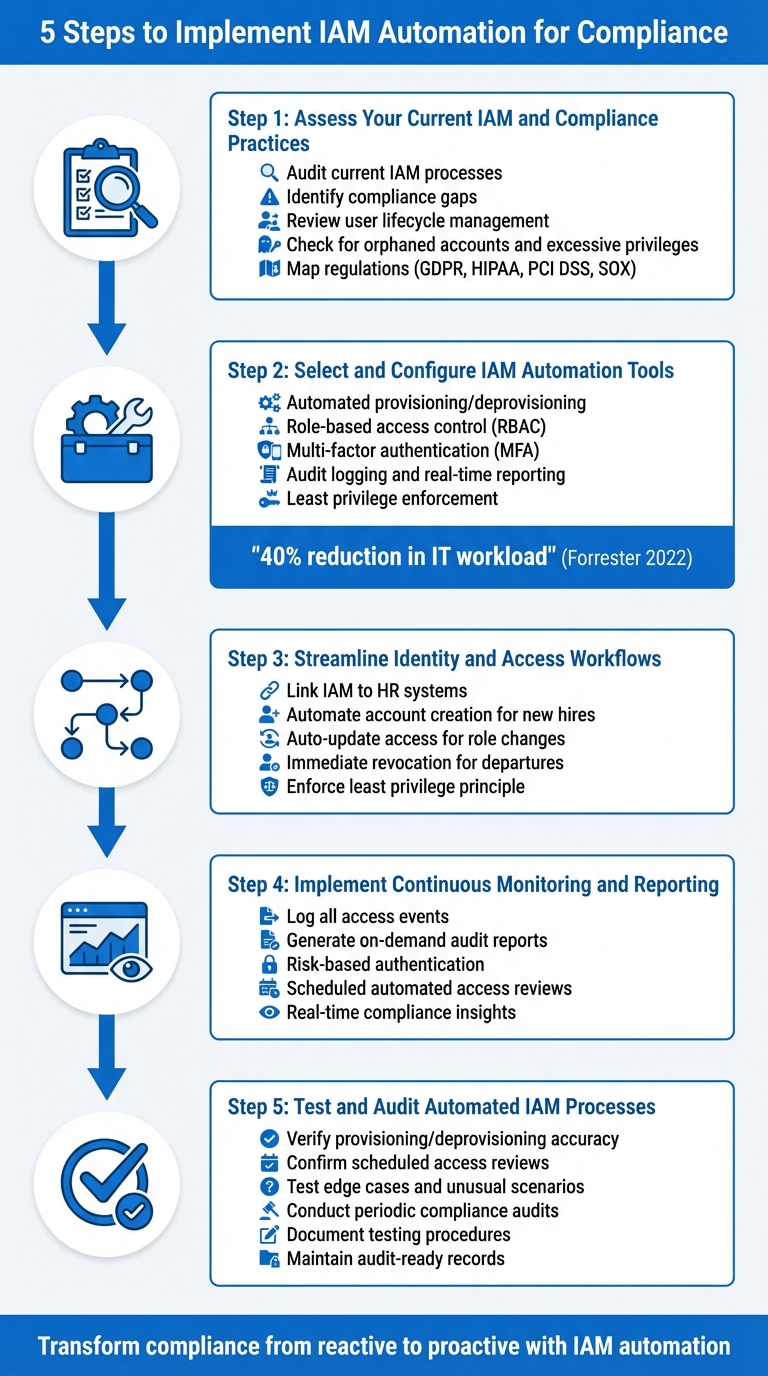 {5-Step IAM Automation Implementation Process for Regulatory Compliance}
:::
{5-Step IAM Automation Implementation Process for Regulatory Compliance}
:::
Step 1: Assess Your Current IAM and Compliance Practices
Start by thoroughly auditing your current Identity and Access Management (IAM) processes to uncover any compliance gaps. Focus on areas like user lifecycle management, access reviews, and audit logging. Identify which regulations apply to your organisation - whether it's GDPR, HIPAA, PCI DSS, SOX, or a mix of these - and pinpoint discrepancies between your current practices and those regulatory requirements [1][2]. Pay close attention to risks such as orphaned accounts left active after employees leave or unchecked excessive privileges [1]. This review should also evaluate how well your procedures handle user access and logging. A comprehensive assessment will help you identify where automation can reduce manual tasks and improve accuracy in managing access and compliance reporting [2]. Once you’ve mapped out these gaps, you’ll be ready to choose the right automation tools.
Step 2: Select and Configure IAM Automation Tools
Choosing the right IAM tools means finding solutions that align with your organisation's specific compliance needs [1]. Look for features like automated provisioning and deprovisioning linked to HR systems, role-based access control (RBAC), multi-factor authentication (MFA), and detailed audit logging [5]. It’s essential that the tool supports regulations such as GDPR, HIPAA, or PCI DSS [3]. Other key features to prioritise include real-time reporting, self-service options, and the ability to enforce least privilege access [1][2]. A 2022 Forrester report revealed that AI-powered IAM solutions can reduce the workload on IT teams by up to 40%, showcasing the potential efficiency gains [3]. Select a system that can scale with your organisation’s growth while still maintaining regulatory compliance [4].
Step 3: Streamline Identity and Access Workflows
Integrate your IAM platform with your HR systems to fully automate user lifecycle management [2]. This means when a new employee joins, the system automatically creates accounts and assigns access rights based on their role and department. As employees transition to new roles, their access rights are updated automatically to reflect their responsibilities, ensuring the principle of least privilege is upheld [2]. When employees leave, access is revoked immediately, eliminating the risk of orphaned accounts [2]. This level of automation ensures that access permissions are always current and compliant with data protection regulations.
Step 4: Implement Continuous Monitoring and Reporting
Your IAM solution should log all access events in detail [2]. The ability to generate on-demand reports for auditors ensures you’re always prepared for compliance checks, avoiding the last-minute stress that often accompanies audits [2]. Use risk-based authentication to adapt security measures dynamically - for instance, requiring additional verification for unusual login attempts or blocking suspicious IP addresses [2]. Schedule regular automated access reviews with built-in reminders and intuitive approval workflows, ensuring a clear audit trail for the entire process [2]. Real-time insights into your compliance status allow you to quickly detect and resolve any issues [2]. Testing system performance will help finalise the setup.
Step 5: Test and Audit Automated IAM Processes
Regular testing is essential to confirm that your automated IAM processes are functioning as intended and meeting compliance standards [6]. Clearly define which access decisions the system will handle automatically and which require human oversight [6]. Tests should verify that provisioning and deprovisioning occur accurately, access reviews are conducted on schedule, and audit logs capture all necessary details. Periodic compliance audits will ensure that policies continue to enforce least privilege access and segregation of duties effectively [1]. Test edge cases and unusual access scenarios to evaluate the system’s robustness. Keep detailed records of testing procedures and results to demonstrate compliance during external audits, providing evidence of your organisation’s commitment to safeguarding sensitive data [2]. This final step ensures that the automated processes you’ve implemented remain effective and compliant over time.
Benefits of IAM Automation for Regulatory Compliance
Streamlining Identity and Access Management (IAM) not only ensures adherence to regulations but also boosts security and operational performance.
Better Accuracy and Efficiency
Managing access manually often leads to errors like forgotten deprovisioning or inconsistent policy enforcement. IAM automation addresses these issues by applying uniform policies across the organisation. For example, when an employee exits, their access is revoked immediately based on HR data. Similarly, role changes automatically update permissions to uphold the principle of least privilege[2].
Automation also simplifies periodic reviews by scheduling checks, sending reminders to managers, and creating comprehensive audit trails. These features can ease the IT workload by up to 40%[3], allowing teams to focus on projects that enhance business outcomes.
Stronger Security and Risk Reduction
Beyond improving efficiency, automation strengthens security by continuously monitoring access and ensuring compliance. It detects policy breaches, orphaned accounts, and excessive permissions in real time while enforcing principles like Zero Trust, least privilege access, and segregation of duties (SoD)[1][2][5].
For regulations like GDPR and HIPAA, automated logs provide clear documentation of resource access and accountability[1][2][5]. Similarly, for PCI DSS compliance, automation handles user IDs and access policies to block unauthorised access to payment data[5]. According to the National Cyber Security Centre (NCSC), over 80% of cloud account breaches could be avoided by implementing Multi-Factor Authentication (MFA) - a feature IAM automation can enforce consistently across all systems.
Lower Compliance Management Costs
IAM automation not only improves accuracy and security but also reduces the costs associated with compliance. Organisations typically allocate around 7% of their IT budgets to compliance and risk management[3]. By reducing manual work during audits, optimising software licence usage, and speeding up incident responses, automation significantly trims these expenses. On-demand compliance reports, for instance, eliminate weeks of preparation time and related costs[2].
The financial impact extends further. Companies with fully implemented IAM and MFA solutions save an average of £1.7 million per breach compared to those without these measures. By proactively enforcing policies and delivering real-time compliance insights, automation helps organisations avoid hefty fines and data breach costs[1][2]. Additionally, the IAM market is expected to grow from USD 13.4 billion in 2021 to USD 25.0 billion by 2026, reflecting a growing reliance on these cost-effective compliance solutions[3].
Integrating IAM Automation with DevOps for Continuous Compliance
With DevOps deployments happening several times a day, traditional methods struggle to keep up. This often leads to gaps between security policies and actual practices. By embedding IAM automation directly into DevOps workflows, compliance checks can be seamlessly integrated into every stage of the development lifecycle. This ensures that security and compliance are no longer afterthoughts but are part of the process from start to finish.
Custom Automation Development
Standard IAM solutions often fall short when it comes to addressing industry-specific regulatory requirements. Custom automation development allows organisations to create workflows that are perfectly aligned with their unique compliance needs. For example, a major financial institution utilised Avatier's Identity Management solution to automate SOX compliance. The results were impressive: an 85% reduction in access certification efforts, a 94% drop in compliance violations, a 70% faster setup time for developer access, and a 40% increase in deployment frequency[8].
Customised solutions can also implement Zero Standing Privileges (ZSP), where administrative access is granted temporarily rather than permanently. This approach replaces always-on
accounts with Just-in-Time (JIT) access, which automatically expires once a task is completed. According to SailPoint, organisations using JIT access reduced standing privileges by 90%, significantly lowering their exposure to potential attacks[8]. These tailored workflows are essential for maintaining strong, automated risk management in fast-paced environments.
Using AI Agents for Risk Assessment
AI-powered IAM tools revolutionise compliance monitoring, turning it into a continuous process rather than a periodic task. AI agents can automate risk-based approval workflows, instantly granting low-risk permissions while flagging high-risk requests for manual review[8]. This ensures a balance between maintaining security and keeping up with the speed of DevOps.
Unlike quarterly manual reviews, AI agents provide constant monitoring of access[8]. They are particularly effective at managing machine identities - like API keys, containers, and service accounts - that are integral to DevOps pipelines and often outnumber human users. These identities require ongoing oversight to prevent unauthorised access, and AI tools excel at this task[7]. By offering continuous supervision, these tools help align the rapid pace of DevOps with strict regulatory standards.
How Hokstad Consulting Supports Automation Integration
Hokstad Consulting leverages its expertise in DevOps transformation to help organisations seamlessly integrate IAM automation into their workflows. Their approach combines cloud infrastructure optimisation with customised IAM solutions that fit directly into existing CI/CD pipelines, ensuring compliance without slowing down deployments.
One standout feature they offer is identity-aware telemetry, which tags logs and metrics with user context in real time[7]. This is especially useful during audits, as it provides clear records of who accessed which resources and when. With experience across public, private, and hybrid cloud environments, Hokstad Consulting ensures that IAM automation functions smoothly across all infrastructure types - whether on-premises or in multi-cloud setups. By embedding these tools into CI/CD pipelines, compliance becomes a continuous, integrated process rather than a separate checkpoint.
Conclusion
Summary of IAM Automation Benefits
IAM automation takes the headache out of compliance by replacing manual, error-prone processes with efficient, automated systems. Instead of scrambling during audits, organisations can rely on audit-ready systems with immutable logs that ensure everything is in order. Security gets a serious upgrade too - instant deprovisioning and strict enforcement of least privilege policies eliminate the risks tied to orphaned accounts, a common issue with traditional methods. IT teams also breathe easier, as self-service portals and automated workflows cut down on manual tasks, while costs shrink thanks to lower labour demands and better resource management that avoids unnecessary spending and regulatory fines.
Operationally, the advantages are hard to ignore. Automated IAM systems deliver continuous insights with full resource coverage, a huge improvement over the periodic sampling that manual monitoring offers. Audit preparation times drop from weeks to mere hours, error rates decrease with consistent policy enforcement, and compliance costs typically see a reduction of 30–50%. Perhaps most importantly, incident response becomes proactive rather than reactive, with real-time alerts and automated fixes addressing issues before they snowball into violations.
With these benefits in mind, organisations can take actionable steps to incorporate automation into their compliance strategies.
Next Steps for Compliance Simplification
Start by laying a strong foundation with clear governance frameworks. Use a RACI matrix to define who is responsible for each IAM task, and set up a governance board that includes representatives from security, IT, HR, and legal teams. Centralise identity management by using a single Identity Provider and standardising federation protocols like SAML 2.0 or OIDC across all cloud platforms to avoid identity sprawl.
Focus on automating high-risk areas first, such as offboarding and privileged access, before expanding to cover the entire identity lifecycle. Connect IAM systems with HR platforms to ensure seamless provisioning for new joiners and immediate deprovisioning for leavers, reducing the risk of privilege creep. Adopt policy as code tools like Open Policy Agent or Kyverno to embed compliance rules directly into CI/CD pipelines. When rolling out new automated policies, start in audit mode to observe their impact without disrupting operations. Finally, map technical controls - such as MFA and encryption - to specific regulations like GDPR, PCI DSS, or FCA guidelines. This creates a clear, traceable matrix that supports compliance during audits.
FAQs
Which regulations can IAM automation help with?
IAM automation helps organisations stay aligned with regulations such as GDPR, ISO 27001, PCI DSS, and FCA guidelines. By automating key processes like access control, monitoring, and reporting, it simplifies compliance with data protection, security, and audit standards.
How do we prove compliance during an audit?
To stay prepared for audits and demonstrate compliance, it's crucial to keep secure, detailed records of all system activities. This includes tracking user actions, system events, and any configuration changes, all with accurate timestamps. Regular reviews of these logs are essential, and encryption adds an extra layer of protection. Implement role-based access controls to limit access to sensitive information, and consider automated tools for managing logs and conducting compliance checks. These practices help maintain data integrity and confidentiality while showing adherence to regulations like GDPR, ensuring you're always audit-ready.
What should we automate first for quick wins?
When aiming for quick wins in automation, prioritise access controls and identity lifecycle processes. Start by automating tasks like user provisioning and de-provisioning. Pair this with enforcing least privilege policies and rolling out multi-factor authentication (MFA). These measures not only prevent privilege creep and ensure accurate access management but also help meet GDPR requirements. The result? Immediate gains in regulatory compliance and smoother operations.