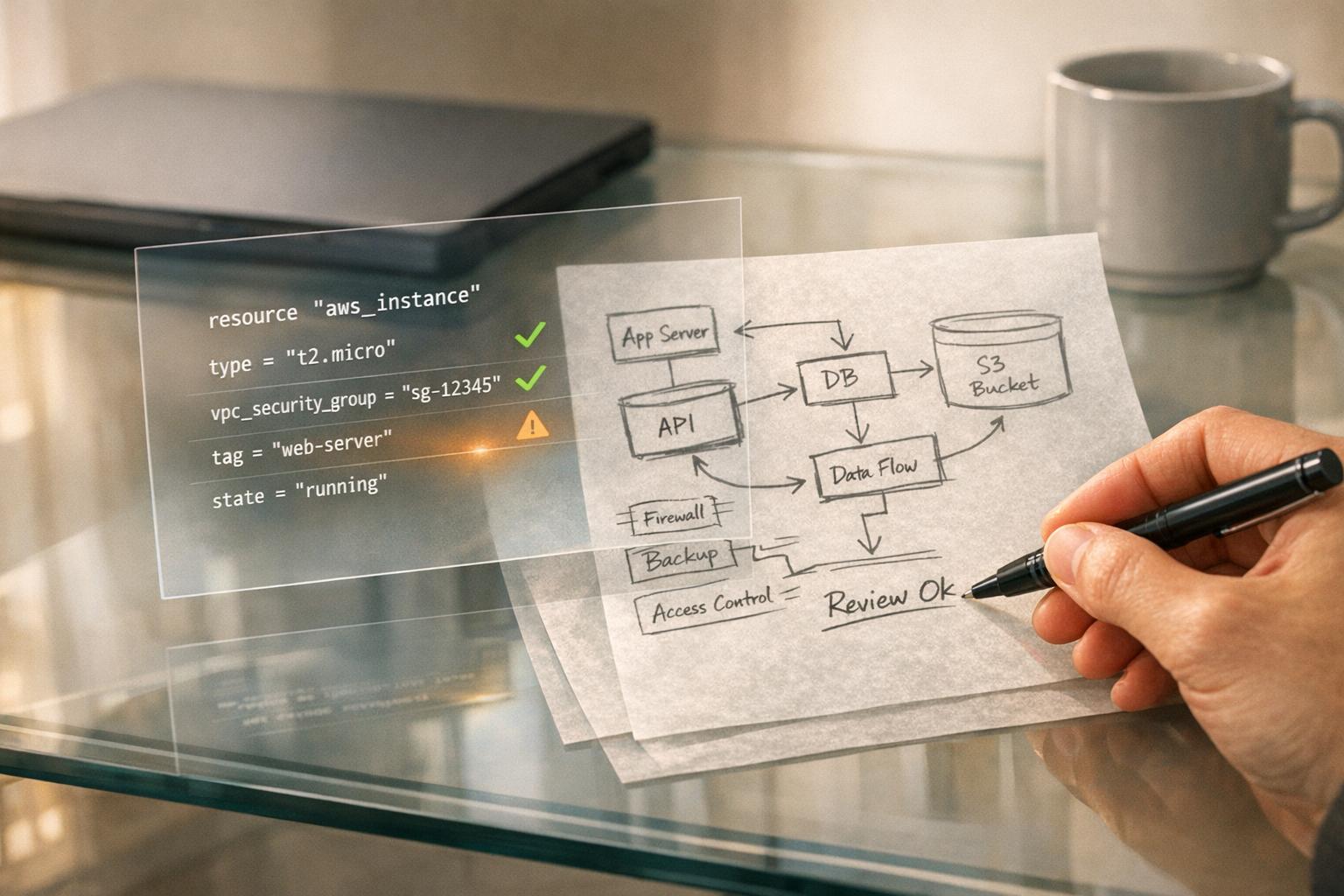
Securing Infrastructure as Code (IaC) requires both automation and human expertise. Here's why:
- IaC Security Testing (Automated): Quickly scans configuration files (e.g., Terraform, Kubernetes YAML) for misconfigurations and vulnerabilities. It's fast, consistent, and scales well in CI/CD pipelines but lacks context and often generates false positives.
- Manual Code Reviews: Performed by engineers to identify complex logic flaws, architectural risks, and business-specific issues. These reviews provide deeper insights but are slower, resource-intensive, and less scalable.
Key Differences:
- Automation is fast and consistent but limited in understanding intent.
- Manual reviews are context-aware but slower and dependent on reviewer expertise.
Quick Comparison
| Attribute | IaC Security Testing (Automated) | Manual Code Reviews |
|---|---|---|
| Speed | Seconds to minutes | Hours to days |
| Scalability | Handles large projects easily | Limited by reviewer capacity |
| Consistency | Uniform across all scans | Varies with reviewer skill |
| Context Awareness | Low | High |
| False Positives | 30–60% | Low |
Best Approach: Use both methods together. Automation handles repetitive tasks and common vulnerabilities, while manual reviews focus on high-risk areas like architecture and business logic. This hybrid approach improves security without slowing down development workflows.
::: @figure 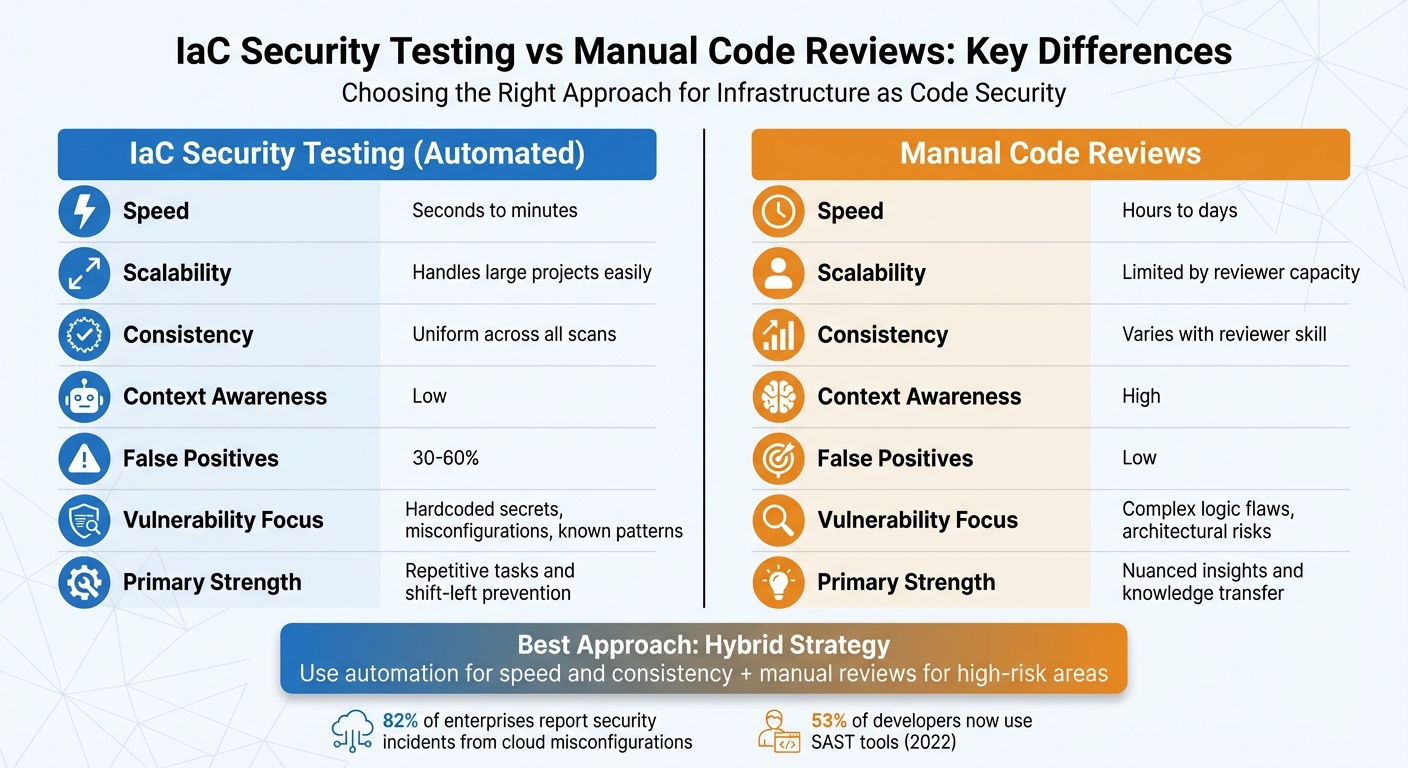 {IaC Security Testing vs Manual Code Reviews: Key Differences Comparison}
:::
{IaC Security Testing vs Manual Code Reviews: Key Differences Comparison}
:::
What Is IaC Security Scanning? Terraform, Kubernetes & Cloud Misconfigurations Explained
Main Differences Between IaC Security Testing and Manual Code Reviews
The key distinction between IaC security testing and manual code reviews lies in their speed and approach. IaC security testing operates on automation, scanning thousands of lines of configuration files in seconds. In contrast, manual code reviews rely on human expertise, requiring a line-by-line inspection, which takes significantly longer and depends on human availability [4][5].
Scalability is another major difference. Automated IaC security tools can handle large codebases and frequent updates effortlessly, integrating directly into CI/CD pipelines [4]. Manual reviews, however, often lag behind as project sizes grow, becoming bottlenecks due to the limited availability of skilled reviewers [4][5]. This scalability gap also affects the consistency and context-awareness of each method.
When it comes to consistency, automated testing shines by applying uniform security rules without fatigue. However, the quality of manual reviews can vary based on the expertise of the reviewer [4][5]. Mohammed Khalil, Cybersecurity Architect at DeepStrike, explains this contrast:
Automated reviews detect syntax errors and known security issues at machine speed, whereas manual review is adept at understanding business logic, architectural decisions, and code readability[5].
Another key factor is context awareness. Automated tools, while fast and consistent, lack the ability to understand the purpose behind the code or its alignment with broader business objectives [4]. Manual reviews, on the other hand, excel in evaluating architectural decisions and domain-specific nuances [5].
The table below highlights these differences in a clear and concise manner:
Comparison Table: IaC Security Testing vs Manual Code Reviews
| Attribute | IaC Security Testing (Automated) | Manual Code Reviews |
|---|---|---|
| Speed | Seconds to minutes; real-time feedback [4][5] | Hours to days; dependent on human availability [4][5] |
| Scalability | Handles large projects and frequent commits [4][5] | Limited by team size; can become a bottleneck [4][5] |
| Consistency | Applies rules uniformly every time [5] | Variable; depends on reviewer skill [4][5] |
| Context Awareness | Low; rules-based and lacks contextual insight [4][5] | High; understands intent, logic, and architecture [4][5] |
| Vulnerability Focus | Hardcoded secrets, misconfigurations, known patterns [1][6] | Complex logic flaws and architectural risks [5] |
| False Positive Rate | 30–60%; requires constant tuning [7] | Low; humans verify relevance [7] |
| Primary Strength | Repetitive tasks and shift‐left prevention [1] | Nuanced insights and knowledge transfer [7][10] |
Benefits of IaC Security Testing
Automated Infrastructure as Code (IaC) security testing brings clear advantages in speed, consistency, and scalability, making it a powerful tool for modern development workflows. These tools can complete scans in seconds, allowing developers to identify and fix misconfigurations before code reaches production [8]. This speed is critical in environments with frequent deployments.
The consistency of automated tools is another game-changer. Unlike human reviews, which can vary depending on the reviewer or workload, automated tools apply the same policies to every commit, ensuring uniformity. Suphi Cankurt from Invicti puts it succinctly:
No human consistently catches every 0.0.0.0/0 in every security group rule on every pull request.[8]
When it comes to scalability, automation shines. Manual reviews often struggle with large, multi-file projects, but automated tools can evaluate every resource against hundreds of policies without losing accuracy. For instance, Checkov includes over 1,000 built-in policies and more than 800 graph-based checks to assess cross-resource relationships [8]. This comprehensive analysis prevents a major risk: one insecure IaC template could replicate vulnerabilities across hundreds of environments. Automated scanning serves as a crucial checkpoint to stop this chain reaction [1]. Together, speed and feedback from these tools integrate seamlessly into CI/CD pipelines.
Speed and Scalability in CI/CD Pipelines
Incorporating security checks directly into CI/CD pipelines - at the commit or pull request stage - helps catch issues early, saving time and cost. This shift-left
strategy ensures developers receive immediate feedback within their workflow, rather than uncovering problems during later security audits [1, 15].
With over 95% of cloud security failures linked to customer misconfigurations, early detection becomes indispensable [1]. A 2022 survey also revealed that 53% of developers now use Static Application Security Testing (SAST) tools, a notable increase from past years [2]. Beyond speed and scalability, these tools are particularly adept at identifying common vulnerabilities.
Detection of Common IaC Vulnerabilities
Automated tools are highly effective at spotting vulnerabilities that often lead to security breaches. They can identify issues like publicly accessible S3 buckets, overly permissive IAM roles, unrestricted security groups, disabled logging, and hardcoded secrets [1, 18, 3]. According to Check Point’s 2024 Cloud Security Report, 82% of enterprises reported security incidents caused by cloud misconfigurations [3].
These tools employ layered analyses - structural, semantic, configuration, and dataflow - to provide robust vulnerability detection [2]. This multi-faceted approach is far more reliable for repetitive checks compared to manual reviews.
Popular tools like KICS and Trivy support multiple IaC platforms and come with extensive policy libraries that align with industry standards such as CIS Benchmarks, SOC 2, and HIPAA [6, 3]. This alignment ensures compliance is built into the process automatically.
Benefits of Manual Code Reviews for IaC
While automated tools are great for speed and consistency, they can't replace the human touch when it comes to understanding the context behind Infrastructure as Code (IaC) decisions. Human reviewers bring judgement and insight that automated tools simply can't match - they understand the why behind architectural choices.
Take architectural trade-offs, for example. Choosing between a microservices approach or a monolithic architecture isn't just about code; it's about team size, deployment needs, and how fast the business moves. Automated tools can't factor in these nuances. Similarly, human reviewers can spot how database schema changes might ripple through downstream systems or affect legacy setups - tasks that go beyond the capabilities of automated systems [7].
Another key reason for manual reviews? Automated tools aren't perfect. They miss about 22% of actual vulnerabilities and only catch half of the issues while generating a significant number of false positives - anywhere from 30% to 60%. This can lead to alert fatigue, where genuine risks might be ignored. Human expertise is essential for tackling these gaps, especially when dealing with custom threat models or intricate configurations [7].
Custom Threat Modelling and Business Logic
Manual reviews shine in areas where automated tools fall short, particularly when it comes to understanding specific business rules or regulations. For instance, healthcare software often has to meet privacy laws that vary by jurisdiction, or payment systems may need to follow intricate approval workflows. Automated tools struggle with these complexities, but human reviewers can step in to ensure compliance. As Ruben Camerlynck from Aikido Security points out:
Manual reviews are especially valuable for nuanced areas such as architectural decisions, business logic, or highly sensitive code - contexts where automated tools may lack understanding.[12]
This human perspective is also crucial for prioritising risks. An automated scanner might flag a vulnerability, but only a human reviewer can judge whether it's a real concern in context. For example, a flagged issue might not be critical if the resource is deployed on a locked-down internal network. Similarly, humans can evaluate whether a design pattern, while technically correct, adds unnecessary complexity [7].
Handling Complex IaC Configurations
When it comes to intricate setups, manual reviews are indispensable. Multi-region deployments, cross-service integrations, and strict compliance requirements all demand a level of expertise that automated tools can't provide. These tools often rely on historical data and struggle with new architectural trends or emerging technologies. Experienced reviewers, on the other hand, can provide the oversight needed when organisations experiment with new cloud services or implement custom security measures.
Manual reviews also offer an opportunity for mentorship. Senior engineers can guide junior developers, sharing organisational design principles and security best practices during the review process. This knowledge-sharing is especially helpful for onboarding new team members. For high-stakes changes - like those involving authentication, database migrations, or IAM policies - many organisations now enforce mandatory human oversight through tools like GitHub's CODEOWNERS, ensuring critical modifications are carefully reviewed [7].
Drawbacks of IaC Security Testing vs Manual Code Reviews
While both approaches are useful, they come with distinct limitations that highlight the need for a balanced strategy. Relying solely on one method - automated testing or manual reviews - can leave your infrastructure vulnerable due to their inherent blind spots.
Automated IaC security testing is highly efficient but lacks the ability to understand context. These tools operate by scanning code against predefined rules, but they can't interpret business logic, developer intent, or architectural trade-offs. As Aikido Security points out:
Automated tools can detect technical flaws but often fail to understand code intent or architectural patterns[4].
This limitation can lead to false positives, where valid design decisions are flagged as issues. On average, automated tools fail to catch 22% of real vulnerabilities and generate false-positive rates ranging from 30% to 60% [7]. These shortcomings underscore the importance of supplementing automation with other methods.
Manual code reviews, on the other hand, excel at contextual understanding but struggle with scalability. GitGuardian captures this challenge well:
Manual code reviews are far better than doing no code reviews... but the reality is that in modern DevOps organisations, only doing reviews by hand is not going to give you the results you need[13].
Human reviewers are resource-intensive, slower, and prone to fatigue, which can lead to missed vulnerabilities. They may also overlook repetitive technical flaws that automated tools can quickly identify. Additionally, manual reviews often fail to catch issues buried in Git history, such as secrets added and then removed in separate commits [13].
Comparison Table: Drawbacks of Both Approaches
| Drawback | Manual Code Review | Automated IaC Testing |
|---|---|---|
| Speed & Scalability | Slow and labour-intensive; bottlenecks CI/CD pipelines [5] | Fast but requires significant setup and rule maintenance [5] |
| Accuracy | Prone to human error, fatigue, and focus issues [5] | High false-positive rates (30–60%) causing alert fatigue [7] |
| Context Understanding | High cost due to reliance on skilled developers [5] | Lacks the ability to interpret business intent or architecture [5] |
| Vulnerability Coverage | Inconsistent; depends on the reviewer’s expertise [5] | Misses around 22% of real vulnerabilities and novel threats [7] |
| Business Logic | Effective for domain-specific and compliance checks [5] | Cannot assess business or regulatory requirements [7] |
Both approaches have their strengths and weaknesses, and they complement each other well. Automation is excellent for identifying routine technical errors quickly, while human reviewers bring the necessary insight to evaluate complex architectural decisions and business logic. A 2024 study revealed that a single static analysis tool identifies only about 50% of actual vulnerabilities [7], while manual reviews often miss straightforward technical issues that scanners excel at catching [5]. This is why combining automated tools with human expertise has become the go-to strategy for secure IaC development in 2025 [5][7].
When to Use IaC Security Testing or Manual Code Reviews
Choosing between Infrastructure as Code (IaC) security testing and manual code reviews depends on your project's specific needs - its risk level, scale, and deployment speed. Each approach has its strengths and limitations, and understanding these will help you make the right decision.
Risk classification is a critical factor. High-risk changes, such as those involving authentication, payment processing, or encryption, demand human judgement. Automated tools, while efficient, cannot evaluate the nuances of security logic or its relevance to your business. For example, a human reviewer is essential to assess the soundness of encryption strategies. On the other hand, low-risk changes - like formatting updates - can be safely handled with automation.
Scale and speed also play a significant role. If you're deploying multiple updates daily across hundreds of environments, manual reviews can quickly become a bottleneck. Automation becomes indispensable in such scenarios, especially when a single flawed template could be replicated across your infrastructure at a scale that humans cannot manage. In fact, the growing reliance on automation is reflected in developer practices: in 2022, 53% of developers reported using SAST scans, a sharp rise from less than 40% in 2020 [1][9].
Best Use Cases for IaC Security Testing
Automated IaC testing excels when speed and consistency are key priorities. It’s particularly effective at catching repetitive errors and identifying common vulnerabilities that might slip through during manual reviews, especially under time pressure [6][2].
Continuous compliance auditing is another area where automation shines. Tools can evaluate code against hundreds of policies simultaneously, such as CIS Benchmarks, NIST, SOC2, HIPAA, and PCI DSS. This ensures consistent application of standards across your infrastructure - something that would be nearly impossible to achieve manually [6][11]. For organisations that need to ensure every resource meets regulatory requirements, automation is the most practical solution.
Automation is also invaluable for large-scale CI/CD pipelines. Tools can scan thousands of lines of code in seconds, providing instant feedback that supports rapid deployment cycles [1][7]. This immediate feedback promotes secure coding practices and keeps development moving smoothly [6][11]. For low-risk changes, tools like GitHub CODEOWNERS can route updates through automation-only pipelines, allowing human reviewers to focus on more complex or high-risk tasks [7].
Best Use Cases for Manual Code Reviews
While automation covers a lot of ground, there are areas where manual reviews are indispensable. For high-risk deployments, where failure could have severe consequences, human oversight is non-negotiable. As Augment Code highlights:
Manual code review remains essential for architectural decisions, cross-service impacts, and domain-specific business logic[7].
When making changes to authentication mechanisms, database schemas, or encryption implementations, experienced developers can provide the nuanced evaluation that automated tools lack.
Architectural changes and cross-service impacts are another area where human reviewers excel. Automation cannot fully grasp the downstream effects of design changes or how well a new approach aligns with long-term technical goals. Senior developers and architects bring critical insights here, assessing trade-offs, maintainability, and subtle logic flaws that pattern-matching tools simply cannot detect.
Compliance audits with specific contextual requirements also benefit from manual reviews. While automated tools can flag technical deviations from standards, only human reviewers can determine if your business logic aligns with unique privacy policies or regulatory obligations. Additionally, manual reviews offer a chance to mentor junior developers, reinforcing design standards and fostering team alignment - something automation cannot replicate [5][7].
When integrating tools into your workflow, it’s wise to start in an informational
mode rather than immediately enforcing blocking rules. This allows you to fine-tune the tools and reduce false positives, which often range between 30–60% in static analysis tools [7]. A phased approach prevents developer fatigue and ensures smoother adoption [9]. Combining both methods - automation for speed and consistency, and manual reviews for nuanced oversight - creates a balanced and robust security strategy for IaC pipelines.
Combining IaC Security Testing and Manual Code Reviews
By 2025, blending automation with human expertise has become the go-to approach for Infrastructure as Code (IaC) security testing [5]. Instead of viewing automated testing and manual code reviews as competing methods, the most effective strategy integrates them into a single, cohesive workflow. Automation handles repetitive tasks, while human reviewers focus on complex, context-specific decisions. This division of responsibilities boosts efficiency without sacrificing security.
Each method has its limitations, but a hybrid approach bridges these gaps. Automated tools, for instance, struggle to understand business logic or architectural intent, while manual reviews, though thorough, can slow down fast-moving pipelines. By letting automation tackle routine issues like trivial bugs and common misconfigurations, human reviewers can concentrate on high-value tasks - such as evaluating authentication mechanisms, assessing architectural trade-offs, and ensuring the code aligns with business goals. This creates a structured process where both methods complement each other seamlessly.
Step-by-Step Hybrid Approach
A sequential hybrid workflow integrates security checks at key development stages, leveraging the strengths of both methods. Here’s how it works:
Start with local scanning in the IDE: Use tools like Checkov or TFLint to catch syntax errors and basic misconfigurations early. This
shift-left
approach provides developers with immediate feedback before code is even committed, reducing workload downstream.Run automated scans in the CI/CD pipeline: Trigger comprehensive IaC scans on every pull request. These scans assess code against policies, identifying issues like unencrypted storage or overly permissive security groups. Initially running these scans in a non-blocking mode allows teams to fine-tune rules and minimise false positives before making them mandatory.
Prioritise and resolve critical findings: Address high-risk issues flagged by automation immediately. Then, move to manual reviews for a deeper inspection of security-sensitive areas, such as authentication logic, complex algorithms, or business-critical paths. Using standardised checklists derived from design documents can streamline this process.
Establish a feedback loop: Regularly update automated rule sets with insights gained from manual reviews. This helps prevent recurring issues and keeps the automated tools relevant.
To further optimise this workflow, use CODEOWNERS files. These can route high-risk changes, like updates to authentication systems or database migrations, to experienced reviewers while allowing low-risk changes, such as documentation edits, to go through automation-only pipelines. This targeted routing ensures human expertise is focused where it’s needed most.
Benefits of a Hybrid Approach
The integration of automated testing and manual reviews offers a level of coverage neither method can achieve on its own. Automation excels at detecting syntax errors, known vulnerabilities, and coding style issues, while human reviewers bring the ability to evaluate architectural decisions and business logic. Together, they reduce technical debt and enhance overall security.
This hybrid setup also combats alert fatigue. By using manual triage or AI-driven filtering to separate genuine risks from false positives, developers can focus on real threats. In fact, hybrid platforms that strategically reduce noise have been shown to cut false positives by over 90% [4].
Manual reviews also serve as a teaching tool, reinforcing secure coding practices among team members. Importantly, this approach aligns with industry standards like the NIST Secure Software Development Framework (SSDF) and ensures compliance with frameworks such as SOC 2, PCI DSS, and HIPAA through robust audit trails.
As Mohammed Khalil, Cybersecurity Architect at DeepStrike, puts it:
Automated reviews are fast and uniform; manual reviews add deep context and mentorship. The ideal approach in 2025 is hybrid.[5]
Conclusion
Securing Infrastructure as Code (IaC) requires a blend of automation's speed and human judgement's depth. Automated IaC security testing can scan thousands of lines in seconds, efficiently catching syntax errors and known vulnerabilities with consistent accuracy [5][4]. Yet, these tools aren't perfect - they can miss around 22% of vulnerabilities and generate false-positive rates ranging from 30% to 60% [7]. On the other hand, manual reviews excel at spotting complex logic flaws and architectural challenges but struggle to keep pace with modern deployment speeds [5].
A hybrid approach is the way forward. Automated scans act as the first layer of defence, flagging routine issues so human reviewers can focus on high-risk areas like authentication mechanisms and cross-service impacts. This not only reduces technical debt but also keeps deployment timelines intact [5][7].
As Mohammed Khalil, Cybersecurity Architect at DeepStrike, aptly puts it:
Code quality and security demand both brains and automation[5].
This highlights that neither automation nor manual reviews alone can ensure robust IaC security. A hybrid strategy, such as using path-based routing to assign critical changes to senior reviewers, balances efficiency with accuracy. With 82% of enterprises encountering security incidents caused by cloud misconfigurations [3], this method is crucial for safeguarding infrastructure in the years ahead.
Another benefit of this approach is reducing alert fatigue. When tuned correctly, a hybrid model can cut false positives by over 90% [4], allowing developers to focus on genuine risks rather than being overwhelmed by noise. For organisations striving to secure their IaC pipelines while maintaining speed, the solution is clear: automate intelligently, review strategically, and merge both into a unified workflow. This integration is key to long-term IaC security.
For tailored advice on improving your IaC security processes, visit Hokstad Consulting at https://hokstadconsulting.com.
FAQs
Which IaC changes must always get a manual review?
Changes to Infrastructure as Code (IaC) that demand manual review typically involve architectural decisions, cross-service interactions, or business-specific logic. While automated security tools are great at spotting misconfigurations, they can't replace the human touch when it comes to understanding the bigger picture. Manual reviews are crucial for evaluating complex or high-stakes changes that impact system architecture or core business processes - areas where context and nuance go beyond what automated tools can handle.
How can we reduce false positives from IaC security scans?
To cut down on false positives, prioritise context-aware analysis over generalised scans. Tools like Semgrep, when paired with AI, can target specific Infrastructure as Code (IaC) elements - like IAM roles or S3 buckets - to pinpoint security concerns more effectively. Fine-tuning your scanning setup with accurate configurations and embedding automated checks into CI/CD pipelines further helps in flagging genuine issues while reducing unnecessary alerts and distractions.
What’s the simplest way to add IaC security checks to CI/CD?
Integrating automated security scanning tools into your CI/CD pipeline is one of the easiest ways to enhance security. For example, tools like Checkov can analyse Terraform or CloudFormation files for potential security misconfigurations during the build process. These tools are straightforward to set up and operate with minimal manual input, ensuring ongoing security checks are seamlessly embedded into your workflow.