
Hybrid cloud backups are a powerful way to protect your data by combining on-premises and cloud storage. But they come with risks that can lead to severe legal and compliance issues if not properly managed. Here's the key takeaway:
- Security Risks: Ransomware, misconfigured access controls, insider threats, and unsecured APIs are common vulnerabilities in hybrid cloud setups.
- Legal Fallout: Breaches can result in hefty fines under regulations like GDPR, class-action lawsuits, and reputational damage.
- Compliance Gaps: Managing security across on-premises and cloud environments often leads to gaps due to unclear responsibilities and scattered audit trails.
Quick Facts:
- GDPR Fines: €7.1 billion issued between 2018 and 2026, with €1.2 billion in 2025 alone.
- Data Sovereignty: Data is governed by the laws of the country where it’s stored, creating jurisdictional challenges.
- Shared Responsibility: Cloud providers secure the infrastructure, but you’re accountable for securing your data and configurations.
To mitigate these risks, organisations must implement strong security measures, conduct regular audits, and align their backup strategies with legal requirements. Proactive management and expert guidance can help reduce exposure to fines and lawsuits while improving overall resilience.
How to Design Secure Protection for Hybrid and Multi-Cloud Environments | Webinar
Need help optimizing your cloud costs?
Get expert advice on how to reduce your cloud expenses without sacrificing performance.
Legal Risks of Hybrid Cloud Backup Breaches
::: @figure 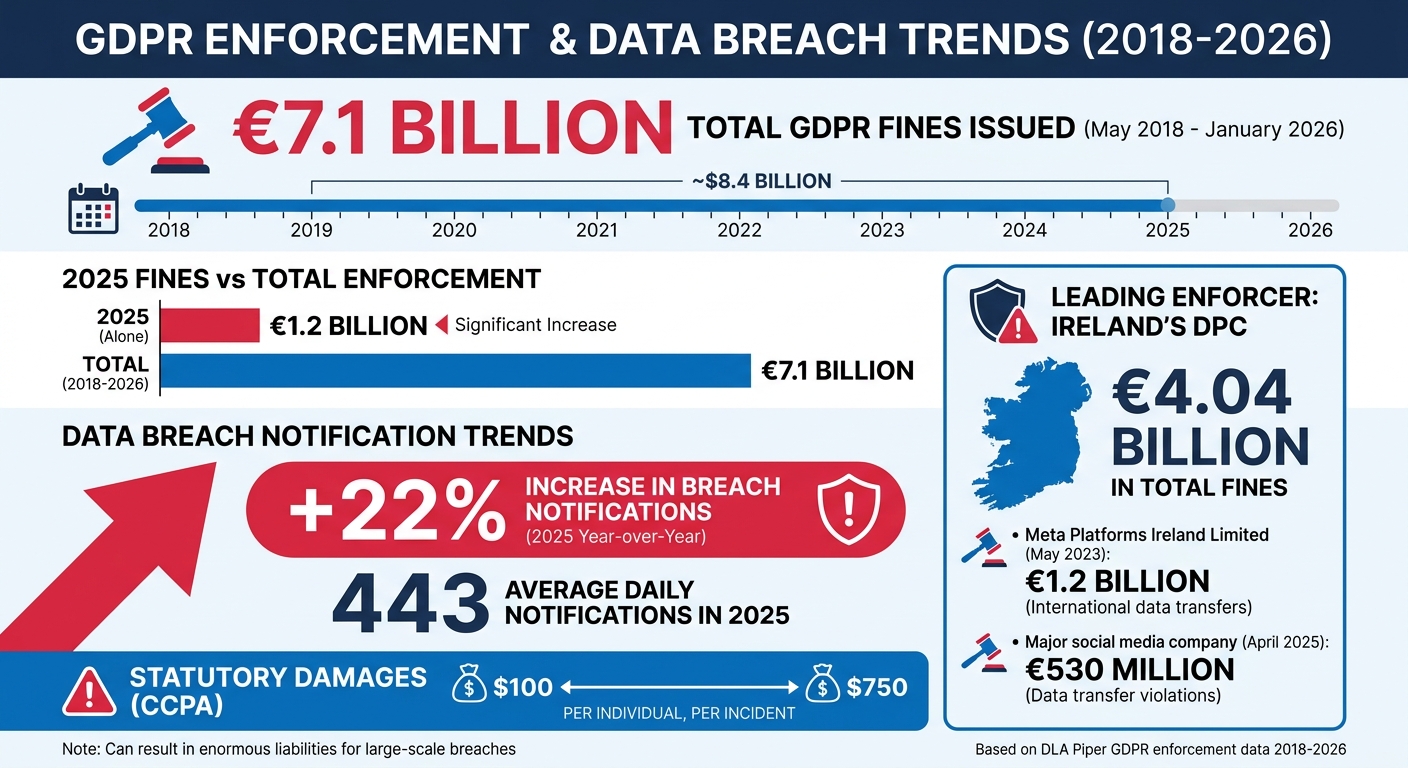 {GDPR Fines and Data Breach Statistics 2018-2025}
:::
{GDPR Fines and Data Breach Statistics 2018-2025}
:::
When a hybrid cloud backup breach happens, the fallout goes far beyond operational headaches. Organisations can face hefty financial penalties, lawsuits from affected parties, and jurisdictional disputes that amplify the risks. With regulators becoming stricter, fines are hitting new highs, and individuals impacted by breaches are increasingly seeking compensation.
GDPR and Data Breach Penalties
The GDPR is known for imposing some of the largest fines in data protection law. Between May 2018 and January 2026, European regulators handed out fines totalling €7.1 billion (approximately $8.4 billion), with €1.2 billion issued in 2025 alone [1]. These figures highlight the regulation's strict enforcement, especially when it comes to breaches of the integrity and confidentiality
principle, which requires strong safeguards against unauthorised access to personal data.
The scale of individual fines can be staggering. For example, in May 2023, the Irish Data Protection Commission fined Meta Platforms Ireland Limited €1.2 billion for issues related to international data transfers. Another major social media company was fined €530 million in April 2025 for similar violations [1]. Since 2018, Ireland's Data Protection Commission has issued €4.04 billion in fines, making it the leading enforcer in Europe [1].
The number of breach notifications is also rising fast. In 2025, there was a 22% increase, with an average of 443 notifications per day [1]. Ross McKean, Chair of DLA Piper UK's Data, Privacy and Cybersecurity practice, commented:
The 22% uptick in personal data breach notifications demonstrates the serious and immediate consequences of these uncertain times for organisations... our report underscores the urgency and need for organisations to optimise cyber defences and operational resilience [1].
Adding to the pressure, regulators are now holding data processors directly accountable. Backup providers and cloud vendors can no longer assume they're protected from enforcement actions. Authorities are increasingly penalising processors alongside data controllers when security measures fail [1].
But fines aren't the only concern. Breaches also open the door to civil lawsuits and liability issues, which can be equally damaging.
Class-Action Lawsuits and Liability
Organisations face the risk of civil litigation from customers, partners, and others affected by data breaches. Under the California Consumer Privacy Act (CCPA), statutory damages range from $100 to $750 per individual per incident [3]. For breaches involving large customer bases, this can lead to enormous liabilities.
Contractual breaches can also result in court-ordered penalties. For instance, in 2020, a Spanish court ordered compensation from a cloud provider after it failed to deliver reliable backup services for Banco Santander [2]. Similarly, in 2019, the UK Information Commissioner's Office fined British Airways heavily for a breach that exposed customer data, citing weak backup security as a critical failure [2].
Major breaches often lead to governance overhauls. After a 2017 breach, Equifax Inc. faced fines and was required to improve its governance after investigations revealed poor backup and monitoring practices [2]. Capital One Financial Corp. faced similar scrutiny in 2019 when a misconfigured firewall allowed unauthorised access to sensitive backups [2].
Even encryption doesn’t guarantee protection from notification requirements. If encryption keys are compromised, organisations lose their safe harbour
and must notify regulators and individuals [3]. The responsibility for these notifications lies squarely with the data controller, not the cloud provider [3].
These legal challenges often intersect with jurisdictional issues, particularly those tied to data sovereignty.
Data Sovereignty Challenges
Data sovereignty adds another layer of complexity to hybrid cloud backups. The principle is simple: data is governed by the laws of the country where it is physically stored [4]. For example, if a UK company stores backups on US servers, the data could fall under US jurisdiction, regardless of ownership. This can create conflicts when legal requirements differ between jurisdictions.
Both live data and backups must meet residency laws [4]. Many cloud platforms automatically replicate data across regions for redundancy, but without proper controls, backups can end up in locations that breach sovereignty laws, exposing organisations to penalties.
The EU has introduced regulations that effectively enforce data localisation. Laws like the Digital Operational Resilience Act (DORA) for financial services and the European Health Data Space (EHDS) for health data require critical providers to store sensitive information within the EU [5]. This aligns with the growing trend of sovereign cloud
solutions, where data storage, processing, and access are restricted to specific jurisdictions. This is particularly significant given that US-based providers control over 70% of the EU cloud market [5].
| Concept | Definition | Legal Implication |
|---|---|---|
| Data Sovereignty | Data is governed by the laws of the country where it resides [4] | Jurisdiction depends on server location |
| Data Residency | Requirement to store data within a specific geographic area [4] | Ensures compliance with geographic regulations |
| Data Localisation | Legal requirement to store and process data within one country [4] | Prevents cross-border data movement |
To navigate these challenges, organisations should map out their backup systems, identifying where data originates, where it is stored, and how it is replicated [4]. Using policy-driven storage systems that route data to compliant regional centres and replacing global disaster recovery sites with local failover options can help minimise cross-border risks [4].
These jurisdictional complexities make it essential for organisations to align their backup strategies with local legal requirements, as discussed further in our risk mitigation guidance.
Compliance Challenges in Hybrid Cloud Environments
Hybrid cloud environments come with a unique set of compliance challenges that go beyond just legal requirements. The mix of on-premise systems and cloud services often results in unclear responsibilities, inconsistent security measures, and scattered audit trails. Even if individual components appear secure, these gaps can lead to regulatory failures.
Shared Responsibility and Security Gaps
One of the biggest hurdles in hybrid cloud compliance is the shared responsibility model. In this setup, cloud providers handle the infrastructure's security (security of the cloud
), while customers are responsible for securing their data, configurations, and access controls (security in the cloud
). As AWS explains:
AWS is responsible for security of the cloud; customers are responsible for security in the cloud [6].
Unfortunately, many organisations underestimate their role in this model. Studies show that by 2025, 95% of cloud security failures are expected to stem from customer errors. In 2024, 82% of data breaches involved cloud-stored data, and 57% of organisations reported non-compliance with at least one regulatory framework in 2025.
A common misconception is that SaaS platforms like Salesforce or Microsoft 365 are fully secured by the vendor. However, organisations remain accountable for tasks such as managing user access, enforcing multi-factor authentication (MFA), and classifying data. For instance, in August 2025, Healthplex, Inc. faced a £1.6 million penalty from the New York Department of Financial Services for failing to implement MFA during an email system migration. This oversight exposed sensitive health data for tens of thousands of consumers. Similarly, the May 2024 Snowflake breach highlighted risks when customer accounts lack proper configuration management.
To address these issues, organisations must clearly define which security controls are the vendor's responsibility and which are theirs. Deploying Cloud Security Posture Management (CSPM) tools can also help, with research showing a 60% reduction in audit failures compared to manual reviews [6].
Encryption and Data Protection Standards
Consistent encryption practices are essential for protecting data and avoiding regulatory penalties. All data - whether at rest, in transit, or during processing - should use recognised encryption protocols like AES-256. Inconsistent key management systems between on-premise and cloud backups can create vulnerabilities, making it harder to control access to sensitive information.
A good rule to follow is the 3-2-1-1-0 backup strategy: maintain three copies of your data across two types of media, with one copy stored off-site, one immutable, and no recovery errors [7]. This approach ensures robust data protection and simplifies compliance audits.
Audit and Monitoring Challenges
Hybrid environments often scatter logs across multiple systems, making it difficult to maintain clear audit trails. Regulators require organisations to show who accessed data, when, and from where. Fragmented logs - spread between on-premise servers and various cloud platforms - make this evidence hard to compile.
Centralised logging solutions, such as SIEM or SOAR tools, can address this issue. By aggregating logs from all environments, these tools streamline compliance reporting and improve incident response processes [8]. Additionally, automated, real-time evidence collection and monitoring enable organisations to spot and fix misconfigurations before they lead to breaches or violations [6].
Governance models also play a key role in managing these challenges:
| Governance Model | Advantages | Disadvantages |
|---|---|---|
| Centralised | Ensures consistent policies and accountability; simplifies audits | Slower response times; less flexibility |
| Federated | Enables faster responses and leverages local expertise | Adds management complexity; risks policy inconsistencies |
Without the right monitoring tools and governance frameworks, proving compliance during audits becomes a major challenge. Manual oversight is no longer enough in complex hybrid environments. Automation and centralised visibility are now critical for meeting regulatory demands. These approaches will be explored further in our discussion on risk mitigation strategies.
How to Reduce Legal and Compliance Risks
To tackle legal and compliance risks in hybrid cloud environments, organisations need a blend of technical controls, robust governance, and ongoing monitoring. By focusing on these areas, businesses can not only tighten security but also meet stringent regulatory demands, significantly lowering their exposure to potential risks.
Deploy Advanced Security Solutions
Tools like real-time SIEM (Security Information and Event Management) and CSPM (Cloud Security Posture Management) are essential for monitoring hybrid environments. They offer visibility, detect threats before they escalate, and provide critical insights for managing complex infrastructures.
Pairing these tools with a Zero Trust architecture strengthens security further. Zero Trust ensures that every access request is verified, regardless of its origin, eliminating implicit trust between on-premise and cloud systems. As Daniel Mercer, Senior Cloud & Security Editor, aptly explains:
If you cannot describe an access path in one sentence, it is probably too permissive [9].
This layered approach is essential for reducing the risk of breaches and ensuring access controls are as tight as possible.
Strengthen Access Controls
Advanced threat detection is just the beginning; robust identity controls are equally crucial. In hybrid environments, identity now serves as the primary control plane. Implementing Multi-Factor Authentication (MFA) for all privileged accounts using phishing-resistant methods is a must. Hardware-backed tokens or biometric verification are particularly effective for backup administrators [9].
Just-In-Time (JIT) privilege elevation is another key measure, granting temporary administrative rights to limit unnecessary exposure. Organisations should also enforce strict separation of duties - administrative accounts used for production workloads should never have permissions to modify or delete backup data or security logs [9]. Additionally, isolating backup networks and management interfaces from standard user environments can help prevent attackers from moving laterally within the system.
Use Immutable and Geo-Redundant Backups
Immutable and geo-redundant backups play a critical role in reducing liability after a breach. Immutable backups, which use WORM (Write Once, Read Many) storage or snapshots, prevent any alteration - even by administrators. Courts have recognised these backups as a proactive security practice
that can demonstrate due diligence and reduce liability in ransomware cases [10].
The 3-2-1-1-0 backup rule offers a solid framework: keep three copies of your data, store them on two different media types, ensure one copy is off-site, another is immutable or offline, and regularly validate backups to ensure zero restore errors [9]. Geo-redundant storage adds another layer of protection by distributing backups across regions, ensuring availability even during regional outages.
Compliance with regulations like GDPR also requires organisations to support selective deletion of user data from backups. This right to be forgotten
capability is increasingly important for meeting legal obligations [10].
Regular Audits and Compliance Framework Alignment
Staying ahead of regulatory requirements means conducting regular audits and automating compliance checks. Aligning with frameworks such as GDPR, PCI DSS, and ISO 27001 provides a structured approach to managing security controls. Automated, real-time evidence collection can identify misconfigurations early, reducing manual workloads and improving overall security readiness.
Incident Response for Hybrid Cloud Backup Breaches
The first 72 hours following a breach are critical. They set the tone for how well you can minimise legal risks and operational disruption. For hybrid cloud setups, having a well-structured response plan is key to reducing damage and staying compliant with regulations.
Detect and Contain the Breach
Early detection is your first line of defence. Tools like Splunk or Azure Sentinel, alongside cloud-native logging systems such as AWS CloudTrail and Azure Monitor, are essential for identifying and confirming breaches through alert reviews [11]. Once a breach is confirmed, act quickly: isolate the affected virtual machines, revoke any compromised credentials, and secure forensic snapshots [11].
Preserving forensic evidence is equally important. Use secure, out-of-band channels to safeguard forensic images and logs, ensuring they remain intact and defensible in legal scenarios [12]. It’s also a good idea to involve external legal counsel to oversee digital forensic investigations. This approach ensures that findings are protected under legal privilege, offering added protection if the situation escalates to court [12].
Once containment is achieved and evidence is secured, the focus should shift to notifying the relevant regulatory bodies.
Regulatory Notifications
In the UK, GDPR Article 33 requires organisations to notify the Information Commissioner’s Office (ICO) and any other applicable authorities (like PECR, NIS, or FCA) within 72 hours of confirming a breach involving personal data. This timeline applies from the moment the breach is identified, not when it occurred. As Rob Bratby, Managing Partner at Bratby Law, explains:
The clock does not start when the breach occurred... it starts when the organisation first knows that personal data has been accessed, disclosed or lost [13].
Consistency is crucial when drafting regulatory notifications and public statements. Inconsistent communication can lead to accusations of dishonesty or mismanagement [13]. It’s also important to remember that even though cloud providers manage infrastructure, the responsibility for data-layer breaches and notifications falls squarely on your shoulders [11].
Post-Breach Remediation and Audits
After the breach is contained, focus on recovery. Begin by restoring data from immutable backups. Within two weeks, assemble a multidisciplinary team to audit the incident thoroughly and update compliance documentation as needed [11][12]. This lessons learned
approach not only addresses vulnerabilities but also shows regulators that you’re taking the necessary steps to prevent future breaches.
These efforts lay the groundwork for bringing in external consultants to further refine your incident response plan, ensuring it’s better equipped to handle future challenges.
Working with Expert Consulting for Compliance
When it comes to hybrid cloud compliance, the landscape can be overwhelming due to its intricate legal and technical challenges. This is where specialised consulting can make a real difference. Expert consultants not only ensure that your backup infrastructure aligns with both security and compliance standards but also help you avoid unnecessary expenses. They extend the risk reduction strategies mentioned earlier, ensuring your hybrid cloud environment remains compliant and secure as it evolves.
Hokstad Consulting's Expertise

Hokstad Consulting is known for its DevOps transformations tailored to hybrid cloud environments. They focus on optimising CI/CD pipelines, seamlessly embedding compliance controls into workflows. By leveraging tools like ArgoCD and Terraform, they enforce infrastructure as code (IaC) practices that comply with GDPR and ISO 27001 standards. The results? Deployment cycles are cut by up to 50%, and automation significantly reduces the risk of human error. In fact, their clients have reported a 40% drop in compliance violations.
Their cloud cost engineering services are another standout. Hokstad Consulting helps businesses optimise hybrid cloud expenses by identifying underutilised backup resources and improving storage capacity. This can lead to a 30–60% reduction in backup costs. By addressing inefficiencies, they help organisations avoid cost-cutting measures - like skimping on geo-redundant backups - that could result in hefty GDPR fines. For example, they assisted a mid-sized UK financial services firm in optimising a hybrid AWS–on-premises backup system after a near-breach. By deploying automated IAM policies via Terraform, they ensured FCA compliance, reduced recovery time objectives from 48 hours to just 4, maintained GDPR-compliant data residency in UK regions, and saved £150,000 annually in hosting costs.
Security audits are another critical offering. Using tools such as Nessus and Qualys, Hokstad Consulting conducts in-depth vulnerability assessments, penetration tests, and compliance gap analyses aligned with frameworks like NIST CSF and CIS Benchmarks. In one recent project for a UK-based client, their audits uncovered 25% more misconfigurations in hybrid S3 and Azure Blob backups. Addressing these issues helped the client avoid potential class-action liabilities. Post-audit, clients have seen a 70% improvement in audit pass rates and quicker breach detection through integrated SIEM solutions like Splunk.
Custom Solutions for Compliance
Hokstad Consulting doesn’t stop at technical hardening - they also provide tailored solutions for proactive compliance monitoring and automation. Their quarterly automated audits, powered by custom scripts (e.g., Driftctl), align with SOC 2 and Cyber Essentials Plus standards. These audits help businesses identify shared responsibility gaps early on, offering real-time compliance scores through dashboards. For hybrid cloud setups, they integrate monitoring tools like Prometheus and Grafana, which provide predictive risk alerts. UK clients have noted a 60% drop in incidents after engaging with Hokstad Consulting, ensuring they stay aligned with evolving regulations such as the UK GDPR post-Brexit.
IAM automation is another area where Hokstad Consulting excels. They implement just-in-time (JIT) access and zero-trust models using tools like HashiCorp Vault and Okta. This approach dynamically rotates credentials, logs all actions for audit purposes, and reduces standing privileges by 90%. Additionally, integrating Azure AD and AWS IAM helps mitigate risks associated with unauthorised access, a leading cause of breaches according to the 2025 Verizon DBIR. These measures are crucial for avoiding class-action lawsuits under UK data protection laws.
Hokstad Consulting also offers encryption and data protection solutions customised to meet UK-specific standards, including the Data Protection Act 2018. They ensure data is geo-fenced to EU/UK regions, further strengthening compliance. Many businesses partnering with Hokstad Consulting see returns on investment within 3–6 months, thanks to their expertise in cost optimisation, automation, and compliance guidance.
Conclusion
Hybrid cloud backup breaches present a serious risk, both legally and financially. Under GDPR, fines can soar to €20 million or 4% of annual turnover, while the average cost of a data breach in the UK stands at approximately £2.94 million [14]. These figures don’t even account for the potential fallout from class-action lawsuits, reputational harm, or the operational disruptions that can stretch for an average of 287 days. All of this highlights the need for robust preventive strategies.
The shared responsibility challenges in hybrid environments, as discussed earlier, often lead to security gaps that attackers are eager to exploit. To address these vulnerabilities, organisations should adopt multi-layered security measures. This means implementing tools like strong encryption, immutable backups, geo-redundant storage, and strict access controls. However, technical measures alone aren’t enough. Regular audits and well-documented incident response plans are essential to demonstrate due diligence to regulators like the ICO.
The financial and operational risks of a breach make proactive risk management a more cost-effective approach compared to dealing with the aftermath. For example, having a formal incident response plan can shave 60 days off breach discovery times, and routine audits can catch configuration issues before they escalate into compliance breaches. Additionally, organisations operating in the UK must navigate the evolving regulatory landscape shaped by the Data Protection Act 2018, which demands flexible strategies to manage data sovereignty and cross-border data transfers.
By combining these defences with expert guidance, compliance can shift from being a reactive burden to a strategic advantage. Firms like Hokstad Consulting specialise in areas like cloud cost engineering, DevOps transformation, and security audits, enabling organisations to optimise their hybrid setups while staying aligned with regulations. Their clients have reported cost savings of 30–50% alongside improved security, proving that operational efficiency and compliance can work together.
To put these strategies into action, start by evaluating your backup architecture, clarifying shared responsibilities, and identifying compliance gaps. Within the next 90 days, implement advanced security controls and establish a regular audit routine. For long-term success, collaborate with specialists who understand the intricate technical and legal demands of hybrid environments.
FAQs
Who is legally responsible if my hybrid cloud backups are breached?
If your organisation does not properly secure its hybrid cloud system, the responsibility for any breaches usually falls on you as the customer. Even if the cloud service provider's system is part of the issue, they are not held accountable. To reduce this risk, it’s essential to implement strong security measures and adhere to compliance protocols.
How do I prove GDPR compliance for backups spread across on‑prem and cloud?
To meet GDPR requirements for backups, whether on-premises or in the cloud, you’ll need to implement a combination of technical and organisational measures. Here’s how:
- Encryption: Use robust encryption methods like AES-256 to safeguard data, ensuring it remains secure both in transit and at rest.
- Key Management: Adopt secure key management practices to control access to encrypted data effectively.
- Access Controls: Enforce strict controls to limit who can access backup systems and data.
Beyond these technical steps, it’s essential to:
- Monitor and Log Access: Maintain detailed logs of who accesses backups and monitor all related activities.
- Data Residency: Ensure that backups are stored within the UK or EU to comply with data residency requirements.
- Regular Reviews: Periodically review your backup policies and conduct compliance audits to identify and address any gaps.
- Third-Party Agreements: Work with external providers to establish clear agreements that outline their responsibilities in meeting GDPR standards.
By combining these practices, you can better align your backup processes with GDPR and protect sensitive data effectively.
How can I keep backups immutable while still meeting the right to erasure?
To keep backups unchangeable while adhering to the right to erasure, organisations can rely on encryption and access controls to store data securely in a fixed state. By managing encryption keys carefully, specific data can be removed when necessary, ensuring alignment with regulations such as GDPR. This method helps maintain both data protection and compliance with legal requirements.