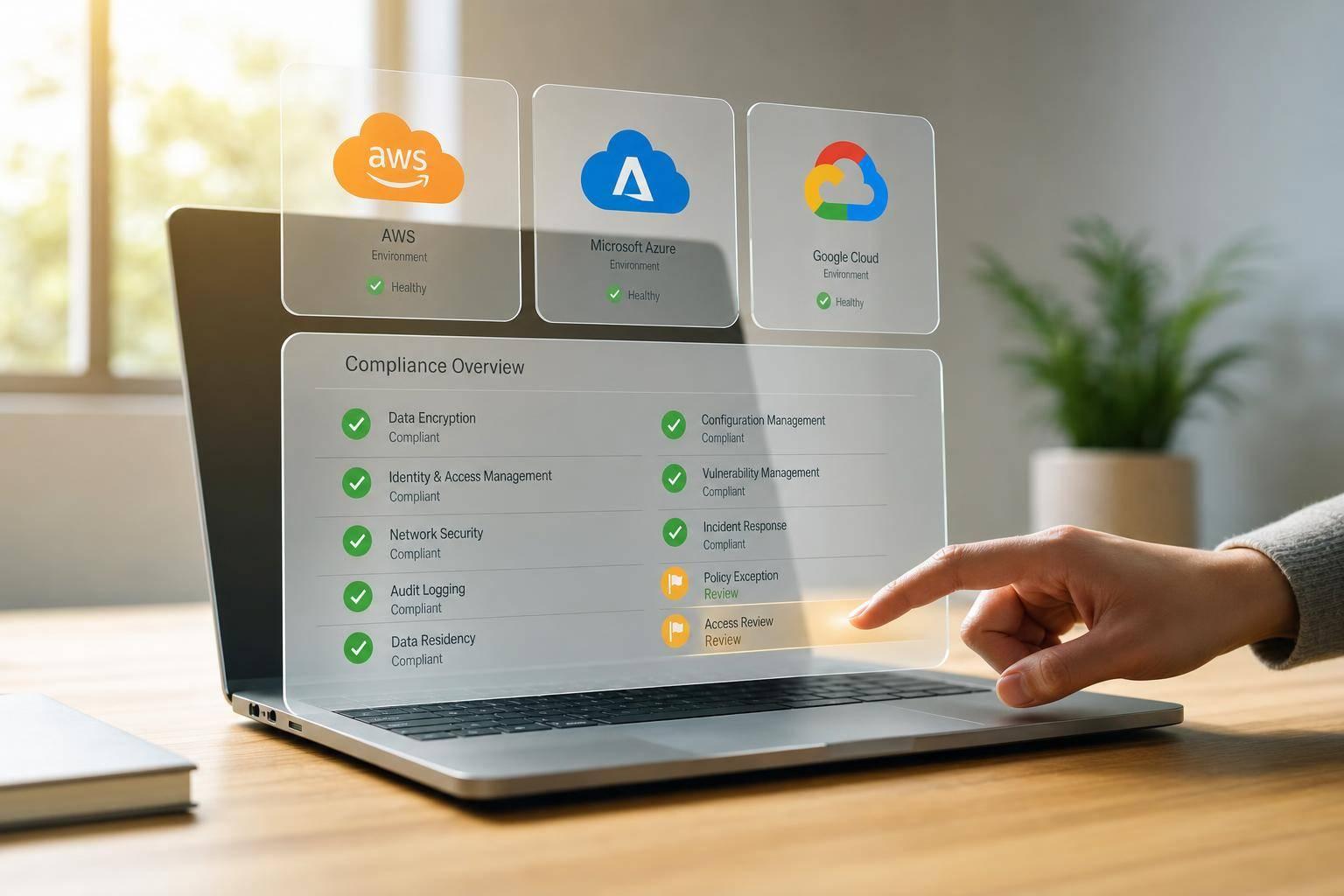
If you run compliance across AWS, Azure and GCP, AI can help cut false alerts, shorten fix times, and reduce audit prep hours - but only if you keep clear audit trails and human checks in place.
From the research in this article, I’d boil it down like this: AI helps most with detection, triage, policy checks in CI/CD, and evidence gathering. Reported results include detection accuracy moving from about 65% to 92%, false positives dropping from 12% to 4%, and remediation time falling from 45 minutes to 12 minutes for some access-control issues. Audit evidence work can also drop from 300–500 hours to 110–170 hours.
If you want the short version, here it is:
- Multi-cloud compliance is hard because each cloud logs and applies controls differently.
- AI helps standardise the view by mapping mixed cloud data into one schema.
- Machine learning spots odd behaviour, while NLP turns legal text into machine-readable controls.
- Policy-as-code blocks bad changes before release instead of leaving them for audit time.
- The main KPIs to track are detection accuracy, false positive rate, MTTD, MTTR, control coverage, and evidence completeness.
- UK firms have extra pressure around UK GDPR, cross-border log flows, and senior-manager accountability.
- The gains only count if decisions stay auditable and higher-risk cases still get human review.
::: @figure 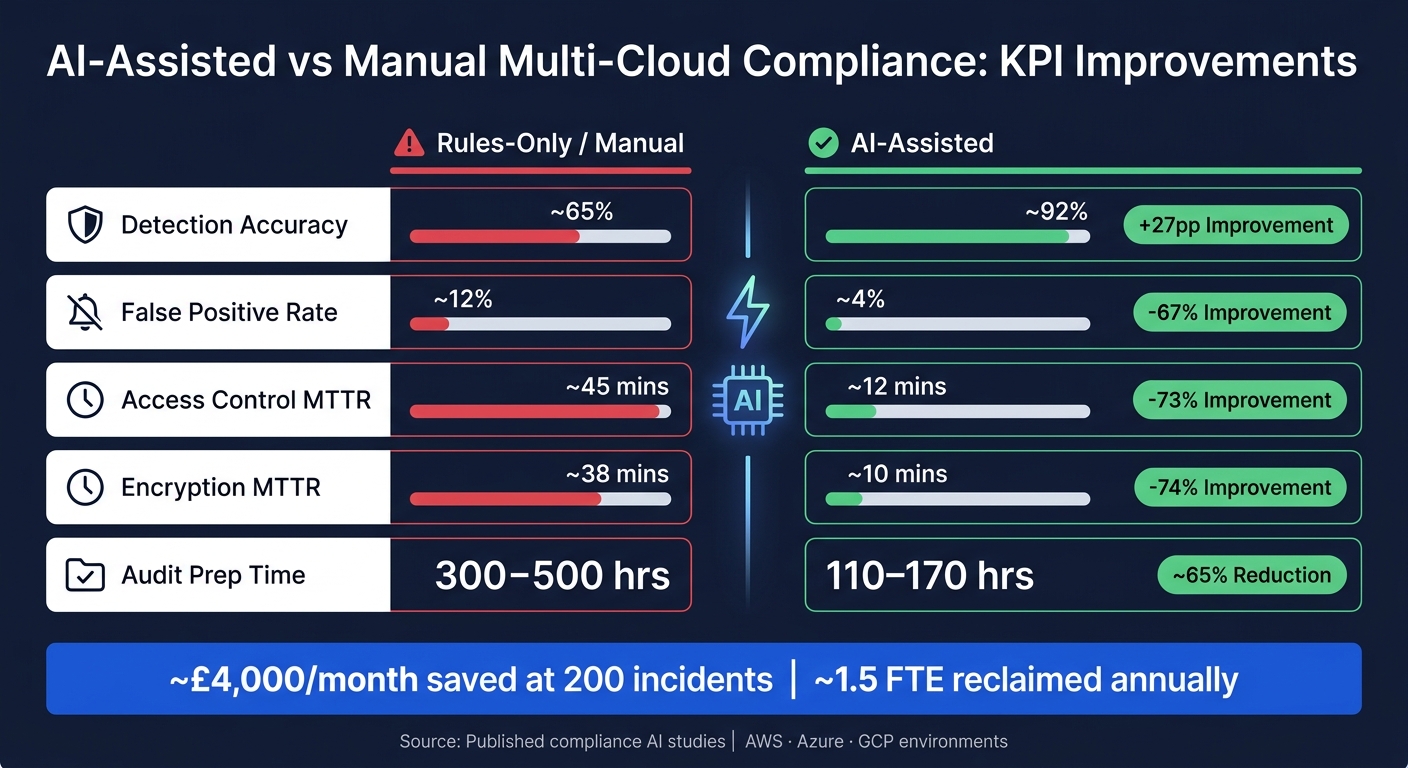 {AI vs Manual Multi-Cloud Compliance: Key KPI Improvements}
:::
{AI vs Manual Multi-Cloud Compliance: Key KPI Improvements}
:::
Compliance Automation: How AI Is Transforming Governance, Risk, and Enterprise Resilience
Need help optimizing your cloud costs?
Get expert advice on how to reduce your cloud expenses without sacrificing performance.
Quick comparison
| Area | Rules-only / manual approach | AI-assisted approach |
|---|---|---|
| Detection accuracy | ~65% | ~92% |
| False positive rate | ~12% | ~4% |
| Access-control MTTR | ~45 mins | ~12 mins |
| Encryption MTTR | ~38 mins | ~10 mins |
| Audit prep time | 300–500 hours | 110–170 hours |
So, if I were setting this up, I’d focus on one thing: use AI to improve the metrics you already report, not as a separate compliance layer.
What the research says about AI methods for compliance monitoring
Machine learning, NLP and policy-as-code
The research points to three methods working in tandem: machine learning for detection, NLP for interpretation, and policy-as-code for enforcement. Each handles a different part of the compliance problem.
On the detection side, unsupervised ML models, especially Isolation Forests and DBSCAN clustering, learn what normal log activity looks like and then flag anomalies.[8][1] In practice, that helps teams spot unusual access patterns or privilege changes and push those alerts higher up the queue, which cuts a lot of the background noise. But detection alone doesn't solve compliance. Rules from regulations still need to be turned into checks that systems can act on.
That’s where NLP comes in. It helps bridge the gap between legal or standards-based text and cloud configuration. AI platforms use NLP to parse frameworks such as UK GDPR, PCI DSS and ISO/IEC 27001, pull out obligations like data minimisation, access control and breach-notification timelines, and convert them into machine-readable control statements.[5][13][16] Those statements can then feed policy-as-code checks in CI/CD, where Terraform files, Kubernetes manifests and access policies are tested before anything goes live. So instead of finding a problem during an audit, teams can catch it before release.
IBM's work on multi-cloud compliance-as-code is a good example here. It expresses security policies, configurations and compliance measurements as versioned, executable code in standardised formats, enabling automated verification as part of deployment workflows.[11] Reports describe double-digit reductions in non-compliant deployments reaching production, along with steadier control enforcement across AWS, Azure and GCP.[7][8][5]
AI in multi-cloud telemetry and remediation workflows
Logs from AWS, Azure and GCP don't arrive in the same shape. That’s a headache if you want one monitoring view across all three. AI systems deal with this by mapping mixed telemetry into a common event schema, such as Elastic Common Schema (ECS) or the Open Cybersecurity Schema Framework (OCSF), so detection models and dashboards can work across providers without bespoke connectors.[17][18] That normalisation is what makes KPI tracking line up across clouds. The same idea applies to configuration data from IaC definitions and cloud APIs, with storage resources, access policies and network rules represented through the same set of attributes no matter which provider hosts them.
Once that telemetry is unified, AI can sort violations by severity, data sensitivity and incident history, then send urgent issues to incident queues while pushing lower-risk findings into review.[10][5] The clearest gains show up in detection, normalisation and triage, not end-to-end automation.[7][8][10][5][15] Auto-remediation works best for plain fixes, like turning bucket encryption back on or rotating an exposed key, while higher-impact changes stay with human reviewers.[7][8][9][12][5][14][15] That split matters even more in regulated UK sectors, where any change touching personal data needs to stay traceable and auditable. This is the point where compliance KPIs start to shift in day-to-day operations.
How AI changes compliance KPIs in practice
These gains don’t just sit in the background. They show up in reports as clear KPI movement.
Core compliance KPIs improved by AI
Studies show AI improves a small group of multi-cloud compliance KPIs: faster detection, fewer false alerts, shorter remediation times and less audit prep work. In plain English, it changes the numbers most compliance teams already watch.
Detection and remediation speed stand out straight away. Studies report that access control violations drop from 45 minutes to 12 minutes to resolve, while encryption misconfigurations fall from 38 minutes to 10 minutes. That works out at roughly a 73–74% cut per incident[1]. Across all incident types, average remediation time falls by around 40%[1][6].
That time saving adds up fast. At 200 incidents a month, the reduction equals about 67 hours saved, or roughly £4,000 per month at £60 per hour[1][6]. For most teams, that’s not a small admin win. It’s time they can put back into actual compliance work.
False positives also drop, from about 12% to 4%[1][19]. That matters because every false alert pulls someone away from a live issue. Less noise means teams spend less time clearing dead ends and more time fixing problems that matter.
Audit preparation is another area where the gap gets hard to ignore. Studies on AI-powered evidence collection for frameworks such as SOC 2 show that manual preparation usually takes 300–500 hours. With AI assistance, that falls to 110–170 hours[20]. Broader ROI analysis of European AI compliance implementations suggests that automation can reclaim roughly 3,000 hours a year. That’s about 1.5 full-time employees across documentation, evidence gathering and control validation[21].
Manual monitoring versus AI-assisted monitoring
The table below uses published study findings to show how manual or rules-only monitoring compares with AI-assisted monitoring across the KPIs that matter most to UK compliance teams.
| Dimension | Manual or rules-only monitoring | AI-Assisted Monitoring |
|---|---|---|
| Detection accuracy (true positive rate) | ~65% baseline[2] | ~92% post-AI deployment[2] |
| False positive rate | ~12%[1] | ~4%[1] |
| Mean time to remediate (access control) | ~45 minutes[1] | ~12 minutes[1] |
| Mean time to remediate (encryption) | ~38 minutes[1] | ~10 minutes[1] |
| Audit evidence preparation | 300–500 hours (SOC 2)[20] | 110–170 hours[20] |
The biggest shifts appear in audit evidence collection and remediation speed. But there’s a catch: those gains depend on explainable controls, human review and clear governance.
Governance limits, explainability and the UK compliance context
Those gains matter only if the controls underneath them stay explainable, auditable and legally defensible. Put simply, better KPI numbers are not enough on their own.
Explainability, data handling and human oversight
Three limits keep coming up: opaque alerts, vendor dependence, and a gap between model scores and audit proof.[22][24][28] A model may flag a breach, but in many cases it still cannot show a clear audit trail for why that flag appeared.[22][29] Better detection, on its own, will not satisfy regulators if the decision path cannot be explained.
Bank of England survey results point to the main AI risks as data privacy, quality, security and bias.[23][25] That fits what many firms are already seeing in practice. In multi-cloud setups, logs can reveal personal data through access records, API calls and transaction traces. That means even operational logs can fall within personal-data scope under UK GDPR.[23][30]
For high-risk alerts, firms should track a few plain but telling measures:
Those checks matter because they show whether people still understand and can challenge what the model is doing. And under UK rules on data handling and accountability, that governance load only gets heavier.
UK GDPR, sector regulation and cross-border data flows
In the UK, compliance metrics have to stand up to legal scrutiny, not just internal review. AI compliance tools sit directly within UK rules, including UK GDPR, Consumer Duty, SM&CR and sector-specific duties.[31][32][33] Under SM&CR, senior managers still hold accountability for AI models and third-party tools used in compliance, no matter how complex those models are or who supplied them.[26][27] Outsourcing the tool does not outsource accountability.
Cross-border data flows add another layer. Multi-cloud logs often move outside the UK, which can trigger international transfer duties. The ICO says controllers and processors must be clear about who starts a transfer and must make sure the right safeguards are in place.[34][35]
Across sectors, the core issue stays the same: does AI improve compliance metrics without weakening auditability, fairness or control over data transfers?
The practical test is not whether AI makes monitoring faster. It is whether the system stays defensible when challenged. Efficiency gains mean little if models misclassify risk, hide their logic or weaken legal accountability.
Applying the research: building a measurable multi-cloud compliance programme
A simple KPI framework for adoption
The next step is practical: turn the research into a model you can measure. That means defining regulatory scope, standardising telemetry, turning controls into policy-as-code, and setting a baseline for MTTD, MTTR, false positive rates, and evidence completeness before you track month-by-month change.[38][40][4]
Start with scope. Decide which regulations apply to each workload - UK GDPR, FCA rules, ISO 27001, or sector-specific frameworks - then map each one to a control owner and an evidence source.[41]
When telemetry is in a consistent format, convert key controls into policy-as-code and plug them into CI/CD pipelines. That way, non-compliant changes can be blocked at deployment rather than spotted later.[36]
After that, set a pre-AI baseline across at least one quarter.[38][41] Define MTTD and MTTR thresholds based on control criticality, then review them each month. It also helps to track:
- Policy violation recurrence rate
- The percentage of controls with automated evidence collection
- Progress against internal governance cycles[38][41]
Where Hokstad Consulting fits
If your team needs hands-on help, Hokstad Consulting can support the rollout by embedding policy-as-code into existing CI/CD pipelines, building dashboards that show compliance KPIs in one view across hybrid and multi-cloud estates, and automating evidence collection so audit preparation takes less manual work. Their delivery should stay tied to KPI improvement.
Conclusion: key findings from current studies
Current research points in the same direction: AI helps multi-cloud compliance most when it is linked to telemetry, policy-as-code, and measurable KPIs - MTTD, MTTR, false positive rates, and evidence completeness - instead of being treated as a standalone compliance layer.[3] Human oversight still matters, especially for exceptions, high-risk decisions, and cross-border data flows.[37][39][40] Define the scope, standardise the data, automate the controls, and measure the result.
FAQs
How does AI standardise compliance data across AWS, Azure and GCP?
AI standardises compliance data across AWS, Azure and GCP by working as an abstraction layer. It takes each provider’s different format and turns it into one machine-readable view.
It pulls telemetry and audit data into one place, then uses machine learning and policy engines to convert requirements such as GDPR or PCI DSS into consistent policies. That means configuration, usage and billing metrics can be mapped to standard control IDs for continuous, real-time oversight.
Which compliance tasks should stay with human reviewers?
AI works well for continuous monitoring and repetitive data gathering. It can scan, flag, and sort information without getting tired, which makes it a good fit for routine compliance work.
But human reviewers still matter when a task needs context and judgement.
That includes areas such as:
- nuanced regulations
- unclear grey areas
- organisational culture
- edge cases
- long-term planning
- final approval for high-risk changes
People are also needed to sense when something looks fine on paper but feels off in practice. That kind of call often depends on business context, past experience, and an understanding of how a decision will land across the organisation.
Human oversight helps keep decisions explainable, fair, and in step with the wider business context.
What should we measure first to prove AI is improving compliance?
Start by looking at your current workflows and pinpointing where automation will have the biggest impact. Before you go any further, track the core indicators that show whether things are improving: tagging consistency, audit completion times, cost prediction accuracy, MTTD for compliance breaches, and MTTR for remediation.
Once you’ve got those basics in place, you can move on to more advanced metrics, such as incident response times and configuration baseline adherence.