
Managing cloud infrastructure at scale is no small feat. Traditional governance methods like manual reviews or static documentation simply can't keep up with the speed and complexity of modern cloud environments. Governance-as-Code offers a solution by automating policy enforcement, ensuring compliance, and reducing errors.
What You Need to Know:
- Governance-as-Code integrates security, compliance, and cost policies directly into deployment pipelines using machine-readable code.
- It eliminates manual processes, speeding up security reviews from days to seconds.
- Organisations report 90% fewer misconfigurations and 10x faster approvals after adoption.
- Tools like Open Policy Agent (OPA), HashiCorp Sentinel, and Kyverno enable automated checks across multi-cloud setups.
- Cloud-native tools like AWS Config and Azure Policy provide platform-specific governance but lack flexibility for multi-cloud environments.
Why It Matters:
- Consistency: Policies are applied uniformly across all environments, reducing human error.
- Collaboration: Security and development teams work together using shared, version-controlled policies.
- Scalability: Works seamlessly whether managing 10 resources or 10,000.
- Auditability: Automated logs simplify compliance reporting for frameworks like GDPR and PCI DSS.
By embedding automated governance into CI/CD workflows and using tools tailored to your infrastructure, you can minimise risks, cut costs, and streamline compliance. Start small with key policies like encryption or tagging, then expand as confidence grows.
Governance as Code Explained: Automate Compliance & Scale Securely
Need help optimizing your cloud costs?
Get expert advice on how to reduce your cloud expenses without sacrificing performance.
Benefits of Governance-as-Code
::: @figure 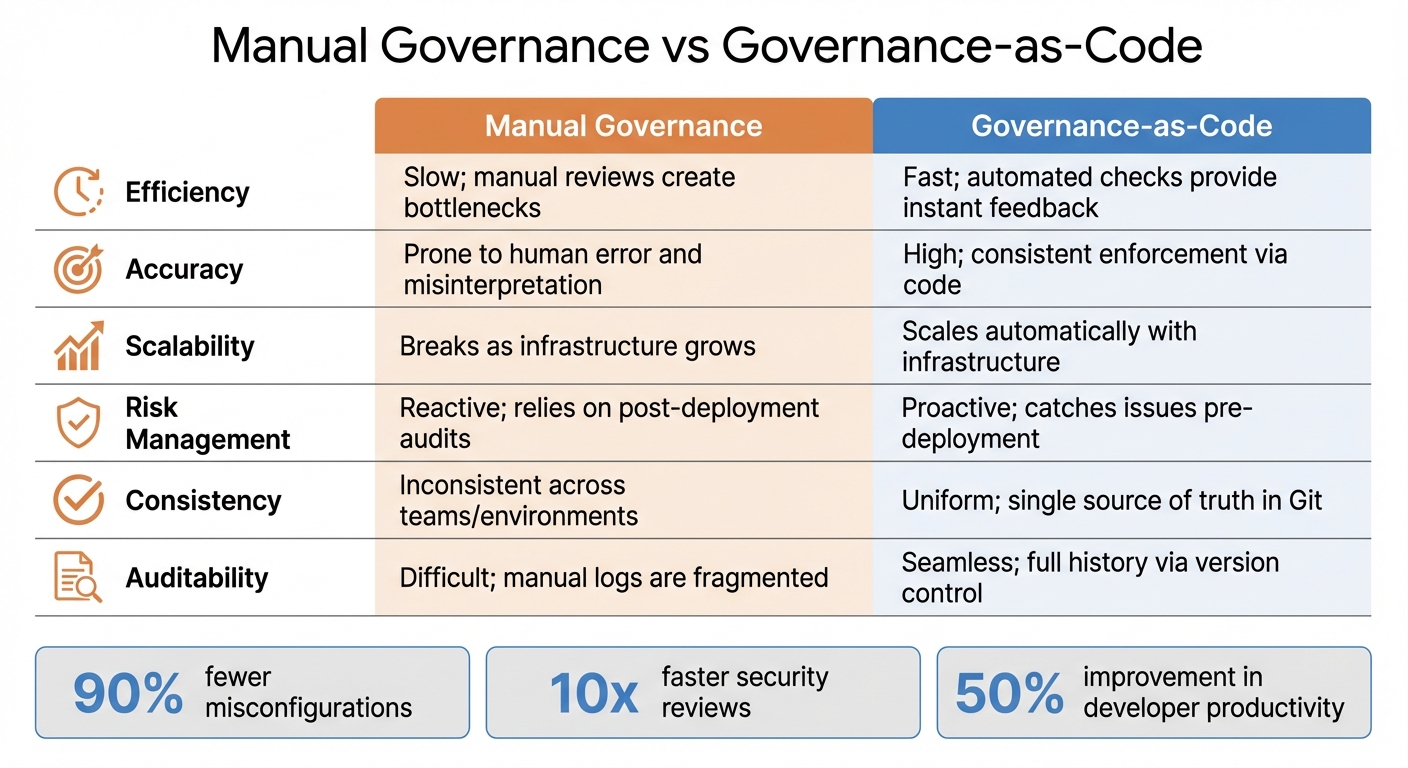 {Manual Governance vs Governance-as-Code Comparison}
:::
{Manual Governance vs Governance-as-Code Comparison}
:::
Governance-as-Code offers measurable improvements to cloud operations, starting with faster approvals and evolving into a new way for teams to collaborate and scale infrastructure effectively.
Consistency and Accuracy
Traditional governance often relies on memory, scattered documentation, and subjective interpretations of rules. This approach makes it tough to maintain consistency, especially when applying policies across environments like development, staging, and production. Governance-as-Code eliminates this guesswork by encoding policies once and ensuring they’re enforced uniformly everywhere [1][9].
The impact on accuracy is profound. For instance, when MediaMarkt introduced policy-as-code, they observed:
All our departments, like governance and security and our central platform team, can now write policies as code that define what is allowed and what isn't. All users immediately see if their code is compliant or not. Also included is cost estimation.[2]
This immediate feedback loop removes ambiguity. Developers no longer need to sift through lengthy compliance documents or wait for manual reviews - they know instantly whether their infrastructure meets the set standards.
Another key advantage is the prevention of configuration drift, where infrastructure gradually deviates from its intended state. By validating every change against predefined policies, organisations maintain consistent security standards over time, even as teams evolve or organisational structures shift [1][9].
Collaboration and Scalability
Traditional governance often creates friction between security and development teams. Governance-as-Code bridges this gap by providing a shared framework, enabling both teams to collaboratively manage and version control policies [1].
This collaborative model scales effortlessly. As Divine Odazie from Spacelift puts it:
Governance as code works the same whether you're managing ten resources or 10,000. Manual processes fall apart as infrastructure grows, but automated enforcement keeps up with whatever pace your team needs.[1]
The scalability of Governance-as-Code also extends to multi-cloud environments. For example, organisations using tools like Open Policy Agent can write a single policy and apply it consistently across platforms like AWS, Azure, and Google Cloud. This flexibility becomes increasingly important for hybrid or multi-cloud strategies [1].
When Asian Development Bank implemented Sentinel policies with Terraform, their security team noted:
Sentinel is going to be that bouncer in a club that allows you to go in or out. For us, that gives us 100% confidence that anything provisioned by Terraform is following our security postures.[2]
Manual Governance vs Governance-as-Code
The contrast between traditional governance and Governance-as-Code becomes clear when comparing operational aspects:
| Factor | Manual Governance | Governance-as-Code |
|---|---|---|
| Efficiency | Slow; manual reviews create bottlenecks [1] | Fast; automated checks provide instant feedback [8] |
| Accuracy | Prone to human error and misinterpretation [7] | High; consistent enforcement via code [1] |
| Scalability | Breaks as infrastructure grows [1] | Scales automatically with infrastructure [9] |
| Risk Management | Reactive; relies on post-deployment audits [9] | Proactive; catches issues pre-deployment [9] |
| Consistency | Inconsistent across teams/environments [7] | Uniform; single source of truth in Git [8] |
| Auditability | Difficult; manual logs are fragmented [1] | Seamless; full history via version control [8] |
Governance-as-Code also provides a financial safety net. By catching costly misconfigurations early, organisations avoid unnecessary expenses. A Petco engineer highlighted this:
You need resource guardrails in the cloud because you don't want your CFO coming down to your office saying, 'Why did you deploy 50 R5.16XLs? We just missed our quarterly objectives because of your deployment.'[2]
Additionally, Governance-as-Code ensures fully automated audit trails [4]. Every policy decision is documented as a version-controlled commit, detailing who made changes, when, and why. This transforms compliance audits from time-consuming tasks into straightforward reviews of Git history [1][8].
These transformative benefits underline Governance-as-Code's power in reshaping cloud policy enforcement, setting the stage for exploring tools and implementation strategies.
Tools for Governance-as-Code
Automating governance transforms it from a manual process into a dependable safety net. Deciding between policy-as-code frameworks and cloud-native tools depends on factors like your team's expertise, infrastructure strategy, and how you plan to enforce governance.
Policy-as-Code Tools
Open Policy Agent (OPA) is a flexible policy engine used for Kubernetes, CI/CD pipelines, and Terraform. As a Cloud Native Computing Foundation project, it employs a declarative policy language called Rego to define rules before infrastructure changes hit production [11][12]. Netflix uses OPA to manage authorisation across its microservices, enhancing security and speeding up feature rollouts by automating policy decisions [4].
HashiCorp Sentinel integrates with Terraform Enterprise, Vault, and Consul, offering fine-tuned guardrails through a simple, human-readable policy language [13][4]. For example, AGL Energy, a major renewable energy provider in Australia, uses Sentinel alongside Terraform Enterprise to automate compliance checks, ditching manual reviews while maintaining deployment speed [14]. As policyascode.dev explains:
Terraform answers the question, 'What do we want to build?' while OPA answers the question, 'Is what we want to build allowed?'[11]
Kyverno takes a Kubernetes-native approach, letting teams manage policies as YAML files without needing to learn Rego or Sentinel [4]. NVIDIA DGX Cloud uses Kyverno to enforce Pod Security Standards for AI workloads, improving security while reducing operational complexity [4]. For teams already proficient with Kubernetes manifests, Kyverno simplifies the process by removing the need for additional learning.
Cloud Custodian focuses on real-time infrastructure scanning and automatic remediation of non-compliant resources using serverless functions [3]. This tool excels in detecting and addressing issues as they arise, rather than waiting for periodic audits.
| Tool | Language | Primary Strength | Best For |
|---|---|---|---|
| OPA | Rego (Declarative) | Multi-cloud compatibility; works with Kubernetes, CI/CD, APIs | Organisations with diverse setups |
| Sentinel | Sentinel (Imperative) | Seamless integration with HashiCorp tools | Teams using Terraform Cloud/Enterprise |
| Kyverno | YAML | Easy adoption; native Kubernetes support | Kubernetes-focused teams |
| Cloud Custodian | YAML | Real-time scanning and self-healing capabilities | Teams needing responsive controls |
While policy-as-code tools are versatile across platforms, cloud-native tools often excel within their specific ecosystems.
Cloud-Native Tools
AWS Config and Azure Policy offer governance tailored to their respective cloud platforms. These tools evaluate resource configurations against compliance standards, monitor runtime states, and can trigger automatic fixes when resources deviate from desired settings [9].
Azure Policy, for instance, includes features like deployIfNotExists and modify, enabling automated corrections that external policy-as-code tools often can't replicate directly [5]. Microsoft highlights this as a key advantage:
By making Azure Policy validation an early component of the build and deployment process, the application and operations teams discover if their changes are behaving as expected long before it's too late[5].
The main downside is portability. Unlike OPA or Sentinel, which work across multiple providers like AWS, Azure, and Google Cloud, cloud-native tools are tied to their ecosystems [9]. However, for organisations focused on a single cloud provider, the deep integration often outweighs the lack of flexibility. For hybrid or multi-cloud strategies, combining policy-as-code tools for CI/CD pipelines with cloud-native tools for runtime monitoring can provide robust coverage.
To start, use non-blocking policies, such as enforcing resource tagging or preventing public S3 buckets, to build trust in the system before applying stricter controls [9]. Organisations using policy-as-code report benefits like 90% fewer misconfigurations, 10× faster security reviews, and a 50% boost in developer productivity [4]. These tools create a strong foundation for embedding automated governance into your CI/CD workflows.
How to Implement Governance-as-Code
Transitioning from manual governance to automated policies can seem daunting, but breaking it into three stages makes the process manageable: defining policies as code, embedding enforcement into deployment workflows, and maintaining continuous oversight of your infrastructure.
Define Policies in Code
Start by identifying critical controls from frameworks like SOC 2, HIPAA, or PCI DSS. Focus on 10–15 high-risk policies, such as preventing public S3 buckets or enforcing encryption for RDS databases [15]. Document these policies in an inventory and translate them into technical rules. For instance, a HIPAA encryption requirement might become a specific rule ensuring that RDS instances have the storage_encrypted parameter set to true [15].
Write these policies in human-readable formats like Rego, Sentinel, or YAML. This makes collaboration across teams easier [4]. Store the policy code in a Git repository, using pull requests for peer reviews to ensure visibility and auditability [15]. To avoid errors, create unit and integration tests to validate the logic of your policies [8].
When deploying new policies, start in audit
or observe
mode. This logs violations without blocking deployments, giving teams time to adapt. Once you’re confident in the policies, switch to enforce
mode for stricter compliance.
With your policies clearly defined, the next step is to integrate them into your delivery workflows.
Integrate with CI/CD Pipelines
Link your version control system, such as GitHub, to your governance platform to create a GitOps workflow. This setup ensures that every pull request triggers an automated policy check. For example, a terraform plan can be scanned for compliance before any infrastructure changes are merged [10]. This shift-left
approach catches violations early, when fixes are easier and less costly.
Make sure your policy engine provides clear, actionable error messages. Instead of vague notifications like Policy failed
, aim for specifics: S3 bucket 'data-archive' violates policy PCI\_DSS\_3.4.1: encryption at rest is required. Add a `server_side_encryption_configuration` block to your Terraform code
[1]. This clarity helps developers resolve issues quickly.
While CI/CD integration prevents new violations, continuous monitoring ensures compliance after deployment.
Monitor and Audit Compliance
Automated governance needs to extend beyond deployment. Preventative controls in CI/CD pipelines are essential but won’t catch everything. Manual changes, configuration drift, and runtime events can still lead to non-compliance. Use tools like AWS Config or Cloud Custodian for real-time monitoring to detect infrastructure that deviates from your policies [1][3]. For minor issues, such as missing tags or publicly accessible storage, automated remediation using serverless functions can resolve problems efficiently [1][3].
Store logs in secure, tamper-proof locations to maintain an evidence trail for audits [15]. Centralise compliance data in dashboards to provide continuous oversight and make audits easier [15][16]. Organisations that adopt these practices can achieve fully automated audit trails and even see a 50% improvement in developer productivity [4].
Best Practices for Automating Cloud Policies
Successfully implementing governance-as-code involves more than just picking the right tools. The way you manage, test, and collaborate on policies plays a major role in determining whether you streamline productivity or create unnecessary friction.
Version Control for Policies
Treat policies as code by using a dedicated Git repository with a clear structure and pull request reviews. This ensures a complete audit trail of every change - tracking what was modified, by whom, when, and why [10] [17]. All updates should go through pull requests, allowing security, compliance, and development teams to review changes before they are merged [1] [8].
To catch issues early, use pre-commit hooks to validate policy logic on developers' machines before committing code [4]. When rolling out new policies, start them in warn
or audit
mode. This allows teams to monitor the impact without disrupting deployments. It's also smart to define clear merge controls and, when needed, separate repositories by environment (e.g., development, staging, production). This reduces the risk of a single configuration error affecting multiple systems.
Once version control is in place, focus on integrating testing early in the development process.
Shift-Left Testing
Policy checks should be part of your CI/CD pipelines to identify violations early. This approach can significantly reduce remediation costs - by up to 100× - compared to fixing issues later in the development cycle [6] [18]. Writing unit tests for policies ensures their accuracy and avoids deployment delays. Some organisations have even shortened their deployment approval times from five business days to just 15 minutes by automating policy checks [6].
Fixing issues later in the software development life cycle (SDLC) can cost up to 100 times more than addressing them early.- Anna Shcherbak, Senior Security Systems Engineer, EPAM [19]
By catching problems early, you can create a smoother process for collaborative reviews.
Cross-Team Collaboration
Once version control and early testing are in place, collaboration becomes key to streamlining automated governance. Pull requests act as a shared platform where security, compliance, and development teams can review and approve policy changes together [1] [8] [10]. Using human-readable policy languages like Sentinel or Rego makes it easier for non-technical stakeholders - such as those in finance or legal - to understand and contribute to policy discussions [2].
Policies can be built and reviewed in collaboration with stakeholders from compliance, finance, cybersecurity, and other departments, but in order to do that, the policy language must be simple to read and write by individuals with a limited background in programming.- HashiCorp [2]
Help developers resolve issues independently by providing clear, actionable error messages. For instance, instead of a generic Access Denied
message, offer guidance like S3 bucket needs encryption; add the following block to your Terraform configuration.
Additionally, establish tiered approval levels for exceptions based on the associated risk.
Hokstad Consulting's Governance-as-Code Services
Hokstad Consulting offers governance-as-code solutions designed to seamlessly integrate into your existing cloud setup. By leveraging established best practices, they provide businesses with the tools and expertise needed to embed automated policies into operational cloud environments. Their approach helps optimise cloud infrastructure while ensuring full compliance with UK regulatory requirements.
Custom Automation Solutions
Hokstad Consulting specialises in tailored automation solutions that align with your current cloud workflows. These solutions are designed to integrate directly with your existing tools and processes, embedding critical policy checks at key stages such as pre-commit, build, and deployment.
By automating repetitive tasks that often bog down development teams, Hokstad Consulting helps reduce workload and improve efficiency. This allows your engineers to spend more time on innovation and less time on compliance-related tasks. These custom solutions also pave the way for broader initiatives in DevOps and cloud cost management.
DevOps Transformation and Cloud Cost Optimisation
When governance-as-code is paired with DevOps transformation and cost engineering, its benefits become even more pronounced. Hokstad Consulting’s approach integrates automated governance into their cloud cost engineering services, delivering cloud cost reductions of 30-50%. This is achieved through automated tagging policies, budget enforcement rules, and right-sizing policies that prevent unnecessary resource allocation.
| Service Area | Governance-as-Code Integration | Main Benefit |
|---|---|---|
| Cloud Cost Engineering | Automated tagging, budget enforcement, and right-sizing | 30-50% reduction in cloud spend |
| DevOps Transformation | Policy checks embedded in CI/CD pipelines | Faster, compliant, and more reliable deployments |
| Custom Automation | Bespoke tool adjustments and task automation | Reduced developer workload and improved efficiency |
| Compliance Services | Codified UK regulatory rules (GDPR, FCA, NHS) | Automated audit trails and reduced regulatory risk |
For UK-based businesses, Hokstad Consulting ensures governance policies align with local regulations, including UK GDPR, FCA guidelines, NHS Data Standards, and ISO 27001. By codifying these rules into your infrastructure, they create automated audit trails and evidence packs that simplify regulatory compliance. This turns what is often a laborious, manual process into an automated system that runs alongside your deployments. Combining automated governance with cost and compliance management strengthens your cloud strategy while keeping you aligned with UK standards.
Conclusion
Governance-as-Code is reshaping cloud management by replacing manual reviews with automated policy checks. The results speak for themselves: organisations report 90% fewer misconfigurations, 10x faster security reviews, and 50% improvements in developer velocity after adoption [4]. By catching issues early in the CI/CD pipeline instead of in production, this approach reduces both risks and remediation costs while speeding up deployment cycles.
One of its standout features is its scalability. Whether managing ten resources or 10,000, the same governance logic applies seamlessly. This method also creates automated, version-controlled audit trails, making compliance reporting for regulations like GDPR much simpler [4]. Developers benefit from instant feedback, eliminating traditional operational bottlenecks.
For UK organisations facing rising cloud costs and strict compliance requirements, Governance-as-Code provides a practical solution. When integrated with FinOps practices like mandatory tagging and budget enforcement, it can cut cloud expenses by 30–50% while maintaining high security standards. Starting with impactful rules - such as blocking public S3 buckets or enforcing resource tagging - allows teams to ease into the process before broadening their coverage.
As MediaMarkt highlighted:
All our departments, like governance and security and our central platform team, can now write policies as code that define what is allowed and what isn't. All users immediately see if their code is compliant or not[2].
This quote perfectly captures the essence of embedding automated, transparent governance into every aspect of cloud management.
The future of cloud operations lies in treating compliance and security as code rather than static documentation. Organisations that embrace Governance-as-Code now are setting the stage for scalable, cost-efficient, and audit-ready operations in the years to come.
FAQs
Where should we enforce governance-as-code: CI/CD, runtime, or both?
Governance-as-code needs to be applied at both the CI/CD pipeline stage and during runtime to ensure thorough compliance and security. In the CI/CD pipeline, policies play a crucial role in validating configurations early on, catching misconfigurations before they make it to deployment. Meanwhile, runtime enforcement continuously monitors for configuration drift and ensures policies are followed in ever-changing environments. By integrating both approaches, you create a layered defence that minimises risks and ensures policies remain consistent throughout the entire lifecycle.
How can we start governance-as-code without blocking deployments?
To ease into compliance without disrupting workflows, start with a phased approach. Begin by using non-blocking policies, such as audit or monitoring tools, which flag compliance issues while still allowing deployments to proceed. Once your team is familiar with these processes, introduce preventative policies. Configure these to issue warnings rather than block deployments outright.
As your team's confidence builds, you can move towards stricter enforcement policies. Adding automation tools for continuous compliance checks and real-time alerts can seamlessly integrate governance into your CI/CD pipeline. This ensures compliance becomes a natural part of your workflow without hindering deployment progress.
How do we prove compliance with automated audit trails?
Compliance is achieved by consistently creating and maintaining evidence through policy-as-code workflows. This approach relies on automated testing and real-time scanning to confirm and document that regulations and policies are being followed. These methods help ensure compliance is maintained with minimal need for manual intervention.