
If I had to boil it down to one line: Flux is often the better fit when I want Kubernetes-native control and Helm-led mesh releases, while Argo CD is often the better fit when I want one clear place to see sync state, approvals and rollout order.
This comparison is about running a service mesh through GitOps day after day, not just installing it once. I’m looking at the parts that usually cause trouble:
- drift control after manual cluster edits
- dependency order for CRDs, control plane, gateways, routes and policies
- Helm handling for mesh charts and add-ons
- policy and approval controls for production changes
- team overhead for a small UK platform team of 2–3 engineers
A service mesh change can fail in three common places: drift, ordering and release handling. That is why the choice is less about feature lists and more about how your team works at 02:00 when a gateway fails, a CRD is missing, or a manual kubectl change knocks production out of line.
Here’s the short version:
- I’d look at Flux first if you prefer CRDs, CLI-led work and
HelmReleaseobjects - I’d look at Argo CD first if you want one application view, sync waves and manual sync control
- In both cases, I would treat admission policy, RBAC, Git approvals and audit records as part of the setup, not optional extras
- I would also keep one rule fixed: one mesh resource must have one reconciler
::: @figure 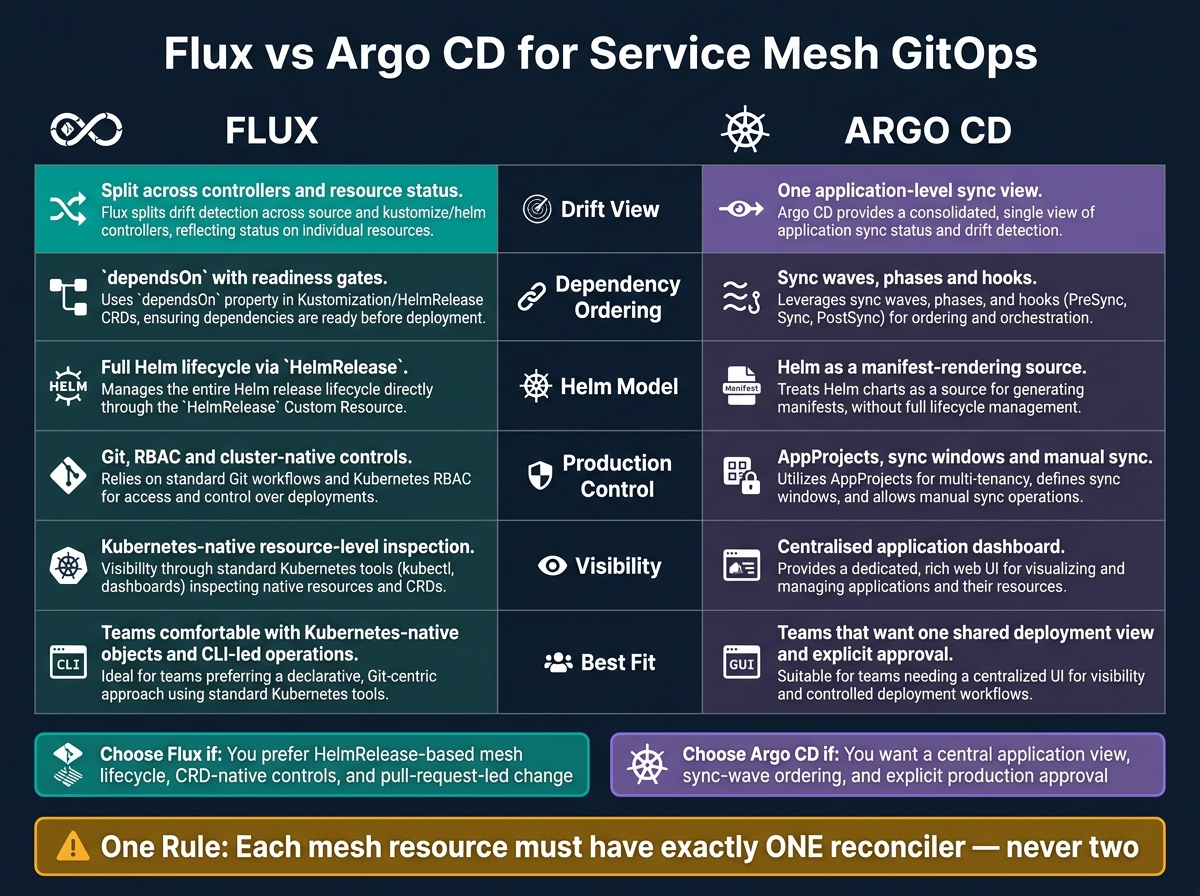 {Flux vs Argo CD for Service Mesh GitOps: Side-by-Side Comparison}
:::
{Flux vs Argo CD for Service Mesh GitOps: Side-by-Side Comparison}
:::
Argo CD vs. Flux CD: Which GitOps tool actually wins?
Quick Comparison
| Criteria | Flux | Argo CD |
|---|---|---|
| Drift view | Split across controllers and resource status | One application-level sync view |
| Drift fix | Reconcile back to Git; Helm drift needs config | Automated sync and self-heal are opt-in |
| Dependency order |
dependsOn with readiness gates |
Sync waves, phases and hooks |
| Helm model | Helm lifecycle through HelmRelease
|
Helm mainly as a render source |
| Production control | Git, RBAC and cluster controls | Git plus AppProjects, sync windows and manual sync |
| Best fit | Teams comfortable with Kubernetes-native objects | Teams that want one shared deployment view |
If I were making the call for a UK team, I would not pick from docs alone. I’d score both tools, then run the same proof of concept on each: install the mesh, upgrade it, force drift, block a dependency, and test rollback. The one that gives the clearest failure signals, the least out-of-hours effort and the cleanest audit trail is usually the right choice.
That’s the lens for the rest of the article.
2. Flux vs Argo CD: workflow-by-workflow comparison
The same mesh change can break in three places: drift, ordering, and release management.
Drift control and recovery from manual cluster changes
If an operator edits an Istio VirtualService or AuthorizationPolicy with kubectl, both platforms spot the drift. The difference is in how they show it and how they fix it.
Flux's Kustomize controller uses a server-side apply dry run to detect drift. Flux's Helm controller compares rendered resources with live state when drift detection is turned on.[15][4][10] Argo CD compares desired manifests from Git with the live cluster state and marks the Application as Synced or OutOfSync.[1][11] In practice, Argo CD gives you one application-level view of the mismatch, while Flux spreads status across controller views and resource status.
For production mesh resources like ingress gateways, traffic policies, and authentication rules, manual review is the safer default. Auto-remediation fits better in dev or for tightly scoped low-risk resources. From there, you can expand once you've checked the drift patterns and know what tends to change.
Intentional differences should stay narrow. Argo CD's ignoreDifferences accepts JSON pointers or JQ expressions for specific fields.[12][13] Flux supports similar field-level exclusions in Helm drift detection.[9] The safest approach is simple: ignore ONLY the exact field you mean to ignore, note the reason in Git, and make sure security-sensitive fields still fire alerts.
| Area | Flux | Argo CD |
|---|---|---|
| Detection method | Server-side apply dry run via Kustomize controller [15] | Desired-versus-live manifest comparison; marks the Application Synced or OutOfSync [1][11]
|
| Auto-remediation | Controller-led reconciliation; Helm drift correction needs explicit configuration [4][10] | Enable automated sync and selfHeal; otherwise manual approval stays in place [1][6]
|
| Intentional differences | Field-level exclusions in controller and Helm drift configuration [9] |
ignoreDifferences with JSON pointers or JQ expressions [12][13]
|
| Production safety | Detect-only by default | Automated sync is opt-in |
| Recovery workflow | Status is split across Flux resources and controller events | Centralised application sync status and diff view |
Once drift is under control, the next place things can go wrong is ordering.
Dependency ordering for CRDs, mesh components and policies
A service mesh rollout is a chain. CRDs, control plane, gateways, trust material, and policies need to land in the right order. Get the stages wrong and you may end up with resources that exist on paper but aren't usable yet.
Flux models this chain with Kustomization.spec.dependsOn. A gateway Kustomization can wait until the control-plane Kustomization is ready before moving ahead.[9] That point about readiness matters more than simple object creation. A control-plane Deployment that exists but isn't healthy yet is not a safe dependency gate.
Argo CD uses sync waves and sync phases. Wave numbers are integers. Lower values run first, and negative values can run before the default wave zero.[2] A common mesh sequence might put CRDs at wave -2, the control plane at -1, gateways at 0, routes at 1, and policies at 2. PreSync and PostSync hooks can run validation or smoke tests at phase boundaries, though hooks bring extra operational work of their own.[14]
Flux leans on dependency links between reconcilers. Argo CD leans on ordering sequences. For a mesh rollout, that's not a small detail. A gateway applied right after a control-plane wave finishes may still be risky if the control plane hasn't finished initialising.
| Dependency concern | Flux | Argo CD |
|---|---|---|
| Ordering feature |
Kustomization.spec.dependsOn; HelmRelease dependencies are also supported [9]
|
Sync phases, argocd.argoproj.io/sync-wave annotations and hooks [2][14]
|
| Readiness handling | A dependent object waits until its prerequisite is ready according to controller status | Resources move ahead according to ordering and health assessment |
| Failure behaviour | A failed prerequisite blocks dependent reconciliation and exposes status through Flux events | A failed hook, unhealthy resource or failed wave can stop sync and leave the Application out of sync |
| Cross-component coordination | Repository-structured dependency graph | Separate Applications coordinated with sync waves and hooks |
| Staged-rollout suitability | Strong for Kubernetes-native dependency graphs | Strong for application-level sequencing and release control |
With ordering set, Helm release handling becomes the next call.
Helm support for mesh charts and add-ons
For mesh add-ons, release mechanics matter just as much as ordering.
Flux's HelmRelease is a managed release object: the Helm controller owns installation, upgrade, and remediation for that release.[4][9] Argo CD uses Helm mainly as a manifest-rendering source, then syncs the rendered resources as an Application.[7] For mesh charts such as Istio components, this means Flux exposes Helm lifecycle controls straight in the HelmRelease spec, while Argo CD keeps the main control point in the Application model.
A safe pattern is to treat CRDs as a separate rollout, pin chart versions, and test upgrades across at least two chart versions in a non-production cluster before promotion. Argo CD supports the Helm crd-install convention and can skip CRD installation when CRDs are managed separately.[7] Flux gives you HelmRelease dependency controls that can stage the same rollout.[9] Even then, CRD schema changes still need careful sequencing and validation.
| Area | Flux | Argo CD |
|---|---|---|
| Chart lifecycle control | Declarative HelmRelease; controller manages install, upgrade and remediation [9]
|
Helm renders manifests; Argo CD synchronises the resulting resources [7] |
| CRD handling | Model CRDs as an explicitly ordered prerequisite; test upgrade semantics carefully [9] | Use Argo CD's CRD handling; verify chart hook and CRD upgrade behaviour [7][8] |
| Rollback | Use Helm release history and a Git revert, subject to chart and CRD compatibility | Revert the source revision and synchronise, subject to chart and CRD compatibility |
| Values management | Values can be declared in HelmRelease and sourced from configured Kubernetes or Git-managed inputs |
Values, files and parameters are supplied to the Helm source configuration |
| Promotion workflow | Pin the chart version in HelmRelease and promote the Git change through environments |
Pin the chart version in the Application source and promote the corresponding Git configuration |
| Operational overhead | More Helm-specific configuration, but a direct release model | More Application and source configuration, but a strong central view across environments |
3. Policy, ownership and operational controls
Once release ordering is set, the next issue is simpler to name but harder to handle: who gets to change it.
Policy enforcement and approval controls
Flux and Argo CD both reconcile Kubernetes state. But that alone doesn't make production safe. For gateways, routes and authorisation policies in particular, you also need protected Git branches, CI checks, an admission policy engine such as Kyverno or OPA Gatekeeper, least-privilege RBAC and a clear approval path. GitOps is one control in that chain, not the whole chain.
Flux leans on Kubernetes-native controls such as RBAC, impersonation, namespace scoping and suspend/resume [3]. That works well, but there’s a catch: its default installation can give controllers broad permissions. Small teams should trim those down early.
Argo CD adds deployment guardrails above Kubernetes permissions. AppProjects, project roles and sync windows can limit which repositories, clusters, namespaces and actions are allowed [16][17].
For UK organisations with change-management duties, production approval should happen before the production config is updated. It shouldn’t rest only on an operator clicking sync. The change record should include:
- the change reference
- reviewer identities
- the commit SHA
- policy check results
- deployment time
- the rollback decision
| Control area | Flux | Argo CD |
|---|---|---|
| Native deployment guardrails | Kubernetes RBAC, impersonation, suspend/resume and namespace scoping | AppProjects, project roles, sync windows and manual sync options |
| Approval point | Protected Git promotion, CI gates and external change tooling | Sync windows, manual sync and project-role restrictions |
| Auditability | Git history, controller events and Kubernetes audit logs | Sync history, application events and Kubernetes audit logs |
| Key risk | Broad default controller permissions need explicit reduction | Overly broad project permissions can permit unintended sync or deletion |
Admission enforcement acts as the backstop. It stops unsafe mesh resources - a wildcard gateway, a permissive AuthorizationPolicy, weak TLS - from landing in the cluster no matter how they arrive: Flux, Argo CD, Helm, an operator or a human administrator [18][19].
Visibility, troubleshooting and overlapping ownership risks
Guardrails only help if teams can see why reconciliation failed after drift, ordering issues or release failures.
Flux and Argo CD surface those failures in different ways. With Flux, troubleshooting usually starts at the relevant Kustomization, HelmRelease or source object. Check its status, conditions, events, logs and current revision. With Argo CD, the usual starting point is the Application dashboard or CLI. From there, check sync status, health, the resource tree, diffs and history [11][20].
Put plainly, Argo CD fits application-level tracing well. Flux fits Kubernetes-native troubleshooting well.
A key operational risk in a service mesh GitOps setup is overlapping ownership. A mesh resource should have one reconciler, not two. If the same object is managed by more than one reconciler, things can go wrong fast: reconciliation loops, flip-flopping state, field-manager conflicts, failed upgrades or policies that look compliant in Git but are quietly overwritten in the cluster.
| Ownership hotspot | Typical failure mode | Mitigation |
|---|---|---|
| Flux and Argo CD manage the same object | Reconciliation loop or flip-flopping state | Assign the object to one platform; exclude it everywhere else |
| GitOps controller and mesh operator both manage fields | Operator defaults overwrite Git-managed values | Document delegation; separate fields or resources explicitly |
| Helm release and raw manifests overlap | Upgrade removes or replaces manually declared resources | Choose one Helm owner; keep chart values in its single source of truth |
| Shared gateway managed by several teams | Conflicting routes, TLS settings or annotations | Platform team owns the gateway; publish a clear interface for consumers |
| Application teams edit mesh objects directly | Manual drift is reverted or creates an emergency inconsistency | Restrict RBAC; provide an approved pull-request or break-glass path |
For a small platform team, the cleanest split is at resource and namespace level. The platform team should own mesh installation, CRDs, control-plane configuration, ingress gateways and cluster-wide policy defaults. Application teams should own their workloads, plus tightly scoped routing or authorisation resources inside approved namespaces.
To make ownership easy to spot, use labels, repository paths and CODEOWNERS entries. And one rule should stay non-negotiable: never let more than one reconciler manage the same mesh resources.
Those controls shape which platform is easier for a small team to run day to day.
4. Which platform fits a small UK platform team?
Once ownership boundaries are clear, the next step is simpler: pick the control model that matches how your team actually works.
Setup, operations and support: a practical comparison
Neither platform is easier in every case. The better choice is the one that lines up with your team's day-to-day way of working.
| Area | Flux | Argo CD |
|---|---|---|
| Initial setup | Install modular controllers; configure source, Kustomize and Helm controllers as needed | Set up the central application model and register target clusters |
| Multi-cluster administration | Per-cluster reconciliation via Git or kubeconfig references | Central instance with registered clusters and ApplicationSet resources |
| Staff familiarity | Better fit for engineers comfortable with Kubernetes custom resources and CLI-led operations | Better fit for mixed teams who need a shared view of deployment state |
| Operational data location | Verify hosting locations for Git, registries, logs and backups | Same requirement applies |
| Recovery-time targets | Per-cluster controllers reduce shared-dependency risk; each cluster still needs its own health monitoring | Central control plane simplifies administration but requires its own recovery plan |
For UK firms handling regulated data, check where Git, registries, logs and backups are hosted. Then record that against UK GDPR and your internal policy.
It also helps to pin down support arrangements before you commit. Write down response times, escalation paths and named on-call cover. That sounds basic, but it often decides whether Flux or Argo CD feels lighter once the system is live.
When to choose Flux and when to choose Argo CD
Choose Flux if your team leans towards Kubernetes-native operations, pull-request-led change, and HelmRelease-based mesh lifecycle control.
Choose Argo CD if you want a central application view, sync-wave ordering and explicit production approval.
The big rule is straightforward: give each resource one owner. Don't let overlapping reconcilers target the same mesh objects. If two controllers push at the same thing, they can overwrite each other or leave you with drift reports that send people in circles.
| Team situation | Stronger fit | What to validate |
|---|---|---|
| Engineers prefer Kubernetes-native controllers and CLI-led operations | Flux | Controller observability and incident-diagnosis speed |
| Helm is the primary packaging mechanism for mesh components | Flux |
HelmRelease dependency ordering, upgrade and rollback behaviour |
| Mixed teams need a shared application health and sync view | Argo CD | Control-plane availability and access-management overhead |
| Production changes require explicit approval or maintenance windows | Argo CD | Audit trail completeness and emergency-change path |
| Several clusters need consistent promotion patterns | Either | Compare ApplicationSet against Flux multi-cluster repository patterns |
| Limited out-of-hours engineering cover | Either, based on proof of concept | Prefer clearer alerts, simpler rollback and tested recovery procedures |
| Strict recovery-time objectives | Either, with tested architecture | Run failure drills for controller loss, repository unavailability and cluster loss |
Use these points to score both tools before moving to the final decision framework.
How Hokstad Consulting can support implementation
Hokstad Consulting can help define the operating model, ownership boundaries, recovery runbooks and automation needed for a Flux or Argo CD rollout.
In practice, that could mean mapping your current mesh and Git repositories, designing the chosen operating model, automating validation and promotion steps, and producing a decision record with cost in pounds sterling.
Keep the final platform choice with your team. The value of the engagement is in getting residency, auditability and recovery targets written down clearly.
5. Decision framework and conclusion
Score both platforms against your mesh requirements
Now that the day-to-day trade-offs are on the table, pick based on evidence, not gut feel. For a small UK platform team, the best fit is usually the one that matches your approval process, on-call cover and audit needs.
A weighted scorecard keeps the decision grounded. Score each platform from 1 to 5, multiply by the weight, then add up the totals.
| Criterion | Weight | What to look for |
|---|---|---|
| Drift correction needs | 15% | Automatic healing vs manual sync approval |
| Approval and segregation of duties | 15% | Who may approve, merge and trigger production changes |
| Helm-led deployments | 10% | Chart lifecycle, CRD handling, rollback behaviour |
| Dependency complexity | 10% | Ordered installation of CRDs, control plane, policies |
| Number of clusters and environments | 10% | Per-cluster controllers vs central control plane |
| Status visibility needs | 10% | Single view vs resource-level inspection |
| Kubernetes expertise | 10% | CLI-led vs UI-led operations |
| Rollback expectations | 10% | Git revert vs Helm rollback; audit evidence |
| Tolerance for controller overhead | 5% | Operational overhead of modular components |
| Admission and change-control maturity | 5% | Admission controls, repository protection, emergency paths |
For instance, a small team running two clusters with strong Kubernetes skills might give Flux a 5 for Kubernetes-native operation and a 4 for controller overhead. Argo CD, on the other hand, might get a 5 for status visibility and manual sync control. The weighted total is the part that counts.
Run a proof of concept before committing
Use the scorecard to trim the shortlist. Then use the PoC to see how each platform behaves with your actual mesh setup.
Run both platforms against the same repo, chart versions, namespaces, secrets model and cluster version in a small non-production cluster. Use real mesh parts, not a stripped-down demo. That’s where the rough edges usually show up.
- Install and upgrade the mesh control plane - record deployment time and time to healthy.
- Deploy a gateway and route, then apply authentication and authorisation policies - check ordering and failure handling.
- Make a manual cluster change - measure detection time, recovery path and audit evidence clarity.
- Withhold a required CRD or policy dependency - verify that the platform retries safely and reports the cause clearly.
- Test rollback both ways - perform a Git revert and a Helm chart downgrade, then confirm rollback completion time, failed reconciliation count and the evidence available to an auditor.
Look beyond the raw pass/fail result. Review auditability, notifications, logs and operator workload as well. A platform can look fine in a lab, then turn into hard work at 02:00 when something drifts or a dependency fails.
Key takeaways
Flux suits teams that want Kubernetes-native reconciliation and declarative Helm operations.[21][5] Argo CD suits teams that want application-level visibility and explicit sync control.[2][6][1]
Policy enforcement, ownership boundaries, repository protection and admission controls matter just as much as the GitOps product itself. If ownership is fuzzy, you can end up with competing controllers and unsafe changes.
A like-for-like proof of concept using real mesh parts - control plane, gateways, routes, authentication, authorisation, drift, dependency failure and rollback - is the safest basis for the final decision.
FAQs
Which tool is easier to run for a 2–3 person platform team?
For a 2–3 person platform team, Argo CD is usually easier to run. Its clear web interface makes syncing, rollbacks, and monitoring simpler, and its centralised model gives small teams one place to see what’s going on.
Flux is powerful and efficient, but its CLI-first, decentralised setup can bring a steeper learning curve and more day-to-day overhead for smaller teams.
How should I split ownership of mesh resources between teams?
Use a hierarchical model that balances centralised governance with team autonomy. In practice, that means platform teams own mesh-wide settings with higher risk, such as mTLS and EnvoyFilters, while application teams handle service-specific config in their own namespaces.
Git CODEOWNERS is a simple way to enforce that split. Shared, mesh-wide manifests can require platform approval, while namespace-specific changes go through the application team. That keeps security and stability under control without slowing down team independence.
What should I test in a proof of concept before choosing?
Test how each tool handles your RBAC needs, especially if you rely on layered or fine-grained permissions. It’s also worth checking whether your repository setup surfaces dependency or sequencing problems once you apply it to a test cluster.
Use dry runs or linting to validate manifests before anything goes live. Then look at the practical side: how well the tool fits into your current CI/CD workflows, what your team can use with confidence, and what your governance model demands, including audit trails and policy enforcement for UK GDPR compliance.