
In private cloud environments, APIs are essential for managing infrastructure, automating processes, and connecting systems. Choosing between custom APIs and off-the-shelf APIs impacts security, compliance, and maintenance. Here's a quick breakdown:
- Custom APIs: Offer full control over security, compliance, and data residency. They can be tailored to meet strict UK regulations like GDPR but require ongoing maintenance and expertise.
- Off-the-Shelf APIs: Provide pre-built security features and faster deployment. However, they lack customisation, may introduce supply chain risks, and depend on vendor updates.
Key Takeaways:
- Custom APIs: Best for organisations needing precise control and compliance, especially in regulated industries.
- Off-the-Shelf APIs: Suitable for faster implementation but may limit flexibility and security oversight.
Quick Comparison:
| Feature | Custom APIs | Off-the-Shelf APIs |
|---|---|---|
| Security Control | High; tailored to specific needs | Limited; vendor-defined features |
| Compliance | Built-in for UK-specific regulations | Vendor certifications (e.g., ISO) |
| Vulnerabilities | Internal risks like weak authorisation | Supply chain dependencies |
| Maintenance | Requires ongoing internal updates | Vendor-managed |
| Deployment Speed | Slower; requires custom development | Faster; ready-made solutions |
Both options have pros and cons. The right choice depends on your organisation's security priorities, regulatory requirements, and resources.
::: @figure 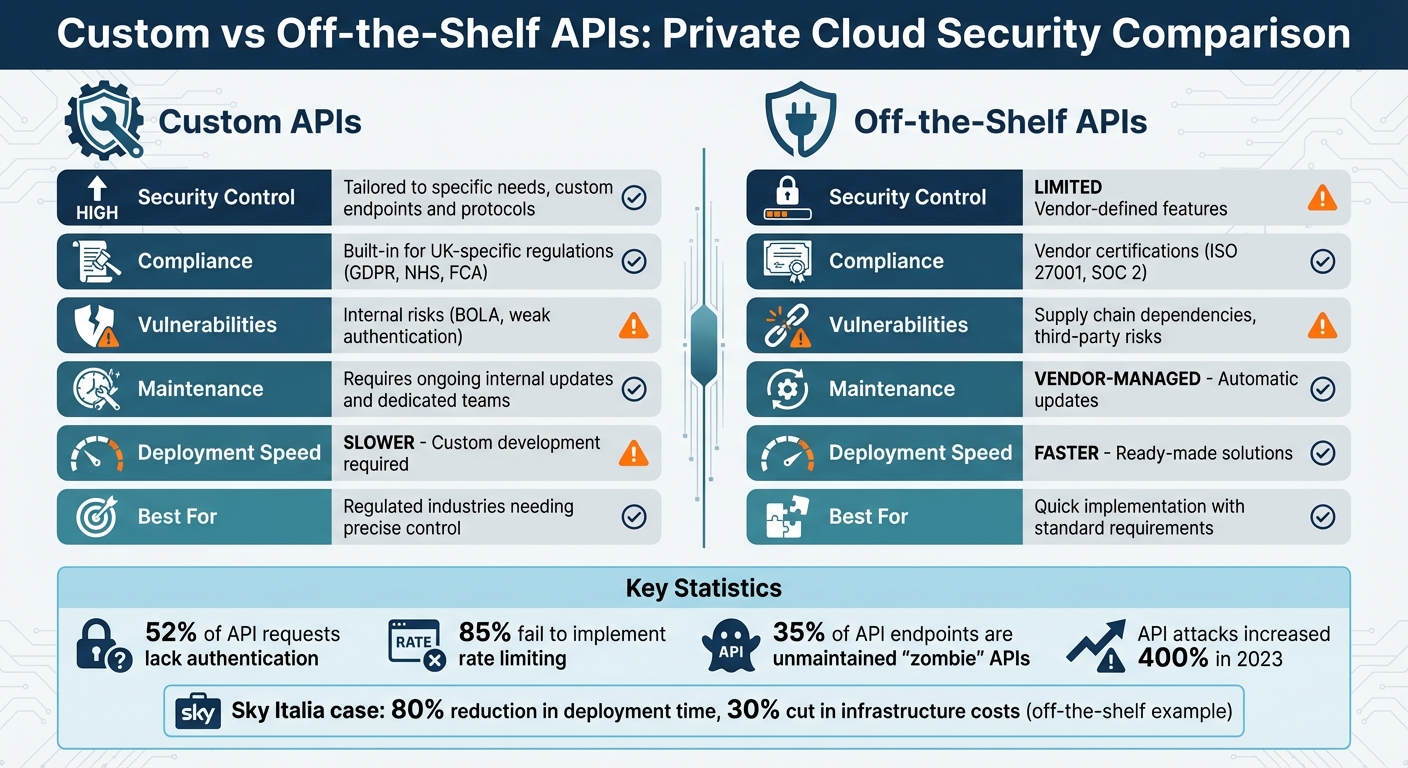 {Custom vs Off-the-Shelf APIs: Security and Compliance Comparison for Private Cloud}
:::
{Custom vs Off-the-Shelf APIs: Security and Compliance Comparison for Private Cloud}
:::
1. Custom APIs
Security Control
Custom APIs give organisations full control over the security design of their private cloud environments. This means they can create bespoke endpoints, data models, and authentication systems tailored to their specific needs. Such customisation allows for precise management of how data is accessed and shared [1].
One major benefit is the ability to deploy privately only. Unlike many pre-built API solutions that rely on public endpoints, custom APIs can function entirely within a private Virtual Private Cloud (VPC). Tools like Ockam support fully encrypted, private deployments, ensuring no public exposure [2]. This approach enhances both performance and security [1].
This robust control is also a stepping stone to implementing stringent compliance measures.
Compliance Capabilities
Custom APIs are particularly effective at embedding compliance measures directly into their architecture. For UK organisations, this is especially useful for meeting regulatory standards like UK GDPR. By building compliance controls into the API from the start, organisations can avoid the challenges of retrofitting later. This is critical for requirements such as data protection by design and ensuring data residency within specific geographic boundaries.
| Compliance Framework | Key API Requirement | Enforcement Method |
|---|---|---|
| UK GDPR | Data protection by design; residency | Encryption, RBAC, geographic controls |
| SOC 2 | Security, Availability, Confidentiality | Audit logs, MFA, disaster recovery plans |
| PCI DSS | Protection of cardholder data | Network segmentation, robust logging |
| NHS DSPT | Protection of clinical/patient data | Access controls, backup verification |
Standards like OpenAPI also help maintain consistent documentation and enforce security practices [4].
Vulnerability Risks
While custom APIs offer flexibility, they are not immune to vulnerabilities. A key risk is Broken Object-Level Authorisation (BOLA), where attackers exploit weak permission checks to manipulate object IDs and gain unauthorised access [3]. Other risks include weak authentication practices, such as poor password policies, sessions that don’t expire, and the absence of multi-factor authentication [3].
API-related attacks have surged by 400% in 2023 [3]. One common threat is injection attacks, where inadequate input validation allows attackers to insert malicious code into SQL, LDAP, or command fields. To mitigate this, organisations must use parameterised queries and enforce strict schema validation [3].
Addressing these vulnerabilities is crucial, but it’s only part of the equation - ongoing maintenance is equally important.
Maintenance Requirements
Managing custom APIs demands a continuous commitment to security updates, patches, and monitoring [1]. Unlike vendor-provided APIs, where the responsibility for updates lies with the provider, organisations using custom APIs must handle this themselves. This requires dedicated development teams and regular security testing, which can lead to higher operational costs over time compared to pre-built alternatives.
2. Off-the-Shelf APIs
Security Control
Off-the-shelf APIs come equipped with pre-built security features that are quick to deploy. These typically include authentication protocols like JWT, OIDC, and OAuth2, alongside TLS encryption, rate limiting using token bucket algorithms, and integration with Web Application Firewalls (WAF) to mitigate risks like SQL injection and cross-site scripting. These features align with PCI DSS standards, offering a solid baseline for security. However, a 2024 analysis highlighted some alarming trends: 52% of API requests lacked authentication, 85% failed to implement rate limiting, leaving them vulnerable to brute force and denial-of-service attacks, and 35% of API endpoints were unmaintained zombie
APIs[5]. While off-the-shelf APIs provide essential security tools, these gaps underline the need for careful implementation and monitoring.
Compliance Capabilities
Standard protocols such as TLS 1.3 and AES-256 are often built into off-the-shelf APIs, making them well-suited for industries like healthcare and finance. Many vendors also secure certifications like ISO 27001 or SOC 2, simplifying compliance for organisations. However, relying on vendor compliance has its risks. For instance, if standards aren't met, breach costs can increase by 12.6%, potentially reaching £5.05 million. Other challenges include the explainability gap
in AI-driven APIs and multi-tenancy concerns, such as tenant hopping, which complicate regulatory efforts in private cloud environments[6]. While these APIs offer strong compliance frameworks, they are not free from vulnerabilities.
Vulnerability Risks
Third-party APIs can expose organisations to supply chain vulnerabilities that threaten private cloud security. A notable example occurred in August 2023, when a Microsoft Power Platform vulnerability allowed unauthorised data access due to minimal differences in Azure Function hostnames[7]. Additionally, organisations often adopt weaker security practices when integrating these APIs, such as trusting external data without adequate validation. With 71% of organisations currently using APIs from third-party SaaS vendors, these vulnerabilities can become gateways for lateral movement within a private cloud setup. Moreover, sensitive data may be transferred across jurisdictions, risking data residency breaches[8].
Maintenance Requirements
One of the advantages of off-the-shelf APIs is that vendors handle maintenance. However, this can also be a limitation. Organisations need to stay alert to breaking changes
introduced by vendor updates, which can disrupt private cloud workflows if documentation isn't updated in time. Additionally, undocumented or unpatched shadow APIs
can create hidden vulnerabilities, leaving systems exposed to potential attacks. While vendor-managed maintenance reduces direct workload, it requires ongoing vigilance to ensure smooth operations.
How to Prevent API Security Risks Caused by AI Agents
Advantages and Disadvantages
When deciding between custom and off-the-shelf APIs for securing private cloud infrastructures, it's essential to weigh their respective strengths and weaknesses. Custom APIs offer unparalleled control over security architecture, enabling organisations to design endpoints, protocols, and authentication systems tailored to their precise needs. This level of control is particularly beneficial for addressing specific UK regulatory requirements, such as NHS data standards or FCA guidelines, while ensuring data stays within UK borders. However, this approach demands significant internal expertise and can lead to longer deployment times.
On the other hand, off-the-shelf APIs provide quick deployment with pre-built security features and vendor-managed certifications like ISO 27001 and SOC 2. These solutions simplify compliance processes for private cloud environments. A notable example is Sky Italia's adoption of the Kong API management platform in March 2025, which led to an 80% reduction in deployment time, a 30% cut in infrastructure costs, and a 20% saving in development costs, all while maintaining 99.99% availability (Source: Hokstad Consulting, 2026). However, this convenience comes at the cost of customisation, leaving organisations reliant on vendor roadmaps and exposing them to potential supply chain vulnerabilities.
The table below provides a side-by-side comparison of how custom and off-the-shelf APIs perform across key security dimensions:
| Feature | Custom APIs | Off-the-Shelf APIs |
|---|---|---|
| Security Control | High; customised endpoints and protocols[1] | Limited; vendor controls functionality and core security logic[1] |
| Compliance Capabilities | Granular control for UK GDPR, NHS, FCA requirements | ISO 27001, SOC 2 certified; may lack UK-specific flexibility |
| Vulnerability Risks | Depends on internal development quality | Exposed to supply chain attacks and third-party dependencies |
| Maintenance Needs | Continuous internal oversight required[1] | Vendor-managed[1] |
| Time-to-Market | Slow; involves design, coding, and extensive testing[1] | Fast; designed for plug-and-playintegration[1] |
These differences highlight the trade-offs involved in selecting an API strategy that meets stringent UK security and compliance needs. Custom APIs require rigorous testing to minimise vulnerabilities that could breach UK GDPR. Meanwhile, organisations opting for off-the-shelf solutions must carefully review Data Processing Agreements to ensure compliance with post-Brexit UK regulations. For custom APIs, automating compliance with UK-specific rules through Policy as Code in CI/CD pipelines can streamline adherence. Conversely, those using vendor-managed APIs should scrutinise Standard Contractual Clauses to confirm data transfer mechanisms align with UK legal standards.
How to Improve Custom API Security
Securing custom APIs requires a multi-layered approach that addresses both external and internal threats. Start by deploying an API gateway as a centralised entry point. This gateway is vital for enforcing key security measures, such as TLS 1.2 or 1.3 encryption, setting up explicit CORS allowlists (avoid wildcards in production), and implementing rate limiting. A robust rate-limiting strategy should include global, per-endpoint, and per-consumer limits. Neglecting this can lead to vulnerabilities - like the case where a threat actor exploited weak rate limiting, sending thousands of requests per minute over weeks to steal millions of records [9][10].
To further secure your APIs, integrate automated scanning tools into your CI/CD pipeline. Use techniques like Static Application Security Testing (SAST), Dynamic Application Security Testing (DAST), and Infrastructure as Code (IaC) scanning early in the development process. These tools can detect vulnerabilities, including Broken Object Level Authorisation (BOLA) and Insecure Direct Object References (IDOR), before your code goes live. For authentication, rely on OAuth 2.0 and OpenID Connect (OIDC), using short-lived access tokens (valid for 5–15 minutes) alongside refresh token rotation. This limits the time attackers have to exploit stolen tokens, significantly improving your security posture.
Beyond these static measures, focus on runtime protection. Use runtime monitoring tools with behavioural analytics to identify anomalies, such as business logic abuse or low-and-slow
attacks. A service mesh can further secure internal communications by enforcing mutual TLS (mTLS) and blocking private IP ranges to mitigate Server-Side Request Forgery (SSRF) attacks [9]. Tools like Traceable.ai and Salt Security can help establish behavioural baselines, making it easier to spot suspicious activity.
Custom APIs also require ongoing maintenance, including tasks like manual hardening, patching, and credential rotation. However, they offer the flexibility to incorporate UK-specific compliance checks and proprietary data protection measures directly into your security framework.
Avoid hardcoding credentials in your codebase. Instead, use centralised secrets management tools like HashiCorp Vault to encrypt secrets and automate their rotation. Enable detailed audit logging on your API servers to track all activities, and set alerts for repeated access attempts to sensitive data. Implement Role-Based Access Control (RBAC) with the principle of least privilege, ensuring users and services only have the permissions they absolutely need. For private cloud environments, such as Kubernetes, enforce a default deny-all
network policy. This prevents lateral movement in the event of a compromised pod, adding another layer of defence to your security strategy.
Conclusion
Deciding between custom and off-the-shelf APIs for your private cloud comes down to your organisation's specific needs and priorities. Custom APIs give you full control over functionality and data residency, which is crucial for meeting UK-specific compliance requirements like GDPR or industry-specific regulations. However, they do require continuous maintenance. On the other hand, off-the-shelf solutions offer quicker deployment with built-in security features but might limit customisation and the ability to fine-tune security controls.
For organisations managing sensitive data or operating in heavily regulated sectors, custom APIs often make more sense despite the added complexity.
A strong security framework is essential to protect your API environment. Key measures include deploying API gateways with TLS 1.2 or 1.3 encryption, integrating automated security scanning into your CI/CD pipeline, and using runtime monitoring tools like behavioural analytics and service meshes. These practices not only reduce the risk of attacks but also preserve the flexibility offered by custom APIs. Together, they form a comprehensive strategy for securing your API infrastructure.
Hokstad Consulting offers expert guidance for tackling these challenges. They specialise in custom development and automation services, helping businesses build secure and compliant API architectures. Their approach integrates multi-layered security measures while also cutting cloud costs by 30–50%. Whether you need help with implementing OAuth 2.0 authentication, automating security scans, or designing compliance frameworks tailored to UK regulations, their solutions ensure your APIs remain secure and cost-efficient.
If you're unsure about your current API security setup, starting with a cloud cost audit and security review could help identify potential risks and areas for improvement early on.
FAQs
When is a custom API safer than an off-the-shelf API in a private cloud?
When using a private cloud, a custom API can offer a higher level of safety, especially in scenarios where enhanced security, strict access controls, or adherence to specific regulations is essential. With a custom API, you have complete control over how security settings and data management are configured. This means you can implement tailored solutions to address specific risks or meet unique requirements effectively.
How can we prove UK GDPR data residency for our APIs?
To comply with UK GDPR data residency requirements for your APIs, ensure all data is both stored and processed within the UK. Opt for cloud providers that operate data centres specifically located in the UK, and maintain thorough documentation or certifications that confirm your adherence to these regulations.
It's important to keep comprehensive records detailing storage locations, access controls, and compliance audits. Regularly evaluate your infrastructure to verify that all data remains exclusively in UK-based data centres, meeting the necessary sovereignty standards.
What are the most common custom API security mistakes to avoid?
When it comes to securing custom APIs, there are a few traps that developers often fall into. These include overreliance on API keys, poor input validation, and lax secrets management.
Overreliance on API Keys: Relying solely on API keys without implementing additional safeguards can leave your system vulnerable. Always pair API keys with least privilege permissions and ensure they are rotated regularly to reduce potential risks.
Inadequate Input Validation: Skipping proper input validation opens the door to injection attacks. Make sure to validate all inputs rigorously to prevent malicious data from compromising your API.
Poor Secrets Management: Secrets like credentials and tokens need to be stored securely. Mishandling these can lead to leaks, which might expose sensitive data or access to unauthorised users.
By addressing these issues, you can protect private cloud environments and stay compliant with regulations like GDPR, which is especially crucial for organisations operating in the UK.