
Continuous compliance integrates regulatory checks directly into DevOps workflows, making compliance fast, automated, and consistent. By embedding security and regulatory controls into CI/CD pipelines, organisations can validate every code commit, infrastructure update, and deployment in real time. This approach reduces delays, prevents human errors, and ensures audit readiness without slowing down development.
Key points:
- Automated compliance checks: Tools validate code and configurations at every stage, catching issues early.
- Policy-as-Code: Regulatory rules are translated into machine-readable policies for consistent enforcement.
- Continuous monitoring: Live environments are checked to prevent compliance drift.
- Audit readiness: Immutable storage and automated evidence collection simplify audits.
For UK businesses, this is particularly helpful in meeting GDPR, NIS2, and industry-specific requirements like the NHS Data Security and Protection Toolkit. Examples include a 35% reduction in deployment delays for a financial services company and a 40% drop in security incidents for a healthcare provider. Continuous compliance not only ensures regulatory adherence but also supports faster, more reliable deployments.
Compliance is Broken: The DevOps Revolution for Audit & Controls (Stop Spreadsheets!)
Core Strategies for Achieving Continuous Compliance
::: @figure 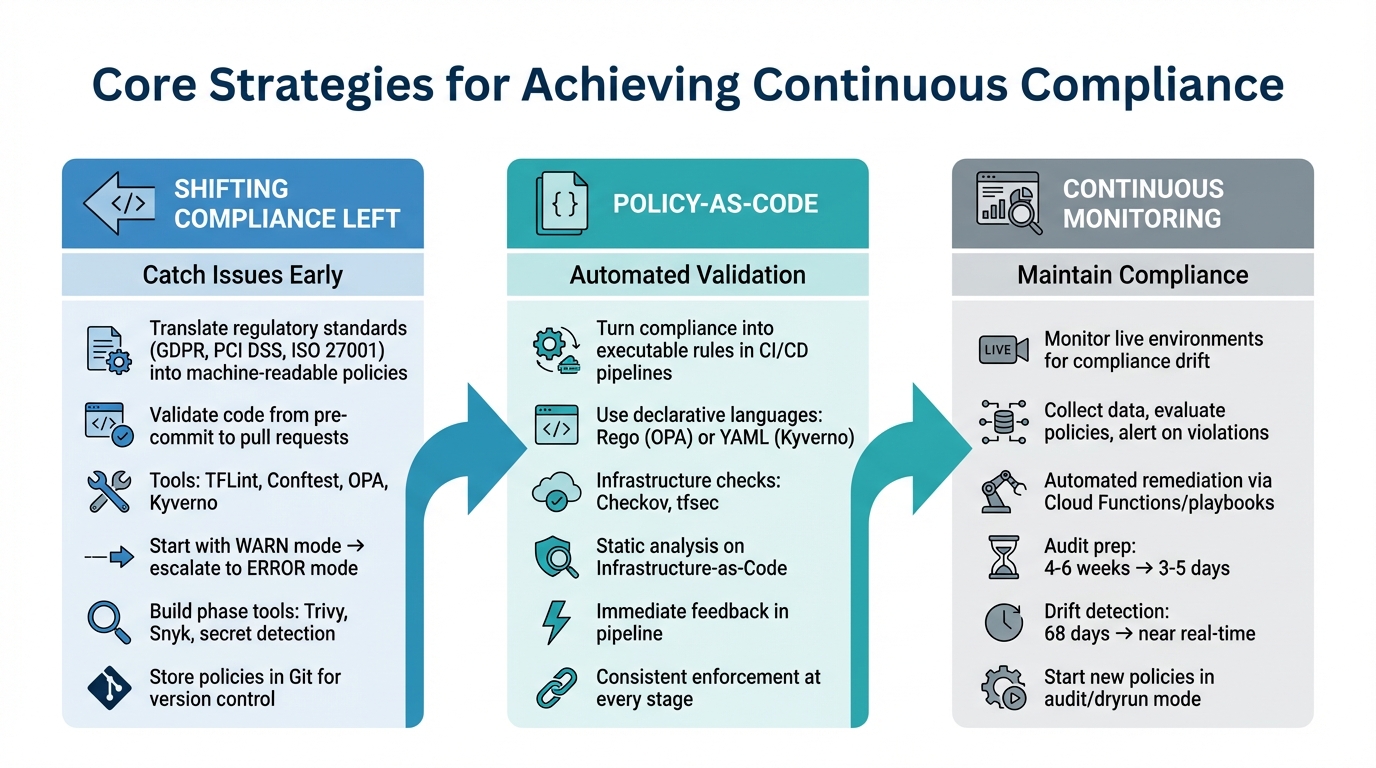 {Three Core Strategies for Continuous Compliance in DevOps}
:::
{Three Core Strategies for Continuous Compliance in DevOps}
:::
When it comes to embedding continuous compliance into your processes, there are three key strategies that can help integrate regulatory controls throughout your development cycle. These approaches are practical and can be adopted gradually by DevOps teams.
Shifting Compliance Left
One of the best ways to minimise compliance issues is to address them early - before they even make it into your codebase. This is where shifting left
comes into play. The idea is to translate regulatory standards like GDPR, PCI DSS, or ISO 27001 into machine-readable policies that can validate code right from the start.
Tools such as TFLint, Conftest, OPA, and Kyverno can identify potential problems at stages ranging from pre-commit hooks to pull requests. Initially, these tools can operate in WARN mode
, flagging issues without blocking progress. Over time, as teams adjust to these new checks, you can escalate critical violations to ERROR mode
, ensuring non-compliant code is stopped before it moves further along.
During the build phase, additional tools like Trivy (for container vulnerabilities), Snyk (for dependency licence analysis), and secret detection tools can further strengthen compliance. Storing these policies in Git ensures they undergo the same peer review and version control as your application code, creating a transparent audit trail.
The next step is to turn those regulatory requirements into automated rules, making compliance checks even more robust.
Policy-as-Code for Automated Validation
Policy-as-Code takes compliance requirements and turns them into executable rules that run automatically within your CI/CD pipeline. Instead of relying on manual processes or checklists, you can define these rules using declarative languages like Rego (for Open Policy Agent) or YAML (for Kyverno).
For infrastructure checks, tools like Checkov and tfsec perform static analysis on Infrastructure-as-Code, identifying misconfigurations before anything is deployed. These tools integrate directly into your pipeline, offering immediate feedback when the context is still fresh.
This approach not only saves time but also ensures that compliance is consistently applied at every stage.
Continuous Monitoring and Incident Response
While early validation is essential, ongoing monitoring is just as critical. Continuous monitoring ensures that live environments remain compliant even as configurations change over time. This involves collecting data, evaluating policies, and using tools to alert teams based on the severity of any violations. Reporting dashboards can also help track compliance trends over time.
To go a step further, automated remediation can address issues as they arise. For example, Cloud Functions or playbooks can quickly fix problems like removing public access to storage buckets, disabling overly permissive firewall rules, or rolling back unauthorised changes.
The results of such monitoring are striking. Organisations that implement continuous monitoring often reduce audit preparation time from 4–6 weeks to just 3–5 days. They can also detect compliance drift in near real-time, compared to the 68-day average seen with periodic assessments [3]. As Josef Kamara, CPA and CISSP, points out:
The annual compliance audit is not a quality assurance mechanism. It is a snapshot... The model fails in environments where 50 to 200 production deployments happen per week[3].
When introducing new policies, it’s wise to start in audit
or dryrun
mode. This allows you to spot compliance issues without disrupting production traffic, ensuring urgent problems are addressed swiftly while avoiding unnecessary alerts.
Integrating Compliance into DevOps Workflows
Bringing compliance into agile workflows requires a mindset shift: treat regulatory requirements as essential quality benchmarks, just like performance and functionality. This process starts with embedding compliance into the Definition of Done (DoD), making it a measurable task.
Compliance in Definition of Done
The Definition of Done is where compliance becomes actionable. Instead of leaving regulatory checks until the end of a release cycle, bake specific compliance tasks into your sprint’s DoD. Examples could include zero critical vulnerabilities detected
, secrets check passed
, or vulnerability scan completed with no policy violations
[4][5].
Automating these checks within your CI/CD pipeline ensures accountability stays within the development workflow. Builds can automatically fail if compliance violations are found, meaning teams cannot mark a sprint item as complete until these gates are cleared [5]. To maintain momentum while teams adapt, temporary overrides can be used, but only with approval from security or compliance teams.
Making Compliance Visible on Agile Boards
Out of sight often means out of mind. When compliance requirements are tucked away in separate systems or spreadsheets, they’re easy to overlook. Instead, integrate compliance dashboards into tools your team already uses - like Slack, Microsoft Teams, or your sprint boards - so breaches are immediately visible to everyone.
Gartner highlights this issue:
Compliance and auditing processes are often not integrated into application development and delivery workflows, hindering speed and agility and leading to poor security and compliance outcomes[4].
Making compliance status as visible as feature progress keeps it top-of-mind. Regular monthly compliance reviews during sprint cycles can also help normalise these activities. Use these sessions to revisit access permissions or analyse security scan results, turning compliance into a routine practice rather than an afterthought. Transparency drives shared accountability, ensuring every team member contributes to regulatory adherence.
Encouraging Shared Responsibility Between Teams
Compliance isn’t just the security team’s job. For continuous compliance to work, everyone has a role: developers write compliant code, security teams manage scanning tools, DevOps engineers maintain pipelines, and compliance officers define policies [5].
A shared policy codebase, stored in Git, can help foster collaboration. Security teams can update policies independently, while developers receive instant feedback in their workflows [1][5]. Tailored reporting also ensures each role gets relevant insights - developers see which policy caused a failure, while security teams get a broader overview and audit trails [4]. By 2028, it’s estimated that 65% of organisations will adopt compliance automation in DevOps, improving lead times by at least 15% [4].
For UK organisations aiming to strengthen compliance within their DevOps frameworks, Hokstad Consulting (https://hokstadconsulting.com) offers expert advice on integrating regulatory requirements into agile workflows without slowing delivery.
Ensuring Audit Readiness and Evidence Preservation
Audit readiness isn’t just a buzzword - it’s about having systems in place to collect compliance evidence automatically and seamlessly. By integrating this process into your DevOps workflows, you ensure that compliance is always provable, rather than scrambling for evidence during an audit. Automated, ongoing evidence collection ensures that data remains unaltered and easily accessible, creating a solid foundation for secure audit practices [6][2].
Immutable Evidence Storage
For evidence to hold up during an audit, it must be impossible to tamper with. This is where write-once-read-many (WORM) storage comes into play. Tools like Amazon S3 with Object Lock (Compliance Mode) or Azure Immutable Blob Storage provide the infrastructure to store logs securely. Even administrators with root access can’t delete or modify these logs once they’re written [11][10].
Take PCI DSS, for example - a framework requiring at least one year of log retention [8]. Immutable storage ensures you meet this requirement while safeguarding against accidental or malicious deletion. Adding cryptographic hashing strengthens this setup: each log entry includes the hash of the previous entry, creating a chain that’s impossible to alter without detection [11][10]. If someone tries to tamper with or reorder records, the hash chain breaks, exposing the interference. Automated scripts can periodically check these hash chains to maintain ongoing integrity [11][10].
Tamper-Proof Audit Trails
A reliable audit trail captures everything - user details, changes made, IP addresses, and the system context [8]. This granularity simplifies investigations and helps auditors trace actions to specific individuals.
To guarantee the authenticity of changes, enforce GPG or SSH-signed commits in platforms like GitHub or GitLab [9]. Be mindful of default retention periods - for example, Azure DevOps retains audit logs for only 90 days [8]. To ensure long-term availability, stream these logs to external systems like Splunk or Azure Monitor Log Analytics [8][7], where they can be stored securely and protected against local tampering.
Read-Only Compliance Dashboards
Once you’ve secured your logs and audit trails, the next step is presenting the evidence. Auditors need access to compliance data, but this shouldn’t interfere with delivery teams. Read-only dashboards solve this problem, allowing compliance and security teams to query audit data independently. Tools like Kusto Query Language (KQL) in Azure Monitor make it easy to map evidence directly to regulatory controls, such as SOC 2 or ISO 27001 [8][12].
To protect this data, apply strict Role-Based Access Control (RBAC), ensuring only authorised personnel can view or manage audit streams [8]. Developers, for instance, should not have access to modify these logs, preserving their integrity. By automating compliance tasks, organisations can reduce the time spent on these processes by up to 82% per framework [12], freeing teams to focus on delivering value.
For businesses in the UK aiming to integrate audit readiness into their DevOps workflows without slowing down deployment, Hokstad Consulting provides tailored solutions. Their expertise spans immutable storage, cryptographic verification, and compliance automation - visit them at https://hokstadconsulting.com for more information.
Future Trends in Compliance Automation
Compliance automation is shifting from slow, manual processes to AI-driven systems that operate at the speed of modern DevOps. As Travis Howerton, Co-founder and CEO of RegScale, explains:
Modern software delivery moves too quickly for traditional compliance approaches. Organizations need compliance systems that operate at the same speed as DevOps pipelines.[13]
AI-Powered Compliance Processes
AI is revolutionising compliance by replacing occasional audits with continuous, machine-driven processes embedded directly into DevOps workflows. AI tools now translate regulations like GDPR and NIST into actionable controls. These systems not only identify non-compliance but also conduct governance checks, suggest fixes, or even implement them automatically. According to Gartner, by 2028, 75% of DevOps continuous compliance automation (DCCA) processes will depend on AI to streamline auditing, reporting, validation, and remediation tasks [14][15]. For businesses in the UK, this means compliance becomes predictive, offering real-time guidance and automated solutions.
This shift allows compliance to be integrated into the development process itself, turning pipelines into active compliance checkpoints.
DevOps Pipelines as Compliance Control Points
DevOps pipelines are evolving into central hubs for enforcing compliance during integration and build stages. Gartner highlights this change:
DevOps pipelines should serve as a centralized control point for compliance enforcement, enabling continuous compliance, reduced manual effort, and real-time, auditable evidence.[14]
This approach ensures compliance is checked continuously throughout the software development lifecycle, rather than waiting for a final review. Standards like OSCAL (Open Security Controls Assessment Language) are also making regulatory requirements machine-readable, allowing them to be seamlessly integrated into DevOps tools and workflows.
These advancements are paving the way for widespread adoption of compliance automation.
Industry Predictions for Automation Adoption
By 2028, 65% of organisations are expected to embed compliance automation into their DevOps practices, cutting compliance risks and reducing lead times by at least 25% [13][14][15]. The shift to compliance-as-code
- where compliance is an automated outcome of the development process - marks a major transformation in regulatory adherence. For businesses looking to keep up, now is the time to explore AI-driven tools that support automated policy creation, continuous monitoring, and code remediation.
Hokstad Consulting specialises in helping UK organisations adopt AI-driven compliance solutions within DevOps workflows. Their expertise combines DevOps transformation with AI-powered automation. Visit Hokstad Consulting to learn how they can support your compliance automation journey.
These trends ensure compliance remains an integral, automated part of the DevOps lifecycle, enabling real-time regulatory adherence with minimal manual intervention.
Conclusion
Continuous compliance blends the fast pace of DevOps with the accountability needed for regulatory audits. As Manvitha Potluri from DevOps.com aptly states:
In the high-stakes world of regulated industries, continuous compliance is the missing bridge between DevOps speed and audit-grade accountability[1].
With tools like real-time validation and Policy-as-Code, organisations can enforce rules consistently across environments. This approach transforms audits from weeks-long processes into quick checks, while also preventing configuration drift.
Key to success is breaking down barriers between DevOps, Security, and Compliance teams. Start with a focused use case - like enforcing encryption on storage buckets - then expand to cover broader regulatory frameworks. Begin by rolling out policies in warn
mode to gather team feedback, and transition to blocking mode once workflows adapt. Collaboration across teams is crucial to achieving this shift.
Evidence suggests that automating compliance within DevOps practices not only cuts lead times but also reduces compliance risks. For UK businesses navigating regulations like GDPR or NIS2, continuous compliance ensures audit readiness becomes a routine state rather than a last-minute scramble. Immutable audit trails and real-time dashboards replace manual evidence collection with tamper-proof records, making it easier to meet regulatory demands without slowing down deployments.
For those looking to implement these strategies, Hokstad Consulting offers tailored support to UK organisations. By combining automation expertise with actionable strategies, they help businesses integrate compliance-as-code into their DevOps workflows. Visit Hokstad Consulting to learn how they can help you build audit-ready infrastructure while maintaining development speed.
FAQs
Where do we start with continuous compliance in our CI/CD pipeline?
Embedding automated compliance checks right at the start of your CI/CD pipeline is a smart move. Begin by setting up a fully automated pipeline and incorporating tools that can handle compliance scanning and vulnerability assessments. By using Policy as Code (PaC), you can enforce rules automatically, ensuring any non-compliant code is flagged and blocked before it progresses further.
To maintain traceability and meet regulatory standards, automate audit logs and compliance reporting. This approach not only simplifies the process but also ensures you stay on top of requirements without manual oversight.
How can GDPR or ISO 27001 requirements be turned into Policy-as-Code?
To turn GDPR or ISO 27001 requirements into Policy-as-Code, you need to encode compliance policies into machine-readable, version-controlled formats. This approach makes policies testable, enforceable, and seamlessly integrated into CI/CD workflows.
The process involves translating compliance controls, risk assessments, and enforcement rules into executable policies. Tools like Open Policy Agent (OPA) can help achieve this. By storing these policies in version control systems, you enable automated compliance checks during both development and deployment. This ensures consistent adherence to requirements and provides an auditable trail for compliance efforts.
How can we prove compliance quickly during an audit?
When it comes to audits, proving compliance doesn't have to be a headache. By leveraging automated audit trails and artefact traceability within your CI/CD pipelines, you create unchangeable records of deployments, access controls, and policy enforcement.
Embedding compliance checks directly into your workflows - like vulnerability scans, code signing, and role-based permissions - ensures that validation happens in real time. Plus, retrieving evidence becomes a straightforward process. This approach not only cuts down on manual work but also speeds up preparation while improving accuracy.