
If I had to boil this down to one rule, it’s this: I should only commit against the steady floor of AI usage, not the busiest month. That’s because cloud commitment discounts can cut costs by 30% to 70%+, but they only work when demand stays high enough to cover the deal.
For AI workloads, that’s where things go wrong. Inference often has a stable base and is usually the safest fit. Training comes in bursts, often with GPU use hitting 85–95% during a run and then dropping close to zero. Dev and test are even less predictable. So if I size commitments from peaks instead of the baseline, I can end up paying for idle capacity.
Here’s the short version:
- Spend-based commitments give more room to move than resource-tied ones.
- Production inference is usually the best place to commit.
- Training and test should often stay on on-demand, spot, or pre-emptible pricing.
- A common guardrail is to commit only 60–80% of the proven usage floor.
- I’d use 60–90 days of data for baseline sizing and review it each quarter.
- For scheduled training, I’d treat only the repeatable part as commit-worthy.
- Layered purchases and staggered renewals help cut lock-in and forecast mistakes.
::: @figure 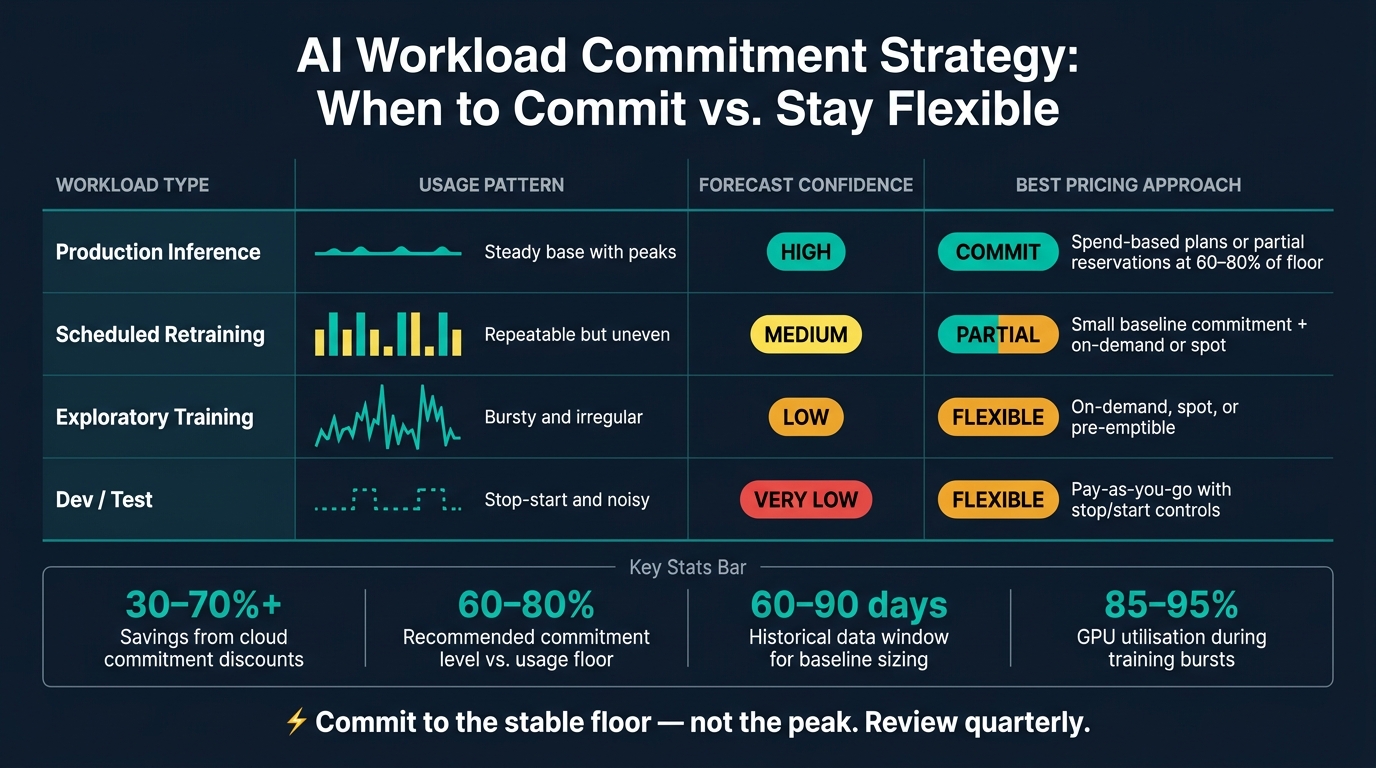 {AI Workload Commitment Strategy: When to Commit vs. Stay Flexible}
:::
{AI Workload Commitment Strategy: When to Commit vs. Stay Flexible}
:::
What Agent Traffic Is Doing to Your Cloud Bill (And How Teams Are Fixing It)
Quick Comparison
| Workload / Option | Usage pattern | Forecast confidence | Commitment fit | Best pricing approach |
|---|---|---|---|---|
| Production inference | Steady base with some peaks | High | Strong | Spend-based plans or partial reservations sized to the floor |
| Scheduled retraining | Repeatable but uneven | Medium | Partial only | Small baseline commitment plus on-demand or spot |
| Exploratory training | Bursty and irregular | Low | Weak | On-demand, spot, or pre-emptible |
| Dev / test | Stop-start and noisy | Very low | Poor | Pay-as-you-go with stop/start controls |
The core idea is simple: separate the baseline from the spikes first, then decide what belongs on a long-term discount and what should stay flexible.
The problem: how bursty AI usage creates commitment risk
AI costs usually come in two layers: a steady base and sudden bursts. That split is what makes commitments hard to size.
GPU-hours, inference demand and storage don’t move neatly together. One can climb while another falls. Over a one- to three-year commitment period, that makes it hard to predict what you’ll use.
Training jobs are a good example. They tend to use GPU capacity in big blocks, often running at 85–95% utilisation while the job is live, then dropping to almost nothing once it ends.[9][10] Inference is no easier to call. Average utilisation is often only 20–60%, but launches, campaigns or partner integrations can trigger sharp spikes with very little warning.[10][11] Storage adds another layer of noise. Datasets grow in jumps, retention rules shift, and logs build up as traffic rises.[12]
The problem isn’t just that costs move. It’s that each part moves on its own. That makes the total bill hard to pin down. So the job is simple in theory, but tricky in practice: work out what’s part of the steady floor and what’s just a spike.
Underutilisation, lock-in and forecast error
Three mistakes tend to turn that variability into wasted spend.
The first is committing above the true usage floor. Teams often project forward from a busy month or an ambitious roadmap, then find training slows down, a project gets paused, or several models are rolled into one. If usage drops below the commitment, you still pay for capacity you don’t use.[8]
The second is lock-in. This gets painful when GPU families, regions or architecture change. Say a data residency rule forces a move to another region. Or a newer GPU generation delivers much better performance per pound. In those cases, the commitment can block the better technical choice. The discount ends up steering architecture decisions.[6][7]
The third is forecast error. More specifically, it’s getting the mix of training, inference and data growth wrong. One common slip is to overestimate long-term training demand while underestimating how much steady inference load a successful AI feature can create. The opposite happens too: teams assume every experiment will become a stable product and commit on the basis of rosy adoption curves.
Why training bursts and test environments rarely justify large commitments
Large training runs often create short periods of heavy GPU use followed by long quiet stretches. That pattern is spiky, and it doesn’t always repeat on a set schedule. As a result, multi-year reservations tied to specific GPU types can leave a lot of capacity sitting idle between runs, which eats into the discount.[3][4]
Development and test environments are even less suited to large commitments. They stop and start by design, so demand shifts too often for a rigid long-term deal to make sense. On-demand or interruptible capacity is usually a better fit here, even if the headline unit price looks higher.
Only a proven, repeatable baseline supports a commitment. Where that baseline exists, a carefully sized commitment aimed at the known floor can make sense. The key word is proven.
Pros and cons table: commit versus stay flexible for bursty AI workloads
| Factor | Commit (reservations / discount plans) | Stay flexible (on-demand / spot) |
|---|---|---|
| Cost per unit | Lower when utilisation stays high and matches the commitment | Higher headline price, but often a better fit for low or uncertain usage; spot or interruptible options can cut costs by up to 90% versus on-demand[2][5] |
| Flexibility | Low - especially with resource-based commitments tied to specific GPU types or regions | High - you can switch GPU generations, regions or providers as your AI plans change |
| Operational complexity | Lower day to day once set up, but harder at the planning level because commitments must stay matched to shifting workloads | More day to day work around autoscaling and interruptions, though modern tooling has made that easier |
| Risk of waste | High for bursty, experimental or fast-changing workloads - the commitment gives no financial cover if usage falls[8] | Low for bursty workloads - you pay only for what you use; the main risk is price volatility |
The trade-off is pretty clear. Commitments pay off when demand is steady. Flexibility pays off when demand is uncertain. For most AI workloads, only part of the estate is stable enough to commit to, and finding that part is where forecasting needs to begin. That’s why the forecast should start with the floor, not the peak.
The solution: forecast the stable baseline before buying commitments
Once you know the floor, you can size commitments from that baseline. Start with workload units - GPU-hours, requests, tokens, storage, and data transfer - and only then turn that into spend using current UK-region pricing and discount rates.[15][6][18]
Use 60–90 days of history and anchor the forecast to the steady floor, not to a one-off high point.[13][14][6][21] Check it every quarter, because new model releases, product launches, and data residency shifts can change demand fast.[15][6][19][21]
Forecasting inference demand from the usage floor
Begin with at least three to six months of production metrics: daily active users, average and minimum requests per minute, p95 latency, tokens per request, and GPU utilisation by model.[15][6][18] Then split the data with care. Strip out promotional spikes - campaign launches and similar bursts - and look at what demand does during normal trading periods.
The steady floor is the lowest rolling 7- or 14-day average request rate during stable business periods, with outages and one-off dips removed. That’s the number you should convert into infrastructure need. Use the same approach for storage: size around day-to-day needs such as model artefacts, cached embeddings, and baseline prompt logs.[13][14][16][20]
Seasonal uplift should sit on flexible capacity, not inside the committed baseline.
Training needs its own forecast, because it follows job cadence rather than live traffic.
Forecasting training and retraining without overcommitting
Training workloads are driven by jobs, not by user demand. Keep a training calendar that logs planned work by GPU type, GPU count, expected runtime, and retraining cadence for each model.
From there, split jobs into two groups. Scheduled retraining for production models - say, a monthly fraud model refresh or a quarterly recommendation engine update - is repeatable enough to support a small partial commitment baseline. Ad-hoc experiments, hyperparameter sweeps, and architecture tests are a different story. Those belong on on-demand or spot capacity.[6][18]
A handy rule of thumb: discount forecasted training GPU-hours by 50–60%.[6] Timelines slip. Models change. Teams change direction. That’s why the forecast window should stay short - one to three months - since longer estimates often end up as rough signals rather than planning figures. It also helps to add a 20–30% buffer to per-job GPU-hour estimates for failed runs and exploratory iterations.[18]
Workload table: inputs, forecast horizon and commitment fit
Use the table below to line up the forecast horizon with the workload type.
| Workload type | Forecasting inputs | Recommended horizon | Commitment fit |
|---|---|---|---|
| Production inference – core models | Requests per second, tokens per request, minimum daily active users, latency targets | 3–12 months, reviewed quarterly | High - savings plans or reserved capacity sized to the P10 usage floor |
| Scheduled retraining – production models | Jobs per month, GPU-hours per job, dataset size, retraining cadence | 1–3 months | Moderate - partial baseline commitment for the most stable jobs; remainder on on-demand or spot |
| Exploratory training and experiments | Job counts, average job size, historical volatility | 1 month or sprint-based | Low - on-demand and spot capacity only |
| Integration and test environments | Test run counts, pipeline concurrency, test dataset storage | 1–3 months | Low - use pay-as-you-go or scheduled stop/start |
Practical ways to reduce commitment risk for AI spend
Once you’ve set the floor forecast, the next step is simple: size commitments around baseline demand, not around your busiest month.
Commit to the floor, not the peak
Set commitments at 60–80% of the usage floor, using at least 60–90 days of GPU and AI service data.[6][23][26][28] That gives you a buffer if usage dips. So if your monthly inference floor sits at £40,000, a commitment in the £25,000–£30,000 range may make sense.
That matters because unused commitment disappears each hour. If you commit too much, that missed usage turns into plain waste.[22][1]
Keep bursty training and test workloads on spot or pre-emptible capacity.[30][31][32] If training jobs are scheduled and repeatable, a small partial commitment may be worth looking at. If they’re occasional big runs, it usually isn’t.
Use flexible and layered commitments as AI infrastructure changes
AI infrastructure moves fast. One large commitment can look fine on paper, then age badly when GPU families change or data residency rules push workloads into a different region.
A safer approach is to layer commitments:
- Use a deep-discount base for the stable floor
- Add a flexible middle layer for workloads that may move
- Leave bursts on on-demand or spot capacity[1][17][2][6][23][24][25][26][27][29]
Stagger commitments each quarter instead of renewing everything at the same time. That helps you avoid one big renewal cliff. It also gives teams room to react to new information before locking in the next tranche, whether that’s a model migration, a region move, or a change in data residency rules.
Risk matrix table: drivers, impact and mitigation
| Risk | Key drivers | Likely impact | Mitigation |
|---|---|---|---|
| Underutilisation | Workload volatility, project delays, optimisation gains reducing GPU need | Stranded spend; forfeited hourly commitment cost | Commit to 60–80% of the usage floor; use shared or cross-service commitment scopes; run quarterly utilisation reviews |
| Lock-in | Committing to specific GPU families or regions that later change; model migrations; new data residency rules | Committed capacity becomes misaligned with actual infrastructure; discount value lost | Favour flexible, cross-service commitment models; stagger purchases; avoid deep discounts on highly experimental GPU types |
| Forecast error | Short historical windows; failure to strip out spikes; overly optimistic growth assumptions | Over- or under-commitment; budget variance | Use 60–90 days of history anchored to the usage floor; apply scenario and Monte Carlo modelling; update forecasts quarterly |
Use scenario modelling to test best-case, base-case, and worst-case demand. Then use Monte Carlo analysis to stress-test commitment size across many possible futures, simulating outcomes across demand growth, model refreshes, and project stops.[23]
Governance, AI roadmap alignment and conclusion
Commitment decisions need to line up with AI product plans, model strategy and FinOps governance, with costs tracked in GBP and workload units. Once the baseline forecast is in place, governance helps keep it tied to the roadmap instead of letting it drift.
Review commitments against model, region and data residency changes
AI infrastructure rarely sits still for long. A model migration, a new UK data residency rule, or a region move can turn an existing commitment into dead weight. That’s why each roadmap review should include a governance check covering model changes, region moves, UK data residency rules and storage growth.
The aim is simple: catch misalignment before renewal, not after a discount turns into a cost problem.
Flag commitments linked to changing regions or instance types so they can be reduced or converted ahead of renewal. A commitment register also helps. Link each commitment to the product, lifecycle stage and environment. Then, when the roadmap changes, it’s much easier to see which commitments may be at risk.
Governance forums - whether a FinOps board or an architecture review - should formally record these checks. Material commitments should require sign-off from Product, ML Engineering, Architecture and FinOps before signature.
Where Hokstad Consulting can help
Hokstad Consulting helps teams improve AI demand forecasting and commitment portfolios through AI strategy, implementation, cloud cost engineering and DevOps optimisation. That can include:
- building forecasting models from business metrics such as daily active users or transaction volumes
- advising on how to layer 1-year and 3-year commitments across inference and training workloads
- implementing FinOps dashboards that track committed spend against actual usage in GBP and workload units
This helps cut the risk of commitments drifting away from the AI roadmap.
Key takeaways for safer AI commitment forecasting
The most reliable AI commitment forecasts stay anchored to the stable floor and are reviewed against the roadmap.
- Commit to the stable floor, not the peak.
- Favour inference over training and test workloads for long-term commitments.
- Use flexible, staggered purchases and review them in both GBP and workload units alongside the AI roadmap.
FAQs
How do I find my true usage floor?
Start by right-sizing your infrastructure so you’re not paying for resources you don’t use. After that, check your cloud provider’s tools and look at at least 30 to 90 days of hourly production data. Relying on averages can send you in the wrong direction.
What you’re looking for is your true usage floor: the minimum capacity your system needs to keep running all day and all night. In most cases, that’s measured at the 10th percentile (P10) of hourly compute usage.
If your usage shifts with the seasons, look back over 6–12 months instead. That gives you a more accurate baseline and helps you avoid sizing your setup too low or too high.
Which AI workloads should stay on-demand?
Keep on-demand pricing for bursty, hard-to-predict demand, short-term experiments, and development or testing work with uneven or temporary usage.
It should also serve as a buffer, usually 20% to 40% of total capacity, to handle unexpected swings in demand and cut the risk of stranded, underused commitments.
How often should I review commitments?
Review commitments based on what’s changing.
For AI workloads with bursty GPU and data demand, check commitment coverage every week or month. Then adjust commitments every quarter so they still match usage.
It also helps to review renewals each quarter, with reminders set for 90, 60 and 30 days before expiry.
Keep your planning inputs up to date too:
- Update growth and release assumptions every month
- Update efficiency targets every quarter
This keeps commitment planning tied to how the business is actually moving, not how it looked a few months ago.