
Cloud migration can save costs and improve scalability, but it comes with serious security risks. Organisations often face challenges like data loss, misconfigured access controls, and compliance issues during the transition. These risks can lead to breaches, delays, and overspending.
Key points to address:
- Data Loss: Poor planning can corrupt or expose data during migration.
- IAM Misconfigurations: Excessive permissions can leave systems vulnerable.
- Compliance Risks: Failing to meet UK data residency and GDPR requirements can result in fines.
Solutions include:
- Encrypting data with AES-256 during migration.
- Adopting least-privilege access policies and multi-factor authentication.
- Using immutable backups to prevent ransomware attacks.
- Selecting UK-based cloud regions to meet compliance standards.
::: @figure 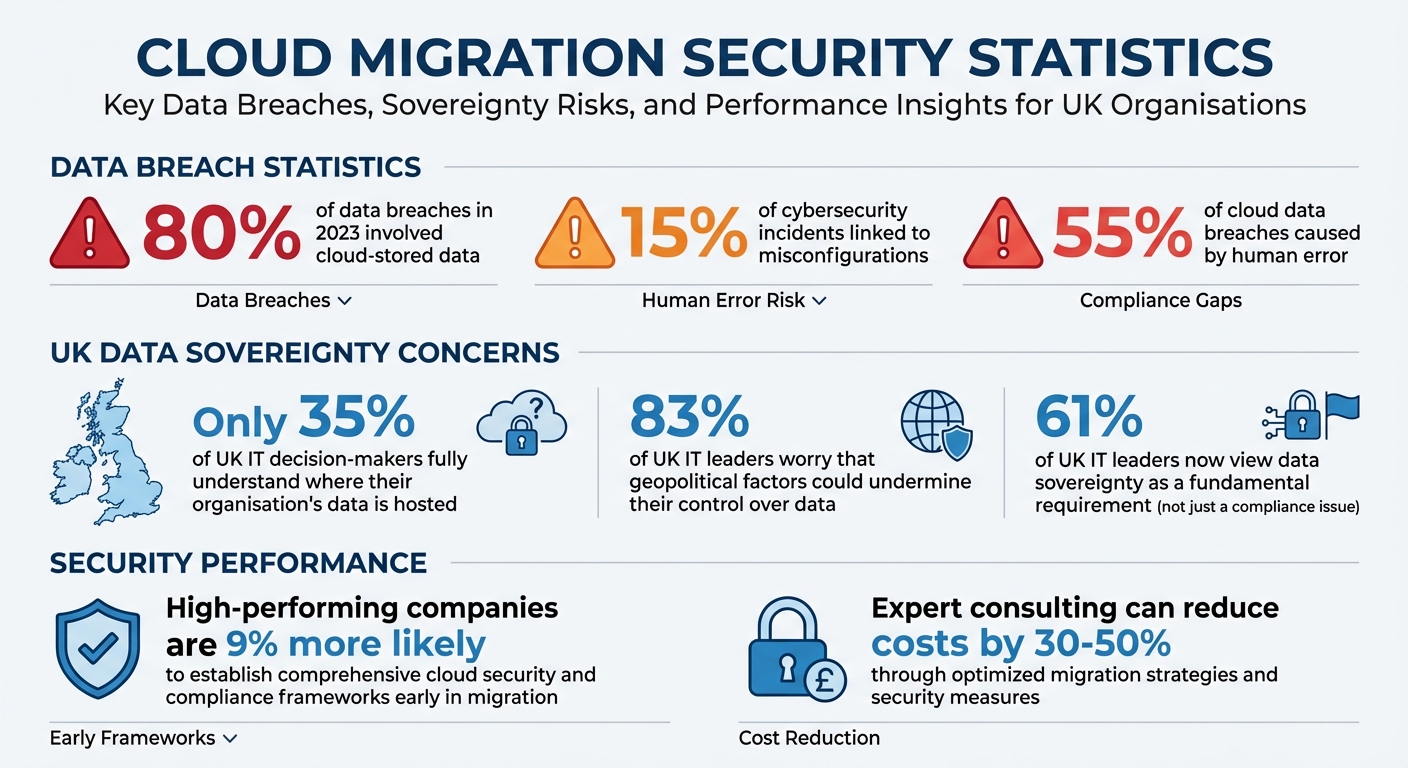 {Cloud Migration Security Statistics and Key Risks in the UK}
:::
{Cloud Migration Security Statistics and Key Risks in the UK}
:::
Navigating Cloud Migration: Risks, Security Concerns, and Cost Clarity
Main Security Risks in Cloud Migration
Cloud migration brings specific security challenges that UK organisations must tackle to safeguard their data, stay compliant, and avoid breaches. Below are some of the most common vulnerabilities encountered during the migration process.
Data Loss and Corruption
One of the biggest risks is data loss. Poorly planned dependency mapping can lead to outages and compromise data integrity. Issues like inconsistent schemas, data duplication, and weak governance can result in corrupted or unreliable data after the migration. Transferring large volumes of data, such as petabytes, without strong synchronisation or a clear cutover plan only increases these risks.
The transfer of data that occurs during a cloud migration increases risk by its nature. Your data is 'exposed' during the migration process and security controls in the cloud may not match the previous environment.- Charlie Waterhouse and Justine Desmond, Synack [2]
The most effective way to mitigate these risks is to treat data migration as its own dedicated project. This means cleaning and reconciling data before the move, creating detailed dependency maps, and conducting rigorous validation checks at every stage. Misconfigured access controls during migration can further expose systems to external threats, making proper governance essential.
Identity and Access Management (IAM) Misconfigurations
IAM misconfigurations often occur during cloud migration, especially when excessive permissions are granted in the rush to make systems operational. These overly broad permissions can remain in place long after the migration, leaving sensitive resources vulnerable. To address this, it’s crucial to define clear roles for account management, access approvals, and audit monitoring.
| IAM Activity | RACI | UK Compliance Link |
|---|---|---|
| Creating Production Roles | Security (Accountable), DevOps (Responsible) | ISO 27001 Annex A |
| Joiners/Movers/Leavers | HR (Responsible), IAM Ops (Responsible) | GDPR Accountability |
| Access Approvals | Line Managers (Responsible) | PCI DSS Least Privilege |
| Audit Log Retention | IT/Security (Responsible) | ICO/GDPR (12-month min) |
By following these guidelines, organisations can prevent lingering misconfigurations that could expose systems to unauthorised access.
Compliance and Governance Challenges
Maintaining compliance during migration is another critical concern. The process of moving data can expose organisations to regulatory risks, particularly when dealing with UK-specific standards. Many organisations struggle with this - only 35% of UK IT decision-makers fully understand where their organisation’s data is hosted [3]. Additionally, 83% of UK IT leaders worry that geopolitical factors could undermine their control over data [3]. This has made data sovereignty a strategic priority, with 61% of UK IT leaders now viewing it as a fundamental requirement rather than just a compliance issue [3].
Sovereignty is no longer a niche concern or compliance checkbox. It's foundational. Businesses are waking up to the fact that without clear, reliable control over where their data resides - and who has access to it - they're exposing themselves to unnecessary risk.- Civo Research [3]
High-performing organisations take a proactive approach, establishing comprehensive cloud security and compliance frameworks early in the migration process. Steps like selecting UK-based cloud regions, implementing effective data classification, and maintaining detailed audit trails are crucial for meeting GDPR requirements and avoiding regulatory penalties. These measures not only protect data but also help organisations maintain trust and avoid costly breaches or fines.
How to Reduce Cloud Migration Security Risks
Once you've identified vulnerabilities, the next step is to apply practical solutions that balance security and operational efficiency, all while adhering to UK compliance standards.
Protecting Data Integrity and Security
Start with a dedicated data migration plan that includes checksum verification and AES-256 encryption. Use checksum verification at every stage of the migration to detect any data corruption early on. Encrypt data both in transit and at rest with robust standards like AES-256 (or stronger) - this is particularly important when transferring data between different regions within the UK. Prepare rollback procedures to revert changes if validations fail, and perform regular checks to reconcile source and destination datasets. For large-scale migrations, opt for dedicated network connections to minimise exposure.
By securing data at every step, you create a solid foundation for effective access management.
Improving IAM Practices
Adopt least-privilege access policies across all cloud platforms. Define universal roles (such as 'Cloud-Platform-Admin' or 'Security-Auditor') that align with AWS, Azure, and Google Cloud. Centralise authentication using SAML 2.0 or OIDC to prevent password sprawl. Enforce multi-factor authentication (MFA) for all users, and consider hardware-based MFA for accounts with elevated privileges. Use PAM tools to enable Just-in-Time access, granting temporary permissions that automatically expire. Automate identity management by linking HR systems to cloud provisioning tools, ensuring access is promptly revoked when employees leave. Conduct quarterly access reviews for standard users and monthly reviews for privileged roles. Disable legacy authentication protocols that lack MFA support unless absolutely necessary.
Securing APIs and Integration Points
API vulnerabilities can surface during migration, especially when integration points are quickly established. Use API gateways to act as a protective layer between your services and external connections. This allows for centralised monitoring and rate limiting. Regularly perform penetration tests on API endpoints, focusing on bypasses and injection vulnerabilities. Use automated tools to scan for exposed API keys or credentials in code repositories. Enforce strict input validation on all API calls, and maintain detailed logs of API activity to identify unusual behaviour. Store API traffic logs in UK/EU regions with GMT/BST timestamps to comply with local data residency rules.
Once API and integration points are secured, it’s equally important to protect backup systems from potential ransomware attacks.
Using Immutable Backup Strategies
Ransomware often targets backup systems during migration. To counter this, implement immutable backups with a retention period of 90 days. Isolate backup environments from production networks by using separate authentication credentials and network segments. Keep at least one backup copy in an alternative UK region or availability zone to guard against regional failures. Regularly conduct drills to test backup recovery processes and ensure they meet recovery time objectives. Set up automated alerts to flag any unauthorised attempts to access or modify backup systems outside of scheduled maintenance.
Building in Compliance and Governance from the Start
To tackle compliance challenges, integrate governance into your migration plan from the beginning. Research shows that high-performing companies are 9% more likely to establish a comprehensive cloud security and compliance framework early on [1]. Incorporate GDPR requirements and the UK government’s Cloud First policies into your strategy. Ensure data is migrated to UK-based cloud regions, and use governance tools like Service Control Policies, Azure Policy Definitions, or Organization Policy Service to avoid data residency breaches. Retain audit logs for at least 12 months, as required by the UK Data Protection Act 2018. Apply security-by-design principles by conducting threat modelling exercises during the planning phase, rather than adding security measures as an afterthought.
Best Practices for Secure Cloud Migration
Pre-Migration Security Planning
When planning your cloud migration, it's essential to align your strategy with your security requirements. For instance, rehosting (often called 'lift and shift') involves moving workloads with minimal changes. While this approach is cost-effective, it offers fewer benefits in terms of cloud optimisation. On the other hand, refactoring modernises applications, allowing you to take full advantage of cloud capabilities - but it comes at a higher cost. Choosing the right method is key to ensuring a secure migration. Once your strategy is in place, implement continuous monitoring to maintain compliance and protect your data throughout the process.
Continuous Monitoring and Security Posture Management
Security doesn't stop once your migration is complete. Using Cloud Security Posture Management (CSPM) tools can help you stay on top of your cloud environment. These tools validate configurations, identify misconfigurations, and send real-time alerts when issues arise. Automated scans are a must - platforms like AWS Config, Azure Resource Graph, or Cloud Asset Inventory allow you to track configuration changes effectively. For UK-based teams, displaying security metrics on dashboards in GMT/BST ensures quick responses to potential threats.
Working with Expert Third-Party Support
Even with a strong internal team, external expertise can add an extra layer of protection for complex migrations. Partnering with specialists can help you address potential vulnerabilities and fine-tune your security measures. For example, Hokstad Consulting offers certified expertise in ISO 27001, SOC 2, and PCI DSS standards. They provide 24/7 Level 2/3 technical support, handling everything from pre-migration audits to identifying vulnerabilities and implementing customised controls. Whether you prefer a retainer or performance-based model, their services can scale with your operations, ensuring your security evolves alongside your business needs.
Conclusion
Cloud migration offers a wealth of opportunities for organisations in the UK, but it requires a strong focus on security from the outset. As we've discussed, the transition between on-premises and cloud systems brings heightened risks, including data loss, IAM misconfigurations, API vulnerabilities, ransomware threats, and compliance issues [5]. With 80% of data breaches in 2023 involving cloud-stored data and around 15% of cybersecurity incidents linked to cloud misconfigurations [4], it's clear that robust security measures are not optional - they're essential.
Careful early planning is the foundation of a successful migration. Steps like readiness checks, implementing policy-as-code, and developing clear IAM strategies can prevent costly mistakes that are difficult to fix later. As highlighted earlier, security measures such as encryption, continuous monitoring, immutable backups, and comprehensive employee training are critical, especially since human error contributes to 55% of cloud data breaches [6].
For more complex hybrid migrations and strict UK compliance requirements, expert guidance becomes indispensable. Hokstad Consulting specialises in secure cloud migrations tailored to UK organisations. Their services include DevOps transformation, IAM optimisation, API security, and immutable backup strategies - all aligned with the UK Cloud First guidance [7]. With certifications like ISO 27001, SOC 2, and PCI DSS, they provide pre-migration audits, identify vulnerabilities, and implement customised controls. Their flexible solutions, offered through retainer or performance-based models, not only adapt to your evolving business needs but also help reduce costs by 30–50%.
FAQs
What should we secure first during a cloud migration?
When moving to the cloud, the first step is ensuring a secure environment by tackling configuration and security risks. Misconfigurations are one of the most common vulnerabilities, often resulting in data breaches or costly regulatory penalties, particularly under GDPR regulations.
To minimise these risks, it's crucial to:
- Ensure secure configurations: Regularly check and adjust settings to align with security best practices.
- Enforce IAM policies: Use tools like multi-factor authentication (MFA) to control access effectively.
- Monitor for configuration drift: Continuously track and rectify any unintended changes to your setup.
On top of that, data protection measures are non-negotiable. Encrypt sensitive information and establish robust network controls to avoid exposing data or creating security loopholes. These steps lay the groundwork for a safer cloud migration process.
How can we prevent over-permissioned IAM roles after go-live?
To keep IAM roles secure and avoid over-permissioning after go-live, it's crucial to take consistent, proactive steps. Start by conducting regular access reviews to ensure permissions align with current responsibilities and stick to the principle of least privilege. Periodic audits can help identify and remove unnecessary access, reducing potential vulnerabilities.
Automating user provisioning and deprovisioning processes is another way to reduce risks and streamline role management. On top of that, enabling multi-factor authentication (MFA) adds an extra layer of security, while monitoring access activity ensures that any unusual behaviour is quickly flagged and addressed. These measures work together to maintain well-managed and secure IAM roles.
How do we prove UK GDPR data residency during migration?
To ensure compliance with UK GDPR data residency requirements during migration, store data in UK-based regions like Azure UK South or UK West. Adopt data handling practices that align with ICO guidelines and conduct necessary evaluations, such as data transfer impact assessments. These measures are key to demonstrating compliance and maintaining proper data residency standards.