Cloud cost anomaly detection tools are essential for identifying and addressing unexpected spikes in cloud spending. With global cloud spending projected to exceed £723 billion by 2026, organisations risk wasting up to 32% of their budgets due to misconfigurations or overlooked resources. These tools use machine learning to analyse past usage patterns, detect anomalies, and provide actionable insights to manage costs effectively.
Here’s a quick overview of the seven top tools:
- Cloudchipr: Multi-cloud support with AI-powered chat for cost analysis. Pricing starts at £38/month.
- CloudZero: Focuses on real-time hourly monitoring and cost allocation. Custom pricing.
- Finout: Offers seasonality-aware anomaly detection and granular control. Fixed-fee model (~1% of spend).
- nOps: AWS-specific with real-time insights and automated savings. Percentage-based pricing.
- Ternary: Multi-cloud management with customisable alerts. Fixed subscription pricing.
- CloudHealth by VMware: Designed for large enterprises with hybrid setups. Custom pricing.
- Vantage: Ideal for engineering teams with Kubernetes and AI integrations. Free for small spend, then tiered pricing.
These platforms reduce delays in detecting anomalies, automate root cause analysis, and integrate with tools like Slack or Jira for faster responses. Whether you're managing a single cloud or a multi-cloud setup, these solutions help control costs and optimise cloud usage.
::: @figure 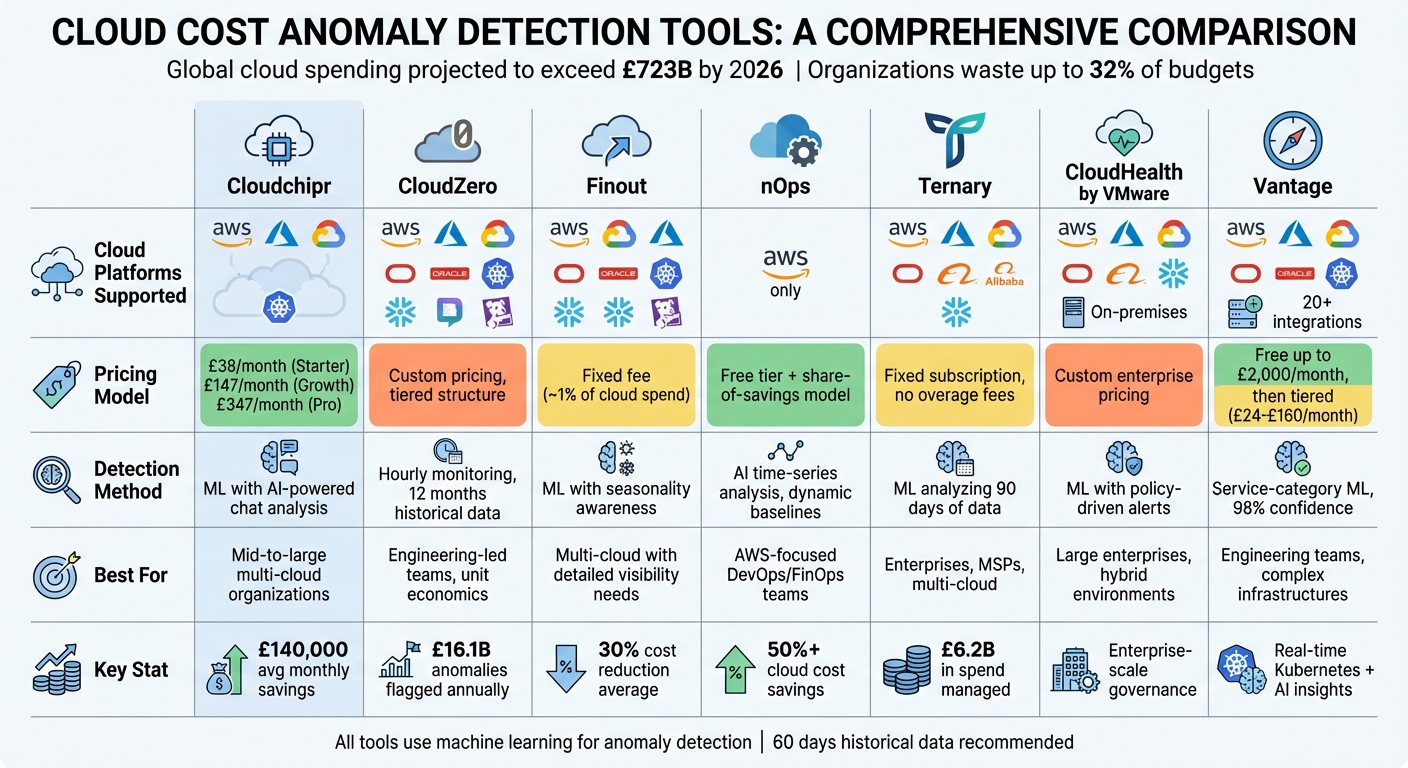 {Cloud Cost Anomaly Detection Tools Comparison: Features, Pricing, and Best Use Cases}
:::
{Cloud Cost Anomaly Detection Tools Comparison: Features, Pricing, and Best Use Cases}
:::
How to master cloud cost anomalies and trend monitoring
1. Cloudchipr
Cloudchipr is an automation-focused platform that leverages machine learning to keep an eye on cloud usage, automatically resolve issues, and investigate cost surges through an AI-powered chat interface. Its FinOps AI agents can answer queries like, Why did our costs spike yesterday?
using a conversational approach.
Primary Clouds Supported
Cloudchipr offers unified reporting for AWS, Microsoft Azure, and Google Cloud Platform, with additional support for Kubernetes environments and SaaS tools like Snowflake and Datadog. This consolidated view combines spending data into a single dashboard, removing the hassle of toggling between multiple billing consoles. This streamlined visibility also enables real-time detection of anomalies.
Anomaly Detection Method
Using machine learning, Cloudchipr establishes baseline spending patterns and flags unusual activities as they happen. It links cost spikes to resource metrics, helping teams determine whether the changes are due to legitimate traffic growth or unexpected resource issues. The AI agents handle spike investigations automatically, pinpointing root causes without requiring manual effort.
For example, one organisation reported six-figure yearly savings by using Cloudchipr's automated workflows to monitor development and sandbox accounts. Another company managed to cut cloud costs by 60% while maintaining 99.99% uptime. These capabilities make the platform a powerful tool for efficient cost management.
Pricing Model
Cloudchipr operates on a fixed monthly fee structure based on cloud spend tiers:
- Starter: £38/month for up to £3,900 in monthly cloud spend
- Growth: £147/month for up to £19,500
- Pro: £347/month for spend between £19,500 and £78,000
For enterprises spending over £78,000 monthly, custom plans are available. A 14-day free trial is also offered, with no credit card required.
Ideal Use Case
Cloudchipr is particularly suited for mid-to-large organisations with complex multi-cloud or Kubernetes setups. It’s especially beneficial for SaaS providers and AI/ML platforms managing dynamic workloads. The platform has proven to deliver substantial savings in both costs and manual effort.
Cloudchipr's automation workflows saved us thousands of engineering hours on cost optimisation and reduced our cloud expenses by seven figures on AWS, GCP, and Azure.[6]
On average, customers save around £140,000 per month and free up approximately 200 engineering hours that would otherwise be spent on manual cost management tasks[6].
2. CloudZero
CloudZero leverages AI-driven anomaly detection to help teams avoid budget overruns in real time. By monitoring cloud costs hourly, the platform allows users to address cost spikes within minutes - far quicker than waiting for traditional billing reports to reveal issues[7].
Primary Clouds Supported
CloudZero simplifies cost management by offering a unified view across multiple platforms, including AWS, Microsoft Azure, Google Cloud Platform, Oracle Cloud, Kubernetes, Snowflake, Datadog, MongoDB, New Relic, and Databricks[9]. This eliminates the hassle of juggling multiple billing dashboards.
Anomaly Detection Method
Using a self-training AI model, CloudZero compares hourly spending from the past 36 hours against 12 months of historical data to identify anomalies. These anomalies are then connected to specific business dimensions - like customers, products, features, or teams - making it easier to pinpoint the cause of cost spikes[7][11].
The platform has flagged anomalies totalling over £16.1 billion annually, identifying 5,558 incidents across its user base. On average, these anomalies cost around £323 per hour[7]. Peter Agelasto, Co-Founder and CPO of Starchive, shared his experience:
I review the alert and see costs up 1,600% of normal. Had we not been alerted, I wouldn't have caught this.[7]
CloudZero uses automated thresholds based on the last 30 days of data but also allows users to set manual percentage limits for projects requiring stricter controls. Alerts are sent via Slack, email, or Jira for seamless communication[8].
Pricing Model
CloudZero offers a tiered pricing structure that stays consistent, even if cloud spending unexpectedly increases[11]. Customers also benefit from a dedicated FinOps Account Manager to help optimise spending and implement best practices[12]. A 14-day free trial is available for qualified accounts[11].
Ideal Use Case
CloudZero is a strong fit for engineering-led organisations and FinOps teams that need detailed insights into unit economics, such as cost per customer or feature. In 2025, fintech company Upstart used CloudZero's anomaly alerts to cut total cloud costs by £16.1 million[10]. Similarly, Ninjacat, a marketing platform, reduced its cloud expenses by 40%, and Drift saved £3.2 million in AWS costs by using CloudZero to improve visibility and accountability within its engineering teams[9].
3. Finout
Finout integrates seamlessly with major cloud providers like AWS, GCP, Azure, and Oracle Cloud. Beyond that, it extends its capabilities to platforms such as Kubernetes, Snowflake, Datadog, Databricks, Confluent, OpenAI, and Anthropic [13][14][15][17].
Anomaly Detection Method
Finout uses machine learning to spot unusual cost spikes or unexpected drops, with built-in seasonality checks that account for recurring patterns like weekday or monthly trends. For instance, a regular drop in usage over weekends won't trigger unnecessary alerts. Users can customise alerts based on either percentage changes or fixed monetary amounts. The system analyses the top 10,000 cost entries and sends notifications through Slack, email, or Microsoft Teams, while limiting alerts to a maximum of 150 per day [15]. These features, combined with seasonality awareness, allow for more precise anomaly detection and tailored notifications.
Vijay Kurra, Senior Manager of Cloud DevFinOps at Tenable, shared his experience:
I highly recommend Finout to any organisation seeking to optimise their cloud resource management and drive cost efficiency in dynamic Kubernetes environments.[17]
Pricing Model
Finout uses a fixed-fee subscription model tied to the organisation’s forecasted annual cloud spend, typically around 1% of the total expenditure. This pricing structure is transparent and locked in, removing the worry of fluctuating costs. Ivan Polonevich, DevOps Team Lead, describes it well:
Finout charges a yearly fee based on cloud spend. This transparent, locked-in pricing structure eliminates concerns about unpredictable expenses based on usage.[16]
Customers can choose between Business, Pro, and Enterprise plans. The Enterprise plan offers advanced features, including unlimited cost centres and full Kubernetes integration [16].
Ideal Use Case
Finout is ideal for organisations managing multi-cloud environments that need detailed visibility across teams, applications, and environments. On average, customers report a 30% reduction in annual cloud costs, while engineering teams save about 50% of their time on cost management tasks [17].
4. nOps
nOps focuses exclusively on AWS, managing an impressive £2.4 billion in annual cloud spend. It's earned the top spot in G2's cloud cost management category [18]. By building on advanced anomaly detection techniques, nOps delivers a solution specifically tailored for AWS-driven infrastructures.
Anomaly Detection Method
nOps employs AI-powered time-series analysis to establish dynamic spending baselines that adapt to daily and weekly fluctuations. It monitors projected versus actual costs in near real-time, grouping anomalies by client, account, project, or team. Each anomaly is assigned a severity level - Low, Medium, or High - along with cost deltas and percentage deviations [19].
Alex Kuan, FinOps Lead at Arlo, highlights the platform’s practical benefits:
nOps doesn't just present data, it highlights the specific optimizations, anomalies, and inefficiencies we can address immediately.[18]
Pricing Model
nOps offers a dual pricing approach: a fixed fee for cost visibility and a share-of-savings model for autonomous optimisation [20]. Available through the AWS Marketplace, its costs align with existing AWS commitments. New users also gain access to a free savings analysis and cloud audit [18].
Ideal Use Case
nOps is a perfect fit for DevOps and FinOps teams managing AWS infrastructures, especially when deeper resource insights are needed beyond what native AWS tools provide. The platform automates cost-saving measures like shutting down idle EC2 instances and removing orphaned EBS volumes, helping users save over 50% on cloud costs [18]. Its exclusive focus on AWS sets it apart from other tools in this space.
Herman Lotter, Technology Operations Manager at Kurtosys, shares his experience:
nOps has transformed how we manage our AWS infrastructure... It gave us automated commitment management and an effortless way to track and monitor our costs with Business Contexts.[18]Need help optimizing your cloud costs?
Get expert advice on how to reduce your cloud expenses without sacrificing performance.
5. Ternary
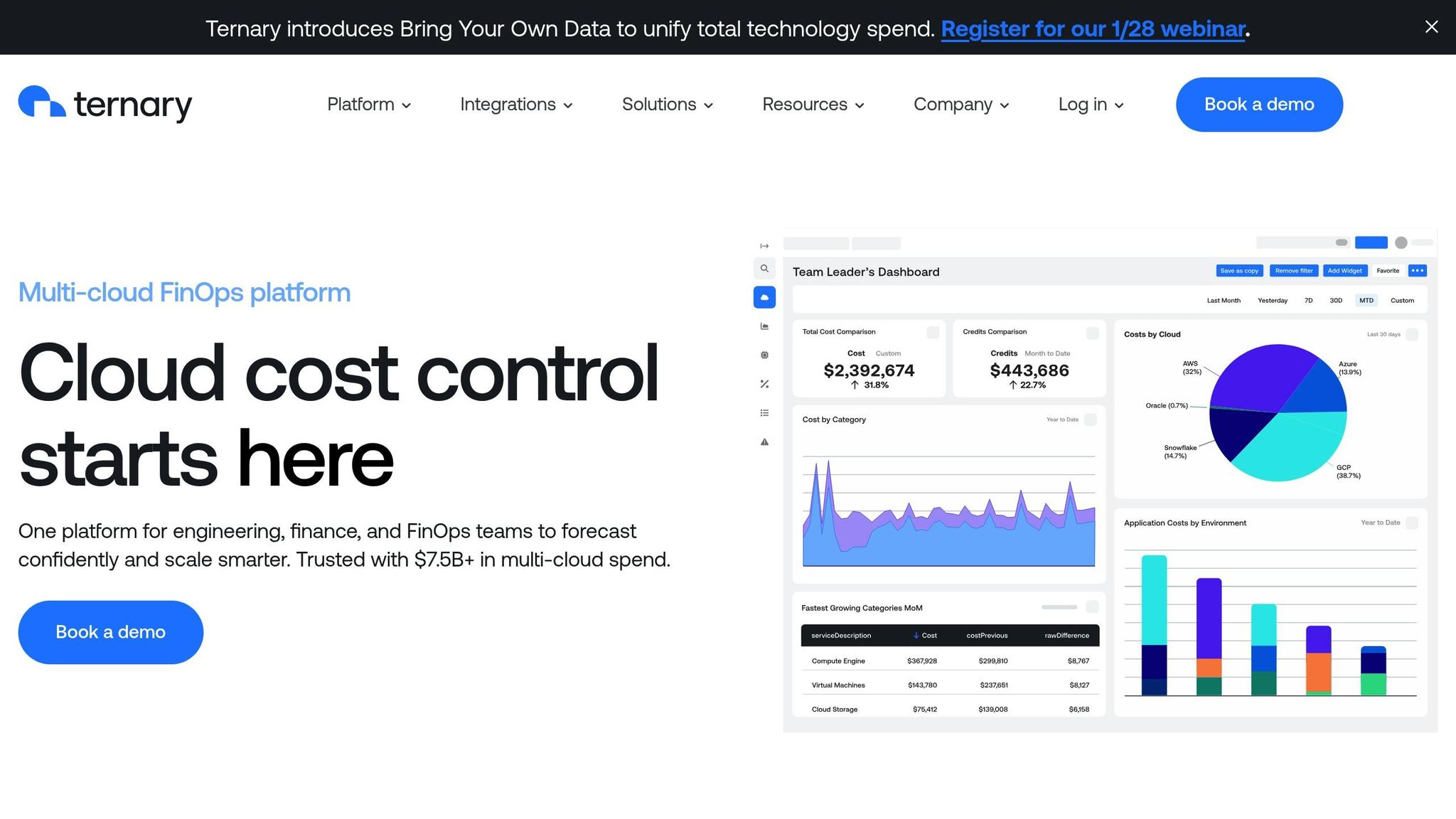
Ternary stands out as a powerful tool specifically designed for managing multi-cloud environments. With oversight of an impressive £6.2bn in multi-cloud spending, it has earned its place as a Leader
in the GigaOm Radar Report for Cloud FinOps 2025 [22][23]. The platform supports major cloud providers like AWS, Microsoft Azure, and Google Cloud, while also integrating seamlessly with Oracle Cloud Infrastructure, Alibaba Cloud, Snowflake, and MongoDB [23][25].
Anomaly Detection Method
Ternary leverages machine learning to examine 90 days of cloud cost data, establishing expected spending ranges [21]. Users can set up custom alert rules based on absolute pound amounts or percentage thresholds, with detailed monitoring available at various levels, such as Service, SKU, Project, or custom business groupings [3][21]. To reduce unnecessary notifications, the platform enforces a minimum non-zero value for relative threshold alerts [3].
When an anomaly is identified, the Identify Root Cause
feature generates a timestamp-filtered report to assist with pinpointing the issue [21][22]. For example, one customer, whose monthly bills typically reached tens of thousands, was alerted to a sudden £830,000 daily spike in BigQuery expenses caused by duplicate testing - flagged a full three weeks before the invoice arrived [24].
Pravash Mukherjee, Senior Director of Technology and Delivery at Decisions, shared his experience:
Before using Ternary, it would take me hours to analyze our cloud costs. Now, I have a single source of truth for all my cloud spending across Google Cloud, Azure, and AWS. With Alert Tracking, I can instantly identify and investigate cost changes.[3][23]
Pricing Model
Ternary operates on a fixed-fee subscription model, structured around cloud spend tiers, with no overage fees or hidden charges [23]. It offers flexibility by providing both a standard SaaS version and a self-hosted option for organisations with stringent compliance needs [23][25].
Ideal Use Case
Ternary is an excellent choice for enterprises and Managed Service Providers managing multi-cloud environments that require tailored controls and detailed visibility. A prime example is BetterCloud, which, under CTO Jamie Tischart, successfully reduced its cloud infrastructure costs from 17% of non-GAAP revenue to just 8% using Ternary [23]. Additionally, its bi-directional Jira integration transforms anomalies into actionable tickets, simplifying the resolution process [3][21][24].
6. CloudHealth by VMware
CloudHealth by VMware, integrated into VMware Tanzu by Broadcom, is a platform tailored for large enterprises managing multi-cloud and hybrid environments. Its standout features centre around governance, policy enforcement, and centralised oversight, offering a unified approach across diverse cloud ecosystems.
Primary Clouds Supported
CloudHealth supports a wide range of environments, including AWS, Microsoft Azure, Google Cloud Platform, Oracle Cloud, Alibaba Cloud, and on-premises data centres [26][27]. It also extends its capabilities to Kubernetes environments, enabling businesses to monitor costs associated with containerised workloads in hybrid setups [26].
Anomaly Detection Method
CloudHealth leverages machine learning to enhance cost monitoring. This technology identifies unusual cost spikes and categorises data by business group, department, or project. Over time, the system refines its accuracy based on user feedback [26]. The Anomaly Dashboard helps visualise the financial impact of each anomaly, while the Perspectives
feature allows organisations to organise cloud data for more precise detection [26].
Additionally, the platform supports policy-driven alerts. Users can set custom thresholds that trigger notifications when limits are exceeded. For further automation, CloudHealth integrates GraphQL and REST APIs, enabling actions to be taken outside the platform's interface [26]. These tools provide an extra layer of governance, complementing the automated alerts found on similar platforms.
Pricing Model
CloudHealth employs a customised pricing model designed for large enterprises. This tailored approach reflects its advanced features, which include role-based access through FlexOrgs
, policy management, and detailed chargeback capabilities [25][30].
Ideal Use Case
CloudHealth is a strong fit for organisations prioritising governance and those already invested in VMware's on-premises infrastructure. It offers a unified interface for managing both public cloud services and private VMware environments [5][25][29]. However, businesses should be mindful of the potential implementation effort required [5].
7. Vantage
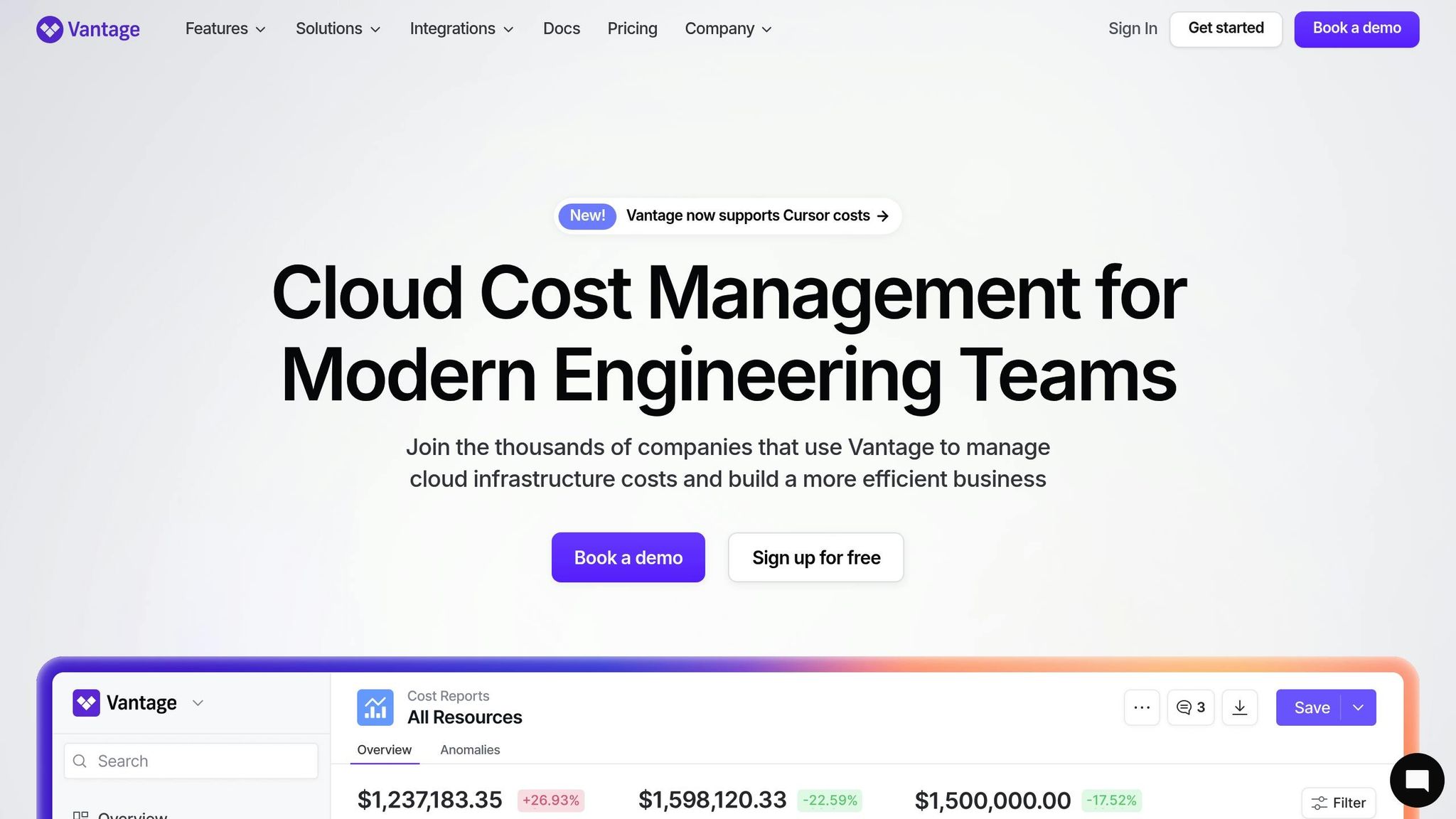
Vantage is a platform tailored for engineering teams, offering a wide range of integrations. It supports major cloud providers like AWS, Microsoft Azure, Google Cloud Platform, and Oracle Cloud, while also tracking Kubernetes costs seamlessly [35]. With over 20 native integrations, it extends its anomaly detection capabilities to services such as Snowflake, Datadog, MongoDB, and AI providers like OpenAI and Anthropic [28][34]. This makes it a strong choice for organisations managing intricate, modern infrastructure setups. These integrations form the backbone of its advanced anomaly detection system.
Anomaly Detection Method
Vantage employs machine learning to model spending across different cost categories in its Cost Report, setting precise thresholds for each [31][35]. Rather than just monitoring overall expenses, it dives deeper, identifying anomalies at the service-category level. For instance, it can distinguish between Data Transfer
and Compute Instance
costs within Amazon EC2 [31]. When a spike occurs, the platform pinpoints the resource responsible, allowing for quick action [35]. To reduce unnecessary notifications, it filters out minor fluctuations and triggers alerts only on the first detection [31]. Alerts can be sent via email, Slack, Microsoft Teams, or even turned into Jira tasks directly [31][37].
Pricing Model
Vantage uses a tiered pricing approach based on monthly cloud expenditure. The Starter plan, free for up to £2,000 in cloud spend, includes three users and six months of data retention. The Pro plan costs around £24/month for up to £6,000, while the Business plan is priced at approximately £160/month for up to £16,000. Enterprise plans are customised to fit specific needs. Additionally, all plans, except Enterprise, include a 5% fee on savings achieved through the Autopilot feature, with Enterprise plans charging 10% [38].
Ideal Use Case
Vantage is particularly suited for multi-cloud organisations and engineering teams that require real-time insights into complex infrastructures, including Kubernetes and AI services [28][33]. Rami Leshem, VP of Platform Engineering at Extend, highlights the platform’s ability to deliver timely and customised alerts [32]. Additionally, its FinOps as Code
capability - enabled by a Terraform provider - empowers teams to manage cost reports and anomaly alerts through code, ensuring streamlined operations [33][36].
Comparison Table
Selecting the right cloud cost anomaly detection tool hinges on your infrastructure, budget, and team requirements. The table below outlines how different platforms stack up, helping you pinpoint the solution that best suits your organisation.
| Tool | Supported Platforms | Detection Method | Pricing Model | Ideal Use Case |
|---|---|---|---|---|
| Cloudchipr | AWS | Machine learning with automated resource optimisation | Usage-based pricing | AWS-focused organisations looking for automated cost savings |
| CloudZero | AWS, Azure, GCP, Kubernetes | Real-time machine learning with unit cost economics | Custom pricing based on cloud spend | Engineering teams needing detailed cost allocation |
| Finout | AWS, Azure, GCP, Kubernetes | Machine learning with Virtual Tags and custom thresholds [13] | Tiered pricing starting at £500/month | Multi-cloud setups with shared costs [13] |
| nOps | AWS | Machine learning with commitment management | Free tier available, then percentage of savings | AWS users focusing on Reserved Instance optimisation |
| Ternary | AWS, Azure, GCP | Statistical modelling with business context | Custom enterprise pricing | Teams bridging finance and engineering collaboration |
| CloudHealth by VMware | AWS, Azure, GCP, Alibaba Cloud [39] | Policy-driven approach with machine learning insights | Percentage of managed cloud spend | Large enterprises managing multi-cloud environments [39] |
| Vantage | AWS, Azure, GCP, Kubernetes, MongoDB [39] | Service-category machine learning with 98% confidence thresholds | Free up to £2,000/month, then tiered pricing | Engineering teams handling complex, modern infrastructures [39] |
Each tool offers distinct features tailored for specific needs. For instance, certain platforms utilise deep learning algorithms that require at least 60 days of historical data, while others, like Finout, emphasise granular tracking with custom thresholds [13]. Some tools also incorporate multi-stage verification processes to minimise false positives, a critical feature for teams managing large-scale cloud environments.
When assessing these options, ensure you have access to 42–60 days of historical data. This is essential since most platforms adjust for seasonal patterns and natural usage variations [1] [2] [4] [40]. Understanding these nuances will help you align each tool’s capabilities with your organisation’s cloud cost management goals.
Conclusion
Cloud anomaly detection has become a vital tool for keeping budgets in check. The seven tools discussed in this article employ machine learning to establish spending benchmarks, track costs hourly, and alert teams to unusual activity before it spirals out of control. By reviewing historical billing data, these platforms can differentiate between natural growth and actual anomalies, helping to minimise false alarms [1]. More than just flagging issues, they turn anomalies into practical insights.
The benefits for businesses are clear. Real-time alerts mean teams can respond to unexpected cost surges immediately, and these tools often deliver instant savings. For example, companies using automated cost controls have reported monthly savings ranging from £11,000 to over £73,000 within just six months [41].
But it doesn’t stop at detection. Automated root cause analysis identifies the exact source of the anomaly, cutting investigation times by up to 90%. This allows engineering teams to focus on innovation rather than troubleshooting [7]. Integration with platforms like Slack, Microsoft Teams, and ITSM systems ensures alerts reach the right people quickly. Some tools even go a step further, offering automated fixes to shut down idle resources or limit usage when costs exceed set thresholds.
In today’s fast-paced cloud environments, these proactive measures are essential for maintaining financial control. With cloud spending on the rise and systems becoming more complex, choosing the right anomaly detection tool can protect profit margins while enabling innovation. Whether managing a single AWS account or a multi-cloud setup, these platforms provide the financial guardrails needed to innovate without overspending [42].
For tailored strategies in cloud cost management, organisations can turn to Hokstad Consulting, known for their expertise in cloud cost engineering and infrastructure management.
FAQs
How do cloud cost anomaly detection tools use machine learning to identify unusual spending patterns?
Cloud cost anomaly detection tools leverage machine learning (ML) to sift through historical spending patterns and establish a typical baseline. By comparing current expenses against these patterns, they can spot unusual deviations that may signal potential issues. They also factor in elements like seasonal spending changes and natural growth, making their analysis more precise.
These ML models go a step further by reducing false alarms. They analyse multiple factors - such as specific services, geographical regions, and account usage - allowing businesses to quickly trace the source of unexpected cost increases. With automated, context-aware insights, these tools empower organisations to take swift action, keeping financial surprises at bay and improving overall budget management.
What should I look for in a cloud cost anomaly detection tool?
When choosing a cloud cost anomaly detection tool, it's important to ensure it can integrate smoothly with your current cloud setup, whether you're using a multi-cloud or hybrid environment. This guarantees thorough monitoring and accurate identification of anomalies across all platforms you rely on.
It's also wise to opt for tools that offer real-time monitoring and automated alerts. These features allow you to spot unexpected cost spikes quickly and take action before they lead to budget issues. Tools with customisable alert thresholds and in-depth root cause analysis can make a big difference in maintaining control over costs and resolving issues efficiently.
Ease of use is another key factor. Go for tools that are simple to set up, have a user-friendly interface, and generate clear, actionable reports. For businesses in the UK, it's essential to choose a tool that supports GBP (£) for precise financial reporting and compliance with local standards.
How do cloud cost anomaly detection tools help reduce expenses and improve cost management?
Cloud cost anomaly detection tools are designed to help organisations spot unusual spending patterns in their cloud usage. By flagging these irregularities early, businesses can act fast to prevent unnecessary costs. Using advanced machine learning, these tools continuously monitor expenses across various accounts and services, identifying anomalies almost instantly and offering insights into what might be causing them.
What makes these tools so effective is their ability to streamline cost management. They provide automated alerts, generate detailed reports, and integrate smoothly with financial systems. This means businesses can address issues quickly, cut down on waste, and use their resources more wisely. By reducing the need for manual tracking and improving visibility, these tools make budgeting easier, tighten cost controls, and contribute to overall savings.