
Cloud cost allocation governance ensures that cloud expenses are tracked, assigned, and managed effectively across teams, departments, or projects. Without a structured framework, organisations risk inefficiencies and cloud sprawl
, making cost control nearly impossible. Here's what you need to know:
-
Key Elements:
- Visibility: Real-time insights into resource usage.
- Accountability: Assigning costs to responsible teams.
- Optimisation: Identifying and reducing idle or unused resources.
- Compliance: Adhering to budgets and spending policies.
Core Practices:
1.  **Standardised Tagging**: Enforcing consistent tags to track resources and costs accurately.
2.  **Budgeting and Attribution**: Using account-based, business unit-based, or tag-based models to allocate costs.
3.  **Chargeback vs Showback**: Chargeback assigns costs directly to teams, while showback provides visibility without financial transactions.
-
Implementation Steps:
- Define roles (finance, engineering, product owners, and executives).
- Automate policy enforcement to ensure compliance.
- Conduct regular audits to review tagging and spending.
Organisations with mature frameworks can allocate over 90% of cloud costs effectively, reducing waste and improving accountability. Start small with visibility (showback) and evolve towards financial accountability (chargeback) as your processes mature. Tools like AWS Budgets, Azure Policy, and automated anomaly detection can simplify this journey.
Building Cloud Cost Governance That Lasts | The Keys to AWS Optimization | S14 E10
Core Components of a Cloud Cost Allocation Governance Framework
::: @figure 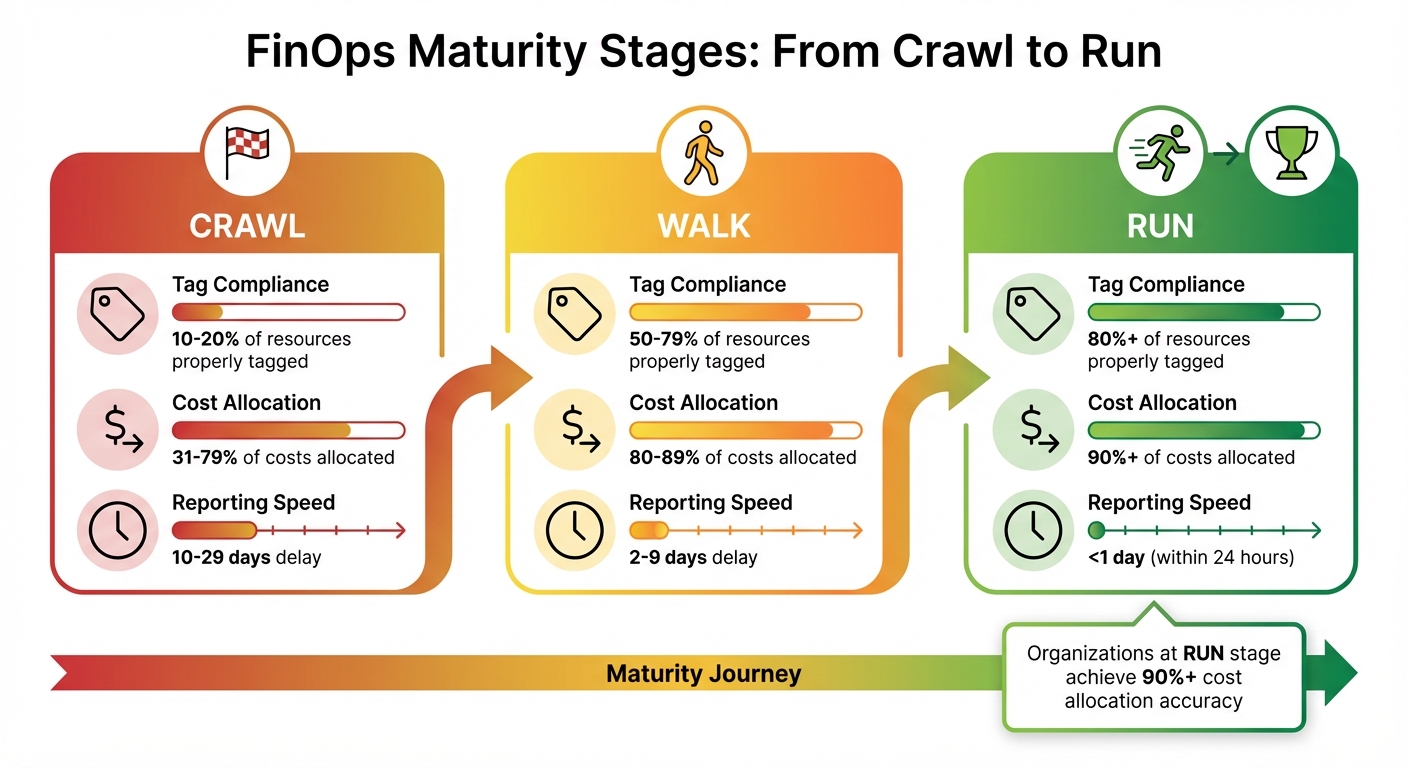 {FinOps Maturity Stages: Cost Allocation and Tagging Compliance Progression}
:::
{FinOps Maturity Stages: Cost Allocation and Tagging Compliance Progression}
:::
A strong framework for cloud cost allocation hinges on three key components that turn billing data into actionable insights, enabling precise tracking and accountability. Here's a closer look at these components and their role in managing costs effectively.
Standardising Resource Tagging
Tags, structured as key–value pairs, are essential for tracking resources and managing costs [10]. Without a consistent tagging approach, organisations face challenges in breaking down costs beyond the subscription level or associating expenses with specific departments, business units, or projects [10][11].
To ensure tagging consistency, governance frameworks often rely on automated policies like Azure Policy or AWS Service Control Policies. These tools enforce tagging rules at the point of resource creation, preventing unallocated spending and ensuring compliance [10][11]. As Microsoft Learn highlights:
Tagging is a fundamental part of any well-managed environment, and it's necessary for establishing proper governance of any environment [12].
It's important to note that tagging limitations vary by cloud provider. AWS allows keys up to 128 characters and values up to 256 characters, while Azure permits keys up to 512 characters (with 256-character values). GCP, however, limits both keys and values to 63 characters [11]. Additionally, AWS and Azure cap the number of tags per resource at 50, while GCP allows up to 64 [11].
For effective tagging, enforce lowercase for keys and values, and enable tag inheritance to capture costs across all resources [9]. Start by prioritising tagging for compute, storage, and database services - these typically account for the bulk of cloud expenditures. Avoid storing sensitive information like passwords or personal data in tags, as they are stored in plain text and may appear in logs or API responses [10]. Some costs, such as data transfer fees or bandwidth charges, cannot be tagged directly and require virtual tags
or manual cost allocation rules to distribute expenses [9][11].
Budgeting and Cost Attribution
A clear organisational structure is essential for accurate cost attribution. Tools like AWS Organizations and Azure Management Groups provide the hierarchy needed to track spending across various levels of an organisation.
Building on the foundation of standardised tagging, budgeting and cost attribution translate usage data into financial insights. Organisations typically choose one of three attribution models depending on their structure:
- Account-based models: Require minimal effort and offer high accuracy, ideal for cases with a one-to-one account-to-team setup.
- Business unit-based models: Demand moderate effort but work well for larger organisations with hierarchical structures.
- Tag-based models: Offer maximum granularity for complex environments but require more effort and provide variable accuracy.
Shared costs, such as networking infrastructure or centralised security tools, pose a unique challenge. These expenses serve multiple teams, making direct attribution difficult. Governance frameworks must establish rules to allocate these costs proportionally among the consuming teams or projects.
Automated monitoring tools, like AWS Budgets with Cost Anomaly Detection and Azure Budgets with Cost Alerts, help organisations stay on track by providing real-time notifications for overspending or unusual patterns.
Chargeback and Showback Models
Once cost attribution hierarchies are in place, organisations can adopt models like chargeback and showback to promote accountability and transparency.
Showback is all about visibility. It involves reporting the charges incurred by specific teams or projects without actual financial transactions. Regular expenditure reports foster transparency and encourage cost-conscious behaviour through peer visibility. This approach is relatively simple, relying on reporting tools and scheduled data sharing.
Chargeback, in contrast, focuses on financial accountability. It involves directly allocating costs to internal departments through formal accounting processes, such as budget deductions or internal billing. This model creates stronger incentives for disciplined resource use but requires integration with finance systems and more complex accounting procedures.
| Feature | Showback Model | Chargeback Model |
|---|---|---|
| Primary Goal | Visibility and transparency | Financial accountability |
| Financial Impact | No money moves between budgets | Actual budget deductions or internal billing |
| Implementation | Easier; uses reporting tools | More complex; needs finance system integration |
| Behavioural Driver | Peer visibility | Direct financial consequences |
| Best Use Case | Early-stage FinOps or shared services | Mature organisations or revenue-generating units |
Many organisations start with a showback model to build trust and establish transparency. As their FinOps practices mature, they often transition to chargeback or adopt a hybrid approach - using chargeback for directly attributable costs (like virtual machines) and showback for shared infrastructure. High-maturity organisations often achieve over 90% cost allocation to specific teams or resource owners, reinforcing the principles of visibility and accountability [3].
Expert support can be invaluable during this process. For example, Hokstad Consulting (https://hokstadconsulting.com) offers tailored guidance to help organisations implement these components, optimising cloud cost allocation and strengthening financial governance.
Key Principles for Effective Governance Frameworks
Effective governance isn't just about having the right tools - it's about applying them in a way that ensures accountability, reduces waste, and drives results. Three key principles - transparency in cost reporting, automated policy enforcement, and cross-departmental collaboration - are essential for turning governance frameworks into practical systems that deliver real value.
Ensuring Transparency and Accountability
When teams have clear visibility into costs, they can better control spending. As the AWS Well-Architected Framework explains:
The capability to attribute resource costs to the workloads, individual organisation, or product owners drives efficient usage behaviour and helps reduce waste.[6]
Transparency works on two fronts: speed and coverage. Leading organisations can report costs within 24 hours of incurring them [3]. Moreover, advanced practices allow over 90% of cloud costs to be attributed to specific owners, eliminating the guesswork of tracking down spending [3].
The level of transparency an organisation achieves directly impacts its ability to control costs. For instance, at the Crawl
stage of maturity, only 10–20% of resources are properly tagged, and just 31–79% of costs are allocated, often with reporting delays of 10–29 days. By contrast, organisations at the Run
stage achieve over 80% tag compliance, allocate more than 90% of costs, and provide cost data in under a day [3].
To make this work, clear rules for allocating shared costs are critical. Automation plays a key role here, embedding these rules into deployment processes to ensure consistency and eliminate manual errors.
Using Automation for Policy Enforcement
Managing governance manually is nearly impossible at cloud scale. This is where automation steps in. By embedding standards into deployment workflows - using tools like Policy as Code - organisations can enforce policies consistently, no matter which team is provisioning resources [14].
For example, platforms such as Azure Policy and AWS Service Control Policies can require specific metadata during resource creation, ensuring that resources are tagged with their cost centre, project, or department identifier [15]. They can also enforce deployment guardrails to block expensive resources or limit deployments to cost-effective regions [15]. Automated release gates in CI/CD pipelines can check whether deployments align with budget thresholds before proceeding, while automated remediation can handle tasks like shutting down idle resources, removing temporary environments, or resizing underutilised instances based on real-time data [16].
To ease adoption, it's often best to start automation in monitor
mode. This approach allows teams to see how policies affect their workflows and make adjustments before enforcement becomes mandatory [15]. Using hierarchical inheritance - where policies are automatically inherited by specific workloads from higher-level groups - can further reduce administrative burden while maintaining consistent standards [15].
Building Cross-Functional Collaboration
While automation ensures consistency, collaboration ensures accountability. In today’s decentralised cloud procurement landscape, technology teams often drive costs directly, bypassing traditional centralised processes [17]. This shift makes it essential for finance, engineering, and product teams to work together to align spending with business goals.
The FinOps Foundation highlights this collaborative approach:
Everyone takes ownership for their cloud usage.[5]
Ownership relies on clear allocation strategies. Finance teams define budgets and shared cost models, engineering ensures resources are tagged and compliant, and product teams align costs with business objectives. Executives, meanwhile, approve overarching strategies to maintain profitability [5].
Establishing a Cloud Business Office or Cloud Centre of Excellence can help centralise oversight by bringing together members from finance, technology, and business units [18]. Regular meetings to review spending, optimisation efforts, and organisational goals, along with a shared understanding of financial concepts, help teams connect technology costs to business outcomes [18].
Collaborative tagging strategies are another key element. Input from stakeholders across technology, finance, business, and security ensures comprehensive reporting. However, it's worth noting that tagging is not retroactive - resources tagged late in the month will only appear in reports from that point onward [3]. Executive sponsorship is also crucial, as it prioritises cost optimisation alongside feature development, ensuring governance efforts are supported at the highest levels [18].
Steps to Implement a Governance Framework for Cloud Cost Allocation
Creating a governance framework involves assigning clear ownership, automating controls, and maintaining regular oversight. Here’s a practical guide to move from defining roles to keeping your framework effective as your cloud environment evolves.
Defining Roles and Responsibilities
Without clear ownership, cloud costs can easily be misattributed. Start by identifying the key stakeholders who will manage your framework:
- Finance: Sets budgets and measures profitability.
- Engineering: Applies tags and automates metadata standards.
- Product Owners: Links costs to business goals.
- Executives: Approve strategies and provide escalation support.
A RACI matrix (Responsible, Accountable, Consulted, Informed) is a helpful tool to document who handles tagging, budget units, and shared cost logic [3][4].
Additionally, form a centralised team, often referred to as a Cloud Business Office (CBO) or Cloud Centre of Excellence (CCoE), to oversee cost allocation. This team should bring together expertise in automation, infrastructure engineering, and financial analysis [18]. Executive sponsorship is crucial - organisations without strong policies for managing cloud usage face a higher risk of inefficiencies [6][18]. An executive sponsor ensures cost management is prioritised alongside development goals and enforces compliance effectively.
| Role | Key Responsibilities in Cost Allocation |
|---|---|
| Finance | Define budget units, set shared cost allocation percentages, and track profitability [3][4][5]. |
| Engineering | Implement and automate tagging standards, and identify metadata sources for analysis [3][4][5]. |
| Product Owners | Provide input on cost allocation, define allocation taxonomies, and align product development with cost drivers [3][4][5]. |
| FinOps Practitioners | Create compliance standards, coordinate between teams, and evaluate strategy adherence [4][5]. |
| Executives | Approve allocation strategies, validate business unit allocations, and determine data granularity [3][4][5]. |
Decide on an ownership model - Centralised (a dedicated team oversees practices), Decentralised (teams manage their own costs), or Hybrid [18]. Establish consistent naming conventions for accounts, projects, and subscriptions before tagging resources [4][5]. To reinforce compliance, require new team members to complete cost-awareness training during onboarding, as they may be used to different standards [6]. Dashboards showing tagging compliance across teams can also encourage accountability [3].
Once roles are in place, focus on embedding automated approval processes to streamline governance.
Establishing Approval Processes
Manual approval workflows often lead to delays or are bypassed entirely. A better approach is embedding automated guardrails directly into provisioning workflows [19]. Tools like AWS Service Control Policies or Azure Policy can enforce mandatory tagging and block the creation of untracked resources [20][3]. This ensures compliance from the very beginning, preventing untagged costs from accumulating.
Another way to optimise is automating the shutdown of idle resources. For example, policies can disable non-production environments during off-peak hours [19][20]. Research from IDC shows that even organisations with governance frameworks waste 20–30% of their cloud spending [19]. By embedding financial signals into delivery pipelines, FinOps shifts from reactive reporting to proactive cost management [19].
Automated approval systems should be paired with regular audits to ensure ongoing compliance.
Conducting Regular Audits and Reviews
Regular audits are essential to align governance policies with changing business needs [6]. Schedule meetings with stakeholders - such as DevOps teams, engineers, and finance - to review requirements and document changes in cloud usage [6][2].
Audits should focus on identifying untagged or non-compliant resources, prioritising high-cost items for correction [3][5]. Tools like AWS Config can automate remediation for resources that fall out of compliance [6].
Leverage cost optimisation insights from tools like AWS Trusted Advisor to pinpoint unused or over-provisioned resources [8][2]. Implement a formal workload review schedule to ensure cloud resources align with organisational priorities [6]. Incorporate unit metrics - like cost per business transaction - into these reviews to provide a more efficiency-focused perspective rather than just looking at total spend [1][7]. Advanced practices in cost governance can achieve over 90% cost allocation accuracy and more than 80% tag compliance [4][5].
Best Practices for Governance Framework Success
Building on the framework's core principles, practices like predictive forecasting, anomaly detection, and consistent tagging play a key role in maintaining cost control. These methods improve visibility, accountability, and automate policy enforcement, as outlined earlier.
Implementing Predictive Forecasting
Predictive forecasting helps shift cost governance from reactive to proactive. By providing early warnings before budgets are exceeded, it allows teams to take timely action to reduce costs [13][24]. This method aligns financial and technical teams around shared metrics [23].
To make forecasting effective, it needs to be detailed. Costs should be forecasted at the level of management accounts, linked accounts, specific environments, or individual projects [13]. Aim for a variance of less than 12% between actual costs and forecasts for highly efficient teams, while a standard target ranges from 12% to 20% [22]. To ensure accuracy, exclude one-off anomalies, deleted resources, and upfront reservations [22].
Accurate forecasts and implementation also provides accountability to stakeholders who are directly responsible for provisioning cost in the first place, and it can also raise their overall cost awareness.- AWS Well-Architected Framework [13]
Replace static annual budgets with trend-based or business driver-based algorithms that reflect the fluctuating nature of cloud spending [13]. Engage sales and marketing teams in the forecasting process to account for non-IT factors like promotions, geographic expansions, or mergers [13]. Set alerts at 110% of the budget to flag potential overruns early [24]. This predictive approach complements the automated enforcement measures mentioned earlier.
Using Anomaly Detection
Anomaly detection is a critical tool for spotting unexpected cloud cost events before they escalate [25][26]. Many organisations still rely on manual or semi-automated methods, underscoring the need for more advanced systems [26].
Detection tools must analyse usage across subcategories like service, account, project, and cost allocation tags to pinpoint root causes [25]. A 7-day running average with a ±3 standard deviation threshold is a common method for identifying anomalies [28]. However, using cloud billing details for detection can delay insights by up to 36 hours from the start of an event [28].
Tailor alert thresholds to the audience: engineering teams may need detailed technical alerts, while leadership should only receive notifications about high-impact anomalies [25]. Document and categorise predictable spikes, such as a new environment launch, as inform to ignore
to avoid unnecessary investigations [26][28]. Measure the effectiveness of your anomaly detection with metrics like Mean Time to Detect (MTTD) and the total cost avoided through quick resolutions [25][28].
Anomalies can also signal security issues, such as cyberattacks or unauthorised resource provisioning, making anomaly detection a key link between FinOps and Security teams [26][27]. Integrating this process with your overall governance strategy ensures continuous oversight.
Maintaining Consistent Tagging Practices
Consistent tagging is essential for accurate cost allocation. Organisations at the Run
level of FinOps maturity allocate more than 90% of their cloud spend through consistent tagging, while Walk
maturity requires at least 80% categorisation [4]. Strict tagging policies help prevent overspending caused by data inconsistencies.
Adopt a unified tagging dictionary and enforce it with tools like Azure Policy or AWS Service Control Policies [10][21][8]. Use deny policies to block deployments missing mandatory tags [8].
To maintain consistency, use lowercase for all tag keys and enforce clear capitalisation rules for values. This avoids duplicate entries in cost reports, such as Environment: Production
versus environment: production
[10]. Separate tags into mandatory core tags (enforced by central IT) and optional custom tags (for team-specific needs) [10]. Avoid storing sensitive data like passwords or personal information in tags, as they are stored in plain text and visible in logs and reports [10].
Regularly assess tagging maturity to identify untagged or mislabelled resources, and update the tagging dictionary as business requirements evolve [21][4]. These practices strengthen the governance framework and ensure alignment with the strategies outlined earlier.
Conclusion
A well-structured framework turns cloud cost allocation into a proactive approach to cost management. By integrating standardised tagging, automated policy enforcement, and cross-functional collaboration, organisations can achieve the transparency needed to accurately allocate costs and ensure teams are accountable for their spending.
Organisations with mature FinOps practices often allocate over 90% of their cloud spend effectively [4], proving that disciplined governance delivers measurable results. However, success hinges on maintaining tagging standards consistently from the start of deployment to enable accurate historical analysis.
Here’s a summary of how these practices influence operations and cost management:
| Feature | Impact on Operations | Impact on Cost Management |
|---|---|---|
| Automated Guardrails | Prevents unauthorised deployments | Stops budget overruns in real time |
| Standardised Tagging | Simplifies resource tracking | Enables precise chargeback/showback |
| Regular Audits | Identifies technical inefficiencies | Eliminates 30–50% of wasted spend |
| UK Compliance Alignment | Ensures legal data sovereignty | Simplifies HMRC and VAT reporting |
These operational improvements directly translate into financial benefits. Hokstad Consulting specialises in designing frameworks tailored to your organisation's needs. Their cloud cost engineering services focus on reducing expenses by 30–50% through strategic audits, automated guardrails, and ongoing optimisation. Whether you're building your first governance framework or refining an existing one, their expertise in DevOps and cloud infrastructure ensures both cost savings and operational efficiency.
FAQs
What role does standardised tagging play in managing cloud costs effectively?
Standardised tagging plays a key role in managing cloud costs effectively. By ensuring resources are labelled consistently across all cloud environments, it becomes much simpler to allocate costs accurately, monitor spending, and maintain clear financial records.
A well-structured tagging framework helps organisations boost accountability, spot areas where costs can be reduced, and make better use of their cloud resources. It also strengthens governance efforts, ensuring cloud resources are managed efficiently and stay aligned with business goals.
What is the difference between chargeback and showback models in cloud cost allocation?
The main distinction comes down to how expenses are handled and shared. Chargeback assigns costs directly to individual departments or teams based on their actual cloud resource usage. This method ensures that teams are financially responsible for what they consume, promoting better cost control and budget management.
Showback, in contrast, offers a clear breakdown of expenses but stops short of billing the teams. Instead, it provides insights into how much each team is spending, encouraging awareness and accountability without directly influencing their budgets.
Both approaches can play a role in managing cloud costs effectively, depending on what aligns best with your organisation's objectives and practices.
Why is collaboration across teams crucial for managing cloud costs effectively?
Collaboration between teams is the backbone of effective cloud cost management. When departments like finance, IT, and operations work together, they can align budgets, streamline resource usage, and stay compliant with regulations. Without this teamwork, organisations face risks like overspending, inefficiencies, and even regulatory penalties.
By encouraging open communication, businesses can establish shared policies and processes that ensure accountability and clarity. Take this example: finance and IT teams can work side by side to monitor cloud usage, spot cost-saving opportunities, and adjust budgets to reflect actual needs. This kind of collaboration not only trims unnecessary expenses but also ensures compliance with UK laws like GDPR and HMRC requirements.
In the end, teamwork doesn’t just cut costs - it builds a solid governance structure, reduces resource waste, and helps organisations stay agile and efficient.