
A risk assessment framework helps organisations identify, evaluate, and address potential risks that could disrupt operations, harm reputation, or lead to non-compliance. Tailoring this framework to your specific needs ensures resources are focused on the most relevant threats while improving operational efficiency. Here's a quick overview of the process:
- Define Objectives and Scope: Set clear goals (e.g., compliance, uptime targets) and focus on critical systems and processes.
- Identify Risks: Use techniques like brainstorming, process mapping, and automated tools to uncover vulnerabilities.
- Analyse and Evaluate Risks: Prioritise risks using a scoring method (e.g., risk matrix) based on likelihood and impact.
- Implement Controls: Choose actions like elimination, substitution, or administrative measures to address critical risks.
- Monitor and Review: Continuously track risks, review controls regularly, and update the framework as needed.
::: @figure 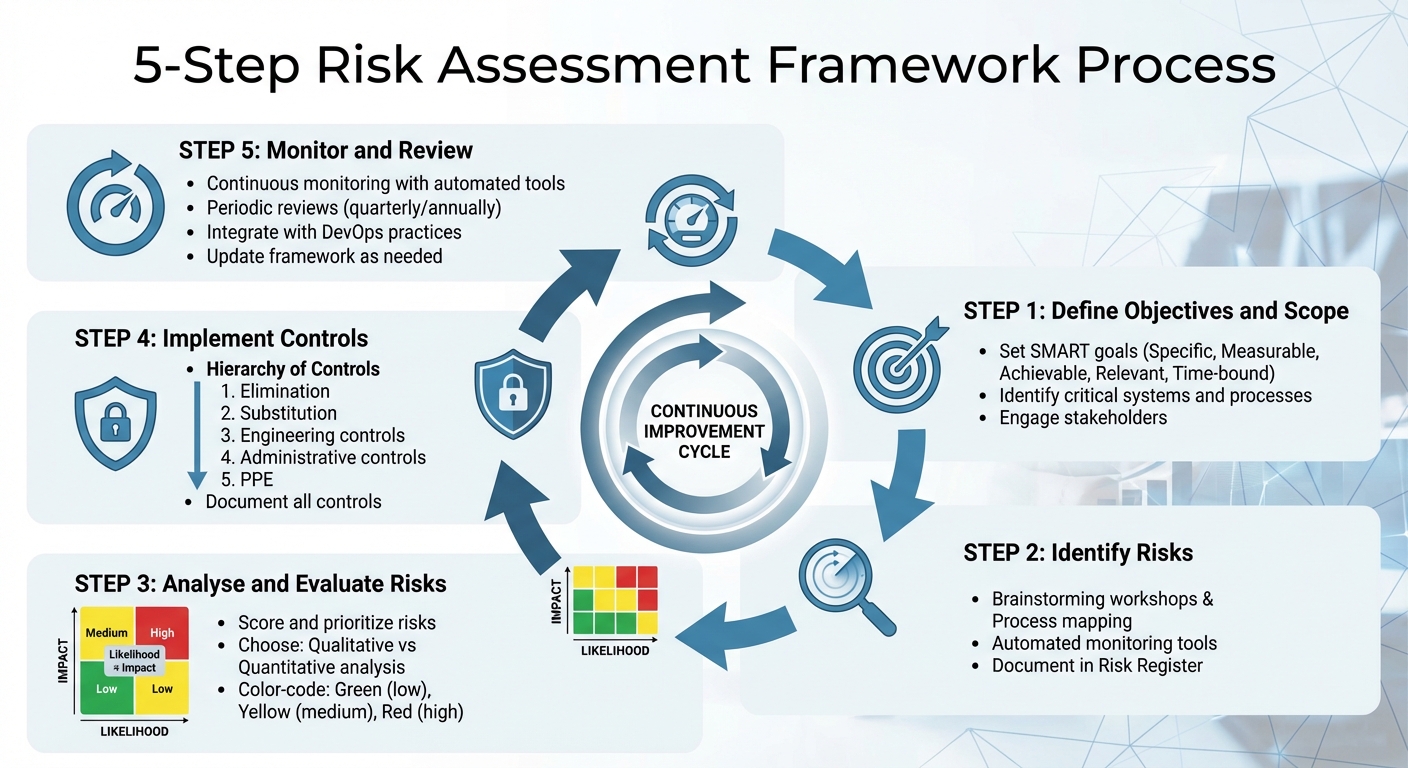 {5-Step Risk Assessment Framework Implementation Process}
:::
{5-Step Risk Assessment Framework Implementation Process}
:::
Step 1: Define Your Objectives and Scope
Set Clear Objectives
Start by identifying risk assessment objectives that match your organisation's priorities. These could involve protecting critical assets, complying with regulations like UK GDPR, or securing cloud infrastructure. To make your objectives actionable, apply the SMART criteria: Specific, Measurable, Achievable, Relevant, and Time-bound. For instance, a goal might look like:
Protect cloud infrastructure against data breaches within 12 months whilst achieving 99.9% uptime[2][3].
Your goals should also address operational challenges. For example, if you're managing DevOps pipelines, you could aim to:
Reduce deployment failures by 30% within six months by identifying risks in CI/CD processes[2][4].
Engage with key stakeholders - including legal, operations, IT, and front-line teams - to ensure your objectives align with broader business needs. Once you've set your objectives, define clear boundaries to keep your risk assessment focused and effective.
Determine the Scope
With objectives in hand, narrow your focus to the systems and processes most relevant to achieving them. This helps prioritise critical risks and avoids spreading resources too thin. Start by identifying systems, processes, and environments that are essential to your goals. For example, this might include:
- Operational processes prone to downtime
- Public, private, or hybrid cloud systems
- DevOps pipelines with CI/CD tools
For a UK-based organisation, GDPR-affected data flows and hybrid cloud hosting might be key areas, while low-impact legacy systems could be excluded if resources are tight.
Stakeholder workshops and asset inventories can help define these boundaries. Using tools like a RACI matrix (Responsible, Accountable, Consulted, Informed) ensures responsibilities are clearly assigned. For instance, if developers are spending too much time on infrastructure tasks instead of feature development, including infrastructure automation in your scope could address this issue. Similarly, auditing manual processes may reveal bottlenecks or error-prone areas that need immediate attention.
Document your scope thoroughly - it will serve as a crucial reference as you move into risk identification and analysis.
Step 2: Identify Risks
Risk Identification Methods
Once you've defined your scope, the next step is to pinpoint vulnerabilities. This involves using a range of techniques to uncover potential risks. For example, brainstorming workshops with cross-functional teams can highlight risks that individual departments might overlook. Similarly, process mapping can expose bottlenecks and manual handoffs prone to errors. If you're working with cloud infrastructure, strategic infrastructure assessments are essential for identifying weaknesses in reliability, speed, or security setups [1].
Looking closer at your workflows, auditing DevOps pipelines can reveal where manual processes slow things down or introduce errors. Past deployment failures or downtime should also be examined through root cause analysis to identify recurring issues [6].
For organisations heavily reliant on cloud systems, automated monitoring tools are invaluable. These solutions provide real-time alerts for performance issues and potential failures [1]. To anticipate external risks, techniques like scenario analysis and PESTLE scanning (assessing Political, Economic, Social, Technological, Legal, and Environmental factors) can help you prepare for challenges such as service outages or regulatory changes like GDPR updates [6].
Documenting all risks in a central Risk Register is crucial. This register should include details such as risk IDs, affected assets, threat sources, existing controls, and an initial scoring of each risk. This creates a single, organised reference point for stakeholders throughout the assessment process [7]. With all risks documented, you’ll be ready to move on to analysing their potential impact.
Common Risk Areas
Certain risks are especially common for organisations managing cloud infrastructure and DevOps workflows. One frequent issue is cloud infrastructure costs spiralling out of control due to unoptimised resources. Implementing cloud cost management strategies can cut expenses by 30–50% [1].
Another challenge is deployment bottlenecks caused by outdated or manual processes. Adopting automated CI/CD (Continuous Integration/Continuous Delivery) and IaC (Infrastructure as Code) can significantly reduce errors - by as much as 90% - and speed up deployments by up to 75% [1]. Similarly, if developers spend too much time on maintenance tasks, it could indicate misallocated resources [1].
Infrastructure reliability is a critical concern too. High downtime rates can disrupt business operations, but optimising your infrastructure and using robust monitoring tools can slash downtime by up to 95% [1]. Other risks include cloud misconfigurations that leave security vulnerabilities, CI/CD pipeline failures that disrupt delivery schedules, and the complexity of choosing between public, private, or hybrid cloud models [1].
For organisations in the UK, GDPR compliance is particularly important. Mishandling GDPR-affected data flows can result in hefty fines, making it essential to prioritise compliance when assessing risks.
The Essential Guide to Implementing a Risk Assessment Framework
Step 3: Analyse and Evaluate Risks
Now that you've documented your risks in Step 2, it's time to dive deeper by analysing and prioritising them. Not all risks are created equal - some are minor nuisances, while others could bring operations to a halt. The goal here is to assess the likelihood of each risk happening and the impact it would have if it did. This process helps you turn a simple list of threats into a clear, prioritised action plan. A risk matrix is a handy tool to streamline this step.
Use a Risk Matrix
A risk matrix is a visual tool that plots risks on a grid, with the Y-axis showing likelihood and the X-axis showing impact. To calculate a risk's score, use this formula: Risk Score = Likelihood × Impact [8][9][10]. The scores are then colour-coded - green for low-priority risks, yellow for medium, and red for high or critical risks - so you can quickly see where to focus your attention [11][12].
Most organisations prefer a 5×5 matrix for its level of detail, though smaller teams might use a simpler 3×3 version. However, the smaller grid can sometimes cluster risks too closely in the middle, making it harder to differentiate priorities [10][12]. To make your matrix meaningful, define clear criteria for each level. For example, Likely
could mean an 80% chance of occurrence or happened three or more times in the past year.
Similarly, High Impact
might mean a financial loss exceeding £50,000. Adjust these thresholds to fit your organisation’s tolerance for risk; what’s catastrophic for one company might be manageable for another [8][10].
The challenge is not just identifying what could go wrong, but focusing limited resources on the threats that matter most.– Victoria Landsmann, monday.com [10]
Once you’ve rated and plotted your risks, you can take action. Typical strategies include:
- Avoid: Eliminate the risk entirely.
- Mitigate: Reduce its likelihood or impact.
- Transfer: Shift the risk through insurance or contracts.
- Accept: Monitor the risk without taking immediate action [10].
With your risk scores in hand, you can also decide whether to use qualitative or quantitative methods to refine your analysis further.
Quantitative vs Qualitative Analysis
Risk analysis falls into two main approaches: qualitative and quantitative.
Qualitative analysis uses descriptive labels like
Low
,Medium
, orHigh
to categorise risks. It’s quick, easy to understand, and works well when you lack detailed historical data or need to align your team fast. However, it can be subjective, relying heavily on judgement [9][10][13].Quantitative analysis, on the other hand, uses hard numbers - like financial costs in pounds or project delays in days. Techniques such as Monte Carlo simulations provide precise measurements, making this method ideal for justifying decisions to executives or boards. That said, it demands high-quality data and expertise, which can make it slower and more resource-intensive [9][10][13].
Quantitative assessments can be precise, but only when supported by high-quality data. They... can give a false sense of accuracy when inputs are incomplete.– Emily Bonnie, Senior Content Marketing Manager, Secureframe [13]
If you’re looking for a middle ground, a semi-quantitative approach might be the answer. This method assigns numerical scores to qualitative categories (e.g., a 1–10 scale), offering a balance between simplicity and detail [10]. For beginners, starting with qualitative methods to identify major risks is a smart move. As your data improves, you can shift to quantitative approaches, especially when you need to present risks in financial terms [13].
To keep your risk assessments current, consider leveraging automated tools and AI-driven systems. These technologies can provide real-time updates on vulnerabilities, helping you make decisions based on up-to-the-minute data rather than relying on periodic reviews [10][13].
Step 4: Select and Implement Controls
After completing your risk analysis, the next step is to choose and implement controls to address those risks. The goal is to focus on the most critical risks - those that could significantly impact your business operations. This ensures resources are allocated where they’re needed most [15][17]. Controls should strike a balance between being effective enough to manage risks within acceptable levels and efficient in terms of cost and effort [14][15].
Types of Risk Controls
To determine the best approach, follow the Hierarchy of Controls. This framework prioritises actions as follows:
- Elimination: Remove the hazard entirely.
- Substitution: Replace the hazard with something less risky.
- Engineering controls: Implement physical or technical solutions, such as network segmentation or safety guards.
- Administrative controls: Introduce policies, training, or procedures to manage risks.
- Personal Protective Equipment (PPE): Use as a last resort when other measures are insufficient [18].
A control framework doesn't need to be complex. It needs to be structured, clear, and easy to maintain.– Frederik, RiskRegister.ai [19]
When implementing controls, work in stages to simplify the process. Start with Quick Wins, which are high-impact, low-effort actions like enabling multi-factor authentication (MFA) or setting up regular data backups. Next, address Core Governance needs, such as developing incident response plans and conducting staff training. Finally, aim for Audit-Ready Maturity by performing internal audits and maintaining thorough documentation [19].
Assign clear accountability for each control. For example, instead of vague instructions like Access should be managed properly
, use specific, actionable statements such as Quarterly user access reviews are performed for all critical systems
[19]. This level of clarity ensures accountability and makes it easier to track progress.
Document Your Framework
Centralised documentation is essential for audits, compliance, and day-to-day operations [19]. Record details for each control, including its owner, rationale, supporting evidence, and review schedule, in a centralised system [19][20]. If pursuing ISO 27001 compliance, maintain a Statement of Applicability (SoA). This document should list all 93 Annex A controls, their implementation status, and the justification for any exclusions. Keep in mind that auditors won’t accept cost or low priority as reasons for exclusion [20].
Each control should directly address a specific risk [19][20]. Proper documentation not only supports compliance but also facilitates ongoing reviews and improvements, helping align the controls with your broader risk management strategy. When presenting technical details to executives, simplify the language. For instance, instead of citing CVE numbers, highlight the financial or regulatory impact of addressing the issue [7].
Investing in a well-documented risk framework can lead to tangible benefits. Organisations with mature frameworks often report a 25% reduction in operational losses, demonstrating that thorough preparation and documentation yield measurable results [16].
Step 5: Monitor, Review, and Improve
Once controls are in place, keeping an eye on them and reviewing their effectiveness regularly is key to staying ahead of emerging risks.
Risk assessment frameworks need ongoing attention as your organisation grows and changes. Without consistent monitoring and review, even a well-designed framework can quickly lose its relevance.
Continuous Monitoring for Real-Time Insights
Continuous monitoring allows you to keep tabs on risks and controls as they happen. This is especially critical for technical risks, where threats can emerge in a matter of hours. Automated tools play a vital role here, spotting unusual behaviour, policy violations, or control lapses instantly. Acting on these alerts quickly can stop small problems from escalating into major crises.
For environments like cloud infrastructure and DevOps, monitoring should focus on key indicators such as deployment failures, security vulnerabilities, unusual access patterns, and configuration drift. These metrics act as early warning signals, helping you identify when controls need updating or when new risks surface.
Periodic Reviews and Adjustments
Regular reviews are essential to ensure your framework remains aligned with your organisation's needs and external changes. The frequency of these reviews should match the risk level of each area. Low-risk areas might only need annual or biennial reviews to confirm everything is running smoothly in stable environments [22]. On the other hand, higher-risk areas may require more frequent reviews - quarterly or even monthly.
A risk assessment framework is a systematic yet straightforward way for an enterprise to identify risks early, analyse them, and respond before they become bigger.– Plane Blog [21]
Umar Zaman, Chief Administrative Officer, Risk and Control at AXA, highlights the importance of a consistent approach:
Risk assessment approaches vary depending on the business processes... however, as a global organisation, one needs to look at risks from a holistic perspective, and in a consistent manner[23].
These regular adjustments help ensure your framework integrates smoothly with modern DevOps practices.
Integration with DevOps Practices
Incorporating controls into your DevOps pipelines turns risk management into an ongoing process rather than a separate task. This integration is especially valuable in modern workflows, where automating security checks and compliance measures can significantly reduce manual errors and save time.
Conclusion
The Importance of Custom Risk Management
Generic risk frameworks often end up as box-ticking exercises - focusing on compliance rather than identifying the unique threats your organisation faces. As Warren Buffett famously said:
Risk comes from not knowing what you're doing.[5]
A tailored framework helps uncover hidden risks that standard registers might miss, addressing the specific challenges your organisation encounters [24].
When employees understand how risk management connects to their daily responsibilities, it leads to better issue reporting and earlier detection. Organisations that involve their teams in choosing or designing the framework see a 50% improvement in successful implementation [26]. A framework should reflect your organisation’s unique needs and priorities, rather than relying on abstract, textbook scenarios.
With these considerations in mind, the focus shifts to actionable steps that embed effective risk management into your processes.
Next Steps to Get Started
To integrate proactive risk management into your organisation, consider the following steps:
- Start with a Pre-Mortem exercise: Imagine a critical project failing a year from now and work backwards to identify potential causes. This approach encourages teams to discuss risks that might otherwise go unnoticed [24].
- Establish leading indicators: Metrics like budget usage, overtime trends, and code quality scores can provide early warnings, allowing you to address issues before they escalate [24].
For organisations operating in cloud and DevOps environments, embedding risk controls directly into deployment pipelines can transform risk management. Companies like Hokstad Consulting specialise in integrating security checks and compliance measures into automated workflows. This approach not only reduces manual errors but also ensures that your risk framework scales alongside your technical operations.
Proactive risk management doesn’t aim to eliminate all uncertainty - it’s about recognising potential pitfalls before they become major issues [25]. For example, implementing frameworks such as NIST has been shown to reduce cybersecurity incidents by 30% within two years. Additionally, organisations that adopt proactive measures can cut compliance costs by 40% [26]. While the investment in building a robust framework may average around £4,000 per team member annually [26], the long-term benefits include avoiding crises and making more strategic use of resources.
FAQs
How do I set the right scope for my risk assessment?
To shape an effective scope for your risk assessment, centre it around the key objectives and areas that align with your organisation’s operations and strategic priorities. Start by pinpointing the assets, processes, and functions that are most relevant. Make sure these align with your organisation’s risk tolerance and any regulatory obligations. By doing this, you can ensure the assessment stays focused - addressing major risks without veering too wide or too narrow - making it easier to identify and plan for mitigation effectively.
What’s the simplest way to score and prioritise risks?
The easiest way to approach this is by using a risk assessment matrix. This tool helps evaluate risks based on two key factors: likelihood and impact. Here’s how you can do it:
- Categorise the likelihood of each risk (e.g., low, medium, or high).
- Assess the potential impact of the risk using the same categories.
- Plot the risks onto the matrix. This visual representation makes it easier to prioritise which risks need immediate action.
This method provides a straightforward and consistent way to stay on top of risk management.
How often should I review and update my risk framework?
Regularly revisiting and updating your risk assessment framework is key to keeping it relevant and aligned with your organisation’s changing needs. This involves ongoing monitoring, evaluation, and fine-tuning of policies and controls to respond to shifting circumstances and newly arising risks. By making frequent reviews a routine part of the framework's lifecycle, you can ensure it stays effective and ready to tackle fresh challenges.