
If I had to boil this down to one point, it’s this: no single tool will keep a hybrid estate compliant on its own. I’d use a stack that covers policy rules, build-time checks, live monitoring, logging, asset tracking, evidence collection, cloud-native controls, and workflow orchestration.
That matters because hybrid compliance is not just about passing an audit. It’s about proving, every day, that controls ran across public cloud, private cloud and on-prem systems. And when audits are manual, the time cost can be huge: 200–400 hours per audit cycle in smaller firms, versus 20–40 hours with automated evidence collection.
If you’re comparing options, these are the 8 tool types that matter:
- Policy as Code engines for rule enforcement in CI/CD, Kubernetes and APIs
- CSPM platforms for drift and misconfiguration checks after deployment
- IaC security scanners for build-time checks before changes go live
- SIEM and log analytics for central logs, audit trails and event history
- Asset discovery tools for a current inventory of cloud, on-prem and SaaS assets
- Compliance reporting and evidence tools for audit packs and control mapping
- Cloud-native policy services like AWS Config, Azure Policy and GCP Org Policies
- AI-assisted compliance orchestration for routing findings, approvals and evidence tasks
What I’d look for in any stack is simple:
- one policy baseline across environments
- control mapping to CIS, NIST, PCI DSS, SOC 2 and UK GDPR
- log retention that fits UK audit and record-keeping rules
- structured exports like CSV, JSON or SARIF
- clear links between findings, owners, fixes and evidence
Automating security and compliance for hybrid environments
Quick Comparison
| Tool type | Main job | Best at | Main gap |
|---|---|---|---|
| Policy as Code | Enforce rules before or during deployment | Blocking bad changes early | Setup and policy writing |
| CSPM | Check live cloud posture | Drift and misconfiguration detection | Less depth for older on-prem systems |
| IaC scanners | Scan templates before deployment | Catching issues in pull requests and CI | No runtime view |
| SIEM | Centralise and analyse logs | Audit trails and event history | Cost and setup effort |
| Asset discovery | Keep an inventory of assets | Ownership, scope and change tracking | No direct enforcement |
| Evidence tools | Build audit-ready proof | Mapping controls to records | Depends on source data quality |
| Cloud-native policy | Enforce rules inside one cloud | Native provider checks and fixes | Poor cross-cloud view |
| AI orchestration | Route tasks across tools | Workflow and evidence handling | Harder to explain decisions to auditors |
My view: the strongest setup usually starts with asset discovery + policy as code + IaC scanning + CSPM + SIEM, then adds evidence tooling on top. Cloud-native services support each provider, and AI layers help move findings into action.
So if you’re choosing tools today, I wouldn’t ask “which single product is best?”. I’d ask: which mix closes the gaps between prevention, monitoring and audit evidence?
What Hybrid Cloud Compliance Automation Must Cover
Compliance automation is a lifecycle, not a single tool. It moves through six linked stages, and each one builds on the one before it. Each stage also lines up with a different tool category in a hybrid cloud stack. Skip one, and you leave a hole.
Asset discovery comes first. You can’t protect or prove anything if you haven’t even catalogued it. Automated discovery should cover public cloud accounts, private cloud clusters, on-premises systems, SaaS integrations, and third-party subprocessors. For each asset, UK teams should record the data owner, the data categories involved, whether personal or sensitive data is present, where storage and processing happen, and the retention period that applies.[7]
Next comes policy codification. This is where regulatory duties become machine-readable rules. FCA handbook provisions such as SYSC 9, along with MiFID II record-keeping duties, require firms to retain records in an orderly way for as long as they remain relevant, with retention periods set by regulation and internal policy.[3][4][5][6] Those rules should be version-controlled, testable, and enforced across the estate.
Then there’s IaC scanning, which stops problems before they reach production. Scanners built into CI/CD pipelines check Terraform plans, CloudFormation templates, Kubernetes manifests, and configuration scripts against those codified policies. For UK organisations, that means flagging things like missing immutability, disabled logging, or data transfers to unapproved jurisdictions.[5][6][7]
After deployment, runtime monitoring watches for drift in live systems. At the same time, log centralisation pulls events from every environment into immutable storage. FCA and MiFID II expectations are pretty plain here: records must be kept in a format that cannot be altered or deleted during the retention period, must be replayable, and must be readily accessible to clients or regulators on request.[5][8]
The last stage is proving that controls actually ran. Evidence automation links controls to audit records such as timestamps, access logs, and test results.[6][7]
These stages sit underneath the eight tool categories covered next.
| Stage | Coverage | UK Focus |
|---|---|---|
| Asset discovery | Cloud accounts, private clusters, on-premises systems, SaaS integrations, subprocessors | Record jurisdiction, data type and retention |
| Policy codification | Regulatory and internal rules as machine-readable code | Map to FCA, MiFID II and UK GDPR obligations |
| IaC scanning | Pre-deployment checks on templates and manifests | Flag missing immutability, disabled logging and unapproved jurisdictions |
| Runtime posture monitoring | Continuous drift detection in live environments | Track logging health across in-scope systems |
| Log centralisation | Aggregated, immutable event storage | WORM-compatible storage; defined retention periods |
| Evidence automation | Control-to-record mapping with retention metadata | Include timestamps, owner and retention metadata |
The next sections break these stages into tool types and show where each one fits in the stack.
1. Policy as Code Engines
Policy as code engines turn the controls defined earlier into rules a system can execute. Those rules can block, log or approve changes across CI/CD, Kubernetes and cloud APIs. In plain terms, PaC is the enforcement layer for the policy stage already set in the compliance lifecycle.
A practical PaC stack has four parts: policy definition, policy evaluation, enforcement points, and audit output.
Hybrid Coverage
OPA works well across mixed estates because the same Rego policy can run in CI, at Kubernetes admission, and through cloud APIs. That means teams don’t have to rewrite the same logic for each layer. Sentinel is a good fit for teams already using Terraform Cloud or Terraform Enterprise.
Automation Depth
PaC moves remediation left by catching misconfigurations before deployment. That’s the big win.
Admission control can block non-compliant deployments at request time. Runtime decision APIs can answer allow-or-deny queries from live services. A sensible way to roll this out is to start in audit-only mode, see what would have been blocked, and then move to blocking enforcement for high-risk controls.
Evidence Integration
Send evaluation logs to your SIEM or log analytics platform so you have a traceable audit trail. Tag each rule with its control reference, then export scheduled compliance summaries. Those logs also feed SIEM and reporting tools, which makes evidence gathering far less painful during reviews.
| Component | Tool | Role |
|---|---|---|
| Policy engine | OPA (Rego) | Evaluates policies across hybrid environments |
| IaC enforcement | Conftest | Runs OPA policies against Terraform plans in CI |
| Kubernetes admission | OPA Gatekeeper | Blocks non-compliant manifests at deploy time |
| Audit storage | WORM-enabled storage | Preserves policy decisions for compliance evidence |
| HashiCorp alternative | Sentinel | Policy enforcement within Terraform Enterprise/Cloud |
Where PaC enforces specific rules, CSPM checks broader posture across accounts, clusters and subscriptions.
2. Cloud Security Posture Management (CSPM) Platforms
Where policy-as-code engines enforce rules at deployment time, CSPM platforms keep watch after deployment. They continuously check cloud configurations to spot misconfigurations, policy breaches, exposed assets and weak identity permissions across IaaS, PaaS and SaaS. In plain terms, CSPM is the runtime counterpart to policy as code. It turns policy into continuous posture data.
Hybrid Coverage
A good CSPM platform discovers and monitors resources across AWS, Azure, GCP, Kubernetes and on-premises infrastructure through connectors or agents. For UK teams, that means one view of misconfigurations and drift across public cloud, Kubernetes and on-premises systems. Many leading platforms rely on agentless scanning, which helps cover large, fast-changing estates without putting sensors everywhere.[13][14]
Framework Mapping
This is where CSPM can save teams a lot of legwork. Most tools come with built-in assessment libraries mapped to frameworks UK teams often need, including CIS Benchmarks, ISO 27001, NIST 800-53, PCI DSS, SOC 2 and GDPR. So when a finding appears, it can already be linked to the relevant control reference.[11]
Automation Depth
Detection on its own only gets you halfway. Strong CSPM tools can automate fixes for common misconfigurations, such as blocking public access, enforcing encryption and tightening IAM roles, using runbooks or cloud automation.[16][17] Many also plug into CI/CD pipelines, so posture checks happen during build as well as in production.
Evidence Output
CSPM platforms keep timestamped posture snapshots, risk scores and remediation records that can be used during audits.[12][15]
| Capability | What to look for |
|---|---|
| Hybrid discovery | Covers public cloud, Kubernetes and on-premises from one console |
| Framework mapping | Pre-built checks for ISO 27001, PCI DSS, NIST and GDPR |
| Remediation automation | Runbooks or cloud automation for common fixes |
| Evidence export | Timestamped posture snapshots tied to specific controls |
| Asset ownership | Clear control scope and ownership for each resource |
CSPM catches live drift. The next category catches many of those same issues before deployment.
3. Infrastructure as Code (IaC) Security Scanners
IaC scanners catch misconfigurations before they hit live environments. They check infrastructure templates - Terraform, CloudFormation, ARM/Bicep, Kubernetes YAML and Helm charts - before anything is provisioned. So instead of finding problems in production, teams can catch them at commit, pull request, or CI stage. That puts IaC scanning right between policy design and runtime monitoring.
Organisations using both IaC scanning and CSPM saw 73% fewer cloud breaches than those using neither.[10]
Hybrid Coverage
Coverage only matters if the scanner fits the IaC stack you use across cloud and Kubernetes formats. In hybrid estates, tools such as Checkov can handle broad rule sets across multiple providers and formats. That said, legacy private-cloud setups or bespoke on-premises tooling often sit outside normal IaC coverage.
Control Mapping
A misconfiguration finding only helps with an audit if it maps to a named control. Good scanners link issues like public exposure or privileged workloads to CIS, NIST, or ISO 27001 controls. For UK teams in regulated sectors, that matters a lot. A finding tied to a control reference is far more useful as audit evidence than a vague alert.
Automation Depth and Evidence Integration
Mature IaC scanning does more than flag issues. It adds enforcement and evidence. Strong setups can block pull request merges when there’s a critical violation, send exceptions through an approval workflow, and log the approver, waiver time, and policy version. In plain terms, you get a clear audit trail tied straight to the policy decision.
Tools should also export JSON, JUnit XML, or SARIF. That makes it much easier to push results into GRC platforms or compliance dashboards without manual evidence collection.[18]
| Capability | What to look for |
|---|---|
| IaC format support | Covers Terraform, CloudFormation, ARM/Bicep, Kubernetes YAML and Helm |
| Control mapping | Findings linked to CIS, NIST, ISO 27001 or internal policy references |
| CI/CD integration | Scans trigger on pull requests with configurable severity gates |
| Exception handling | Approval workflow with logged waivers and policy version references |
| Evidence export | JSON, JUnit XML or SARIF output compatible with GRC and audit tools |
Those outputs should also feed into SIEM and evidence automation.
4. SIEM and Log Analytics Platforms
Policy engines and scanners help stop bad changes before they land. SIEM shows what actually happened across the estate.
These platforms pull events from on-premises systems, public cloud, private cloud and SaaS into one analysis layer. From there, they normalise logs and link identity, endpoint and network activity, so teams can trace activity across different environments instead of piecing it together by hand.[19][20][21]
Frameworks such as ISO 27001, PCI DSS, SOC 2 and GDPR all rely on detailed audit trails for user activity, admin changes and security events. Without one joined-up platform, UK organisations can find it hard to prove full coverage during audits or regulatory checks.[21][23] SIEM is also the place where events from policy engines, CSPM and IaC controls come together into a single record of what happened, and when.
Hybrid Coverage
Good hybrid coverage means the SIEM can ingest, parse and correlate telemetry from both older on-premises systems and newer multi-cloud workloads.[19][21][22] In plain terms, it should support Windows and Linux servers, Active Directory or Entra ID, AWS CloudTrail, Azure Activity Logs and GCP Audit Logs, plus key SaaS APIs for platforms such as Microsoft 365 and Okta. That gives you visibility into sign-ins, permission changes and admin actions across the stack.[19][21][22]
Local collectors on-premises matter as well. They can buffer logs during connectivity outages and keep audit trails moving when the network drops, which is important for UK operational resilience expectations.[19]
Control Mapping and Evidence Integration
Many SIEM tools come with dashboards mapped to ISO 27001, PCI DSS and SOC 2. Each report should be tagged with control IDs, such as ISO 27001 A.12.4 for logging and monitoring, so exports are ready for audit use instead of being nothing more than raw log dumps.[21][23]
Logs should also sit in tamper-evident storage, with delete access tightly restricted and log-handling procedures written down and followed.[26][27] That turns the SIEM into the evidence layer for the rest of the stack.
| Capability | What to look for |
|---|---|
| Hybrid source coverage | Native connectors for on-prem Active Directory/Entra ID, AWS, Azure, GCP and key SaaS platforms |
| Control mapping | Built-in dashboards tagged to ISO 27001, PCI DSS, SOC 2 and GDPR requirements |
| Log integrity | Tamper-evident storage with restricted delete access and defined retention policies |
| Evidence export | Scheduled reports in CSV, JSON or PDF formats aligned to specific control sets |
| AI-assisted analytics | Risk-based alerting and anomaly detection to surface compliance-relevant events |
CSPM findings and IaC scanner results can also be brought in as enriched events, and the SIEM should provide structured exports for reporting tools.[21][24][25] Use cloud SIEM when scale is the main driver. Keep on-prem SIEM when data residency or regulatory rules mean logs must stay on-premises.[28][29][30]
Accurate source mapping depends on a complete asset inventory.
5. Asset Discovery and Configuration Inventory Tools
A solid inventory is the source of truth for the rest of your compliance stack. Asset discovery and configuration inventory tools build the main record of assets across on-premises, private cloud and public cloud setups, often inside a CMDB. Your SIEM and CSPM lean on that record, so if the inventory is wrong, everything built on top of it starts to wobble.
Hybrid Coverage
Good hybrid coverage pulls together a few different methods. It uses API-based cloud discovery for AWS, Azure, GCP, Kubernetes and SaaS, then pairs that with network-based and agent-based discovery for on-premises systems. After that, it reconciles the data into one record per asset.[32]
That sounds neat on paper, but there are a few usual gaps. Ephemeral cloud resources can appear and vanish before slower scans notice them. Shadow SaaS can slip in outside the normal procurement route. And older on-premises systems? They often sit in the corner like an old filing cabinet nobody wants to open.
Control Mapping
Each asset should be tagged with the right context: owner, data class, environment and the controls that apply to it, such as PCI DSS encryption or UK GDPR personal data handling.[33][9][35]
Cloud-aware CMDBs can link new instances to their cloud accounts and services on their own, then run compliance checks and open remediation tickets when those assets drift from the required configuration.[31][35] That matters because infrastructure changes all the time. Without that link, control mapping can go stale fast and turn into a snapshot from last month instead of a picture of what exists now.
Automation Depth and Evidence Integration
Automation can be light-touch or near constant. Some teams stick with scheduled scans. Others run real-time, continuous discovery tied into ITSM, security and compliance workflows.[2][34]
For audit evidence, the CMDB shows what exists, who owns it, how it is configured and how it changes over time.[34][36] That gives auditors something concrete to work with instead of a pile of spreadsheets and last-minute screenshots. Exportable dashboards can show asset counts, compliance status, open deviations and remediation actions, ready to hand over without stitching everything together by hand.
When discovery data also feeds into the SIEM and CSPM layers, the evidence gets richer. You’re not just showing that an asset exists. You’re also showing incident data, configuration drift and remediation timelines around that asset.[2][33]
| Discovery approach | Strengths | Typical limitations |
|---|---|---|
| API-based cloud discovery | Fast, continuous visibility into AWS, Azure, GCP and SaaS | May miss legacy or disconnected on-premises assets |
| Network-based / agentless discovery | Useful for on-premises, legacy and segmented environments | Requires network access and reconciliation tuning |
| CMDB-backed inventory | Best for ownership, lifecycle and change history | Depends heavily on data quality and reconciliation discipline |
| Continuous discovery | Strongest for drift detection and evidence automation | Needs integration and governance to stay accurate |
That inventory then feeds the reporting layer, where teams turn raw asset data into audit evidence.
6. Compliance Reporting and Evidence Automation Tools
Building on discovery, posture and log data, this layer turns control data into audit-ready evidence. Compliance reporting and evidence automation tools continuously collect, sort and package proof that your controls are working.
The time savings can be huge. Manual evidence collection can eat up 200–400 hours per audit cycle for smaller organisations. Automated platforms cut that down to 20–40 hours - up to a 90% reduction.[40]
Hybrid Coverage
The tools worth a look connect to both public cloud and on-premises environments, not just a single cloud provider. In practice, that means pulling evidence from AWS, Azure and GCP, along with VMware, Windows, IAM directories, CMDBs and ticketing systems.
Why does that matter? Because without that range, your audit pack will still have gaps. That’s often where teams get caught out, especially when controls sit across the line between cloud and on-premises systems.
Control Mapping
Strong platforms build a single control library and map each control to multiple frameworks at the same time, such as ISO 27001, SOC 2, PCI DSS and GDPR.[37][38] Evidence gathered for one framework can then be reused where controls overlap, which cuts a lot of duplicated work.
For UK teams, this helps when you need to line up internal, regulatory and contract requirements. It turns raw technical artefacts into documentation auditors can work with.
Automation Depth and Evidence Integration
Reporting tools give you outputs. Evidence automation tools go a step further and collect proof straight from source systems. The better platforms pull evidence through APIs - access reviews, MFA enforcement records, encryption settings, patch status and change approvals - and timestamp everything with a full audit trail.[38][39]
That audit trail matters. Auditors don’t just want to see that a control looks right today. They want proof that it was operating at a specific point in time.
| Evidence source | What it demonstrates |
|---|---|
| IAM and identity providers | Privileged access reviews, MFA enforcement |
| SIEM and log platforms | Log retention, incident detection activity |
| Ticketing and ITSM systems | Change approvals, remediation timelines |
| Cloud configuration APIs | Encryption status, policy compliance, drift |
| IaC repositories | Policy-as-code history, deployment approvals |
Automated reminders and auditor portals - where external reviewers can access evidence directly - make audit prep more repeatable and cut down on email chasing.[38][39][41]
The next layer is cloud-native policy and configuration services, which feed this evidence stream automatically.
7. Cloud-Native Policy and Configuration Services
Cloud providers also ship native policy layers that check resources inside their own platforms. They can flag, block, or fix changes that break your rules. When you use them well, they become the enforcement layer that sits alongside the rest of a hybrid security stack.
Hybrid Coverage
The main limit is scope. AWS Config, Azure Policy, and Google Cloud Organisation Policies work best inside their own platforms. They do not natively give you one shared view across on-premises systems or other clouds.
In a hybrid estate, it helps to treat them as platform-specific enforcement points, not as one unified control plane. AWS Config can also assess non-AWS assets by ingesting external configuration data as custom resources.[44]
Control Mapping
Native policy layers turn compliance requirements into provider-specific rules. Those rules can run at deployment time or against resources that already exist. AWS Config maps to CIS and SOC 2 rules, Azure Policy uses built-in definitions and initiatives, and Google Cloud Security Command Center supports compliance dashboards with Organisation Policy constraints.[1][45]
A practical way to handle this is to set one baseline mapped to NIST SP 800-53 and UK GDPR/ICO guidance, then connect each requirement to the right provider rule or constraint. That gives auditors a clear line from high-level requirements down to policies they can test in each cloud. Used together, these native rules form the baseline that other tools need to check and report on.
Automation Depth
These services range from audit-only checks to prevention and auto-remediation. AWS Config and Azure Policy can audit existing resources and flag non-compliance. Azure Policy also supports deny effects that block non-compliant deployments outright, plus DeployIfNotExists and Modify effects that can fix settings automatically, such as adding diagnostic settings or enforcing tags.[1][46]
Google Cloud Organisation Policies are preventive only. They stop non-compliant resources from being created, but they do not scan past configurations. That can leave gaps if older misconfigurations are still sitting there.[43]
A sensible starting point is audit mode. That shows you your baseline as it stands today. After that, you can fix the issues you find and then switch high-risk controls to deny or strict enforcement, such as public storage buckets or unrestricted network ports.
Evidence Integration
These services feed straight into audit workflows, but UK teams still need to send native logs to a central SIEM and match retention periods across the estate. In financial services, that often means keeping records for several years.[42]
Put plainly, these services only do part of the job on their own. Their output needs to be centralised with the rest of the hybrid evidence chain.
Where native controls stop at the provider boundary, AI-assisted orchestration can tie the whole stack together.
8. AI-Assisted Compliance Orchestration Services
AI-assisted orchestration sits above the tools many teams already use. Think of it as a coordination layer that pulls signals from across a hybrid estate and turns them into automated workflows that people can actually act on.
It doesn't replace CSPM platforms, SIEM systems or IaC scanners. Instead, it helps move findings into remediation and evidence workflows. The main point is simple: it turns isolated alerts into one remediation and evidence workflow.
Hybrid Coverage
AI-assisted orchestration brings together signals from public cloud, private cloud and on-premises systems into a single workflow.
Control Mapping
Manual control mapping across frameworks takes time and drains team capacity. AI-assisted platforms can parse regulatory text, suggest control mappings and flag gaps across ISO 27001, SOC 2, UK GDPR and PCI DSS.
That matters because one control can map to multiple frameworks at the same time. So instead of different teams doing the same mapping work again and again, they can cut duplicate effort.
Automation Depth
Research reports shorter compliance cycles, lower manual effort and higher accuracy. In day-to-day use, the orchestration layer can handle routine checks like patch verification, log retention and MFA enforcement automatically.
When a task needs judgement, such as risk acceptances or policy changes, it routes those items to human reviewers. That's a good split: let the system handle the repetitive work, and keep people focused on calls that need context.
Evidence Integration
The platform can collect, classify and tag evidence from cloud APIs, CI/CD, HR and endpoint systems into an audit-ready repository, while respecting UK data-residency rules.[47][48][49]
For UK teams, that cuts the manual work tied to annual ISO 27001 surveillance audits or FCA reviews. It also makes it easier to check whether evidence is current and complete.[47][48]
That makes this category the coordination layer, not another point tool.
The next section compares the eight categories by role and coverage.
How the 8 Categories Compare
::: @figure 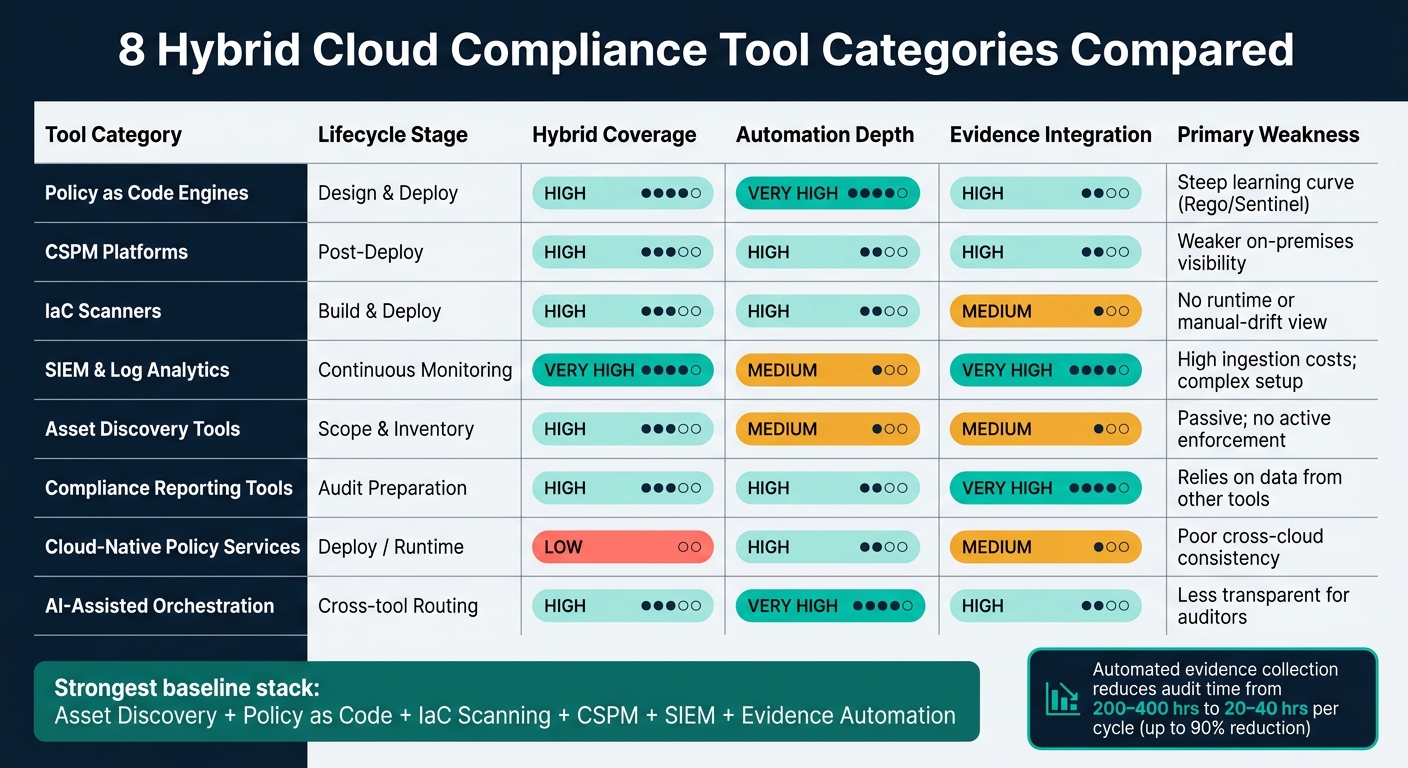 {8 Hybrid Cloud Compliance Tool Categories Compared}
:::
{8 Hybrid Cloud Compliance Tool Categories Compared}
:::
No single category covers the full lifecycle. The strongest hybrid programmes mix a few of them together. This comparison uses the same lifecycle stages defined above.
The table below shows where each category fits in that lifecycle and where it does its best work.
| Category | Lifecycle Stage | Hybrid Coverage | Control Mapping | Automation Depth | Evidence Integration | Primary Weakness |
|---|---|---|---|---|---|---|
| Policy as Code Engines | Design and deploy | High (vendor-neutral) | High (customisable) | Very High (CI/CD and runtime gates) | High (Git history) | Steep learning curve (Rego/Sentinel) |
| CSPM Platforms | Post-deploy | High (multi-cloud) | High (CIS, NIST, ISO 27001) | High (drift detection, ticketing) | High (dashboards, snapshots) | Weaker on-premises visibility |
| IaC Scanners | Build & Deploy | High (multi-format) | Medium (secure configuration) | High (pre-deployment checks) | Medium (scan logs) | No runtime or manual-drift view |
| SIEM & Log Analytics | Continuous Monitoring | Very High (hybrid) | Medium (incident-focused) | Medium (alerting, investigation) | Very High (immutable audit trails) | High ingestion costs; complex setup |
| Asset Discovery Tools | Scope & Inventory | High (cloud/on-prem visibility) | Low (inventory only) | Medium (inventory automation) | Medium (snapshots) | Passive; no active enforcement |
| Compliance Reporting Tools | Audit Preparation | High (SaaS/cloud) | Very High (audit-ready) | High (evidence collection) | Very High (framework-aligned) | Relies on data from other tools |
| Cloud-Native Policy Services | Deploy / Runtime | Low (single-cloud) | High (native frameworks) | High (native enforcement) | Medium (provider logs) | Poor cross-cloud consistency |
| AI-Assisted Compliance Orchestration | Cross-tool routing | High (cross-tool) | Medium (risk-based) | Very High (workflow routing) | High (analytics layer) | Less transparent for auditors |
Read the table as a trade-off map, not a ranked list.
A few patterns stand out straight away. SIEM and log analytics sit at the top for evidence because they pull logs and control events into one place. That gives teams a strong audit trail, even if setup can be messy and ingestion costs can bite.
At the other end, cloud-native policy services tend to struggle across mixed estates. They work well inside their own provider, but that provider-specific focus makes cross-cloud consistency harder.
There’s also a clear split between prevention and detection. IaC scanners catch bad templates before deployment. Policy as Code Engines go a step further by blocking non-compliant changes in CI/CD or at admission time. That difference matters. One flags issues; the other can stop them before they land.
Next, these categories are mapped to representative tools and platform examples.
Representative Tools and Platform Examples
Below are representative tools by category, not a ranked shortlist. The aim is simple: map each compliance layer to the tools teams use day to day.
Policy as Code Engines: OPA is the most portable choice. Teams use it to enforce policies across Kubernetes admission control, APIs, CI/CD pipelines and Terraform with Rego, then store and version those policies in Git. Conftest runs OPA policies against Terraform plans, Kubernetes manifests and Dockerfiles in CI/CD, returning pass/fail output for pipeline reports. Terraform Sentinel sits directly inside Terraform Cloud and Enterprise and supports three enforcement levels - advisory, soft and hard - but it stays within the HashiCorp ecosystem and usually needs a paid tier.
CSPM Platforms: These tools keep checking cloud posture and produce compliance reporting artefacts. Lacework inventories resources across AWS, Azure, GCP and Kubernetes and validates posture against CIS best practices.[53] Datadog Cloud Security checks alignment with PCI DSS, SOC 2 and HIPAA, and brings posture findings together with runtime threat alerts.[52][54] Check Point CloudGuard CSPM assesses compliance across AWS, Azure and GCP with built-in or custom rulesets, though cross-cloud consistency takes careful ruleset management.[50][51]
IaC Scanners: Checkov comes with more than 750 predefined policies for Terraform, CloudFormation, Kubernetes, Helm, ARM and Docker.[56] Trivy includes misconfiguration checks for Terraform and container artefacts, but support for non-container IaC formats is more limited. KICS covers Ansible, OpenAPI and Docker alongside standard IaC formats, which helps in mixed stacks. Terrascan runs on OPA/Rego underneath and ships with 500+ security policies, so custom Rego rules written for OPA can be reused directly.[55][58]
SIEM and Log Analytics: Microsoft Sentinel is cloud-native, scales for hybrid telemetry, and uses built-in AI for detection and response, though costs can climb fast at scale.[57] Splunk Enterprise Security ingests machine data across endpoints, networks, cloud and identity systems, but the licensing overhead can be heavy. IBM QRadar centralises security visibility and correlates user behaviour anomalies. It is now available as a cloud-native SaaS offering, though moving from on-premises deployments can be hard.
Asset Discovery and Configuration Inventory: Native cloud services - AWS Config, Azure Resource Graph and Google Cloud Asset Inventory - provide authoritative resource lists that CSPM platforms consume through APIs, though each one stops at its own provider boundary. Agent-based and network-based tools extend coverage to on-premises and legacy systems, but they need disciplined reconciliation to stop records going stale.
Compliance Reporting and Evidence Automation: This layer turns findings into audit-ready evidence. Dedicated GRC platforms ingest findings from CSPM tools, SIEM incidents and IaC scanner outputs, then map them to frameworks such as ISO 27001, SOC 2 and PCI DSS to produce structured evidence packages. The catch is straightforward: the output is only as good as the completeness and accuracy of the upstream data sources.
Cloud-Native Policy and Configuration Services: Native cloud controls deal with provider-specific enforcement. AWS Config rules, Azure Policy initiatives and Google Cloud Organisation Policy constraints enforce baseline configuration within each provider boundary. AWS Config and Azure Policy support audit and remediation modes; Google Cloud Organisation Policies are preventive only and do not scan existing resources.[43][44][45][46] None of these services gives teams a single view across providers without extra tooling.
AI-Assisted Compliance Orchestration: Tools in this group parse regulatory text, suggest control mappings across frameworks such as ISO 27001, SOC 2 and UK GDPR, and route findings into remediation and evidence workflows automatically.[47][48][49] The trade-off is less transparency for auditors who need to trace decisions back to specific rules or human approvals.
Even with all of these tools in place, hybrid estates still break down in the gaps between clouds, platforms and inventories.
Common Gaps UK Teams Should Watch For
Most failures don't happen inside the tools. They happen in the gaps between them.
That's the pattern UK teams keep running into: the hand-off breaks. One tool finds an issue, another tool should act on it, and somewhere in between the thread gets lost. That tends to show up across the discovery, enforcement, monitoring and evidence chain above.
Inconsistent policy definitions are a common gap across hybrid estates. If one environment uses one rule set and another uses something slightly different, things drift fast. The fix is a single policy-as-code baseline mapped to each environment, with automated drift detection.
Ephemeral workloads create a different headache. They can spin up and disappear before scheduled scans ever see them. So point-in-time scanning isn't enough on its own. Use IaC scanning at build time, continuous API-driven discovery at runtime, and mandatory tagging for owner and classification.
Discovery is only useful if the findings reach SIEM in a format people can work with. CSPM and IaC findings must be normalised before SIEM ingestion. Without that, alerts become messy, fields don't line up, and reporting turns into a manual slog. Use a common schema for control ID, environment, severity, owner and remediation deadline.
Evidence export is another common failure point. Plenty of tools keep evidence trapped in proprietary views, and retention can be shorter than UK audit needs. That becomes a problem the moment an auditor asks for proof from months back and the record is gone. Check for structured CSV or JSON exports mapped to control IDs and configurable retention periods.
The same issue shows up again in native cloud policy layers. Native cloud controls fragment compliance in multi-cloud estates. They work inside one provider only, so on their own they don't give you a joined-up view. The safer approach is to place them inside a cross-cloud baseline: define provider-agnostic control objectives first, then map them to each cloud's native policy layer.
Conclusion
No single tool covers the whole hybrid cloud compliance lifecycle. You need a connected set of tools that work together: policy as code, IaC scanners, CSPM, asset discovery, SIEM and log analytics, reporting tools, cloud-native policy services, and AI-assisted orchestration. Put together, they form a steady loop of prevent, detect, evidence and report.
The right mix comes down to three things: estate size, regulatory burden, and integration depth. In plain terms, the bigger and more complex your estate, the more care you need with tool selection. If you’re working under heavier regulation, you’ll also need stronger evidence automation and tighter control mapping.
That’s why integrations matter so much. Native integrations, APIs, webhooks, and exportable evidence formats can save a lot of pain later. Without them, “automation” often turns into manual admin dressed up as something smarter.
The split of work should stay clear. Automation should handle repeatable checks and evidence collection. People should own policy, exceptions, and risk acceptance.
FAQs
How do I choose the right hybrid compliance stack?
Start with your organisation’s regulatory requirements, such as UK GDPR or ISO 27001. Then look at how complex your infrastructure is and how your current DevOps workflows run day to day.
If you’re working across more than one platform, it helps to put vendor-neutral tools first. Open Policy Agent (OPA) is a good example. It gives you one policy layer across different systems, which makes life a lot easier when teams aren’t all using the same stack.
Pick tools that plug into your CI/CD pipelines so security checks happen early. That means shift-left security and IaC scanning can happen before deployment, not after something has already gone live.
It also makes sense to add CSPM for centralised visibility and drift detection. And if you want governance to stay consistent - and ready for audits when they come around - a Cloud Centre of Excellence can help keep everyone working to the same rules.
Which tool types should I deploy first?
Start by cataloguing your infrastructure with cloud-native tools such as AWS Config or Azure Resource Graph. That gives you a clear view of what you have and where it sits.
Next, put IaC security scanners like Checkov or Terrascan into your CI/CD pipelines. That way, you can catch issues before they make it into production.
It also helps to add a policy engine such as Open Policy Agent (OPA) for steady hybrid cloud governance. Put together, this gives you visibility, prevention, and centralised control.
How can I prove compliance across cloud and on-prem?
Use continuous, automated oversight instead of periodic manual audits. In plain terms, make compliance part of the system itself. That means turning security and regulatory requirements into machine-readable policies, so teams can enforce, monitor and fix configurations the same way across cloud and on-premises setups.
Bring audit logs and compliance data into one place, such as a SIEM or monitoring dashboard. This gives you a single source of truth for audit-ready reporting and cuts down the usual back-and-forth when someone asks for evidence.
Policies also need to stay in step with UK rules, including GDPR and ISO 27001. If those policies drift, the whole process starts to wobble.