
If I had to cut this down to one answer, it’s this: for UK apps, GCP led slightly on p95 latency and throughput, AWS stood out on scaling speed, and Azure offered the highest single-volume storage IOPS. But in most production setups, region choice, storage tier, autoscaling settings and egress costs will shape your results more than the cloud brand alone.
If you’re comparing providers for a UK workload, I’d focus on four checks first:
- User latency from UK regions
- p95/p99 app latency under load
- Autoscaling during traffic spikes
- Monthly cost in £, including egress and storage
The numbers in this piece are close enough that there is no clear winner for every case. GCP posted 175 ms p95 and 1,920 req/s, AWS 180 ms and 1,850 req/s, and Azure 195 ms and 1,780 req/s. For reliability, all three list 99.99% multi-zone compute SLA. For storage-heavy databases, Azure tops the table at up to 400,000 IOPS per volume, ahead of AWS at 256,000 and GCP at 120,000.
What I’d take from that:
- Pick AWS if burst scaling and high-scale web traffic are your main concern.
- Pick Azure if you run Microsoft-heavy systems or need very high disk IOPS.
- Pick GCP if throughput, containers or data-heavy services matter most.
- Don’t judge on averages alone. p95, p99, error rates and failover design matter more.
- A multi-zone setup should be your baseline for customer-facing UK services.
::: @figure 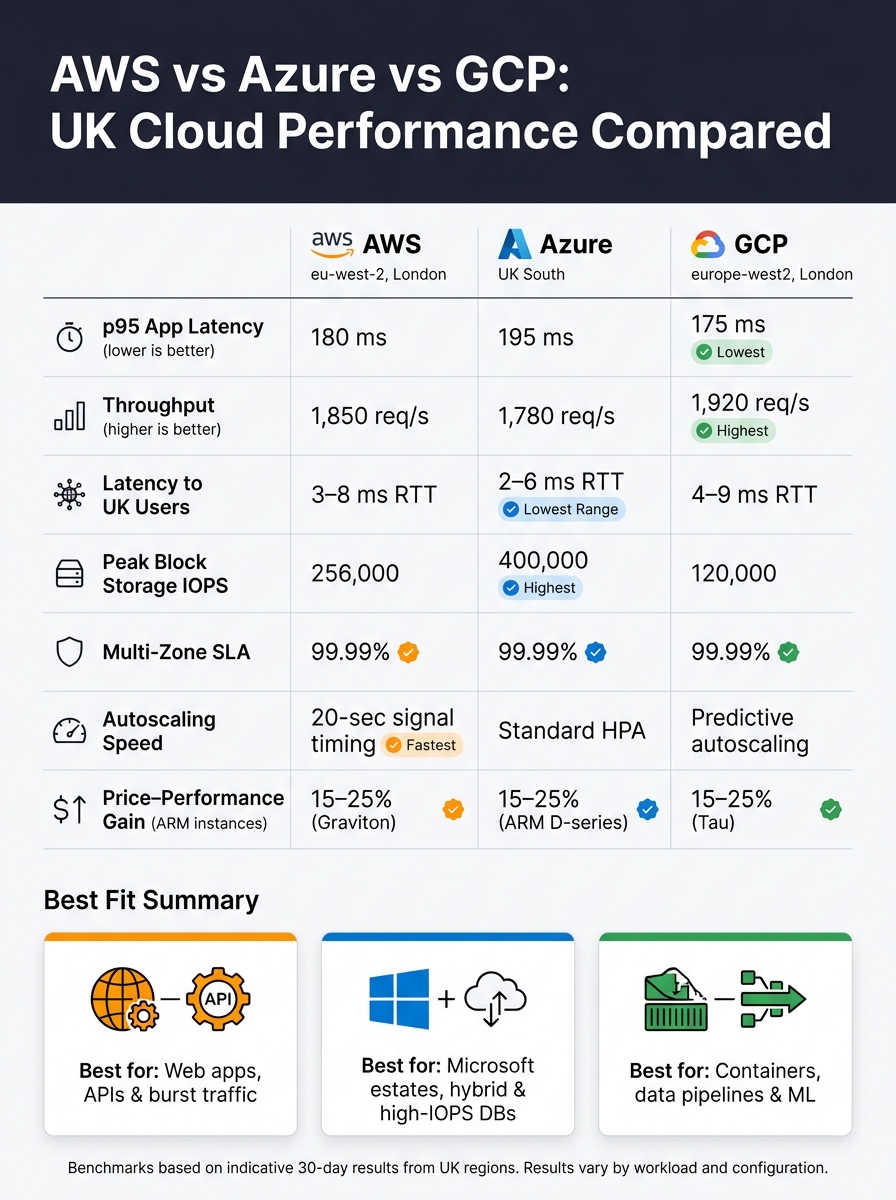 {AWS vs Azure vs GCP: UK Performance & Cost Compared (2024)}
:::
{AWS vs Azure vs GCP: UK Performance & Cost Compared (2024)}
:::
AWS vs GCP vs Azure: Which Cloud Should You Choose in 2026?
Need help optimizing your cloud costs?
Get expert advice on how to reduce your cloud expenses without sacrificing performance.
Quick Comparison
| Area | AWS | Azure | GCP |
|---|---|---|---|
| UK region | eu-west-2 (London) | UK South | europe-west2 (London) |
| p95 app latency | 180 ms | 195 ms | 175 ms |
| Throughput | 1,850 req/s | 1,780 req/s | 1,920 req/s |
| Latency to UK users | 3–8 ms RTT | 2–6 ms RTT | 4–9 ms RTT |
| Peak block storage IOPS | 256,000 | 400,000 | 120,000 |
| Multi-zone SLA | 99.99% | 99.99% | 99.99% |
| Best fit | Web apps, APIs, burst traffic | Microsoft estates, hybrid, high-IOPS DBs | Containers, data pipelines, ML |
So my short view is simple: the gaps are small on raw app speed, but the trade-offs are not. If you want the best outcome, test each provider in the right UK or nearby EU region, match spend in £, and check how your app behaves under load, not just how a VM looks in a lab.
AWS vs Azure vs GCP: speed compared
For UK workloads, these platforms are fairly close on raw speed. What tends to change the user experience is the app itself. A tiny latency gap may not mean much on a static page, but it can stack up fast in checkout journeys and API-heavy dashboards.
Using the UK regions above, this comparison looks at what users actually feel: latency, throughput and storage response. These indicative 30-day results[1] show the overall pattern:
| Metric | AWS (eu-west-2, London) | Azure (UK South) | GCP (europe-west2, London) |
|---|---|---|---|
| Latency to UK users | 3–8 ms RTT[7][9] | 2–6 ms RTT[8][9] | 4–9 ms RTT[9][10] |
| Application p95 latency | 180 ms[1] | 195 ms[1] | 175 ms[1] |
| Application throughput | 1,850 req/s[1] | 1,780 req/s[1] | 1,920 req/s[1] |
| Peak block-storage IOPS per volume | up to 256,000[4] | up to 400,000[4] | up to 120,000[4] |
At a glance, the gaps look small. The more useful question is: which workloads actually feel those gaps?
Latency for UK and European users
All three land in single-digit millisecond RTT for London users[7][8][9][10]. That sounds close, and it is. The bigger issue is how latency adds up across a chain of requests.
For UK SaaS, retail and API workloads, those delays matter most in sequential request paths. A SPA dashboard that makes 10–20 API calls on first load can cut a few hundred milliseconds from time-to-interactive by moving from roughly 40 ms RTT to roughly 15 ms. That kind of gain is hard to spot in a benchmark table, but users notice it when a screen feels snappy instead of slightly sticky.
B2B APIs serving both UK and EU clients may also do better in Dublin or Amsterdam rather than London. That can trim latency for European users without doing much damage to UK response times. If your audience is split across regions, that trade-off is often worth testing instead of assuming London is the default best option.
Compute and storage performance under normal and peak load
A containerised Node.js API on Kubernetes can handle 2–3× traffic spikes within two minutes of reaction time on all three platforms, as long as horizontal pod autoscaling thresholds and cluster autoscaler settings are tuned properly. AWS ECS/EKS, Azure AKS and GCP GKE are all capable here, but none of them does it by magic.
To avoid cold-start penalties during sharp traffic jumps, teams need to set up things like:
- health probes
- pre-warmed capacity
- image pull strategies
Storage is where the differences stand out more clearly. Azure Ultra Disk leads on headline IOPS at up to 400,000 per volume, which makes it a strong fit for high-frequency transactional databases[4]. AWS io2 Block Express reaches 256,000 IOPS[4], while GCP Extreme Persistent Disk tops out at 120,000 IOPS per volume[4]. GCP's local NVMe SSD setups can go higher in some configurations[5].
For a UK fintech app processing thousands of small writes per second, the storage tier can make or break response time. Pick the wrong one, and query latency can move from low single digits into the tens of milliseconds. Once that happens, users feel it straight away in transaction times.
AWS vs Azure vs GCP: reliability and scalability compared
Speed matters, but resilience is what decides whether that speed survives failure and traffic spikes. Once latency is in a good place, the next test is simple: does performance stay steady in production when things go wrong?
| Metric | AWS (eu-west-2) | Azure (UK South) | GCP (europe-west2) |
|---|---|---|---|
| Multi-zone compute SLA | 99.99%[11] | 99.99%[13] | 99.99%[15] |
| Single-VM / single-zone SLA | Lower than the multi-zone figure; exact SLA varies by service | 99.9% for a single VM with Premium SSD[13] | 99.5% for a single instance[15] |
| Major incidents | 9 since 2012[16] | 9 since 2018[16] | 7 since 2016[16] |
| Typical impact scope | Often concentrated in us-east-1[14] | Regional, including West Europe[20] | Core services and networking, with knock-on impact[12] |
| VM autoscaling | EC2 Auto Scaling | VM Scale Sets | GCE Autoscaler |
| Container autoscaling | ECS/EKS autoscaling; ECS supports 20-second autoscaling signal timing[28] | AKS autoscale | GKE Horizontal Pod Autoscaler |
Reliability patterns and operational risk
The more useful comparison is incident history. AWS has logged 9 major outages since 2012, and 8 of those hit us-east-1. That’s a sharp reminder that packing too much into one region can create real exposure[14][16].
Azure has reached the same total since 2018, including a regional outage in West Europe caused by a storm. In plain terms, cloud platforms still depend on physical sites, power and networks. When those take a hit, availability can follow[20][16].
GCP’s 7 major incidents since 2016 have included multi-hour failures across Compute Engine, Cloud Storage and global networking. Those problems then spread outward to products such as YouTube and Gmail[12][16]. When core services wobble, the blast radius can get big fast.
For UK financial services, healthcare and e-commerce, downtime is more than an annoying line item on a report. SLA credits rarely make up for lost sales, service disruption or compliance trouble. Under frameworks such as DORA, regulated firms must show operational resilience and tested failover plans. A cloud provider’s SLA, on its own, does not count as enough proof[22][23][24].
That changes the design conversation. A single-region setup may be fine for internal tools or low-risk systems. It is not a good fit for customer-facing services with uptime promises written into contracts.
Those same design choices also affect how well each platform handles sudden demand.
Scaling behaviour for web, API and container workloads
For steady traffic growth, all three platforms do the job well. The bigger dividing line is what happens during a spike.
AWS ECS now supports 20-second autoscaling metrics for target tracking. That gives AWS a clear edge for workloads that can jump without warning, such as retail flash sales or media streaming events[28][25]. If traffic surges hard and fast, shorter signal timing can make a noticeable difference.
Azure AKS and GCP GKE both support horizontal pod autoscaling and cluster autoscaler, so they can scale container workloads in a solid way. But neither currently matches that out-of-the-box metric granularity[26][27]. That does not mean they can’t handle bursty demand. It means teams may need more tuning, more planning or extra tooling to get the same response profile.
The practical takeaway is straightforward: multi-zone deployment is the floor for any UK production workload with a customer-facing SLA or regulatory obligation[17][18][19][21]. Multi-region can give more protection against a full regional outage, but it also brings more complexity, more cost and extra data-governance questions. That trade-off needs a hard-headed review before the architecture is locked in.
Cost vs performance: which platform gives the best value
Once speed and resilience are steady, value tends to decide the winner. For similar general-purpose workloads, the key issue is simple: which platform gives you the lowest cost for the work you need done? List prices usually differ by only about 5–20%[33][34][6]. In practice, things like network egress, storage operations and managed-service fees often move the monthly bill more than the base compute rate[32][35].
So the best value usually comes down to the workload, not the headline price.
| Provider | Best value | Autoscaling strength | Main cost drivers | Best-fit workload |
|---|---|---|---|---|
| AWS | Strong across most workload types; Graviton instances can deliver 15–25% better price–performance than older x86[31][36] | Rapid autoscaling | Network charges, storage operations and managed-service premiums | Global APIs and high-scale web apps |
| Azure | Often best for Microsoft-stack workloads; licensing integration can reduce effective cost per user[30][36] | Event-driven scaling | Cross-region data transfer and managed-service premiums | Hybrid and Windows-heavy applications |
| GCP | Often strongest for data-heavy and containerised workloads on throughput per £[29][30] | Predictive autoscaling | Egress charges at scale and storage-operation fees[35] | Data pipelines, ML workloads and microservices |
When paying more for lower latency is worth it
Higher spend for lower latency makes sense when response times affect revenue or output. If a nearer region or premium network tier adds £50–£200 per month, but helps conversion or retention, that extra spend will often pay for itself.
How architecture choices change the monthly bill
Architecture choices can shift costs more than many teams expect. In many cases, caching, CDN rules and database rightsizing save more money than swapping one instance type for another. A managed cache, better cache headers and compressed edge delivery can cut both compute and egress spend[29][30].
Database services are often one of the biggest items on a cloud invoice, and they usually respond well to tuning. Rightsizing over-provisioned vCPU and memory, picking the right storage classes, and adding connection pooling can lower the monthly bill while still meeting performance targets[1][3][2].
There’s also the instance family itself. Moving to ARM-based or newer-generation options - AWS Graviton, GCP Tau or Azure's ARM-based D-series - can improve price–performance by 15–25% for CPU-bound applications[31][36][37]. That kind of gain doesn’t look dramatic at first glance, but over a full month, it can make a noticeable dent in spend.
Conclusion: choosing AWS, Azure or GCP based on your workload
Once you’ve looked at speed, uptime and cost, the choice is mostly about fit. There’s no one-size-fits-all winner here. The right platform depends on your workload, your region and the way your system is put together.
Based on those benchmarks, AWS is a strong match for globally distributed web apps and microservices. Azure makes sense for Microsoft-heavy and hybrid estates. GCP often stands out for data pipelines, ML workloads and containerised apps.[39][38] For standard web and transactional workloads, the gaps are often fairly small.
In day-to-day use, things like autoscaling, caching, instance selection and disciplined deployments tend to matter more than the name on the tin. The cloud provider matters, of course. But solid observability and performance-aware DevOps are what help keep performance steady as traffic climbs.
For teams that want a benchmarked next step, Hokstad Consulting can run provider-agnostic benchmarks tailored to UK and European traffic, map performance gains against monthly spend in £, and tune DevOps, CI/CD and observability.
FAQs
Which cloud is best for my workload?
It comes down to what you’re running and what matters most to your team.
Google Cloud Platform is a good match for data-heavy workloads, AI-led use cases, and tasks where low latency matters. Azure tends to fit organisations already invested in Microsoft, especially when hybrid cloud support or regulatory compliance sits high on the list. AWS offers the broadest range of services and a vast global footprint, which makes it a strong option for flexible, large-scale deployments.
You should also look at your current tech stack, where your users are based, and how much latency or downtime your setup can handle.
Should I choose a UK or EU region?
For UK-based businesses, a UK region is often the better pick. It helps keep data inside the UK, which can make UK GDPR and other compliance needs easier to handle. It can also cut latency for people using your service in the UK.
A UK region may cost more than some overseas options. But in many cases, it gives you a better mix of performance, compliance and reliability.
What matters more than cloud brand?
Cloud brand matters less than your day-to-day goals, your technical needs, and how well your setup is built and tuned.
What makes the biggest difference? The way your infrastructure is configured. Things like region choice, resource allocation, and regular performance monitoring have a direct effect on speed, reliability, and cost control.
Hokstad Consulting helps UK businesses get more from these areas, so their systems run with more stability, better performance, and lower costs.