
AWS Reserved Instances can save you 30–70% on EC2 costs, but managing them manually is challenging. Automation helps by aligning commitments with actual usage, reducing waste, and saving time.
Key Points:
- What are Reserved Instances (RIs)? A pricing model where you commit to specific EC2 configurations for 1 or 3 years in exchange for lower costs.
- Savings Potential: Discounts of up to 70% compared to on-demand rates.
- Challenges: Overcommitting leads to wasted spend; undercommitting forces reliance on expensive on-demand instances.
- Manual Management Issues: Forecasting errors, underutilisation, and overcommitment are common and costly.
- Automation Benefits:
- Cuts manual effort by up to 95%.
- Reduces cloud costs by 30–40%.
- Adjusts RI commitments in near real-time based on demand.
- Tools for Automation: AWS Cost Explorer, AWS Lambda, and third-party platforms.
For UK businesses, automation ensures predictable savings while simplifying budgeting and reducing errors. Hokstad Consulting specialises in tailored solutions to optimise RI management and achieve measurable cost reductions.
Common Problems in Managing AWS Reserved Instances
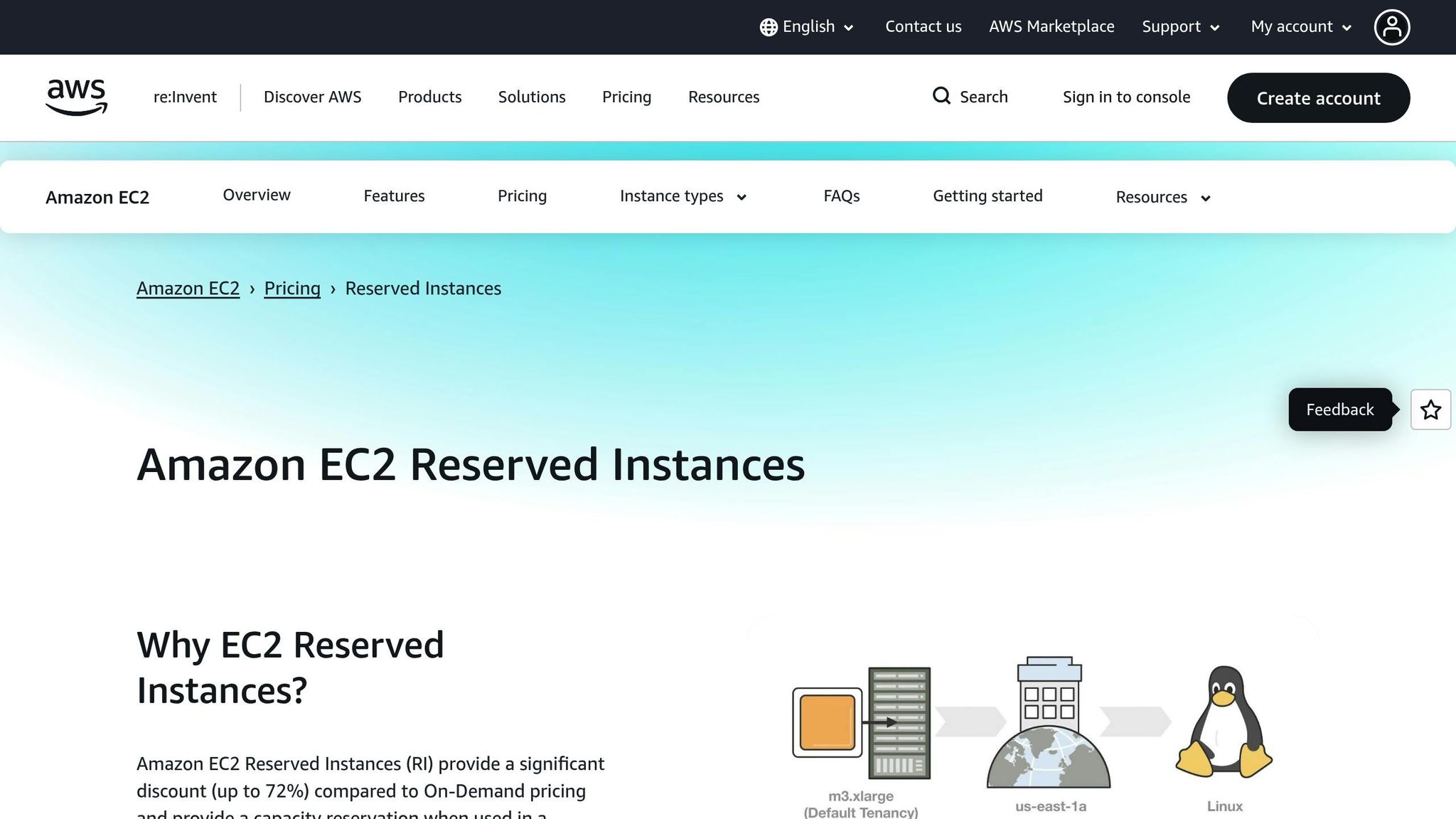
Managing Reserved Instances manually can lead to costly mistakes that undermine the savings they’re supposed to deliver. The main issue is straightforward: you're committing to fixed capacity in a cloud environment where demand is anything but predictable. This mismatch often results in two expensive outcomes: either paying for unused capacity or scrambling to cover unexpected demand with pricey on-demand instances.
As cloud setups expand, the problem only gets worse. Managing a handful of instances might be doable, but when you’re dealing with dozens - or even hundreds - across multiple regions, it becomes overwhelming. What works on a small scale falls apart as complexity grows, and the financial impact of errors can quickly escalate. Let’s dive into the key challenges, starting with forecasting and planning.
Forecasting and Planning Errors
Predicting future workloads is no easy task, even for seasoned teams. Businesses need to estimate their compute requirements months or even years in advance, but the reality is that markets shift, customer behaviours evolve, and business priorities change. What seems like a safe forecast today could be wildly off the mark six months down the line.
Take this example: a UK-based e-commerce company anticipated a 30% traffic increase and purchased 10 Reserved Instances to handle the expected load. But traffic only rose by 10%, leaving four instances unused. This miscalculation cost the company £12,000 over a year in wasted spend, as Reserved Instances can’t be cancelled or refunded [3][6]. What was intended to save money turned into an unnecessary expense.
On the flip side, underestimating demand can be just as damaging. Another company predicted moderate growth and bought five Reserved Instances, but actually needed eight. The shortfall forced them to rely on on-demand instances, adding £8,000 in extra costs over the year [3][6]. Since on-demand rates can be up to 75% higher than Reserved Instance rates, even small forecasting errors can result in significant overspending.
These issues are amplified in dynamic environments where usage fluctuates frequently. Manual tracking is not only time-consuming but also prone to errors, especially when teams are stretched thin. A 2024 survey revealed that companies using automated tools reduced Reserved Instance waste by 40% compared to those relying on manual processes [2][7]. This highlights how challenging it is to manage forecasting without the right tools.
The root of the problem often lies in the data. Historical usage patterns can provide a baseline, but they don’t account for business changes like new product launches, marketing campaigns, or seasonal demand spikes. Without real-time monitoring and advanced analytics, teams are left making educated guesses based on incomplete information.
Underutilisation and Overcommitment Risks
Forecasting errors don’t just cause mismatched capacity - they directly lead to underutilisation and overcommitment. Underutilisation means paying for Reserved Instances that aren’t being used, while overcommitment locks you into costs you can’t easily escape. Both scenarios waste money, either through unused capacity or missed savings opportunities.
For instance, if a business commits to a three-year Reserved Instance but sees its workload drop after the first year, the remaining two years become a sunk cost [2][4]. Unlike on-demand instances, which can be turned off when not needed, Reserved Instances continue to rack up charges, whether or not they’re being used.
Research shows that companies relying on manual Reserved Instance management can face up to 30% higher cloud costs due to forecasting errors and underutilisation [2][7]. For UK businesses operating in competitive markets, this inefficiency can directly impact profitability.
Manual processes are a big part of the problem. Teams often miss shifts in workload patterns, delay adjusting Reserved Instance purchases, or overlook underutilised instances entirely [2][5]. It’s not a matter of effort - it’s that manual methods simply can’t keep up with the speed and complexity of modern cloud environments.
Key metrics like instance utilisation rates, the balance between on-demand and Reserved Instance usage, and forecast accuracy are essential to monitor [2][5]. However, tracking these manually across different instance types, regions, and accounts becomes a monumental task. By the time underutilisation is identified, weeks or even months of wasted spending may have already piled up.
This challenge is especially pronounced for UK businesses facing seasonal demand or market fluctuations. Retailers, for example, deal with predictable holiday spikes, but the baseline demand between peaks can vary significantly year to year. Financial services firms may see usage shift due to regulatory changes or market volatility. Without continuous monitoring and automated adjustments, maintaining the right level of Reserved Instance coverage is nearly impossible.
The answer isn’t to avoid Reserved Instances - they offer too much potential for cost savings to be ignored. Instead, businesses need systems that can continuously analyse usage, predict demand more accurately, and automatically adjust commitments to align with actual needs. These issues highlight why automation is becoming essential for managing Reserved Instances effectively.
Automating Reserved Instance Management
Manual processes often struggle to keep pace with the dynamic demands of modern cloud environments, leading to forecasting errors, underutilisation, and overcommitment. Automation offers a solution by continuously monitoring usage, adjusting commitments in near real time, and making decisions based on actual demand - no spreadsheets or periodic reviews required.
For UK businesses, this shift is more than just a convenience. It transforms Reserved Instances into a dependable cost-saving tool by eliminating guesswork, cutting unnecessary expenses, and freeing up engineering teams to focus on strategic projects. Let’s break down how automation achieves this.
Benefits of Automation in Reserved Instance Management
The benefits of automating Reserved Instance management are clear, particularly when it comes to cost control. One of the most immediate advantages is the reduction in manual effort. Manually managing Reserved Instances can consume dozens of hours each month, especially in large AWS environments with multiple accounts, regions, and instance types. Automation handles this workload seamlessly, analysing usage patterns, generating recommendations, and even executing purchases or modifications without human input [8][11].
Some organisations report cutting manual cost management time by as much as 95% [11]. For UK-based companies, this could mean reclaiming several workdays each month for initiatives that directly contribute to growth or innovation.
Automation also improves coverage and utilisation rates. By continuously monitoring usage and triggering new purchases as needed, automated systems ensure coverage stays aligned with actual demand, reducing reliance on costly on-demand billing [8][3].
The financial impact can be substantial. Automated Reserved Instance management has been shown to reduce AWS compute costs by 30–40% while maintaining performance [11]. For a UK company spending £50,000 per month on AWS, this could translate to savings of £15,000–£20,000 monthly - or £180,000–£240,000 annually.
Another advantage is the reduced risk of errors. Manual forecasting often depends on incomplete data or outdated assumptions, whereas automated tools rely on algorithms and current usage patterns to make decisions. This approach removes much of the guesswork and keeps commitments within acceptable risk levels [8][11].
Automation also brings agility. Business needs are rarely static - workloads shift, new projects arise, and demand fluctuates. Automated systems can quickly detect these changes and adjust Reserved Instance portfolios accordingly, whether by purchasing additional capacity, modifying existing commitments, or listing unused instances on the AWS Reserved Instance Marketplace [10][11][7]. This kind of continuous rebalancing is nearly impossible to achieve manually.
For finance and FinOps teams, automation provides more predictable budgeting. By smoothing out month-to-month bill variability and improving forecast accuracy, automated Reserved Instance management simplifies financial planning and reporting in GBP [8][11].
Finally, automation helps minimise underutilisation and overcommitment. Instead of locking in capacity based on a single forecast, automated tools use rolling usage windows - such as 30, 60, or 90 days - and apply safety margins to keep commitments slightly below peak demand. This approach reduces the risk of paying for idle capacity while still benefiting from the discounts Reserved Instances offer [10][7].
Automation Tools and Methods
Now that we’ve covered the benefits, let’s look at the tools and methods that make automation possible. These solutions address forecasting and underutilisation challenges by aligning capacity with demand.
Automation doesn’t require a complete overhaul of your AWS setup. Many organisations start with native AWS tools and build automation around them. For instance, AWS Cost Explorer offers recommendations for Reserved Instance purchases based on historical usage, while AWS Compute Optimizer provides rightsizing suggestions to ensure instances are appropriately sized before commitments are made [10]. These tools can be integrated into workflows where scripts or orchestration tools periodically fetch recommendations, validate them against internal policies, and apply approved changes programmatically.
A common approach involves deploying AWS Lambda functions to analyse coverage and utilisation against pre-set thresholds. These functions pull data from AWS Cost and Usage Reports and Cost Explorer, generate recommendations, and can even execute purchases or modifications automatically. They can also integrate with AWS Budgets and SNS to notify teams, open tickets, or apply changes based on pre-approved rules [10].
Beyond AWS’s native tools, many organisations turn to third-party platforms specialising in cloud cost management. These platforms often include advanced features like machine-learning-based demand forecasting, portfolio rebalancing, and financial dashboards tailored for stakeholders [9][10][7]. Some extend automation across multiple AWS services, combining Reserved Instances with Savings Plans and using advanced algorithms to optimise coverage [9][10][7].
When evaluating third-party tools, UK businesses should prioritise features like multi-account support, reporting in GBP, configurable risk profiles (e.g., conservative versus aggressive commitments), and governance capabilities that align with internal approval processes [9][10][7]. These platforms often charge based on the savings they achieve or a percentage of optimised spend, aligning their incentives with cost reduction and offering a “risk-free” model where fees are tied to realised savings [9][7].
Advanced tools can also track AWS Reserved Instance Marketplace demand patterns - such as peak times for specific instance types and regions - and automatically list or reprice unused Reserved Instances to maximise resale value [11]. This feature is particularly beneficial for organisations needing to offload commitments quickly due to workload changes or migrations.
The success of automation depends on reliable data. Key metrics include Reserved Instance coverage percentage (how much of eligible usage is covered), utilisation rate (how much purchased capacity is used), effective hourly cost per instance family, and the ratio of on-demand to committed spend [8][10][2]. These metrics should be monitored over time, converted to GBP where necessary, and used to validate the impact of automation.
Automation engines typically operate on short cycles - hourly or daily - ensuring that new instances, migrations, and scaling events are quickly reflected in the Reserved Instance strategy. This minimises the time workloads run on costly on-demand rates [8][3]. Some platforms aim for near-total Reserved Instance or Savings Plan coverage on steady workloads by continuously rebalancing commitments [8][10][7].
Before implementing automation, it’s important to set clear guardrails. These might include maximum term lengths (e.g., three years), preferred regions, budget limits, and acceptable coverage targets to ensure the system doesn’t overcommit beyond the organisation’s risk tolerance [8][10][7]. For instance, automation could be configured to purchase only one-year Reserved Instances for development environments while allowing three-year commitments for stable production workloads.
Rightsizing must be done before making commitments. Ensuring that instances are properly sized and rationalised avoids locking in oversized resources for years [10][11].
Finally, tagging and governance are critical. A well-structured tagging strategy helps differentiate environments, applications, and owners, ensuring automation runs smoothly. Typically, finance or FinOps teams define cost and risk thresholds, platform or DevOps teams maintain automation pipelines, and product teams communicate upcoming changes to avoid disrupting automation logic [8][10][11].
Need help optimizing your cloud costs?
Get expert advice on how to reduce your cloud expenses without sacrificing performance.
How Hokstad Consulting Can Help
Managing Reserved Instances effectively requires both technical know-how and financial expertise. It’s about understanding how cloud commitments translate into financial results, integrating cost-saving measures into existing DevOps workflows, and finding the right balance between risk and reward. For UK businesses facing these challenges, Hokstad Consulting offers a combination of cloud cost engineering skills, DevOps automation experience, and solutions designed to deliver measurable savings.
Instead of relying on generic tools or one-size-fits-all advice, Hokstad Consulting collaborates with finance, engineering, and leadership teams to create automation tailored to business goals, budgeting cycles in GBP, and compliance requirements. Their team demystifies Reserved Instance options - like Standard versus Convertible, or deciding between one-year and three-year terms - and translates them into predictable savings while aligning with UK governance and financial planning. Let’s explore how their custom solutions and audits make a tangible difference in cost management.
Custom Automation Solutions
While off-the-shelf tools can provide basic recommendations, they often fail to account for the unique needs and constraints of individual organisations. Hokstad Consulting develops custom automation solutions that optimise Reserved Instance portfolios based on actual usage patterns, business priorities, and risk tolerance.
The process starts with analysing workload profiles. For critical, steady-state services, Hokstad locks in long-term Reserved Instances to maximise discounts, while dynamically adjusting coverage as demand shifts. When it comes to workloads with fluctuating demand - like those in UK retail, financial services, or media - Hokstad takes a different approach. They optimise Reserved Instance baselines and use a mix of Savings Plans or on-demand capacity to handle spikes. For example, they account for UK-specific demand trends, such as increased retail activity during Christmas or end-of-quarter financial processing, ensuring you’re not tied to capacity that’s only needed occasionally.
These automations are seamlessly integrated into existing DevOps workflows. Hokstad embeds Reserved Instance optimisation into CI/CD pipelines and infrastructure-as-code practices, ensuring that new services and instance types are automatically evaluated for Reserved Instance coverage as they move through development, staging, and production. They also connect with popular observability and cost tools like Datadog or Grafana, enabling DevOps teams to monitor Reserved Instance usage and act on automated recommendations without leaving their preferred platforms.
For organisations operating under strict UK governance or industry regulations, Hokstad ensures that automation strategies are built with compliance in mind. Policies, approval workflows, and reporting mechanisms are implemented to meet audit and board-level requirements. Guardrails, such as limits on term lengths, region preferences, budget caps, and coverage targets, are configured to prevent overcommitment. For instance, they might recommend purchasing only one-year Reserved Instances for development environments while allowing three-year commitments for stable production workloads.
The financial results can be impressive. Hokstad Consulting typically reduces infrastructure costs by 30–50% [1], with some clients saving over £50,000 annually [1]. For example, a SaaS company cut costs by £120,000 per year after cloud optimisation, while an e-commerce business achieved a 50% performance boost alongside a 30% cost reduction [1]. These savings come from rightsizing instances, converting underperforming Reserved Instances, and implementing automated purchasing rules to avoid underutilisation and unexpected on-demand expenses.
Cloud Cost Auditing and Reduction
In addition to custom automation, Hokstad Consulting offers cloud cost audits to establish a foundation for long-term savings. These audits examine a minimum of 12 months of AWS usage, Reserved Instance coverage, and utilisation patterns to identify overcommitment, underutilisation, and missed discount opportunities.
By correlating usage data with tagging, environments, and business units, Hokstad’s audits uncover inefficiencies and quick wins. They benchmark your current Reserved Instance strategy against best practices, providing clear financial insights into potential savings and risks.
The audit delivers a prioritised set of recommendations, including quick wins and longer-term initiatives. Quick wins might involve reallocating or modifying Reserved Instances to match current needs, listing unused instances on the AWS Reserved Instance Marketplace, or rightsizing oversized instances before committing to new ones. Longer-term strategies focus on embedding cost awareness into daily operations through automation, continuous monitoring, and governance.
Hokstad’s audits make Reserved Instance savings accessible to everyone in the organisation. They set up reports and dashboards that translate Reserved Instance usage and savings into business-relevant metrics - such as cost per application, team, or customer - using GBP and UK financial standards. By working closely with finance and leadership teams, Hokstad helps define coverage and utilisation targets, setting up automated alerts and governance checks to ensure metrics stay on track.
This approach ensures that Reserved Instance optimisation becomes a continuous practice rather than a one-off effort. Hokstad leverages AI-driven models to predict usage shifts and adjust Reserved Instances accordingly, while their DevOps expertise ensures these automations are delivered as reliable, testable pipelines aligned with governance and operational standards in UK enterprises.
Additionally, Hokstad offers a flexible payment model: their fees can often be capped at a percentage of the savings achieved. This means you only pay based on actual cost reductions, offering a “risk-free” way to achieve significant savings.
Conclusion
AWS Reserved Instances can slash costs by up to 75% compared to on-demand pricing [3]. However, realising these savings involves more than simply purchasing reservations. Managing Reserved Instances manually, especially at scale, presents significant challenges and often leads to unnecessary expenses [4].
This is where automation becomes a game-changer. By analysing historical usage, predicting future needs, and dynamically adjusting reservations to match demand, automated systems eliminate the need for manual intervention. This ensures optimal Reserved Instance coverage - up to 100% [2]. Such operational efficiency doesn’t just save time; it directly translates into major cost reductions, allowing organisations to prioritise innovation over tedious spreadsheet management.
Automation can reduce cloud costs by as much as 50%, potentially saving organisations tens of thousands of pounds annually [1]. These savings come from removing manual inefficiencies and reducing human error, ensuring every pound spent on cloud infrastructure delivers maximum value.
For UK businesses looking to adopt automated Reserved Instance management, Hokstad Consulting offers tailored solutions designed to achieve lasting cost reductions. Their expertise includes seamless integration with current DevOps workflows and detailed cloud cost audits to identify quick savings and establish ongoing optimisations. Plus, their flexible payment model - capping fees at a percentage of the savings achieved - ensures financial risk is minimised. With Hokstad Consulting, businesses can streamline their cloud operations without compromising reliability or performance.
As highlighted throughout this guide, Reserved Instance optimisation isn’t a one-time decision. It’s an ongoing process that requires regular adjustments and expert oversight. By addressing the inefficiencies of manual management and embracing intelligent automation, organisations can transform Reserved Instances into a powerful tool for controlling cloud costs while maintaining the agility needed to grow.
FAQs
How can automation help businesses save money with AWS Reserved Instances?
Automation is a game-changer when it comes to cutting costs tied to AWS Reserved Instances. It ensures resources are utilised effectively by helping businesses match instance sizes to their needs, adjust usage to fit actual demand, and streamline purchasing decisions to boost savings.
With automation in place, companies can cut down on waste, allocate resources more effectively, and save as much as 30–50%. Beyond trimming expenses, it also makes managing cloud infrastructure far less complicated.
What financial risks can businesses face by not automating the management of AWS Reserved Instances?
Failing to automate the management of AWS Reserved Instances can quickly become a costly oversight. Without automation, businesses might miss unused or underutilised Reserved Instances, leading to wasted resources and inflated expenses.
Relying on manual processes also opens the door to mistakes. For example, businesses might forget to renew expiring Reserved Instances or fail to adjust their usage to match shifting workloads. These missteps can result in paying higher on-demand prices or losing out on potential savings, both of which directly affect the company’s financial performance.
Automation tools can change the game. They ensure Reserved Instances are continuously monitored, adjusted, and aligned with current needs. This not only helps businesses cut unnecessary costs but also simplifies cloud spending management.
How can businesses automate the management of AWS Reserved Instances to optimise cloud costs?
To manage AWS Reserved Instances efficiently and reduce cloud costs, businesses can turn to automation tools. These tools simplify the process of purchasing, tracking, and using Reserved Instances. They can analyse usage trends, suggest the most suitable Reserved Instance options, and dynamically adjust allocations to maximise savings.
Hokstad Consulting specialises in cloud cost engineering and provides solutions for automating Reserved Instance management. By creating customised strategies, they assist businesses in cutting unnecessary expenses and improving cost efficiency within their cloud systems.