
If you're managing Kubernetes at scale, choosing between ArgoCD and Flux can be challenging. Both tools are leaders in GitOps, where Git serves as the single source of truth for infrastructure. Here's the key difference: ArgoCD uses a centralised hub-and-spoke model, while Flux adopts a distributed, agent-based approach. Your choice depends on whether you prioritise centralised governance or decentralised autonomy.
Key Takeaways:
- ArgoCD: Best for enterprises needing central control, visual dashboards, and scalability for up to 50,000 apps. Ideal for teams requiring real-time monitoring and simplified multi-cluster management.
- Flux: Perfect for edge computing, air-gapped environments, and setups prioritising security and autonomy. Lightweight and efficient, it operates independently in each cluster.
Quick Comparison:
| Feature | ArgoCD | Flux |
|---|---|---|
| Architecture | Centralised hub-and-spoke model | Distributed agent-based model |
| Scalability | Tested up to 50,000 apps and 1,000 clusters | Scales horizontally across clusters |
| UI | Web-based dashboard with real-time monitoring | CLI-focused; no native dashboard |
| Security | Central credential store | Local credentials in each cluster |
| Resource Usage | Higher, due to API server and Redis | Lower, with modular controllers |
| Best Use Case | Centralised governance for large enterprises | Edge, IoT, and air-gapped environments |
Both tools excel in their own ways. ArgoCD is ideal for centralised control and visibility, while Flux is better for environments requiring independence and efficiency. The right choice depends on your team's workflow and infrastructure needs.
::: @figure 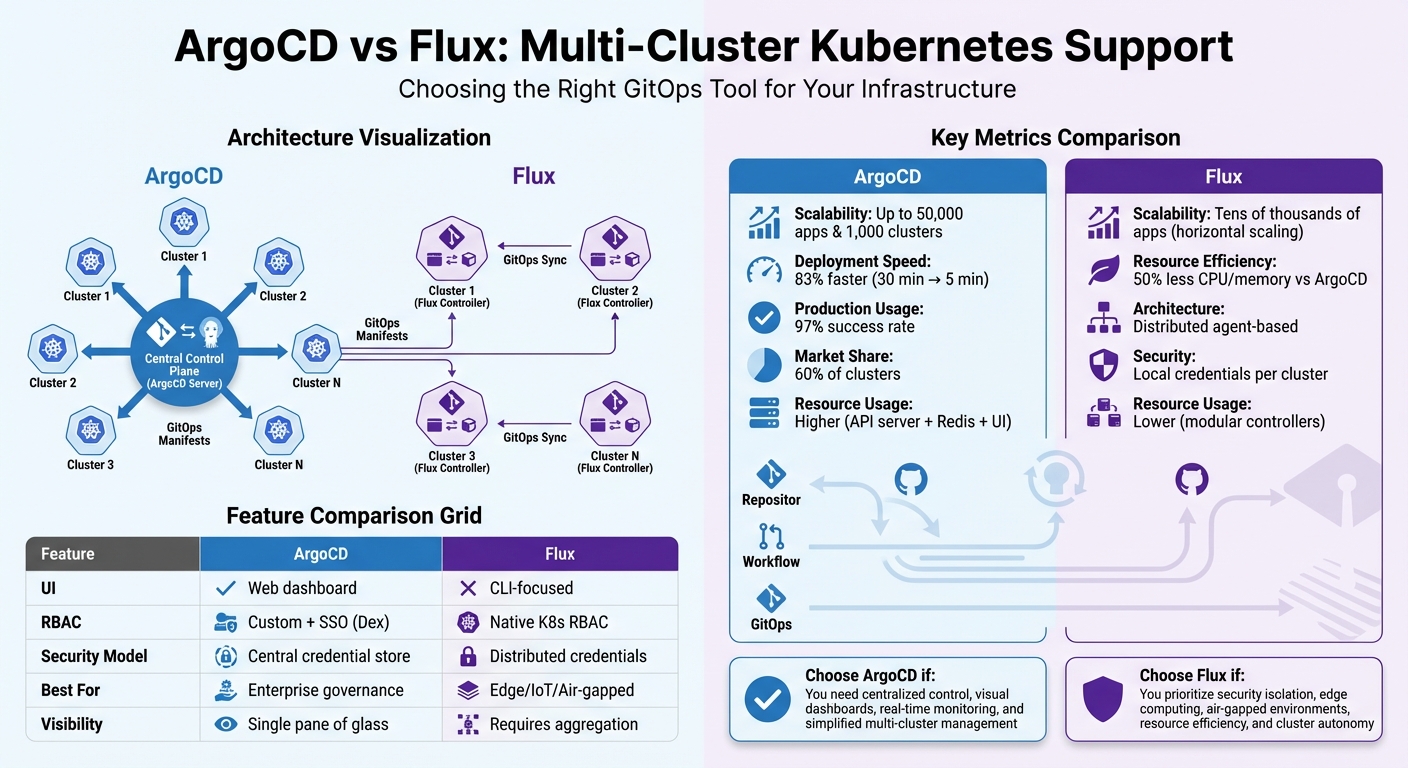 {ArgoCD vs Flux Multi-Cluster Kubernetes Architecture Comparison}
:::
{ArgoCD vs Flux Multi-Cluster Kubernetes Architecture Comparison}
:::
ArgoCD Multi-Cluster Architecture
Centralised Control Plane
ArgoCD operates on a hub-and-spoke model, where a central control plane manages multiple remote clusters. This setup ensures updates from Git are automatically propagated, while any unauthorised changes made directly to clusters are reverted [4][3][9][10]. Tools like Namespace mapping and ApplicationSets make it possible to automate deployments across various clusters and regions [10][3]. This efficiency can significantly cut deployment times - reducing them by 83%, from over 30 minutes to just 5 minutes [12].
For those prioritising security, an agent-based model offers an alternative. In this setup, workload clusters pull configurations themselves, avoiding the need to store credentials in the central hub [9][11].
This centralised approach not only simplifies deployment processes but also lays the groundwork for improved real-time monitoring, which is explored next.
Visibility and Monitoring
ArgoCD’s web-based dashboard offers what many describe as a single pane of glass
- a unified interface displaying the health, sync status, and resource hierarchies of all managed clusters [9][4]. This means you can oversee application deployments in real time without the hassle of switching between Kubernetes contexts.
ArgoCD was designed from day one to be a tool for developers. Its philosophy is that deployment information should be visible, accessible, and easy to understand.– Atmosly [4]
One standout feature is the real-time visual diffing tool. It highlights discrepancies between the live state of a remote cluster and the desired state stored in Git [3][1]. This drift detection runs continuously, offering automated or manual self-healing options to bring clusters back in sync. For organisations managing large application graphs or deployments spanning multiple namespaces, this level of visibility is invaluable. However, while the UI handles hundreds of applications seamlessly, performance begins to lag when managing around 3,000 applications [14].
When combined with its visibility features, ArgoCD’s scalability and governance capabilities make it a strong choice for enterprise-level deployments.
Scalability and Governance
ArgoCD’s centralised architecture supports role-based access control (RBAC), allowing administrators to map OIDC groups to specific permissions. This ensures teams are restricted to their assigned clusters or projects, all from a single configuration point [4][3]. Additionally, the system includes sync windows, which define when updates can or cannot occur - essential for managing maintenance windows in enterprise environments [1].
Performance-wise, ArgoCD is built to handle large-scale operations. It has been benchmarked to manage 500 clusters and 50,000 applications [13]. Testing by the CNOE project (2023–2024) demonstrated that a full fleet synchronisation could be achieved in just 22 minutes using nine controller shards distributed across three m5.2xlarge nodes [13]. Sharding across controller replicas ensures consistent performance, even as fleets grow larger [13][14].
For organisations aiming to centralise governance while maintaining visibility and scalability, ArgoCD provides a comprehensive solution. However, as deployments expand, careful planning around resource allocation and security boundaries becomes increasingly important.
Comparing GitOps: Argo CD vs Flux CD, with Andrei Kvapil | KubeFM
Flux Multi-Cluster Architecture
Flux's distributed model offers a distinct take on multi-cluster management, standing apart from centralised architectures by giving each cluster the tools to operate independently.
Distributed Agent-Based Model
With Flux, controllers are deployed directly onto each Kubernetes cluster in standalone mode. Each cluster runs its own reconciliation logic, operating autonomously. These controllers include the source-controller, kustomize-controller, and helm-controller, each managing a specific part of the GitOps lifecycle. By using Kubernetes Custom Resource Definitions (CRDs), Flux ensures delivery workflows are managed in a way that feels natural to Kubernetes users.
One standout feature is the source-controller, which keeps a local cache of artefacts from Git, OCI, and Helm repositories. This local cache allows the cluster to detect and fix configuration drift even if the Git server or external network goes down.
Running Flux in the standalone mode offers a higher degree of security and autonomy for the clusters at the expense of operational overhead when it comes to bootstrapping and monitoring the Flux instances.– Stefan Prodan, Principal Engineer at ControlPlane.io
This decentralised approach removes the need for a central credential store, reducing the risk of a broad security breach. If one cluster is compromised, the impact is contained. For production environments, this means deployments can continue without being affected by central control plane outages. This design is particularly effective in setups with limited or intermittent connectivity.
Flexibility for Edge and Isolated Environments
Flux's pull-based model is an excellent fit for edge computing, IoT, and air-gapped environments. Since agents initiate connections to external sources, there’s no need to expose the cluster's API server or maintain constant connectivity to a central manager. This not only simplifies operations but also strengthens security.
In October 2025, GitLab adopted Flux as its default Kubernetes GitOps engine, praising its modular toolkit as a key advantage [2]. Other major organisations, including Volvo, Ring Central, and Anchore, have also embraced Flux for their production workflows, benefiting from its decentralised architecture.
In traditional hub-and-spoke setups, a failure in the central management cluster can disrupt workload clusters' ability to reconcile. With Flux’s distributed model, workload clusters remain functional and continue reconciling their state against Git, even during external failures.
Resource Efficiency and Simplicity
Flux’s lightweight architecture makes it an ideal choice for resource-constrained environments. Its modular design ensures that only the necessary controllers are deployed, using fewer resources compared to centralised systems that require additional components.
Flux's minimal resource footprint makes it a strong choice for edge computing and other resource‐constrained deployments.– Michael Guarino, Plural.sh
By relying solely on native Kubernetes RBAC, Flux aligns seamlessly with standard Kubernetes practices. It can scale to manage tens of thousands of applications within a single installation through vertical scaling [2]. Additionally, its local reconciliation model spreads the workload across clusters, avoiding bottlenecks at a central point.
While this architecture requires independent bootstrapping and centralised metrics aggregation, tools like the Flux Terraform provider can automate the bootstrapping process. For monitoring, the notification-controller on each cluster can send events to a central alerting system, providing a unified view of operations across clusters.
Need help optimizing your cloud costs?
Get expert advice on how to reduce your cloud expenses without sacrificing performance.
ArgoCD vs Flux: Side-by-Side Comparison
Comparison Table: Key Criteria
Here's a breakdown of how ArgoCD and Flux tackle multi-cluster Kubernetes deployments. From scalability to security, each tool approaches the challenges differently. The table below highlights their strengths and limitations across crucial areas:
| Criterion | ArgoCD | Flux |
|---|---|---|
| Architecture | Centralised hub-and-spoke model with a single control plane managing remote clusters | Distributed agent-based model, with each cluster running its own independent controllers |
| Scalability | Central hub scales well, tested up to 50,000 apps and 1,000 clusters, though UI performance may drop with 3,000–5,000 apps [2][6] | Horizontal scaling across clusters; limited only by Kubernetes API capacity [3][6] |
| User Interface | Built-in web UI offering a unified view of all clusters | CLI-focused; lacks a built-in dashboard |
| RBAC & Governance | Fine-grained RBAC with SSO integration via Dex; uses Projectsfor policy enforcement [2][6][5] |
Relies on Kubernetes RBAC; governance is cluster-specific or managed through Git [3][5] |
| Security Model | Centralised credential store for all managed clusters | Credentials stored locally in each cluster, reducing centralised risk [3][4] |
| Resource Usage | Higher resource usage due to API server, Redis, UI components, and in-memory resource graph [6] | Lower resource usage with modular, lightweight controllers [6] |
| Multi-Cluster Deployment Speed | ApplicationSets speed up deployments by 83%, reducing times from 30 minutes to about 5 minutes [6] | Distributed reconciliation spreads workload without central coordination [3] |
| Best Use Case | Ideal for enterprises needing centralised governance and visual oversight | Suited for edge computing, IoT, and air-gapped environments [3] |
Strengths and Weaknesses
Let’s dive into what makes ArgoCD and Flux stand out - and where they might fall short.
ArgoCD shines in environments that need centralised control and an intuitive interface. Its dashboard provides a clear, consolidated view of application health, making it easier for teams to manage rollbacks and deployments without deep Kubernetes knowledge. In November 2025, AWS launched a fully managed ArgoCD service for EKS, simplifying scaling and maintenance challenges [6]. However, its centralised model has drawbacks. The control hub can become a bottleneck when managing thousands of apps, and storing credentials centrally introduces a single point of failure. For example, when GetYourGuide transitioned from Spinnaker to ArgoCD in 2024–2025, they successfully managed their Kubernetes workloads but had to implement validation webhooks to avoid accidental namespace deletions [6].
On the other hand, Flux excels in security and efficiency. Its decentralised architecture ensures that a breach in one cluster doesn’t compromise others. Each cluster operates independently, and Flux’s lightweight design uses about half the CPU and memory of ArgoCD during synchronisation [6]. In October 2025, GitLab adopted Flux as its default Kubernetes GitOps engine, praising its modular approach [2]. Companies like Volvo and Anchore rely on Flux for production workloads, especially in edge and IoT setups where connectivity can be unpredictable.
That said, Flux’s lack of a native UI can be a hurdle. Teams without additional tooling may struggle to get a unified view of their clusters. Moreover, the need to bootstrap each cluster individually and aggregate metrics centrally adds operational complexity. While these trade-offs are manageable for teams comfortable with CLI workflows, organisations prioritising developer-friendly dashboards may find Flux less appealing.
Next, we’ll explore scenarios where either ArgoCD or Flux is the better fit for specific deployment needs.
When to Choose ArgoCD or Flux
Choosing ArgoCD for Centralised Governance
ArgoCD is ideal for organisations that need a unified approach to managing multiple Kubernetes clusters. If your platform teams enforce policies across dozens - or even hundreds - of clusters, ArgoCD's hub-and-spoke design is a perfect match. Its built-in web interface simplifies tasks like syncing applications, rolling back changes, and accessing logs, even for developers who lack in-depth Kubernetes knowledge. As one Reddit user shared via Northflank:
Argo CD just makes it easier to show devs what's happening in the cluster. They can roll back or trigger syncs without needing to understand Helm or kubectl[16]
The numbers back this up: ArgoCD is used in 60% of clusters and 97% of production deployments [6]. It has been proven to scale up to 50,000 applications and manage 1,000 clusters [2][6]. With ApplicationSets, multi-cluster deployments can be sped up by as much as 83% [6]. AWS even launched a fully managed ArgoCD service for EKS in November 2025, eliminating the need to manage the stack yourself [6].
ArgoCD is also a strong choice for organisations prioritising security and audit trails. Its centralised audit trail is independent of cluster-level Kubernetes users [2][4]. Features like AppProjects for logical grouping and native Dex SSO integration (supporting OIDC, Okta, and Google) make it easier to meet compliance requirements [17][6][7]. However, securing the central hub, which holds credentials for all managed clusters, is critical [4].
If decentralisation is more important to your organisation, you might want to consider another option.
Choosing Flux for Decentralised or Edge Environments
Flux excels in scenarios where security and resource efficiency are top priorities. Its distributed agent model ensures that each cluster operates independently, keeping credentials local. This isolation means that a breach in one cluster won't jeopardise the others [15][4][3]. This makes Flux particularly well-suited for edge computing, IoT, and air-gapped networks, where clusters can't rely on a central management plane.
Choose Flux if you want a lightweight, secure, set-it-and-forget-it tool that adheres strictly to Kubernetes patterns. It is the best choice for Edge computing, massive scale (thousands of clusters), or strict security environments where clusters cannot accept incoming connections.- Atmosly [4]
Flux's modular controllers are resource-efficient, using about half the CPU and memory of ArgoCD during synchronisation [6]. It can scale to manage tens of thousands
of applications through both horizontal and vertical scaling [17][2]. For teams that prefer CLI workflows and strict Infrastructure-as-Code practices, Flux integrates seamlessly into Kubernetes-native workflows [4][3].
Trade-Offs and Considerations
Each tool has its strengths, and the right choice depends on your operational goals. If you prioritise visibility, ArgoCD's web interface makes onboarding easier and provides real-time oversight of your Kubernetes fleet. However, it requires a heavier control plane (API servers, Redis, UI components) and centralises risk within the hub [3][8]. Flux, on the other hand, focuses on isolation and efficiency, though you'll need additional tools to aggregate metrics and visualise clusters [4][3].
Your RBAC needs can also influence your decision. For complex, application-specific permissions that differ from cluster-level access, ArgoCD's custom RBAC layer offers more flexibility [16][8]. If you prefer to stick with Kubernetes' standard security primitives, Flux is the better option. Some organisations even adopt a hybrid approach - using ArgoCD for development and test environments while deploying Flux in production to maximise autonomy and security [15].
The decision ultimately comes down to whether centralised control or distributed independence aligns better with your deployment strategy.
Conclusion
Deciding between ArgoCD and Flux isn’t about finding a one-size-fits-all solution - it’s about aligning the tool with your organisation’s specific needs. ArgoCD’s centralised hub-and-spoke model provides the visibility and control platform teams require when managing hundreds of clusters. Its user-friendly web interface makes troubleshooting easier, even for those without deep expertise. Impressively, 97% of ArgoCD users report successful deployments in production, with a Net Promoter Score of 79 [6].
This comparison highlights the trade-offs between centralised oversight and operational independence. For teams needing a unified view to monitor application health across multiple clusters, ArgoCD’s architecture is a strong choice. On the other hand, Flux’s lightweight, agent-based model is ideal for distributed environments where clusters need to operate independently or where resources are limited. It also offers better isolation in the event of a security breach and reduces overhead.
Both tools benefit from additional solutions for YAML abstraction, such as Helm or Kustomize. Some organisations even adopt a hybrid strategy - using Flux for infrastructure-level tasks like managing cluster add-ons and CNI, while leveraging ArgoCD for application delivery [6].
Your operational environment plays a big role in this decision. For example, AWS EKS users can take advantage of the fully managed ArgoCD service launched in November 2025, removing the need for stack maintenance. Meanwhile, Azure users can benefit from a native Flux extension for AKS [6]. Ultimately, the best choice depends on your team’s workflows and the security requirements of your environment. Regardless of the tool, GitOps remains a cornerstone for automating and securing multi-cluster deployments.
If you’re looking to fine-tune your approach, expert advice can make all the difference. Hokstad Consulting offers support in DevOps transformation, cloud cost optimisation, and custom automation, helping organisations craft GitOps strategies tailored to their unique multi-cluster needs.
FAQs
How do I choose between a centralised and a distributed GitOps model?
Choosing between a centralised or distributed GitOps model comes down to what works best for your organisation's structure and goals. A centralised model, such as Argo CD, relies on a single control plane to handle deployments across multiple clusters. This approach keeps things straightforward and gives you a unified view of your operations. On the other hand, a distributed model, like Flux, operates independently within each cluster. This setup offers more scalability, greater autonomy for individual clusters, and a lighter footprint. The right choice will depend on factors like your team's workflow, the scale of your operations, and how you prefer to manage deployments.
What extra tooling do I need to monitor Flux across many clusters?
To keep an eye on Flux across multiple clusters, you'll need some external tools for better visibility and management. Popular choices include Prometheus and Grafana, which work together to gather metrics and display the overall health of your deployments. These tools connect seamlessly with Flux controllers, offering dashboards and alerts to keep you informed.
In some cases, you might also need to create custom integrations or scripts that tap into Flux APIs. This can help you track things like deployment statuses, errors, and any configuration drift across your clusters.
How can I reduce ArgoCD control-plane resource usage at scale?
To fine-tune ArgoCD's control-plane resource usage on a larger scale, it's important to configure CPU and memory requests and limits for workloads. This prevents the risk of overloading your resources. You can also adjust the application controller's parallelism settings to strike the right balance between resource consumption and sync performance.
For environments with extensive workloads, enabling controller sharding is a smart way to distribute the load more effectively. Additionally, adopting decentralised setups - like resource sharing through argocd-agent - can help keep the control plane's resource demands manageable as the number of clusters increases.