
I start an AI plan with one business result - not a list of pilots. Choose one process, record its current performance and set one primary KPI, with quality and risk limits.
I use five steps to turn that goal into a controlled test:
- Define the outcome: state what should change, for whom and how you’ll measure it.
- Rank use cases: compare value, feasibility, data, cost and risk.
- Check readiness: resolve gaps in data, access, privacy, skills and support.
- Assign owners: name who can approve, pause, stop and restart the work.
- Plan delivery: set dates, budgets and checks for preparation, pilot, validation and launch.
My target is one use case ready to test within weeks. Keep access narrow, require human approval for high-risk actions and meet UK data protection requirements. Scale only when the results justify it; otherwise, fix the gaps or stop.
::: @figure 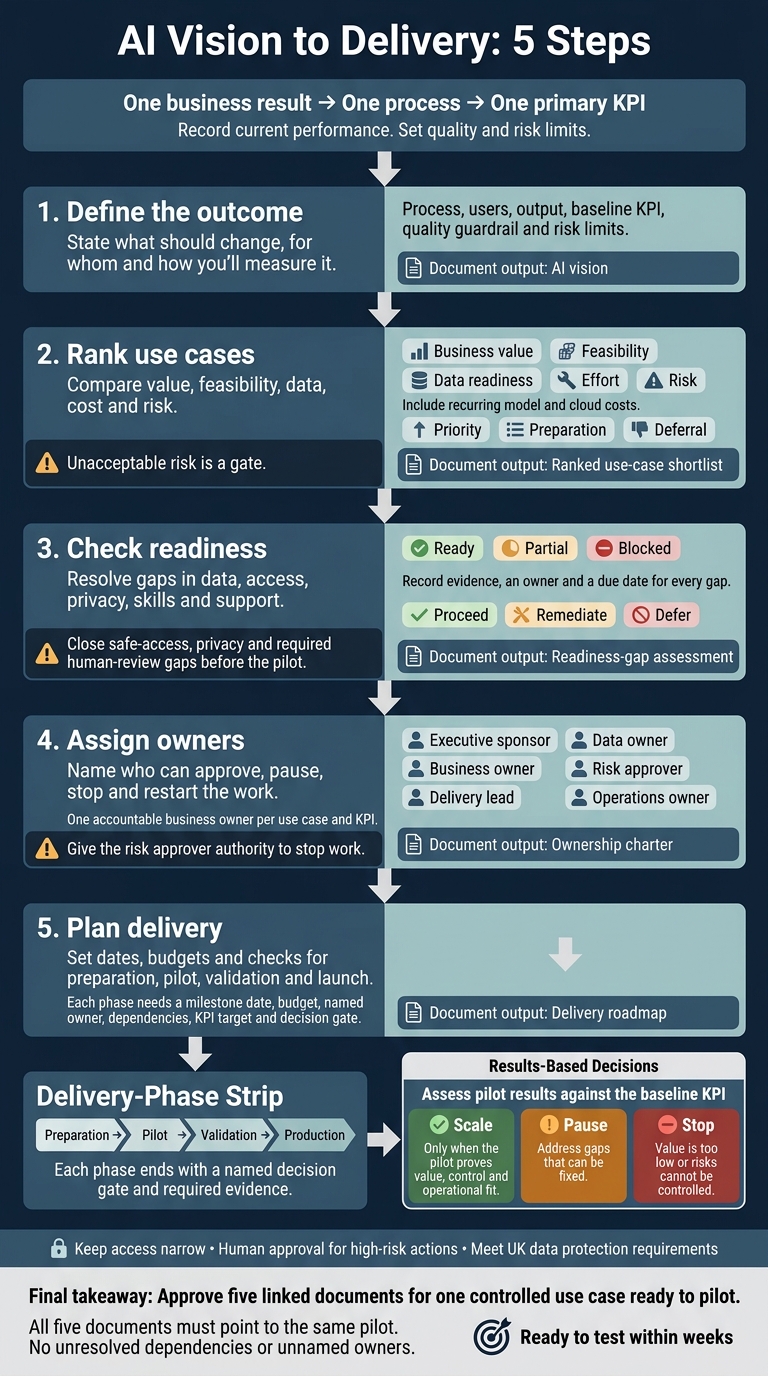 {AI Vision to Delivery: 5 Steps}
:::
{AI Vision to Delivery: 5 Steps}
:::
Step 1: Define an AI Vision Based on Business Goals
Turn Business Goals into Measurable Outcomes
Start with the business priority and the process causing the most friction. Be clear about the output you want:
A labelled inbox, a draft proposal or a prioritised backlog.[1]
Map the whole process - inputs, transformations, checks and outputs - instead of building your AI plan around a job title.[2]
Choose one primary KPI tied to the business goal, alongside a quality guardrail that must not deteriorate. Record how you’ll measure the outcome so delivery teams have a clear target.
Write the Vision and Define Risk Limits
Use this rule to guide delivery decisions:
We will use AI to improve [business outcome] in [process] for [users], measured by [KPI], while maintaining [risk or governance requirement].
Keep the vision to one page. Name the process, users, output and hand-off checks.[2] Leave model and tool choices open until the requirements are clear.
Set out which data teams can use, which outputs need human review and which actions are off limits. Check structure, consistency and domain rules - an output that sounds plausible isn’t enough.[2] Once the improvement and risk limits are clear, use the vision to rank use cases in Step 2.
Step 2: Rank Use Cases by Value and Feasibility
Compare Value, Feasibility, Effort and Risk
Use the Step 1 vision and risk limits to rank each proposal. Frame it as the smallest workflow change that delivers value, then define the task, expected benefit and KPI. Record the current KPI baseline before estimating any improvement. Check whether the proposal cuts a measurable cost today, fits existing workflows and can be delivered in weeks, not quarters.[1]
Apply the same criteria to every proposal:
| Dimension | What to check |
|---|---|
| Business value | Does it support the business goal and deliver a measurable benefit? |
| Feasibility | Are integration access and workflow fit sufficient for a limited test? |
| Data readiness | Is the required data accessible and validated? |
| Effort | What integration work and recurring model and cloud costs are required? |
| Risk | Can review and validation checks contain failures? |
Compare more than build costs. Include recurring model and cloud costs too.[4][2] Use the scores to place proposals into priority, preparation or deferral.
Choose Early Use Cases and Defer Weak Proposals
Rank proposals on a value–feasibility matrix. Put high-value proposals that can be delivered in small steps first. Keep high-value work with unresolved data or system dependencies in preparation, and defer lower-value work.[4]
Proposals that fail the cost, workflow-fit or short-test checks belong in an experimental track, not the core delivery plan.[1][3] Unacceptable risk is a gate: approve delivery only when review controls and validation checks can contain failures.[2]
Create a ranked shortlist recording each proposal’s benefit, baseline KPI, dependencies, risks and delivery order. For deferred proposals, record the evidence needed to revisit them.
How to Identify Strategic Use Cases for Your Business
Step 3: Check Readiness for Each Use Case
Use the ranked shortlist to check whether each use case is ready for a pilot.
Review Data, Systems, People and Governance
Check the data, systems, workflows and skills needed for production. Build a knowledge pack containing task instructions, verified facts, and good and bad examples.[1] Base it on the selected use case, KPI and risk limits.
Confirm that integrations, security controls and monitoring can handle the expected load. Mark each dependency as ready, partial or blocked.
Define who handles reviews, exceptions and escalations, then address any skills or training gaps. Give each agent one production role, an owner and an access profile.[1] Before approving the pilot, confirm privacy arrangements, compliance with UK data protection requirements, human oversight and escalation routes.
Assign Owners and Deadlines for Readiness Gaps
Keep a readiness register for each shortlisted use case. Record evidence, not assumptions. For every gap, include supporting evidence, an owner and a due date.
| Capability | Status | Supporting evidence | Risk rating | Accountable owner | Corrective action | Dependency | Target date |
|---|---|---|---|---|---|---|---|
| Data quality and context | - | Data review; source records; checked instructions | High | Data owner | Validate inputs and complete the knowledge pack | Source access | Pilot |
| Access and privacy | - | Permissions audit; privacy review | High | Security lead and Data Protection Officer | Restrict permissions and resolve privacy gaps | Approved access design | Pilot |
| Human oversight | - | Review process; escalation route; training check | High | Business process owner | Assign reviewers and test handover | Staff availability | Pilot |
| Production support | - | Monitoring tests; support runbook; test results | Medium | Service owner | Test alerts, failure handling and operational support | Pilot findings | Launch |
Close gaps affecting safe access, privacy and required human review before the pilot. Complete all readiness items needed for production before launch.
Proceed when the evidence is complete. Remediate when gaps have clear fixes and deadlines. Defer when a blocker cannot be removed.
Use the completed register to assign owners and decision rights in Step 4.
Step 4: Assign Owners and Decision Rights
Name Owners for Business, Delivery, Data and Support
Bring any unresolved readiness gaps from Step 3 into the ownership charter. Assign one accountable business owner to each use case and KPI. Name the executive sponsor, delivery lead, data owner, risk approver and operations owner, and spell out what each person can decide.
Keep executive decisions separate from delivery work. The sponsor decides whether further investment is justified; the delivery lead manages implementation within approved limits.[3] Record each person’s authority and escalation route - not just their job title.
Set Approval, Escalation and Stop Rules
Add the responsibility matrix below to the charter, replacing role labels with people’s names. A = accountable, R = responsible, C = consulted, - = no assigned duty.
| Activity or decision | Business | Technology | Data | Risk | Operations |
|---|---|---|---|---|---|
| Approve investment and scale-up | Sponsor: A/R | - | - | - | - |
| Approve pilot and production deployment | Business owner: A/R | - | - | - | - |
| Deliver technical performance | - | Delivery lead: A/R | - | - | - |
| Maintain data quality and data stewardship | - | - | Data owner: A/R | - | - |
| Accept remaining risk | - | - | - | Risk approver: A/R | - |
| Manage daily support | - | - | - | - | Operations owner: A/R |
Give the risk approver authority to stop work. Name the technical team members who can trigger a circuit breaker or rollback, and who can authorise a restart. Set measurable escalation triggers and record who receives each alert. Use logs for low-risk actions, thresholds for limited autonomy and human sign-off for high-risk actions.[2] A model’s confidence score alone does not prove that an action is safe.
Send process disputes to the business owner and funding disputes to the executive sponsor. Keep risk objections with the named risk approver.
Before delivery starts, record who can approve the pilot, deployment, pause, restart and scale-up, along with the evidence required for each decision. Use these named owners to make those decisions, keeping final accountability with one person.
Use the owners and stop rules to build the delivery roadmap and decision gates in Step 5.
Step 5: Build a Delivery Roadmap with Decision Gates
Plan Preparation, Pilot, Validation and Production
Turn the approved use cases into a gated roadmap using the named owners and stop rules from Step 4. Bring the approved vision, ranked use cases, readiness actions and owners into one roadmap.
Move through preparation, a focused pilot on real data, validation and production. Address security and compliance during preparation.[4] End each phase with a named decision gate and specify the evidence needed to pass it.
Keep the pilot narrow. Use one knowledge pack containing instructions, examples and facts, and use reviewed edits to improve instructions that can be reused.[1]
Set Milestones, Budgets and Decision Gates
Give each phase a milestone date and budget, then complete this template:
| Phase | Deliverable | Owner | Dependency | KPI target | Decision gate |
|---|---|---|---|---|---|
| [phase] | [deliverable] | [named owner] | [dependency] | [agreed target] | [decision, gate owner and required evidence] |
Use Pilot Results to Decide Scale, Pause or Stop
Assess the pilot against the baseline KPI defined in Step 1 and recorded in Step 2. Pause to address gaps that can be fixed. Stop if the value is too low or the risks cannot be controlled. Scale only when the pilot proves value, control and operational fit.
Conclusion: Approve the 5 Delivery Documents
Once the five steps are complete, approve five linked documents: the AI vision, ranked use-case shortlist, readiness-gap assessment, ownership charter and delivery roadmap. The goal is one controlled use case ready to pilot, not broad adoption.
Sign off only when the use case can be tested within weeks, fits existing workflows and targets a measurable business result. It must also have no unresolved dependencies or unnamed owners.[1] All five documents must point to the same pilot. Approve the pilot only if it meets these conditions. Otherwise, keep it experimental and do not scale.
FAQs
How do I isolate AI’s impact on my business KPI?
Define success metrics upfront that connect AI performance to business KPIs, such as cost per transaction, revenue growth or customer satisfaction. Use structured logging and dashboards to set a baseline, so you can compare performance before and after AI integration.
Track technical and business metrics together to separate gains from AI from issues that already existed. Review results regularly with business, IT and finance teams to keep AI spending aligned with business goals.
What if my highest-value use case has poor data?
Modernise your underlying systems before implementing AI [1]. AI needs secure, integrated and well-documented workflows to deliver consistent value [1]. Set up data contracts and clear requirements instead of trying to fit AI into outdated infrastructure [2].
Start with a focused readiness and feasibility assessment. Before you commit to production, Hokstad Consulting helps check whether your data can support your goals and train models effectively [3][4].
How much evidence do I need before scaling a pilot?
Before scaling a pilot, check that the AI delivers measurable value and works reliably within existing workflows. Run at least three safe, successful cycles. For automated tasks, aim for a first-time test pass rate of at least 95%. Define clear success metrics, such as lower costs, time saved or fewer errors.
Use human oversight, at least two quality gates, performance monitoring and documented logs to confirm readiness and guide improvements.