
AI monitoring tools improve detection and resolution times for complex systems, especially those involving AI workloads. However, these tools often come with high costs due to increased telemetry data. Here's a quick summary:
- Standard Tools (e.g., Datadog, Splunk): Affordable for basic metrics but struggle with AI-specific challenges. Costs can escalate with high-cardinality data.
- AI-Native Tools: Better for detecting nuanced AI issues like semantic drift but significantly more expensive, often doubling or tripling costs.
- Hokstad Consulting: Offers tailored solutions to optimise monitoring expenses, often saving 30–50%.
Key Stats:
- AI monitoring reduces Mean Time to Detect (MTTD) from 8.3 to 2.1 minutes and Mean Time to Resolve (MTTR) from 47 to 18 minutes.
- AI workloads generate 10–50x more telemetry data, inflating costs.
- Monitoring can consume 8–18% of an AI project’s budget.
For cost-effective monitoring, consider hybrid strategies combining basic tools with AI-specific solutions, and focus on optimising data ingestion to manage expenses.
1. Hokstad Consulting
Hokstad Consulting focuses on refining AI-driven monitoring systems to maximise operational value. Their philosophy is simple: avoid unnecessary tools and ensure every pound spent on monitoring delivers tangible results. Founded by Vidar Hokstad, the consultancy specialises in auditing cloud and monitoring expenses, identifying inefficiencies, and restructuring strategies to prioritise what truly matters. This directly tackles the cost and performance challenges businesses often face.
Cost Drivers
One of the primary issues Hokstad Consulting addresses is the observability tax.
They tackle this by optimising data ingestion, filtering out irrelevant data at the source before it reaches expensive commercial platforms. This method can lead to 30–50% savings in cloud expenditure, with monitoring overheads frequently being one of the first areas to benefit.
Performance Metrics
Hokstad Consulting takes monitoring beyond the usual metrics like uptime and latency. For AI workloads, they stress that a system can appear operational - services running and APIs responding - while still failing to deliver accurate or contextually grounded results. For instance, an AI model might be functioning but generate outputs that are inconsistent with source data or lack proper context. To address this, they advocate tracking qualitative metrics such as faithfulness and groundedness alongside traditional performance indicators [4][6]. This approach ensures that cost savings go hand in hand with reliable system performance.
Monitoring's success is invisibility. If it works, nobody talks about it. If it fails, everyone does.- James Barnes, StatusCake [7]
Return on Investment
Hokstad Consulting measures ROI not just by cutting costs but also by saving time. Faster detection and resolution cycles reduce the workload on engineers and minimise on-call stress. Their no savings, no fee model further ensures clients face no financial risk upfront, as fees are tied to a percentage of the actual savings achieved.
Need help optimizing your cloud costs?
Get expert advice on how to reduce your cloud expenses without sacrificing performance.
2. Standard Observability Platforms
Platforms like Datadog, Splunk, Grafana Cloud, and New Relic are the go-to solutions for enterprise monitoring. They are well-established and integrate seamlessly with cloud infrastructures. However, their pricing models, originally designed for steady and predictable workloads, are being challenged by evolving demands.
Cost Drivers
The pricing structures of these platforms can be quite intricate. Take Datadog, for instance - it charges separately for various services: infrastructure monitoring costs approximately £12–£18 per host/month, log ingestion is priced at around £0.08 per GB, and additional fees apply for application performance monitoring and log indexing. For a mid-sized team of 100 engineers managing 50 services, monthly costs can reach about £7,730, translating to an annual expense of £92,800 - and that’s excluding any AI-related workloads [11].
Introducing AI workloads can inflate costs significantly, with increases ranging from 40% to 200%. This is largely because a single large language model (LLM) call can generate 8–15 spans, compared to the 2–3 spans typically produced by standard API endpoints [9].
Another major cost factor is cardinality. When metrics are tagged with unique identifiers like User IDs or Transaction IDs, the number of billable time series can skyrocket. This can sometimes lead to unexpected invoices running into seven figures annually [8][3]. As one expert aptly put it:
Observability is no longer a vendor selection problem. It is a cloud cost discipline problem that happens to involve a specific vendor surface.- FinTekCafe [8]
These cost pressures highlight the challenges standard platforms face, especially when paired with performance limitations.
Performance Metrics
High costs also influence performance monitoring. Traditional tools often rely on static thresholds, which can struggle to identify subtle issues. For example, when Prometheus scrapes a metric, it provides raw data without applying algorithms or predictive models [1]. While this transparency is helpful for debugging, static thresholds (like CPU > 80% or latency > 500ms) can miss nuanced errors, such as outputs that are technically correct but semantically flawed - an issue that becomes more common with AI workloads [4].
On average, standard platforms report a Mean Time to Detect (MTTD) of 8.3 minutes and a Mean Time to Resolve (MTTR) of 47 minutes, but they also generate false positive rates as high as 67% [1]. This alert noise can be overwhelming for large engineering teams, adding to operational strain.
Return on Investment
Navigating these cost and performance challenges is essential to achieving a strong return on investment (ROI). Standard observability platforms can deliver an ROI of 200–500% through benefits like revenue protection, reduced cloud waste, and time saved for engineers [12]. Avoiding downtime is critical, as IT outages are projected to cost enterprises around £4,200 per minute (approximately $5,600/minute) by 2026 [12].
Examples from real-world optimisation efforts highlight what’s possible. In 2026, Zendesk reduced its observability costs by 60% by auditing low-value telemetry and switching to single-span ingestion [9]. Similarly, RapDev led a migration from Splunk to Datadog, cutting log volume by 90% and saving roughly £550,000 annually [9].
However, active budget management is crucial. Over 53% of organisations exceeded their observability budgets by more than 10% in the past financial year, and 36% of enterprises now spend over £750,000 annually on these tools [10][14]. While the potential ROI is substantial, it requires careful oversight and proactive management - not just automatic licence renewals.
3. AI-Native Monitoring Tools
AI-native monitoring tools are designed specifically to tackle the challenges of overseeing AI systems. Unlike standard platforms, these tools excel at identifying complexities like reasoning loops, toolchains, semantic drift, and subtle behavioural issues that traditional static thresholds often miss. However, these enhanced capabilities come with higher costs.
Cost Drivers
A major factor driving costs is the sheer volume of telemetry data generated by AI workloads - up to 10–50 times more than traditional services [2]. Managed AI-native tools typically charge based on the number of traces or events. For smaller-scale operations, the costs remain manageable, ranging from £1,200 to £2,400 annually for 100,000 traces per month. But as the scale increases to 10 million traces per month, managed solutions can skyrocket to £64,000–£119,000 per year. Self-hosting can cut these expenses to around £24,000–£48,000 annually, though this requires 0.2 to 0.5 FTE of senior engineering time for upkeep [15].
Adding to this, the use of an LLM to evaluate output quality (commonly referred to as LLM-as-judge
) can significantly inflate costs by doubling or even tripling effective trace counts. As engineer-founder Tian Pan aptly puts it:
The result is an inversion that would be funny if it weren't expensive: you're paying more to watch your AI think than to make it think.[2]
These cost considerations are offset by the performance benefits these tools bring, as outlined below.
Performance Metrics
AI-native tools excel in reducing false positives and improving alerting accuracy. By employing dynamic baselining - which learns normal traffic patterns and flags only genuine anomalies - these tools cut false positives from 67% to 23%, while reducing daily alert volumes to just 12–18 [1]. This approach outperforms static thresholds, catching subtle issues like hallucinations, silent classifier shifts, or retrieval errors that produce outputs that are technically correct but semantically flawed [4].
The ability to detect these nuanced failures makes the higher costs worthwhile, especially for teams managing advanced AI systems where undetected issues can lead to significant risks or operational setbacks.
Return on Investment
Balancing cost with operational efficiency is a key challenge for modern cloud environments. The return on investment for AI-native monitoring becomes clear when considering the savings from faster failure detection. For instance, reducing mean time to resolution (MTTR) by just five minutes can save around £8,000 per incident in typical SaaS setups [13]. Moreover, organisations adopting AI-native observability have reported a 20% reduction in total operations costs within the first year [13].
Industry recommendations suggest allocating 8%–14% of total project budgets to AI monitoring for customer-facing systems, with this figure rising to 12%–18% for regulated or high-stakes environments [4]. Arthur Wandzel of SFAI Labs highlights the risks of neglecting monitoring:
A project that spent 30 percent on eval and zero percent on monitoring has built a system whose eval was meaningful at launch and increasingly decorative thereafter.[4]
For teams not ready to fully adopt managed AI-native solutions, a hybrid strategy can be a practical middle ground. This involves using traditional monitoring tools for basic infrastructure metrics (e.g., CPU usage, disk space, and heartbeats) and layering AI-native tools to track complex behaviours and semantic anomalies. Tiered sampling - capturing all errors but only 10–20% of normal requests - can reduce telemetry volume by up to 70% without sacrificing critical insights [1][2].
Pros and Cons
::: @figure 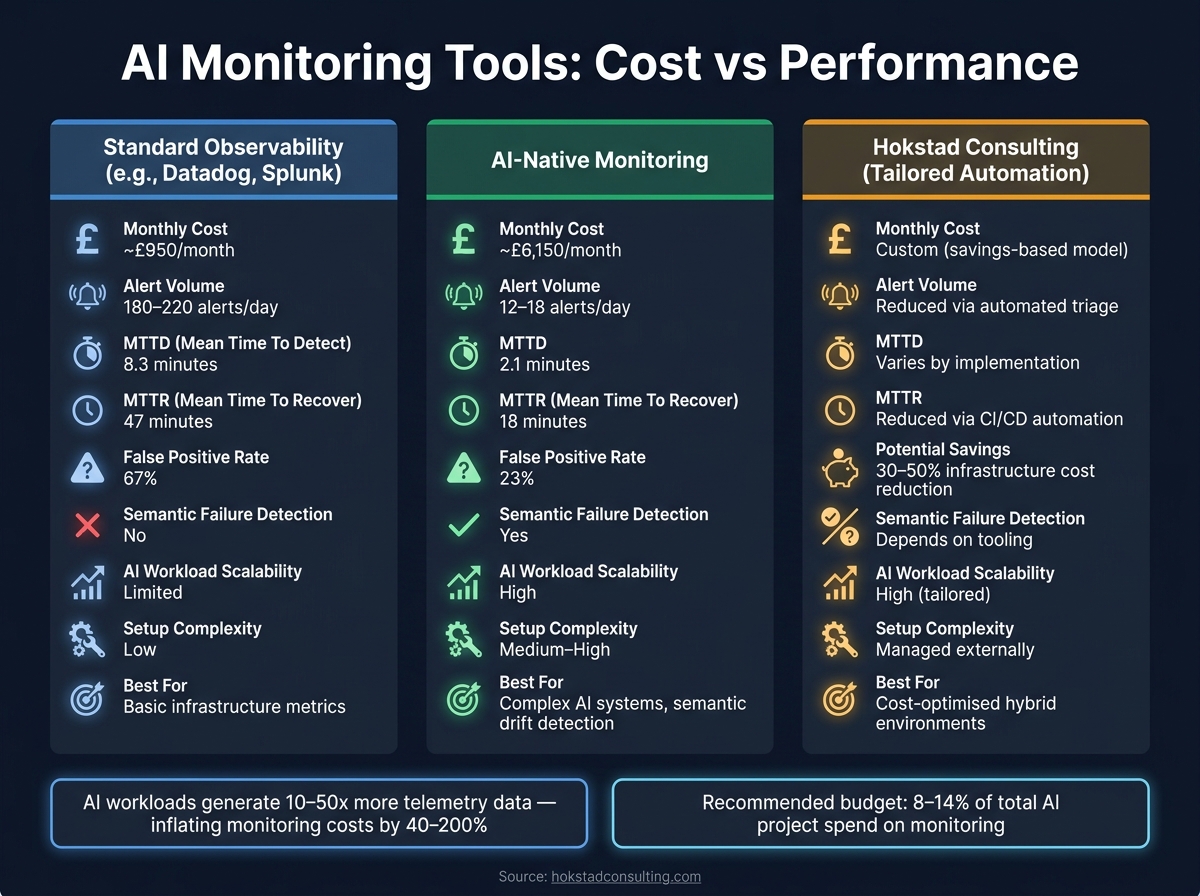 {AI Monitoring Tools: Cost vs Performance Comparison 2026}
:::
{AI Monitoring Tools: Cost vs Performance Comparison 2026}
:::
Different monitoring strategies come with their own strengths and weaknesses. To build on the earlier discussions about cost and performance, the table below summarises the key trade-offs among standard observability, AI-native monitoring, and Hokstad Consulting's tailored automation approach.
| Aspect | Standard Observability | AI-Native Monitoring | Hokstad Consulting (Automation) |
|---|---|---|---|
| Monthly Cost | ~£950/month | ~£6,150/month | Custom (savings-based model available) |
| Alert Volume | 180–220 alerts/day | 12–18 alerts/day | Reduced via automated triage |
| MTTD | 8.3 minutes | 2.1 minutes | Varies by implementation |
| MTTR | 47 minutes | 18 minutes | Reduced through CI/CD automation |
| Semantic Failure Detection | No | Yes | Depends on tooling chosen |
| Scalability for AI Workloads | Limited | High | High (tailored per environment) |
| Setup Complexity | Low | Medium–High | Managed externally |
| Learning Period | None | 2–4 weeks | Minimal (pre-configured) |
This table highlights the trade-offs between cost, alert efficiency, and operational responsiveness for each approach.
Standard observability tools are a cost-effective way to monitor infrastructure metrics, but they fall short when it comes to AI workloads. These platforms treat AI systems like any other service, so they often fail to detect semantic failures that don’t trigger obvious errors like CPU spikes or HTTP issues [4]. Additionally, they struggle to handle the high-cardinality telemetry typical of AI environments.
AI-native monitoring tools address these gaps, but their benefits come at a steep cost. For organisations operating at scale, managed solutions can cost between £64,000 and £119,000 annually for 10 million traces per month [15]. Moreover, the LLM-as-judge
evaluation pattern can significantly inflate trace counts, potentially doubling or tripling costs. These systems also require a learning period, often proving unreliable in the first two weeks, with stability and dependability arriving only after around three months [1].
As DevOps engineer Kedar Salunkhe aptly puts it:
AI monitoring isn't a shortcut. It's a multiplier. If your foundation is weak, it multiplies the chaos. If your foundation is strong, it multiplies the value.[1]
For teams looking to gain the benefits of AI-native monitoring without the added complexity or expense, Hokstad Consulting offers a structured approach. They focus on selecting the right tools and optimising costs, helping organisations avoid paying for enterprise-level features they don’t yet need. Their expertise in cloud cost engineering often leads to 30–50% reductions in infrastructure spending, which can be directly applied to observability stacks that have grown beyond their initial scope. This aligns with the broader theme of the article: tailored cost management is crucial for balancing these trade-offs effectively.
Conclusion
The big question is whether the performance improvements justify the expense. While standard observability platforms work well for simpler systems, they often fall short when dealing with high-cardinality telemetry in AI workloads. On the other hand, AI-specific tools can dramatically cut detection and resolution times. By 2026, businesses should allocate around 8–14% of their total AI project budget for monitoring, increasing to 12–18% in sectors with strict regulations [4]. These figures highlight the importance of a well-planned budget.
For UK businesses in industries like financial services or healthcare - where sensitive data is the norm - compliance adds another layer of complexity. Monitoring tools must meet GDPR requirements, include PII masking, and ensure incidents are detected within 30 minutes to comply with DORA. Additionally, the EU AI Act’s transparency rules, effective from 2 August 2026, will demand even greater accountability [5]. These regulations make it clear that monitoring strategies must strike a careful balance between cost and compliance.
To navigate these challenges, a hybrid monitoring strategy is key. Traditional monitoring can handle basic infrastructure checks, while AI-native tools should focus on complex microservices and detecting behavioural anomalies [1]. Before selecting a platform, run a two-week proof of concept on your own systems rather than relying on a vendor’s demo [16]. Also, start with tiered sampling to keep data ingestion costs under control [2].
For organisations finding in-house management too demanding, Hokstad Consulting offers tailored cloud cost engineering and DevOps services. They’ve helped clients achieve 30–50% reductions in infrastructure costs by optimising monitoring systems. Ultimately, every pound spent on monitoring should provide measurable value, ensuring costs stay in line with the benefits delivered.
FAQs
How do I know if AI-native monitoring is worth the extra cost for my system?
To determine the cost per insight for AI-native monitoring, divide your monthly expenditure by the number of actionable findings it provides. If the cost of these insights exceeds the financial impact of the failures they help prevent, the investment might not be worthwhile.
AI tools shine in environments with well-structured systems, helping to improve Mean Time to Resolution (MTTR) and cut down on alert fatigue. However, in disorganised or chaotic setups, they can actually magnify existing problems. These tools are most effective when manual monitoring struggles to manage the sheer volume of signals.
What’s the quickest way to cut telemetry costs without losing critical visibility?
One of the quickest ways to lower telemetry costs while keeping visibility intact is by implementing tail sampling at the OpenTelemetry collector level. This approach allows you to retain 100% of error traces and high-latency outliers, while sampling routine, healthy requests at a rate of just 5–10%. The result? A potential reduction in total data volume by as much as 90%.
Hokstad Consulting also recommends additional strategies to optimise costs, such as:
- Consolidating redundant tools to streamline operations.
- Filtering out unnecessary attributes that don't provide meaningful insights.
- Applying retention policies that reflect actual usage patterns, ensuring you're not paying for data you don't need.
By combining these practices, you can maintain critical visibility while significantly cutting down on expenses.
Which AI quality signals should I monitor beyond uptime and latency?
Monitoring goes far beyond just uptime and latency. It's crucial to keep an eye on hallucination rates, accuracy, and how relevant the outputs are to ensure the system remains dependable. Keep track of metrics like token usage per request, the speed at which costs accumulate, and any unusual expenses, such as inefficient model routing.
Pay attention to behavioural signals too - things like task completion rates, retries, and user feedback can provide valuable insights into how effective the system is. Hokstad Consulting supports businesses in fine-tuning these metrics, helping to streamline deployment cycles and cut down on cloud costs.