
AI is transforming configuration management by automating complex tasks, improving reliability, and reducing human error. It addresses challenges like configuration drift, compliance issues, and scaling in cloud environments. Here's what you need to know:
- AI tools now offer proactive drift detection, real-time compliance monitoring, and self-healing systems.
- Platforms like Ansible, Puppet, Chef, and CFEngine integrate AI to streamline infrastructure management.
- Key features include natural language commands, machine learning for predictive insights, and automated remediation.
- Examples: Swisscom saved 3,000 hours annually with Ansible; DBS Bank automated compliance with Puppet.
Quick Overview of AI-Driven Tools:
- Hokstad Consulting: Real-time drift detection, compliance automation, and tailored AI strategies.
- Ansible: Event-driven automation, natural language playbook creation, and inventory forecasting.
- Puppet: Natural language insights, automated compliance, and self-healing infrastructure.
- Chef: Predictive risk analysis, real-time drift detection, and unified dashboards.
- CFEngine: Peer-based anomaly detection, autonomous agents, and high scalability.
AI in configuration management simplifies operations, boosts efficiency, and ensures systems remain secure and compliant. Each tool offers unique strengths, so selecting one depends on your organisation's needs.
::: @figure 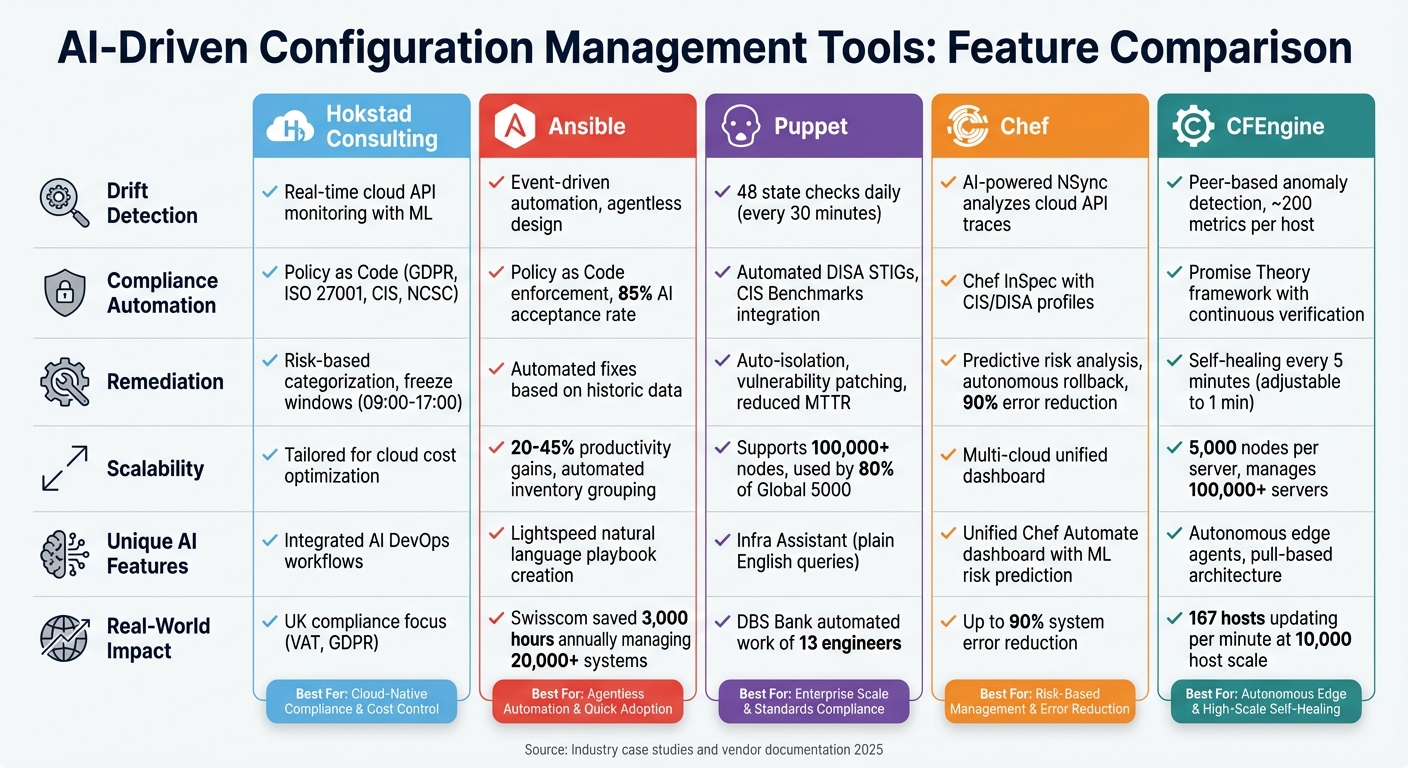 {AI-Driven Configuration Management Tools Comparison: Features and Capabilities}
:::
{AI-Driven Configuration Management Tools Comparison: Features and Capabilities}
:::
No Time to Drift: AI, Configuration Management and the Future of Enterprise Security
1. Hokstad Consulting
Hokstad Consulting focuses on weaving AI directly into DevOps workflows to help businesses cut cloud costs while improving system reliability. Rather than adding AI as an external feature, they incorporate it straight into configuration management. This approach shines through their strategies for drift detection, compliance automation, and remediation.
Drift Detection
Hokstad Consulting uses machine learning to monitor cloud API traces in real time, spotting deviations from normal behaviour before they lead to outages [8][3]. Their AI agents can interpret erratic cloud API activity to understand potential infrastructure changes. This allows for automated reconciliation, ensuring any unauthorised changes are incorporated back into the original configurations [3].
Compliance Automation
To maintain strict alignment with organisational policies, Hokstad Consulting employs Policy as Code. Tools like HashiCorp Sentinel and Open Policy Agent enforce these policies by blocking non-compliant changes during deployment. This ensures adherence to UK-specific standards such as GDPR, ISO 27001, CIS benchmarks, and NCSC guidance.
AI plays a key role in compliance by identifying unusual spending and usage patterns that might signal security breaches or misconfigurations. Immutable audit logs track every drift event and remediation action, offering transparency for regulatory audits. Additionally, automated tagging ensures that expenses are correctly allocated to specific projects - critical for meeting VAT requirements and aligning with financial year schedules in the UK.
Remediation Capabilities
Hokstad Consulting categorises drift based on risk levels to ensure swift yet safe responses. Low-risk changes are handled automatically, while high-risk modifications require manual approval. Their system includes retry logic and real-time monitoring, with freeze windows (09:00–17:00) in place to safeguard operations during peak business hours.
2. Ansible
Ansible has seamlessly integrated AI into its automation platform using AIOps, which combines machine learning with big data. This allows it to detect logged events, suggest responses, and carry out remediation actions [7]. By leveraging AI, Ansible enhances how organisations manage configuration drift, maintain compliance, and scale operations across distributed infrastructures.
Drift Detection
Event-Driven Ansible takes observability data and translates it into automated corrections, enabling real-time management of drift [9][7]. Thanks to its agentless design, corrective actions are limited to the affected endpoints, ensuring that any changes are contained to the compromised system. This is particularly critical given the rise in cloud exploitation cases, which saw a 95% increase in 2022, often caused by misconfigurations and human error [9].
Shahid Ali Khan, a DevOps Leader at LambdaTest, highlights the benefits:
With current AI technology in place, Ansible can detect and automatically fix issues on the basis of historic data in the inventory without the need for manual intervention, reducing the risk of human error [10].
Tools like Ansible Lightspeed further streamline this process. Using generative AI, Lightspeed creates playbooks and tasks based on natural-language prompts, speeding up the response to detected drift [7][6].
Compliance Automation
After identifying drift, Ansible's AI-driven compliance features use Policy as Code to enforce internal standards during automation runtime. This ensures that all actions remain within authorised boundaries [7][6]. Generative AI also simplifies the creation of playbooks that align with organisational standards, reducing the likelihood of manual mistakes [11][4]. During technical previews, AI-generated content recommendations for Ansible achieved an impressive 85% acceptance rate [12].
Scalability
Ansible’s AI capabilities make managing complex and distributed environments more efficient. Automated inventory grouping and demand forecasting are key features. AI clusters hosts by operating system and location, simplifying inventory management while accurately predicting resource needs [10]. Khan adds:
AI here with Ansible can help detect the usage and forecast based on exact demand [10].
The implementation of AI coding assistants in Ansible has led to productivity gains of 20% to 45% [12].
3. Puppet
Puppet has embraced modern AI-driven configuration management to simplify and enhance infrastructure oversight. One standout feature, the Infra Assistant, allows users to query their infrastructure using plain English instead of the typically complex Puppet Query Language (PQL) [5][13]. Available in Puppet Enterprise Advanced, this tool translates natural language queries into actionable insights, helping teams quickly detect configuration drift and other issues - often within seconds [5][13].
Drift Detection
Puppet's agent-based system performs 48 state checks daily (every 30 minutes by default) to ensure servers stay aligned with their intended configurations [17][20]. By integrating AI into this process, Puppet can uncover subtle signs of compromise that manual checks might miss [16]. Its declarative model also ensures that any unauthorised changes are automatically reversed, maintaining the desired state [15]. As Margaret Lee and Robin Tatam from Puppet clarify:
Infra Assistant can't make changes - it can only provide insights [5].
Beyond detecting drift, Puppet leverages AI to ensure compliance and simplify remediation processes.
Compliance Automation
A compelling example of Puppet's capabilities comes from DBS Bank in Singapore. The bank used Puppet's AI-driven compliance tools to automate tasks like report generation and security remediation, which previously required the efforts of 13 engineers [15]. By adopting Puppet's self-healing infrastructure-as-code aligned with DISA STIGs, DBS automated enforcement processes, freeing up engineers to focus on higher-priority work [15]. Puppet’s AI assistant also integrates with CIS Benchmarks and Puppet Comply, enabling automated audit trails and making compliance more accessible for less-experienced team members [15][18].
Remediation Capabilities
Puppet’s AI strategy, powered by Perforce Intelligence, is designed to act swiftly when threats are detected. Robin Tatam from Puppet's Security & Compliance team highlights this proactive approach:
AI, coupled with robust automation, empowers us to move beyond reactive firefighting and towards a proactive, resilient security posture [16].
With these capabilities, Puppet can automatically isolate compromised systems, block malicious traffic, and patch vulnerabilities - drastically reducing Mean Time to Recovery (MTTR) without requiring manual intervention [16].
Scalability
Puppet's AI-driven tools are built to handle infrastructure at an impressive scale. The platform supports organisations managing over 100,000 nodes [19], and about 80% of Global 5000 companies rely on Puppet for their critical infrastructure [14]. Its AI capabilities allow thousands of servers to be managed as a single entity, a crucial feature for environments like AI clusters and large-scale language model training systems that demand precise, distributed configuration [17].
Need help optimizing your cloud costs?
Get expert advice on how to reduce your cloud expenses without sacrificing performance.
4. Chef
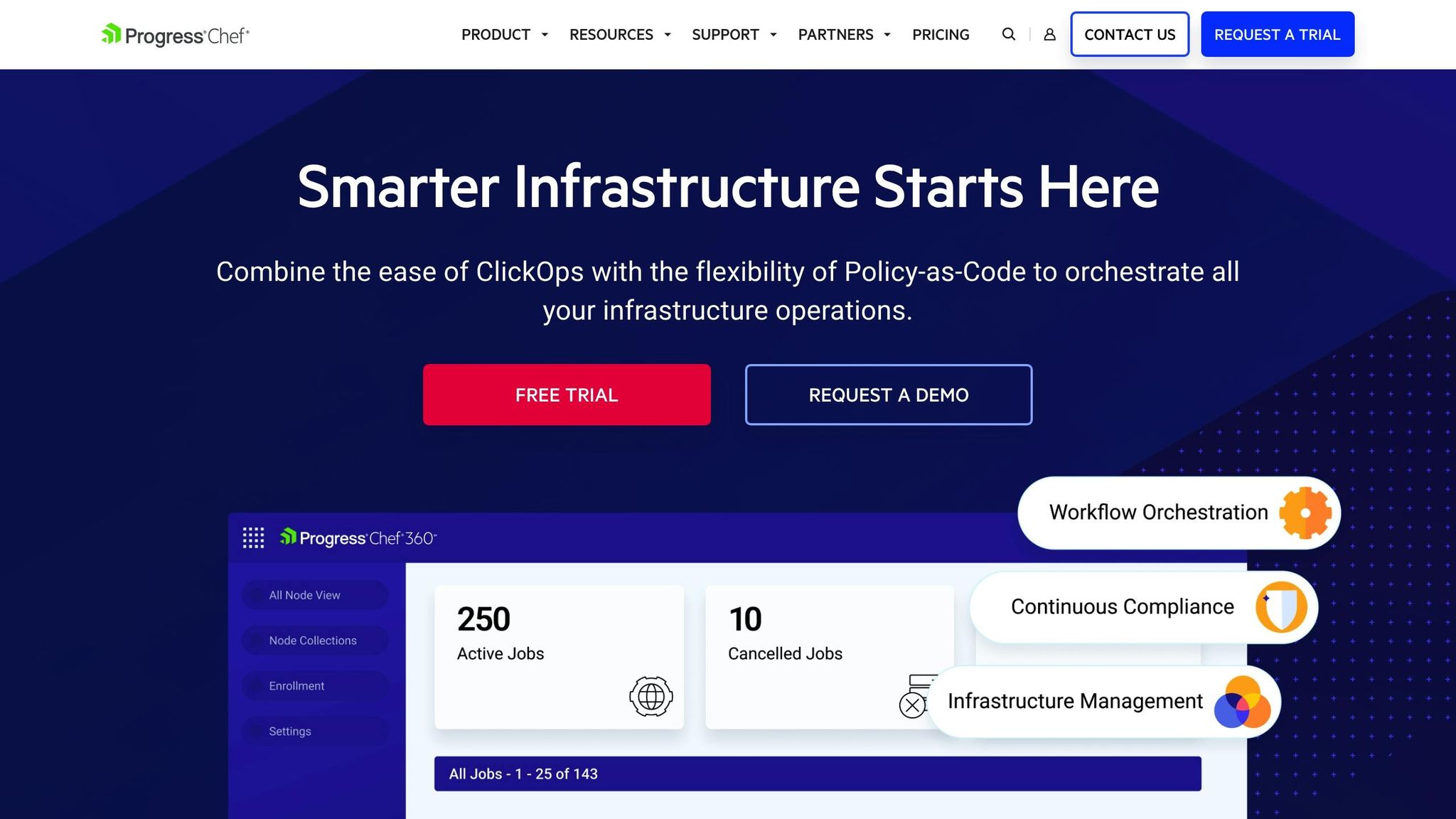
Chef incorporates AI throughout its platform to simplify configuration management. At the heart of this is Chef Automate, an enterprise dashboard that unifies Chef Infra (infrastructure), Chef InSpec (compliance), and Chef Habitat (applications) into a single, auditable system [22].
Drift Detection
Chef's approach to drift detection uses AI to go beyond traditional scanning methods. With the AI tool NSync, it analyses cloud API traces like AWS CloudTrail and Azure Activity Logs to identify changes that other Infrastructure as Code (IaC) tools might miss [3]. Large language models help interpret the intent behind complex API events, filtering out unnecessary or temporary actions to focus on actual drift [3]. Chef Automate offers a real-time view of all changes within the environment, whether initiated by users or systems. Its dashboards and query tools enable quick identification of root causes across entire fleets [22]. This ensures a more thorough and proactive approach to maintaining compliance.
Compliance Automation
Chef InSpec supports compliance by allowing teams to write rules as code or use pre-built CIS and DISA profiles. AI then automates the enforcement of these rules across hybrid and multi-cloud environments [22]. The platform can scan cloud environments and virtual machines for policy adherence without needing agents installed on systems. It also integrates seamlessly with tools like ServiceNow, Slack, Splunk, and ELK/Kibana via webhooks and data feeds [22]. Chef Automate produces detailed, customisable reports that highlight security risks and outdated software, consolidating data from the entire ecosystem to provide actionable insights [22].
Remediation Capabilities
Using machine learning, Chef evaluates configuration changes to predict potential risks before updates are applied, offering corrective rollbacks when needed [1]. The platform supports autonomous rollback mechanisms, which enable systems to self-heal by reverting to stable configurations after errors or unauthorised changes [1]. Chef Automate's unified view helps teams prioritise solutions for detected issues, and automated remediation scripts can be triggered through webhooks when compliance failures occur [22]. This AI-driven remediation approach aligns with the industry's shift towards error-free, autonomous configuration management.
Scalability
Chef Automate is designed to grow with enterprise needs. By leveraging AI, it audits and refines Infrastructure as Code, enhancing reliability and cutting down on resource waste [22]. This scalability complements Chef's capabilities in drift detection and compliance, reducing manual intervention and minimising errors in complex, multi-cloud environments. AI-powered automation within Chef has been shown to reduce system errors by up to 90% [21].
5. CFEngine
CFEngine approaches AI-driven configuration management with a distinctive Promise Theory framework. In essence, CFEngine ensures that every promise
made in its system is continuously monitored and upheld. Its monitoring daemon, cf-monitord, collects data from system probes, using both historical and real-time information to establish a baseline for each machine [23]. These baselines, represented as special variables, allow CFEngine to make dynamic policy decisions. Instead of relying on fixed thresholds, the system adapts its remediation strategies based on how the system actually behaves [23][28].
Drift Detection
CFEngine's drift detection employs a peer-based anomaly detection method. This means hosts work together to check each other’s files for irregularities, reducing the strain on central servers [24]. The monitoring daemon observes approximately 200 metrics for each host, including variables, classes, and inventory details. When anomalies like excessive CPU usage or unauthorised file changes are detected, edge agents act immediately [24]. By default, these agents enforce policies every five minutes, but the interval can be adjusted to as little as one minute [24]. This proactive monitoring forms the backbone of CFEngine's ability to respond autonomously to issues.
Remediation Capabilities
CFEngine’s self-healing features are designed to operate independently at the edge. According to its documentation:
Every promise that you make in CFEngine is continuously verified and maintained. It is not a one-off operation, but a self-repairing process should anything deviate from the policy [23].
This convergence model ensures systems are automatically restored to their intended state without requiring manual input. For instance, if SSH fails and the policy server becomes unreachable, CFEngine can activate emergency remote access or automatically fix SSH configurations [24]. Its pull-based architecture means that even if the central policy server goes offline, local agents continue to enforce the last valid policy [27].
Scalability
CFEngine is designed to handle environments of all sizes efficiently. A single policy server can manage up to 5,000 nodes with five-minute check-ins, all while requiring minimal hardware resources [26][29]. The system is versatile enough to manage everything from small embedded devices to infrastructures with over 100,000 servers [25][27]. For instance, CFEngine can oversee 10,000 hosts, with an average of 167 hosts updating per minute when updates are distributed over an hour [24]. Its lightweight, C-based codebase contributes to its impressive performance and low resource usage, making it a reliable choice for large-scale operations [25][27].
Advantages and Disadvantages
Each tool's AI-powered features offer distinct benefits and challenges, influencing how they fit into broader infrastructure management strategies.
Ansible stands out with its agentless design and the ability to generate natural language code through Lightspeed. It's been effectively deployed by Swisscom to manage over 20,000 IT and network systems, saving thousands of hours annually at scale [30]. Its event-driven automation and inventory forecasting make it particularly effective for self-healing scenarios [10]. However, custom training of AI models is often required to align with specific organisational processes [10]. Richard Henshall, Senior Manager of Ansible Product Management at Red Hat, points out that while AI is a form of automation rather than a thinking machine, it offers advanced models capable of streamlining data access [10].
Puppet simplifies infrastructure management with its Infra Assistant, which provides natural language insights, eliminating the need for complex PQL queries. This lowers entry barriers for less experienced engineers [5]. The tool also integrates with Role-Based Access Control (RBAC), ensuring security while enhancing visibility [5]. However, the AI assistant is strictly read-only and cannot directly execute changes. As Margaret Lee from Puppet explains:
Infra Assistant can't make changes - it can only provide insights [5].
This ensures strong governance but necessitates human involvement for implementing fixes.
Chef offers flexibility with its Ruby-based policy-as-code framework [31][32]. This is particularly valuable for organisations with intricate pipeline requirements. On the flip side, it comes with a steeper learning curve, as users need to be proficient in Ruby and Erlang to fully utilise the platform [32]. Chef's AI features are more focused on pipeline integration and vulnerability scanning rather than generative functionalities [31].
CFEngine, meanwhile, shines in scalability. Its autonomous agents and mature declarative model make it ideal for large-scale operations [31][32]. However, it lacks the generative AI capabilities found in other platforms [32]. Additionally, the ongoing shortage of professionals skilled in both DevOps and AI remains a significant hurdle for organisations [17].
These comparisons underline how AI integration differs across tools, emphasising the importance of selecting a solution that aligns with specific automation and management needs.
Conclusion
AI-powered configuration management is reshaping how infrastructure is managed at scale. Its standout features include natural language interfaces that simplify complex tasks, event-driven automation for self-healing systems, and automated drift reconciliation to keep infrastructure aligned. These capabilities bridge the gap between senior-level expertise and less experienced engineers, but it's essential to align these advanced tools with your organisation's operational needs.
When selecting tools, it's crucial to consider the specifics of your environment. For example, organisations managing extensive hybrid cloud systems can benefit from Ansible's event-driven automation, as evidenced by numerous industry success stories. On the other hand, if security and governance are top priorities, Puppet's RBAC-integrated approach offers enhanced visibility and control [5]. For large-scale setups that rely on autonomous agents, CFEngine's declarative model remains a reliable choice, even though it doesn't yet include generative AI capabilities.
Looking ahead, advancements in agentic AI point to even more sophisticated automation. A collaborative study by the University of Michigan and Amazon Web Services in 2025 introduced NSync, an LLM-powered tool that achieved a 0.97 pass@3 accuracy rate in reconciling infrastructure drift across 372 real-world scenarios. It also improved token efficiency by 47% [3]. This indicates that future tools will likely evolve from simple code generation to systems capable of understanding intent and autonomously repairing configurations.
However, before diving into AI-enhanced automation, a solid foundation is essential. As Piyush Patel, Managing Architect at Red Hat, aptly puts it:
If you are going to perform a task more than twice then spend time to automate it [2].
Start by implementing policy-as-code guardrails to ensure AI-driven decisions adhere to security standards [6][7]. Additionally, weigh the value of enterprise features against their cost, especially since over half of organisations prioritise cost reduction [33].
For organisations looking to integrate AI into their DevOps workflows, Hokstad Consulting offers tailored services, including AI strategy development, agent creation, cloud infrastructure optimisation, and DevOps transformation. Visit Hokstad Consulting for expert guidance on navigating this evolving landscape.
FAQs
How does AI help detect and fix configuration drift automatically?
AI brings a new level of efficiency to configuration management by leveraging machine learning to keep an eye on live system setups, comparing them to predefined baselines like Infrastructure as Code (IaC). When it detects any discrepancies - commonly referred to as configuration drift - it can step in immediately to fix the issue without needing human input.
This might involve updating IaC scripts, activating serverless functions, or even rolling back recent changes to return the system to its intended state. By automating these tasks, AI not only saves valuable time but also minimises the chance of human mistakes, helping to keep systems stable and compliant.
What are the main advantages of using AI for compliance automation?
AI-driven compliance automation brings a host of advantages to the table. One standout benefit is its ability to enhance accuracy, cutting down on human errors and reducing the reliance on manual processes. This frees up teams to concentrate on more strategic, high-value activities.
Another key feature is real-time monitoring, which not only keeps compliance efforts current but also produces audit-ready, time-stamped records. This makes verification straightforward and ensures that compliance processes stay transparent. On top of that, AI can anticipate and mitigate potential violations before they escalate, helping businesses sidestep hefty fines and operational setbacks.
By simplifying compliance workflows, AI offers significant savings in both time and money. For companies striving to meet regulatory requirements effectively, it’s a game-changing solution.
How do AI-powered tools like Ansible and Puppet improve scalability in cloud environments?
AI-powered tools like Ansible and Puppet play a key role in managing cloud environments by automating essential tasks such as provisioning, handling configuration drift, and orchestrating workloads. This automation ensures that thousands of cloud instances can be deployed, updated, and maintained consistently, eliminating the need for time-consuming manual efforts.
With AI-driven automation, these tools provide the flexibility to scale operations seamlessly. Organisations can respond to shifting demands quickly while keeping their systems stable and efficient. This approach not only speeds up deployment cycles but also minimises human error, resulting in a more dependable infrastructure.