
E-commerce platforms lose customers - and revenue - when sites are slow. A delay of just 100 milliseconds can cut conversion rates by 7%. Traditional CDNs, which rely on static routing, struggle with modern demands like flash sales and traffic spikes. This is where AI steps in, transforming CDN performance with predictive caching, smarter traffic management, and real-time content delivery.
Here’s what AI-powered CDNs achieve:
- Faster Load Times: Reduces Time to First Byte (TTFB) from 430 ms to 215 ms.
- Higher Cache Efficiency: Boosts cache hit ratios from 83% to 95–97%.
- Lower Costs: Cuts origin server egress data by up to 79%.
- Personalised Experiences: Delivers tailored content based on user location, device, and network.
AI Techniques for CDN Optimisation
AI-powered CDNs have introduced advanced methods to predict demand, manage traffic, and deliver content more efficiently.
Predictive Caching with Machine Learning
Machine learning is reshaping how CDNs handle content storage, shifting from a reactive approach to a more proactive one [2][5].
For instance, Temporal Convolutional Networks (TCNs) are excellent at identifying long-term traffic patterns, making them ideal for forecasting daily peaks or scheduled events [2]. On the other hand, LSTM networks with attention layers excel at managing unpredictable traffic spikes, such as viral trends or sudden flash sales, by prioritising recent anomalies [2].
Reinforcement learning (RL) takes caching a step further by using reward-based policies to decide which content should remain in the cache, minimising the chances of evicting high-value assets prematurely [2]. Graph Neural Networks (GNNs) complement this by mapping relationships between edge nodes. This allows a busy node to prompt nearby nodes to pre-load content, preventing overloads before they happen [2].
E-commerce platforms benefit significantly from these advancements. Machine learning models can create smarter cache keys by factoring in product SKUs, variants, and regional user data, enabling dynamic pages to be served locally instead of repeatedly fetching them from the origin server [2]. Additionally, lightweight models like TensorFlow Lite can run directly at the edge, assembling personalised content without requiring a round-trip to the origin [7].
Take the 2022 FIFA World Cup as an example: Akamai managed peak traffic of 44 Tbps by leveraging AI-driven predictive algorithms. This approach cut rebuffering rates by 50% compared to traditional caching methods [2]. Similarly, Valve successfully delivered 25 PB of data within 36 hours for a major Steam update. By combining demand forecasting and RL-based cache management, they sustained an average throughput of 120 Gbps while keeping 95th-percentile latency under 40 milliseconds [2].
These innovations in predictive caching are setting the stage for smarter traffic forecasting.
Traffic Forecasting with Neural Networks
Neural networks extend the capabilities of AI by anticipating traffic surges and enabling CDNs to distribute server loads effectively, preventing bottlenecks before they impact users [4].
By integrating external data like social media trends, weather updates, and global news, these systems refine their predictions in real time [2][6]. For example, they can predict increased traffic to winter clothing pages during a cold spell or pre-load content tied to a trending story before it goes viral.
Netflix’s Peregrine
system is a great example of this in action. Using a combination of reinforcement learning and Graph Neural Networks, it forecasts content demand and pre-positions assets, reducing content startup delays by 12% [2]. Federated learning is also emerging as a way to train these models across distributed edge nodes while maintaining user privacy, further improving localised forecasting accuracy [7][4].
Real-Time Content Delivery Optimisation
AI doesn’t just predict; it also reacts in real time to optimise content delivery. Smart routing leverages live telemetry data - such as round-trip times, throughput, and error codes - to determine the most efficient path for each request. This helps the system bypass congested routes or resolve peering issues on the fly [3].
These AI-driven systems can reroute traffic or allocate resources in under 500 milliseconds, far outpacing traditional CDNs that might take several minutes to respond manually [2][6]. Edge personalisation further boosts performance by using lightweight inference models at edge nodes to assemble custom pages locally. For e-commerce, this means personalised product recommendations, pricing, and inventory updates can be delivered without the delays associated with fetching data from a central database [7].
The results are impressive. AI-powered CDNs have slashed the average Time to First Byte from 430 milliseconds to 215 milliseconds and improved P95 global latency by 31%, reducing it from 80 milliseconds to 25 milliseconds [2][3]. Cache hit ratios have also jumped from around 83% to between 95% and 97%, cutting origin server load and lowering egress costs [2].
Gartner estimates that by 2026, 30% of all CDN traffic will be managed by AI-driven decisions, a sharp increase from just 5% today [2].
Research Findings and Case Studies
Recent applications showcase how AI is transforming high-traffic, personalised content delivery networks (CDNs). These examples highlight how AI-powered systems are meeting the growing demands of e-commerce by improving efficiency and tailoring user experiences.
Dynamic Edge Computing for High-Traffic Websites
Alibaba Cloud introduced AliCCS
, an AI-based Congestion Control Selection system, across its global CDN infrastructure. This initiative, led by Xuan Zeng and a team from Alibaba and Sun Yat-sen University, ran for a year and achieved impressive results. The system enhanced Quality of Experience (QoE) by 9.31% and significantly lowered retransmission rates across various networks in China. Additionally, the project delivered verified cost savings of over US$10 million [8].
AliCCS dynamically selects the most suitable congestion control algorithm for specific geographic regions, replacing the limitations of static configurations that often struggle with diverse network conditions. By processing AI workloads at the edge, the system achieved three times the throughput of traditional cloud setups while cutting costs by 20–86% [1][9].
These advancements demonstrate the potential for further progress in personalised content delivery.
Real-Time Personalisation in E-Commerce Platforms
Building on the success of dynamic edge computing, retail platforms are now leveraging AI to provide real-time personalised experiences. By using edge-based AI, retailers can offer instant customisation for their customers.
In August 2025, ThredUp introduced an AI-powered fashion assistant that delivers real-time styling recommendations, driving a verified 30% year-on-year increase in their customer base [9].
Carrefour also launched Hopla
in August 2025, a generative AI tool designed to suggest recipes based on the contents of a customer's shopping basket. It adapts recommendations to fit budget and dietary preferences in real time [9]. Similarly, Zalando implemented a ChatGPT-powered virtual stylist, which not only answers customer queries but also offers personalised fashion advice. This innovation reduced response times from 200 ms to approximately 40 ms [9].
What once took 200ms round-trip can now happen in 40ms locally - at scale. The personalization logic lives in the delivery layer, so it's fast, flexible, and invisible to the user.– Pedro Salvado, Principal Product Manager, Akamai Technologies [9]
These developments highlight how edge-based AI can deliver sub-50 ms response times for personalised content. The result? AI-driven recommendations that increase conversion rates by up to 25% and boost average order values by 15–30% [10].
Performance Metrics and Analysis
::: @figure 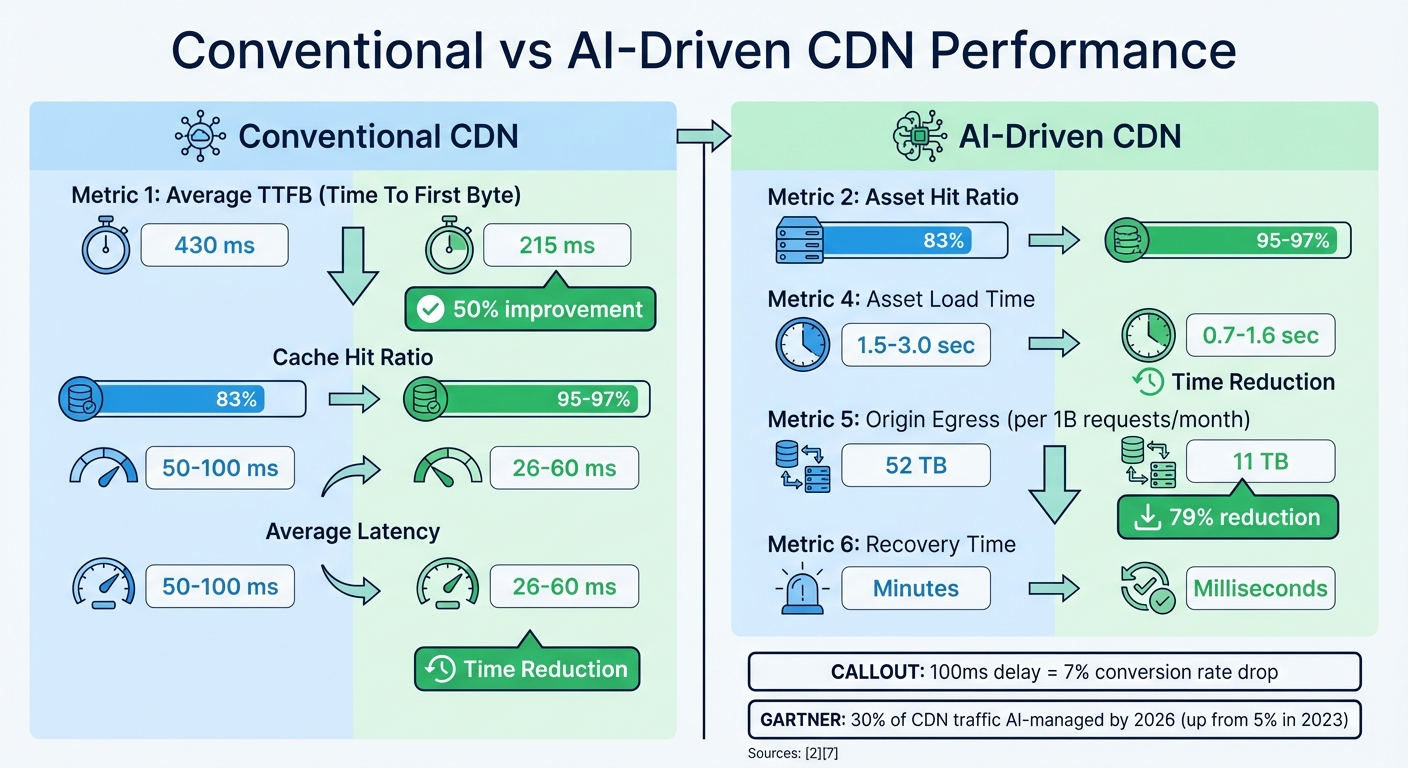 {Conventional vs AI-Driven CDN Performance Comparison}
:::
{Conventional vs AI-Driven CDN Performance Comparison}
:::
Key Metrics: Latency, Cache Hit Ratios, and Cost Savings
To understand how AI reshapes CDN performance, let’s break it down into three critical metrics: Time to First Byte (TTFB), Cache Hit Ratio (CHR), and origin egress costs. TTFB measures the time it takes for the first byte of data to reach the user after a request is made. Even a 100 ms delay in TTFB can reduce conversions by as much as 7% [2]. Amazon famously noted that every 100 ms of added latency costs them 1% in sales [7].
Cache Hit Ratio (CHR) reveals how often content is served from the edge rather than being fetched from the origin server. Traditional CDNs typically achieve a CHR of about 83%, but AI-powered predictive caching boosts this to an impressive 95–97%. This improvement significantly cuts down origin egress, which is the amount of data transferred from the origin server. For example, a platform handling 1 billion requests per month might see origin egress drop from 52 TB with a conventional CDN to just 11 TB with an AI-optimised system [2].
Other metrics like p99 latency (the slowest 1% of requests) and retransmission rates also play a major role, especially during traffic surges. AI-driven congestion control systems, such as Alibaba Cloud's AliCCS, have shown the ability to reduce retransmission rates by 25.51% to 174.36% [8]. Additionally, during extreme traffic spikes (10× normal levels), AI systems can lower error rates by 47% [7]. The following table highlights these performance differences.
Comparison Table: Conventional vs AI-Driven CDN
Here’s a side-by-side look at how conventional CDNs stack up against AI-enhanced ones:
| Metric | Conventional CDN | AI-Driven CDN |
|---|---|---|
| Average TTFB | 430 ms | 215 ms [2] |
| Cache Hit Ratio | 83% | 95–97% [2] |
| Average Latency | 50–100 ms | 26–60 ms [6] |
| Asset Load Time | 1.5–3.0 sec | 0.7–1.6 sec [6] |
| Origin Egress (1B requests/month) | 52 TB | 11 TB [2] |
| Recovery Time | Minutes | Milliseconds [6] |
The advantages of AI-driven CDNs are undeniable, especially for high-traffic e-commerce platforms. Cedexis Radar data from Q1 2025 highlights that AI-assisted routing achieved a median global latency of 38 ms, compared to 52 ms for traditional CDNs [7]. Looking ahead, Gartner forecasts that by 2026, 30% of all CDN traffic will be managed by AI-driven systems, a sharp increase from just 5% in 2023 [2]. For e-commerce sites, where 70% of users abandon a page if it takes longer than three seconds to load [6], these advancements directly safeguard revenue and drive growth.
Need help optimizing your cloud costs?
Get expert advice on how to reduce your cloud expenses without sacrificing performance.
Future Directions for AI in CDN Optimisation
Agentic AI for Adaptive Routing
The evolution of real-time optimisation in CDNs is moving towards intelligent delegation. The focus now is on agentic AI - systems that not only automate tasks but also make decisions autonomously. As Chandan Gaur from XenonStack aptly summarises:
The next leap in DevOps is not automation - it's delegation to intelligent agents[12].
These intelligent agents take on the role of proactive managers, continuously monitoring network conditions, identifying anomalies, and rerouting traffic as needed. This transforms CDNs from reactive systems into predictive and agile orchestrators.
Traditional routing methods, which rely on static parameters like geolocation or server health, are giving way to dynamic approaches powered by reinforcement learning techniques such as Q-learning. These AI-driven systems analyse real-time metrics like cache usage, server loads, ISP performance, and even time-of-day patterns to make instant routing decisions [6]. The benefits are substantial: hyperscalers can cut egress costs by 20–30% [1], and latency can drop by up to 30% compared to static routing [6]. Moreover, recovery from failures becomes nearly instantaneous - agents can reroute traffic in milliseconds without waiting for DNS updates [6].
For industries like e-commerce, where every millisecond matters (a 100 ms delay can slash conversion rates by 7%), such improvements are crucial. By minimising latency during high-demand events, agentic AI directly protects revenue streams [6].
Hybrid Cloud Approaches for E-Commerce
Dynamic routing isn't the only game-changer. Hybrid cloud architectures are reshaping how e-commerce platforms handle traffic and computational loads. These setups intelligently distribute tasks between edge nodes and central cloud environments, balancing cost and performance in high-traffic scenarios. AI plays a key role, enabling real-time decisions on whether to process workloads locally or offload them to the cloud, based on factors like resource availability and budget constraints [13].
In practice, hybrid edge systems can achieve impressive results, such as an 88% cache hit ratio and end-to-end latency as low as 20 ms - over 50% faster than traditional CDNs [11]. This is particularly important as video content, projected to make up 74% of all mobile data traffic by the end of 2024 [11], demands faster and more efficient delivery. However, implementing such systems isn’t without challenges. Robust data pipelines and sophisticated distributed systems are essential, and edge nodes’ limited resources require careful load balancing to avoid overloading MEC servers [11][4].
Emerging technologies like Communication–Computing–Caching (CCC) convergence are paving the way for ultra-low-latency solutions, especially in preparation for 6G networks and fog-edge architectures [11]. Additionally, there's growing interest in carbon-aware routing, where AI not only optimises for speed but also prioritises energy-efficient network paths to reduce environmental impact [6].
Hokstad Consulting's Role in AI and Optimisation
As businesses aim to meet the increasing performance demands of e-commerce, expert guidance becomes indispensable. Hokstad Consulting specialises in leveraging cutting-edge AI innovations like agentic routing and hybrid cloud strategies to deliver tangible improvements in both latency and cost efficiency. Their expertise spans DevOps transformation, cloud cost engineering, and strategic cloud migrations - key to deploying advanced AI-driven CDN solutions.
Hokstad Consulting excels in reducing cloud costs by 30–50% through techniques like predictive load balancing, right-sizing resources, and implementing advanced caching strategies. These efforts align perfectly with AI-driven CDN optimisation. For businesses exploring hybrid cloud setups, they offer tailored solutions across public, private, and managed hosting environments, ensuring seamless zero-downtime migrations and ongoing performance enhancements.
Their No Savings, No Fee
model provides reassurance, tying their fees directly to measurable results. Whether it’s implementing Q-learning agents for adaptive routing or integrating MEC offloading for demanding computations, Hokstad Consulting equips businesses with the infrastructure and strategic insights needed to transform AI research into scalable, production-ready systems.
Conclusion
AI-powered CDN optimisation has shifted from being a cutting-edge experiment to an essential strategy for e-commerce businesses. The numbers speak for themselves: AI-driven systems significantly improve cache performance, reduce load times, and cut infrastructure costs. Every 100 milliseconds of added latency can slash retail conversions by up to 7% - a stark reminder of how crucial speed is in online shopping [2].
These improvements don’t just enhance performance; they directly impact revenue and operational flexibility. Organisations report bandwidth cost savings of up to 69%, with origin egress costs dropping significantly in normalised deployments [2]. Intelligent routing can reduce egress costs by 20–30%, and origin failover times are slashed from 60 seconds to just 4 seconds [1][3]. These gains aren’t just technical - they’re financial game-changers.
Looking ahead, Gartner estimates that AI will manage 30% of CDN traffic by 2026, a leap from just 5% in 2023 [2]. Businesses that delay adopting AI risk falling behind competitors already leveraging adaptive routing and personalised content delivery. Retailers using edge personalisation are already seeing conversion rates rise by 10–15% [7].
For those ready to make the leap, the first step is to measure baseline metrics like TTFB, cache hit ratios, and cost per 1,000 requests [7]. Starting small with pilot deployments in a single region allows businesses to test and validate these improvements without overextending resources [2]. Companies like Hokstad Consulting can guide organisations through this process, offering tailored solutions in AI strategy, cloud cost management, and DevOps to turn research into actionable systems.
In today’s fast-paced digital landscape, speed, efficiency, and adaptability are non-negotiable. By adopting AI-driven CDN technologies, e-commerce platforms can transform these insights into a decisive competitive advantage.
FAQs
How does AI enhance caching efficiency in CDNs for e-commerce websites?
AI plays a key role in improving caching efficiency for Content Delivery Networks (CDNs) in e-commerce. By leveraging predictive algorithms and real-time data analysis, it fine-tunes the delivery of content. How? By studying user behaviour and traffic trends, AI ensures that frequently accessed content is stored closer to the users. This means faster load times and smoother website performance.
The benefits don’t stop there. This method not only cuts down on latency but also enables e-commerce platforms to manage heavy traffic with ease. The result? A smoother shopping experience for customers and reduced strain on servers.
How do neural networks improve traffic forecasting for CDNs?
Neural networks play a key role in improving traffic forecasting for Content Delivery Networks (CDNs), offering a smarter way to predict traffic patterns. This means CDNs can handle resource allocation, load balancing, and congestion management more efficiently, resulting in smoother content delivery and a better experience for users.
By processing historical data alongside real-time trends, neural networks help CDNs stay ahead of demand surges or declines. This not only boosts performance but also cuts down on latency. Such predictive capabilities are particularly crucial for high-traffic e-commerce websites, where maintaining consistent performance can directly impact customer satisfaction and sales.
What are the benefits of using real-time AI optimisation for content delivery in e-commerce?
Real-time AI-powered tools are transforming how e-commerce platforms manage content delivery. They help achieve faster page loading times, provide a smoother browsing experience, and boost conversion rates. By using smart load balancing and predictive caching, these systems minimise delays, maintain steady performance, and keep things running seamlessly, even during peak traffic.
The benefits go beyond just happy customers. These advancements also improve search engine rankings and drive more sales, making them a must-have for today’s e-commerce businesses.