
AI agents can cut CI/CD test time and cloud cost, but I’d only trust them inside clear human-set limits.
If I had to boil this down, it’s simple:
- Use AI to pick and order tests so teams get feedback sooner
- Use AI to draft and maintain tests but keep human review in place
- Use AI to group failures and spot flaky tests so teams spend less time on noise
- Never let AI make high-risk release calls alone, especially around payments, PII, access control, VAT, or compliance checks
The numbers help explain why teams care. One study cited in the article says 89% of organisations automate deployment and test execution through CI/CD tools, but only 45% trigger automated tests automatically. Another research point says ML-based selection can exclude up to 75% of tests on average and cut end-to-end pipeline time by up to 63%. That can mean less wasted compute and lower spend, which matters when large suites run on every commit.
Here’s the short version of how I see it:
- Test creation: AI can suggest tests from code diffs, defect history, coverage, and CI logs
- Test maintenance: self-healing can fix minor selector or schema changes, but not business-rule changes
- Test selection: risk tags help decide what runs on each commit, PR, nightly job, or release candidate
- Test ordering: short, high-signal checks should run first
- Failure triage: AI can cluster repeat failures into one root-cause view and flag flaky tests
- Governance: high-risk actions need audit trails, approvals, and versioned prompts/models
::: @figure 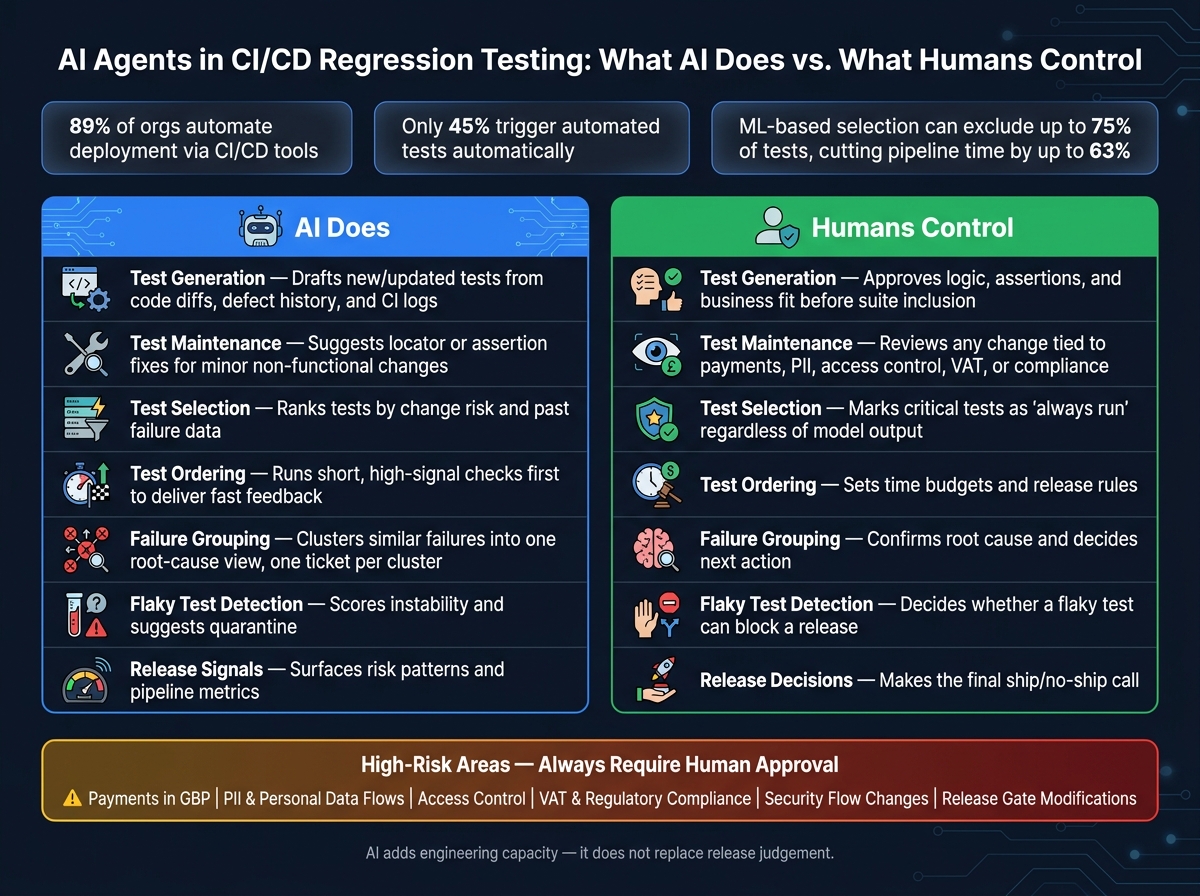 {AI vs Human Control in CI/CD Regression Testing}
:::
{AI vs Human Control in CI/CD Regression Testing}
:::
How to test AI agents with traces, evals, and CI/CD
Quick comparison
| Area | Where AI helps | Where people stay in control |
|---|---|---|
| Test generation | Drafts new or updated tests | Approves logic, assertions, and business fit |
| Test maintenance | Suggests locator or assertion fixes for minor changes | Reviews any change tied to money, data, access, or rules |
| Test selection | Ranks tests by change risk and past failures | Marks some tests as always run |
| Test ordering | Runs short, high-signal checks first | Sets time budgets and release rules |
| Failure grouping | Clusters similar failures and cuts duplicate tickets | Confirms root cause and next action |
| Flaky test handling | Scores instability and suggests quarantine | Decides whether a test can stop a release |
| Release decisions | Surfaces risk and patterns | Makes the final ship/no-ship call |
My main takeaway: AI is good at sorting, ranking, and grouping. It is much less reliable at judging intent. So the safe model is straightforward: let the agent do the admin-heavy work, and keep people responsible for the parts that can affect customers, compliance, or release risk.
That’s the frame I’d use for the rest of the article.
Using AI agents to create and maintain regression tests
AI agents can help with regression testing in two ways: they can draft new tests and help look after old ones. But there’s a hard line here. People still need to approve what gets into the suite. If an agent can spot where change brings risk, it can also sketch the tests that should cover that risk.
Creating tests from code changes and defect history
AI agents can pull together code diffs, PR context, coverage, defect history and CI logs to suggest new or updated regression tests. They can look at changed modules, endpoints or UI flows, then propose checks aimed at those areas. If a pull request touches checkout, for instance, the agent can connect repeat issues like VAT errors or postcode validation failures to focused tests [1][7][14]
For UK teams, that often means more than just the obvious technical paths. Tests may need to cover:
- payment flows
- address formats
- permissions
- regulatory checks
Product owners or business analysts should still confirm that each test lines up with a real business rule before it goes into the main suite [2][10][15]
Cutting brittle tests with self-healing and maintenance help
Self-healing can cut routine maintenance when a UI refactor changes a selector or an API adds optional fields. In those cases, the agent can suggest a new locator or tweak an assertion without changing the test’s intent. That helps teams deal with small front-end or API changes without spending time on trivial breakages [3][8][12]
Keep self-healing limited to non-functional changes. If a change touches payments, PII, access control, VAT or other regulatory logic, it should stay out of automatic healing and go to a human for review. If not, a test may be fixed
to match the wrong behaviour and hide a real regression [5][9]
Adding AI-generated tests to CI without losing control
A staged promotion model helps keep quality and cost in check. AI agents can suggest tests from new commits and defect patterns, then tag them by component, risk level and estimated run time. Engineers can review the logic, assertions and fit with UK-specific flows before those tests are versioned. It also makes sense to run new tests in shadow mode first, so the team can see whether they help and what they do to the pipeline before they affect release gates [2][4][6][11][13]
Only promote tests that catch real defects and keep false positives low. Teams can also tune how often each test runs so pipelines stay fast and spend stays under control. Those same risk tags can guide which tests run first [2][4][6][11][13]
Choosing the right regression tests with AI
The next step is deciding which tests should run each time. If new tests already have risk tags, AI can use those tags to narrow the run to the checks that matter most.
Risk-based test selection for faster pipelines
An AI agent can look at changed files, dependencies, test-to-code links, and past failures to rank tests by risk for a given change. That makes it possible to run only the highest-risk tests on each commit or pull request, then leave broad end-to-end or cross-browser suites for nightly or pre-release runs.
Research on CI test optimisation shows that ML-based selection can exclude up to 75% of tests on average, cutting end-to-end CI pipeline time by up to 63% [17][18].
Still, this kind of selection needs guardrails. Tests tied to payments in GBP, legal compliance, personal data flows, or safety-critical functions should be marked as always run, no matter what the model suggests. That’s the key idea: risk-based optimisation works best inside boundaries set by people, not in place of them.
Ordering tests by fault risk and run time
Selection and ordering go hand in hand. Once the agent has picked the tests to include, it can rank them so short, high-signal checks run first. That gives developers a useful result within minutes, often before code review has finished. Longer, lower-risk tests can run after that, while the broadest suites stay reserved for release candidates or scheduled overnight runs.
A pipeline-aware approach reported selecting 87% of developer-relevant tests while using only a 50% execution-time budget, which shows that careful ordering can keep most of the useful signal while cutting runtime a great deal [16].
There’s a trade-off here:
- Full-suite execution gives the most coverage, but feedback is slow.
- Rule-based selection is simpler to maintain.
- ML-based selection often gives the best balance of speed, signal, and cost when the data is clean.
Once selection is working, the next task is to group failures and sort real regressions from noise.
Grouping failures and triaging results with AI
After you’ve picked the highest-risk tests, the next job is simpler to describe and harder to do: turn a wall of failures into one clear signal for each root cause.
When a single issue sets off loads of failures, the main problem isn’t the failures themselves. It’s the noise. AI cuts through that noise by clustering related breaks into one investigation instead of spraying teams with dozens of separate alerts.
Grouping failures by component, stack trace, and error pattern
AI agents cluster JUnit XML, JSON results and logs based on shared signals. They group failures by owner, stack trace similarity, and repeated error text, so one incident can cover all related test breaks.
That means fewer duplicate failure tickets in each run. When connected to Jira or Azure Boards, the agent can create one ticket per cluster, update that same ticket in later runs instead of opening duplicates, and send it to the owning team on its own.
Result triage and flaky test detection
Once related failures are clustered, the next step is triage before ownership is assigned. Each cluster should be classified as one of these:
- product regression
- flaky test
- data issue
- environment failure
For flaky tests, score each test using its past pass/fail rate, quarantine unstable tests so they don’t block the build, and still keep them visible in debt metrics [19][20].
That kind of triage can save time, but it still needs limits and human review, which the next section covers.
Limits, governance, and the human decisions that still matter
Once AI starts selecting, clustering, or rewriting test logic, the next issue is simple: where does human control need to stay absolute?
What AI agents still do poorly
AI agents are good at spotting patterns and drafting tests. What they can't do is judge business intent or confirm whether a test still checks the right thing. That gap matters a lot.
The biggest weak spots are business intent and fast-moving requirements. When logic, APIs, or user journeys shift, generated tests and self-healing fixes can drift out of date or start pointing teams in the wrong direction. In practice, an agent can keep a test green while leaving a broken assertion in place or hiding a changed business flow.
That creates a real risk of false confidence. If a pipeline passes because self-healing quietly changed what a test checks, that pipeline no longer reflects what is happening in the product.
For example, an agent may treat a payment failure as a locator issue, while only a human can confirm whether a transaction was duplicated or partially processed.
Governance rules for safe use
This is where risk-based control matters most. Before giving an agent any autonomy, classify pipeline activities by risk.
- Low risk: clustering failures and suggesting test order can be automated
- Medium risk: drafting tests for review needs human sign-off
- High risk: changing release gates, modifying security or payment flows, or suppressing failures must always need human approval
For high-risk actions, teams also need a full audit trail. That should cover the model version, prompt, inputs, reviewer, and outcome. Prompt and model versions should sit alongside code in version control, so teams can explain why a test was added or changed and reproduce results if a production incident needs checking later. This matters even more in regulated environments.
Conclusion: Use AI for speed and signal, keep humans accountable
AI agents can cut pipeline time and reduce wasted compute in a meaningful way. They help with test generation, risk-based prioritisation, failure grouping, and triage. But those gains only hold up when the agent is constrained, measured, and reviewed.
The right way to look at it is straightforward: AI adds engineering capacity; it does not replace release judgement. Humans still need to own business-critical flows, unclear failures, and the final decision to ship. Trust should come from audit trails, approval gates, and clear limits - not from a green pipeline on its own.
FAQs
How do we start using AI agents safely in CI/CD?
Start with reliable unit tests, solid version control, and infrastructure that can cope with the workload. Then bring in AI step by step, with security checks and human oversight all the way through.
Begin in monitor-only mode, where AI scores alerts or suggests actions without blocking builds. Add trust tiers and Policy-as-Code guardrails, check AI output against your existing checks, and put circuit breakers in place for latency or cost limits.
Which regression tests should always run?
In CI/CD, run smoke tests on every commit. They act as a key safety net for major issues.
Even if AI agents trim regression suites with Test Impact Analysis, put the focus on core feature happy paths, critical business logic, and integration points between systems. Hokstad Consulting helps businesses use these AI-driven methods to keep high-value areas tested on a consistent basis while cutting execution time.
How can we measure whether AI is actually improving test pipelines?
Track AI-specific quality and pipeline metrics over time. That means watching how the system performs, not just whether tests pass or fail.
Focus on metrics such as test selection accuracy against ground truth, self-healing success rate, first-time pass rate, and model inference latency. These show whether the AI is picking the right tests, fixing brittle tests when things change, keeping pipelines stable on the first run, and responding fast enough to avoid slowing delivery.
You’ll also want to monitor defect detection rate, flaky-failure rate, mean time to feedback, and cost per test execution. Taken together, these numbers give you a clearer picture of quality, speed, and spend. If one metric improves while another gets worse, you can spot the trade-off early instead of finding out later when the pipeline starts to drag.
To tie changes back to the AI, use A/B testing or branch-to-branch comparisons. That gives you a cleaner before-and-after view, so you can see whether gains came from the AI itself or from something else in the delivery process.