
I use backpressure to keep AI agents from accepting more work than they can finish. I cap queued and running tasks, set one deadline from arrival to completion, and pause or reject work when capacity runs out. A queue absorbs bursts - it does not make workers faster.
My approach covers four checks:
- Bound the load: limit task counts, payload sizes, tool calls and retries across all workers and replicas.
- Choose what waits: reserve capacity for critical tasks; defer or drop lower-priority work under clear rules.
- Handle unfinished work: pass cancellation through each stage, remove expired tasks and prevent duplicate actions.
- Test the limits: track p95/p99 latency, queue age, completions and £ per completed workflow during bursts and dependency failures.
A full queue must change what the producer does. Otherwise, I’m just storing the overload somewhere else.
::: @figure 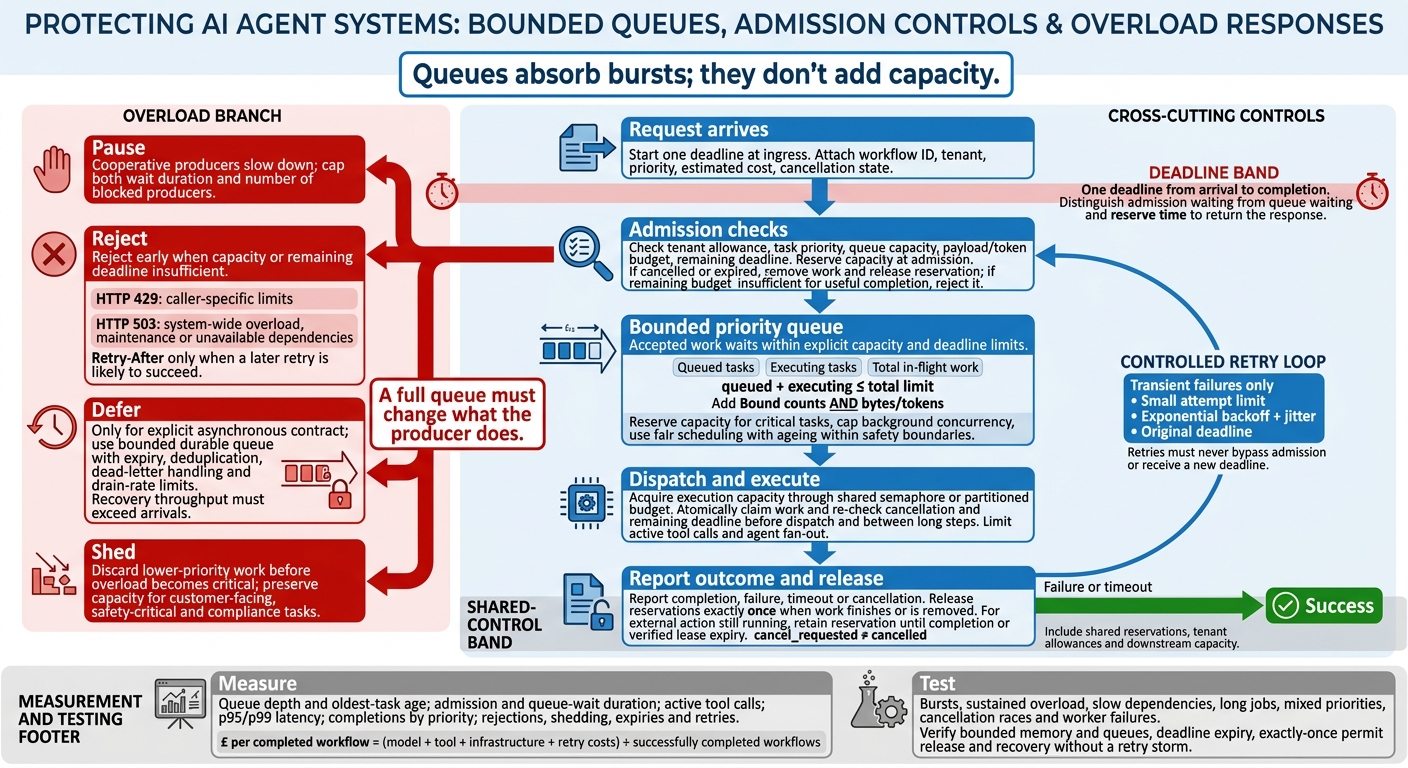 {AI Agent Backpressure: From Admission to Completion}
:::
Backpressure: When to Say No (AI System Design #18)
Set Queue Capacity and Waiting Limits
Bounded queues make overload an explicit choice: pause, reject or shed work. Set separate limits for executing tasks, queued tasks and total in-flight work, so queued + executing never exceeds the total limit. Active concurrency limits resource use during execution; queue capacity limits waiting work.
Pair task counts with a byte or token budget. Use estimated tokens, bytes or expected compute cost to account for context, expected output and tool fan-out. Reserve capacity at admission and release it when work finishes or is removed. Task counts alone cannot protect memory when payload sizes vary.[9]
Size Queues for Throughput and Latency
Size the queue around the waiting-time budget, not peak demand. Little’s Law (N = X × R) gives a baseline: in a stable system, average in-flight work equals throughput multiplied by response time. It does not guarantee p95/p99 latency.[12]
Measure representative workloads and track executing work separately from waiting work. Then size the backlog to fit an acceptable waiting-time budget. A larger queue only postpones rejection; it does not fix a capacity shortfall.[5][6]
| Design | Latency | Memory risk | Reliability under overload | Implementation complexity |
|---|---|---|---|---|
| Bounded queue | Waiting stays bounded if deadlines are enforced | Controlled through count and payload limits | Exposes overload before resources run out | Moderate: needs admission, expiry and rejection rules |
| Unbounded queue | Waiting can grow without limit | High as payloads accumulate | Can hide overload until timeouts or failure | Simple at first; recovery is difficult |
| Direct rejection | Immediate admission decision | Minimal memory for waiting work | Protects accepted work; callers must handle rejection | Simple admission; still needs a retry policy |
Choose How Requests Enter the Queue
Once you have sized the queue, decide what happens when it fills. Choose blocking, timed admission or immediate rejection explicitly.
Blocking works only when you cap both the waiting duration and the number of waiting producers. Without those limits, the backlog simply moves into request threads, sockets or suspended agent tasks. Timed admission waits only until its admission deadline.[7][8][11]
| Queue state | Agent action | Wait limit | Client outcome |
|---|---|---|---|
| Available | Admit and reserve capacity | No admission wait | Accepted |
| Filling | Admit only if the deadline and resource budgets remain feasible | Short, explicit admission timeout | Accepted with queue delay, or retryable overload |
| Full; capacity expected shortly | Wait briefly or use a bounded deferred queue | Fixed admission timeout; cap blocked producers | Delayed acceptance or retryable overload |
| Full; completion before the deadline is unlikely | Reject without adding work | Zero additional wait | Clear overload response for this deadline |
Use One Deadline for Waiting and Execution
Use one deadline for every stage. Admission waiting happens before acceptance; queue waiting happens after acceptance but before execution. Start the deadline at ingress, then pass the remaining budget through admission, queueing, model/tool execution and result handling.
Measure admission waiting and queue waiting separately. Reserve time to send the response, and reject work if its remaining budget is too short to finish usefully.[8][9]
Pass cancellation through to queued records, workers and tool calls. Cancellation may not stop an external action already under way, so mutations need idempotency and status reconciliation. Remove expired tasks, release their reservations, and re-check cancellation before dispatch and between long steps.
Retry only transient failures. Use a small attempt limit, exponential backoff and jitter. Every retry must pass admission again and fit within the original deadline.[8][9][10][11]
Define Overload Responses and Task Priorities
Once queue and deadline limits are set, decide how the system will respond to overload.
Decide When to Pause, Reject, Defer or Shed Work
Base the response on queue occupancy, wait time, worker availability and task priority. Pause producers as the queue approaches its limit. Defer tasks only when they have an explicit asynchronous contract. Shed low-priority work before workers, memory or queue capacity reach their limits.
| Response | Benefits | Drawbacks | Suitable workloads | Stability conditions |
|---|---|---|---|---|
| Pause producers | Keeps accepted work and slows queue growth | Needs cooperative producers and can stall upstream workflows | Batch enrichment, scheduled agent tasks | Producers must follow pause signals and resume gradually |
| Reject excess requests | Gives fast feedback and protects latency | Work is lost unless callers retry or recover it | Interactive requests with strict deadlines | Reject early and bound retries |
| Defer to a bounded durable queue | Survives brief outages and separates acceptance from execution | Adds delay, storage costs and retry complexity | Catalogue updates, report generation and other asynchronous jobs | Set capacity limits, expiry, deduplication, dead-letter handling and drain-rate limits; recovery throughput must exceed arrivals |
| Shed low-priority work | Keeps capacity available for critical workflows | Abandons some work, which may need reconciliation | Recommendations, enrichment and optional analytics | Set explicit priority rules and shed work before overload becomes critical |
Task priority determines which work survives when capacity tightens.
Protect Critical Tasks and Limit Starvation
Prioritise customer-facing, safety-critical and compliance tasks. Shed optional work first.
Shedding discards work to reduce load. Priority-based shedding decides what to discard based on business and safety impact. Assign classes using workflow criticality, remaining deadline, estimated execution cost and safety or compliance consequences - not an unverified “urgent” label. Record the reasons in task metadata.
Reserve worker capacity for critical classes, cap background concurrency and schedule work fairly within each class. Ageing can increase waiting tasks’ effective priority within safety boundaries, reducing starvation during recoverable overload. If overload persists, background work may still need to be rejected or expired.
Return Clear Overload Statuses
Overload responses tell callers that queue limits have been reached. Use HTTP 429 for caller-specific limits and HTTP 503 for system-wide overload, maintenance or unavailable dependencies. Include Retry-After only when a later retry is likely to succeed.[13]
Expose deferred, rejected, shed and expired states, along with task IDs and reasons. For deferred work, provide a status endpoint or completion event. Retry actions that have side effects only with persisted idempotency controls.
These signals work only when workers and replicas share the same limits.
Implement, Monitor and Test Backpressure
Place a bounded priority queue between planning and execution, and use a semaphore to limit active tool calls. At admission, check the tenant allowance, task priority, queue capacity and request deadline. Each queued item should store its workflow ID, priority, enqueue time, deadline, cancellation token and estimated cost. Report every outcome to the calling workflow, and reject excess work at admission rather than letting the queue grow.[3][4]
Apply the policy across the admission path, queue and worker pool.
admit(task):
    if cancelled(task) or now() >= task.deadline:
        return report(task, EXPIRED)

    if !tenant_budget_available(task.tenant, task.priority):
        return report(task, REJECTED_TENANT_LIMIT)

    if !global_slots.try_acquire():
        if task.priority < SHED_THRESHOLD:
            return report(task, SHED_LOW_PRIORITY)
        if !queue.try_enqueue(task, priority=task.priority):   # bounded priority queue
            return report(task, REJECTED_QUEUE_FULL)
        return report(task, QUEUED)

    start_worker(task)
    return report(task, ADMITTED)

queue_worker loop:
    while running:
        task = queue.pop()
        if task == NONE:
            continue
        if cancelled(task) or now() >= task.deadline:
            report(task, EXPIRED)
            continue
        global_slots.acquire()
        start_worker(task)

execute(task):
    try:
        result = call_tool(task, timeout=remaining(task.deadline))
        report(task, COMPLETED, result)
    except Timeout:
        report(task, TIMED_OUT)
    except Cancelled:
        report(task, CANCELLED)
    except Error:
        report(task, FAILED)
    finally:
        global_slots.release()  # release should be idempotent
Before execution, atomically claim the task so retries or duplicate callbacks cannot run it twice. Make release idempotent too: retries, cancellation races and duplicate callbacks must not inflate capacity.
Every worker and replica must use the same reservation model for these rules to work.
Coordinate Limits Across Workers and Replicas
A local semaphore is not a global limit. Use a shared semaphore or partitioned budget to coordinate downstream capacity, alongside tenant allowances and bounded agent fan-out. The queue bound must also apply across replicas.
Pass cancellation through the planner, queued tasks, workers and child agents. For each reservation, record the owner, lease expiry and cancellation state. Keep cancel_requested separate from cancelled: a caller disconnect does not prove the tool has stopped. Hold the reservation until completion or verified lease expiry.[4]
Track Waiting Time, Completions and Cost
Once the path is in place, measure whether it behaves as intended.
Track queue depth, capacity and utilisation; oldest queued-task age; admission rate; queue-wait duration; active tool calls; and available slots. Also record rejection and shedding counts, retries, cancellation, timeout and failure rates, tool latency, and completions by priority.
Use p95 and p99 alongside averages, and compare deadline misses with your latency targets. If queue wait rises while execution time stays steady, arrivals are likely exceeding capacity. If execution time rises, look for a slow dependency.
Calculate £ per completed workflow by dividing model, tool, infrastructure and retry costs by the number of successfully completed workflows. Keep workflow IDs in traces, not metric labels, to avoid unbounded label growth.[16][17][18]
Test Overload and Find Bottlenecks
Test bursts, sustained load, slow dependencies, long jobs and mixed priorities. Repeat each scenario with mixed priorities and cancellation. Check that memory and queue length stay bounded, queued tasks expire at their deadlines, cancellation reaches workers, and high-priority tasks are admitted within the target latency.
Force worker failures and cancellation races to check that permits are released exactly once. Keep sending traffic after the dependency recovers to confirm that the queue drains without a retry storm.[15]
| Symptom | Likely cause | First fix |
|---|---|---|
| Queue depth and oldest-task age rise together | Arrivals exceed the throughput the system can maintain | Lower admission, shed low-priority work, or increase safe worker capacity |
| Queue is full but workers are idle | Scheduler, semaphore or partitioning bug | Inspect reservations, worker polling and per-tenant quotas |
| Execution latency rises while queue wait is stable | Slow tool, model or downstream dependency | Apply tool timeouts, circuit breaking and dependency limits |
| Replicas scale up but downstream errors increase | Aggregate concurrency exceeds provider or database capacity | Add a shared global limit and reduce fan-out |
| High-priority tasks starve | FIFO or unbounded background traffic | Use weighted priority queues, reserved capacity and ageing |
| Memory grows during overload | Unbounded queue, retained payloads or retry accumulation | Bound the queue, store large payloads externally and cap retries |
| Capacity appears free after cancellation, but provider usage remains high | Downstream cancellation is not instantaneous | Retain the reservation until completion or lease expiry |
| Queue drains slowly after recovery | Retry storm or insufficient consumer capacity | Add exponential backoff with jitter and rate-limit retries |
Conclusion: Limit Work and Plan for Overload
Once the limits and policies above are in place, check that they hold under load. Queues absorb bursts; they don’t add capacity. Limit queued and executing work, cap waiting time, and carry one deadline through queueing, execution and retries. When capacity runs out, pause producers that can honour backpressure, reject work that will miss its deadline, defer durable jobs or shed low-priority tasks.[3][14]
Retries need the same capacity and deadline rules. Route them through one layer, cap attempts and use one retry budget. Apply exponential backoff with jitter. Stop when the deadline or a full queue makes another attempt wasteful.[3][19]
Before deployment, cover these checks:
- Define latency and cost targets. Set queue, concurrency, per-tenant and downstream limits, with one deadline and bounded waits.
- Document when to pause, reject, defer, cancel or shed work. Return clear overload statuses with retry guidance, and reserve capacity for critical tasks.
- Track queue depth, wait time, execution time, completions, expiries, retries, token use and cost. Test burst traffic, sustained overload and dependency failures.
Tune the limits using measured p95/p99 latency, completions, rejections, expiries and cost, rather than queue depth alone.
FAQs
How do I set queue limits for unpredictable AI workloads?
Use bounded queues to prevent resource exhaustion during traffic spikes. Monitor queue depth, the age of the oldest message and system resources to spot bottlenecks. Avoid unbounded queues.
Set clear thresholds for scaling and rejecting requests. For inference workloads, a common scale-up trigger is 10–25 queued requests sustained for 30–60 seconds. During congestion, return 503 Service Unavailable or 429 Too Many Requests with a Retry-After header so clients can back off.
When should I pause agents rather than reject requests?
Pause agents or queue requests when work is asynchronous and short delays are acceptable. This manages load without losing tasks, holding traffic spikes in a queue until resources become available [1][2].
Reject requests through load shedding when the system is near capacity and protecting critical work matters more than total throughput. This is especially useful for user-facing, synchronous interactions [2].
How can I shed low-priority tasks without losing essential work?
Prioritise requests by importance. When capacity is reached, reject or delay the lowest-priority tasks first. Shed excess requests early - ideally at the edge proxy or API gateway - before they use downstream resources.
For asynchronous agent workloads, monitor queue depth and use it to trigger backpressure: slow incoming requests or drop low-priority tasks. Keep handlers idempotent so that rescheduling or retrying critical tasks doesn't cause duplicate side effects.